Video Producer Resume Examples: the lines they read
Create a Video Producer Resume That Captures Attention
By Mustafa Tarabya, founder of CVBooster · Published · Updated
Build a dynamic video producer resume with production management, post-production skills, and audience engagement metrics that media and marketing teams look for.
Sample resumes for a video producer
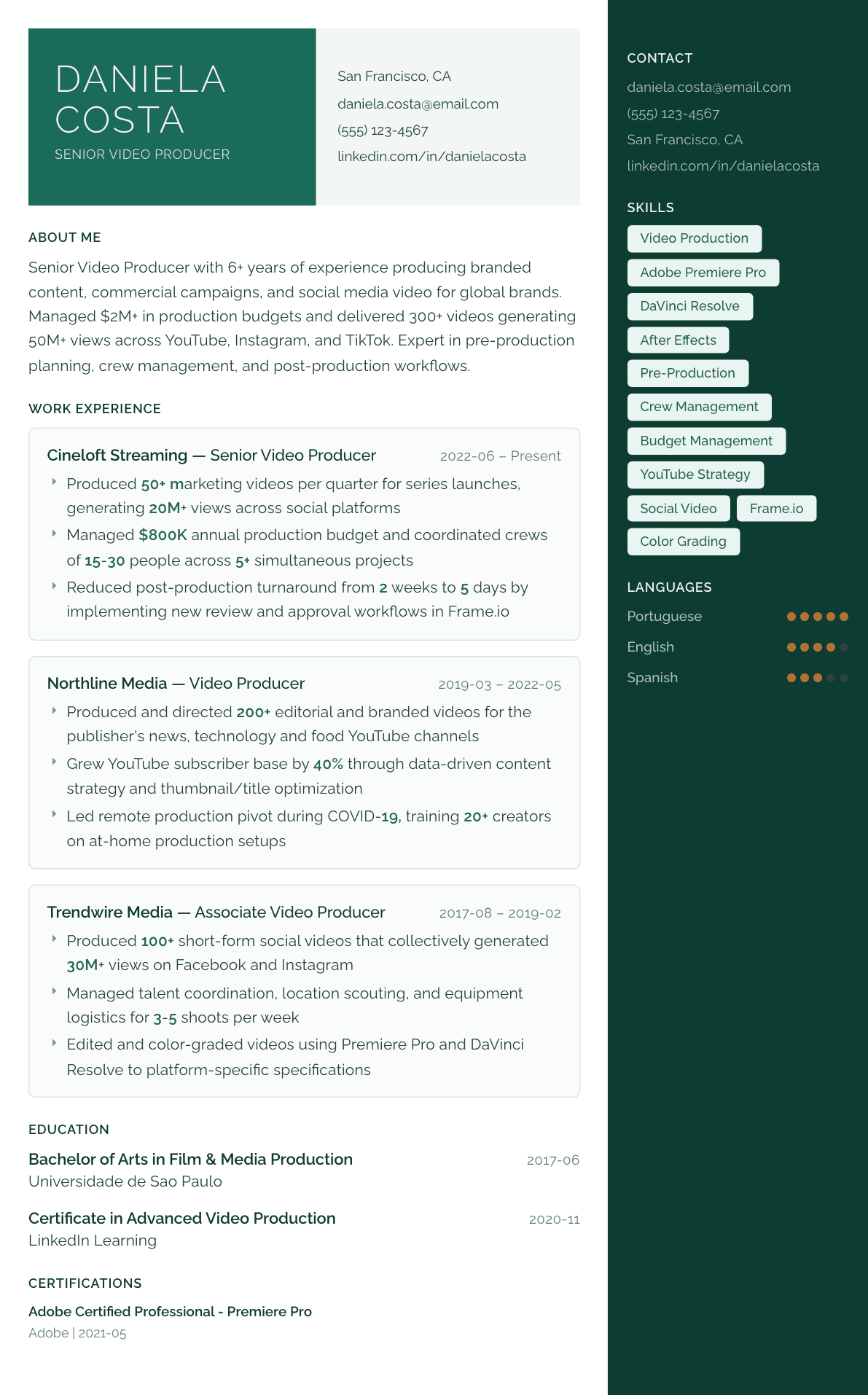
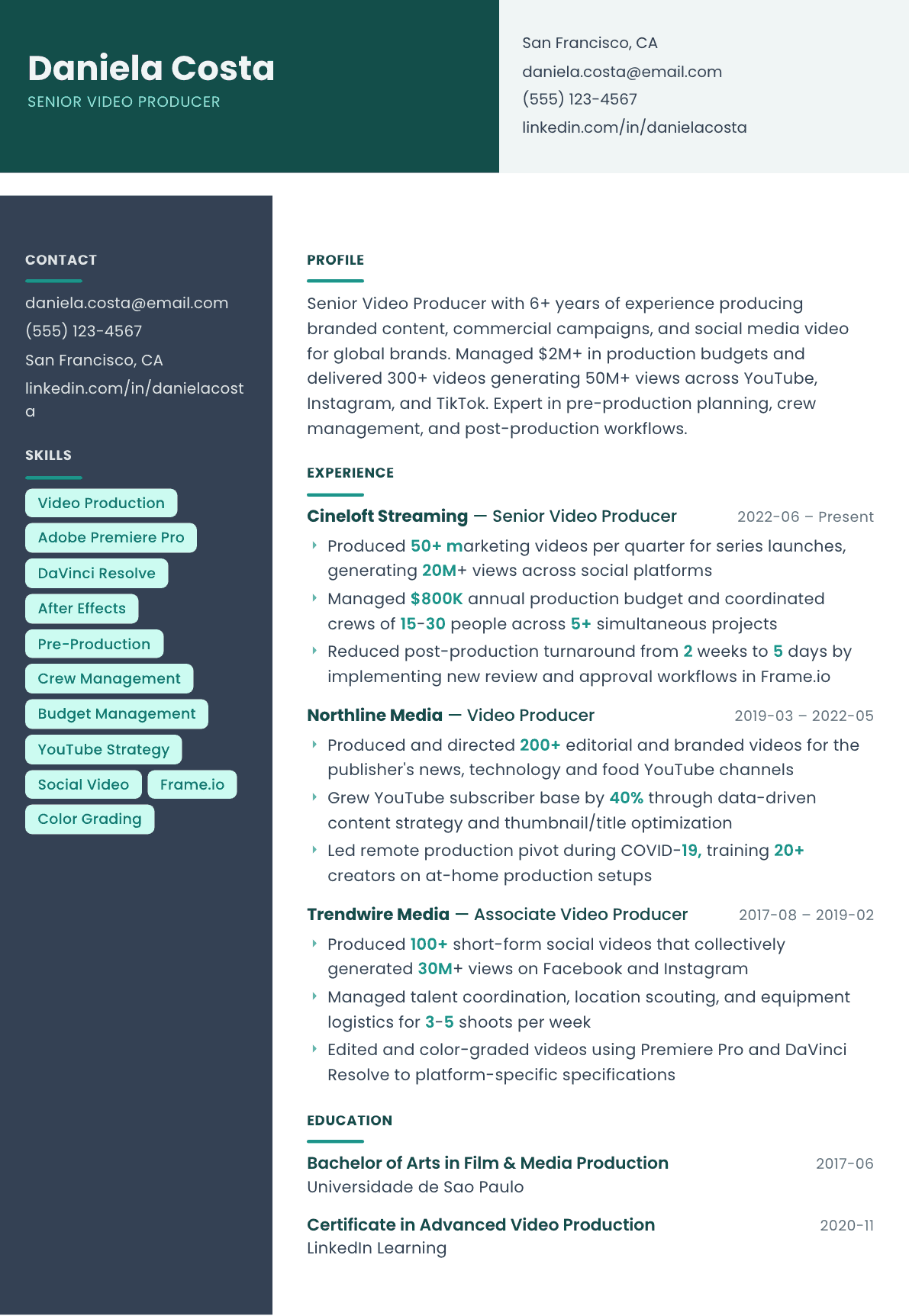
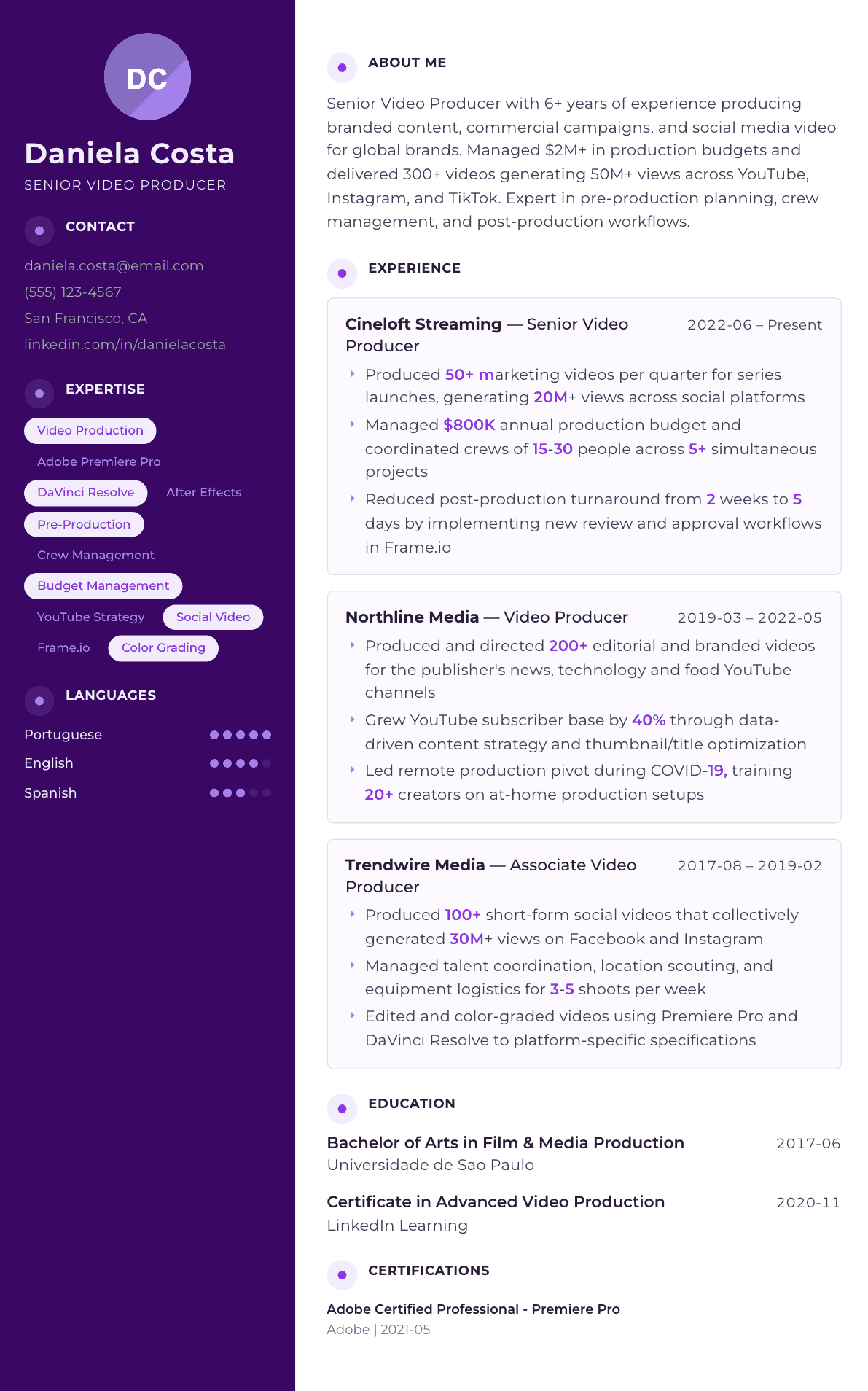
The same video producer content laid out in three CVBooster templates, so you can see what the finished document looks like before you write a word.
Example Video Producer summary
Video Producer with 6 years making branded and editorial content that has earned 50M+ views across YouTube, Instagram and TikTok. Managed $2M+ in production budgets and crews of 15-30 for streaming and publisher clients. Owns the work end to end, from concept and budget through color and delivery.
Skills to list on a Video Producer resume
- Video Production
- Adobe Premiere Pro
- DaVinci Resolve
- After Effects
- Final Cut Pro
- Pre-Production Planning
- Post-Production
- Crew Management
- Budget Management
- YouTube Strategy
- Social Media Video
- Color Grading
- Sound Design
- Motion Graphics
- Frame.io
What actually gets this resume read
- Quantify your output: number of videos produced, total views, subscriber growth, and budget managed.
- List production tools and software: Premiere Pro, Final Cut, DaVinci Resolve, After Effects, Frame.io.
- Showcase both pre-production (concepting, budgeting, scheduling) and post-production (editing, color, sound) skills.
- Highlight platform-specific expertise: YouTube, TikTok, Instagram Reels, or broadcast/streaming.
- Include links to your reel or portfolio -- visual proof of your work is essential.
- Mention team management experience: crew sizes, cross-functional coordination, freelancer management.
How to write a video producer resume
Video producer means the person who makes the shoot happen: the budget, the schedule, the crew, the locations, the releases and the delivery. It sometimes also means the person who edits, and at small companies it usually means both plus the camera. The first job of the resume is to say which producer you are, because a line producer who has never opened a timeline and an in house producer who shoots, cuts and grades are both accurate uses of the title.
The reader is a creative director, a head of content or an executive producer with a slate to staff. They screen for format and scale: branded social video, documentary, commercial, live event, corporate internal, or scripted. Then they screen for whether you can bring a shoot in on budget, because that is the risk they are actually hiring against.
This guide covers how to build the resume around productions rather than duties, how to present budget and crew scale, three summaries by career stage, before and after bullets, and the questions producers ask when their credit line is one word on a long list.
Format: reel link first, productions as the unit
Reverse chronological, one page. The reel link goes in the header and nowhere else, and it must open to a cut under two minutes with your specific credit stated on each piece. A producer reel that shows work you did not produce is the single fastest disqualification in this field.
Under each employer or as a freelancer, list productions rather than responsibilities. Title or client, format, length, crew size, budget band, and your credit. Six well described productions tell a creative director more than twenty lines of duties.
- Header: name, city, phone, email, reel link, and whether you travel or hold a passport for international shoots.
- Per production: format, deliverable count, crew size, budget band, and your exact credit.
- State plainly whether you edit, and in which application.
Summary: format, scale, and where you sit on the shoot
Three lines. Name the formats, the typical budget band you work in, the crew sizes you have run, and your role on set. A producer who runs six person branded shoots and a producer who supports a forty person commercial crew are solving different problems, and the budget band communicates that faster than any adjective.
If you own the whole pipeline, say so. End to end from concept and budget through shoot to final delivery is a phrase that in house teams search for, because it means one hire instead of three.
Experience: pre production is where you prove yourself
Most producer resumes are heavy on shoot day and light on everything around it, which is backwards. Describe the pre production you owned: the treatment or the creative brief, the budget you built and defended, the schedule and call sheets, casting, location scouting and permits, crew and vendor booking, insurance, and appearance releases. This is the part that separates a producer from a coordinator.
Then the shoot. Crew size, camera package, whether you were on set running the day or remote, how many setups and deliverables you got, and what you did when something failed, because something always fails. A bullet about losing a location on the morning of a shoot and still delivering the day is more memorable than any equipment list.
Then post. Whether you cut it yourself, who did, how you managed the review cycle, the asset and version management, color and sound finishing, captions and localization, and the delivery specifications per platform. Version control on a shoot with three rounds of client notes is a real and describable skill.
Name the tools where they are load bearing: the editing application, the review and approval platform, the project management and scheduling tools, and the storage and archive setup. Producers who have built a media management system that another editor could pick up are worth saying so.
Budget and crew: bands, not exact figures
Give budget as a band per production and per year, and pair it with what the money bought: crew size, shoot days, locations and deliverable count. A band with that context tells a hiring manager exactly what scale you are comfortable at. An exact figure with no context tells them nothing and dates quickly.
Say whether you came in on budget, and how you handled overruns. Producers are hired to be trusted with money, and a line about renegotiating a location or restructuring a two day shoot into one to protect the budget carries more weight than any view count.
Results: views are the weakest thing you can claim
View counts belong to the distribution, not to the production, and every experienced reader knows it. Where you have them, attach them to the piece and the platform, and add a stronger production metric next to it: deliverables per shoot day, cost per finished minute, turnaround from wrap to first cut, or the number of cutdowns produced from a single shoot.
Efficiency numbers are the ones that make in house teams call you. Producing eight social cutdowns and a two minute hero film from one shoot day is a claim that a content lead immediately understands as money saved.
Video Producer resume summary examples
Production coordinator
Video production coordinator with two years supporting branded shoots for an agency. Book crew and equipment, build call sheets and schedules, run releases and location paperwork, and assist on set. Edit rough cuts in Premiere Pro and handle media ingest and backup.
Five years in
Video producer with five years making branded and editorial content in house. Run six to ten person crews on shoots of one to three days, own budgets in the mid five figures, and deliver a hero film plus eight social cutdowns from a single shoot day. Cut and color in Premiere Pro and DaVinci Resolve.
Senior or executive producer
Senior video producer with nine years across commercial and documentary work, managing an annual slate of roughly 30 productions and a team of three plus freelance crew. Own budgets, vendor contracts and the review pipeline, and have run international shoots across four countries.
Work experience bullets: before and after
Before: Produced videos for the marketing team.
After: Produced 30 branded films a year for marketing and sales, running crews of six to ten on one and two day shoots with budgets in the mid five figures per production.
Volume, crew size, shoot length and budget band let a creative director place your experience immediately.
Before: Managed production budgets.
After: Built and defended budgets for a slate of 30 productions, renegotiated two location and crew contracts mid quarter, and closed the year within the approved total with no production cut.
Defending and renegotiating shows financial ownership, where managed only implies you saw the spreadsheet.
Before: Handled pre production for shoots.
After: Owned pre production end to end: treatments, shooting schedules, call sheets, casting, location permits, appearance releases and certificates of insurance for shoots across three states.
Naming the actual paperwork proves you have run the unglamorous half of production that stops shoots being canceled.
Before: Edited videos and delivered final files.
After: Cut and color graded in Premiere Pro and DaVinci Resolve, ran client review through Frame.io with two note rounds, and delivered platform specific masters with captions for broadcast, web and vertical social.
The review process and the delivery specifications show a finished pipeline rather than a rendered file.
Before: Videos got millions of views.
After: Delivered a hero film and eight social cutdowns from one shoot day, cutting cost per finished minute by roughly half against the previous year of agency produced work.
An efficiency metric belongs to the producer, while view counts belong to whoever bought the distribution.
Hard skills
- Production budgeting
- Shooting schedules and call sheets
- Crew and vendor booking
- Location scouting, permits and releases
- Casting and talent coordination
- On set producing
- Camera and lighting package planning
- Adobe Premiere Pro
- DaVinci Resolve and color grading
- After Effects and motion graphics
- Frame.io review workflows
- Media management and archiving
- Captioning and platform delivery specifications
- Sound recording and mix supervision
Soft skills
- Calm problem solving on set
- Directing talent who are not performers
- Negotiating with vendors
- Managing client note rounds
- Clear written call sheets and briefs
Mistakes that cost video producer candidates the interview
- Sending a reel that includes work you did not produce, which is the fastest way to lose a hiring producer.
- Writing duties instead of productions, so nobody can tell what scale of shoot you have actually run.
- Leading with view counts, which belong to distribution rather than to your production work.
- Omitting budget bands and crew sizes, the two facts a creative director uses to place you.
- Skipping pre production paperwork, which is the part that most often separates producers from coordinators.
- Not saying whether you edit, when small in house teams are usually hiring for exactly that combination.
Video Producer resume questions
What should a video producer reel show?
Under two minutes, cut for pace, with your specific credit stated on every piece. Include a range of formats if you work across them, and never include work you did not produce, since a hiring producer will often know the people who did.
Should I put production budgets on my resume?
Use bands rather than exact totals, and pair them with crew size, shoot days and deliverable count. That combination tells a creative director what scale you are comfortable at, which is the main thing they are trying to work out.
Do video producers need to know how to edit?
For in house and small agency roles, almost always. Larger commercial and broadcast productions separate the roles cleanly. Say plainly whether you cut and in which application, since claiming an editing depth you do not have is exposed in the first technical conversation.
How do I list freelance video work on a resume?
Group it under a single freelance heading with the date range, then list the clients and productions underneath with your credit on each. That reads as a continuous career rather than a scatter of short jobs, and keeps the productions as the unit of the resume.
How do I move from editor to producer?
Lead with any budgeting, scheduling and crew coordination you have already done, even informally, and add the pre production paperwork you have handled. Producers are hired on trust with money and logistics, so evidence of running a day is worth more than another line about your edit skills.