Instructional Designer Resume Examples: read this first
Design an Instructional Designer Resume That Teaches Employers Your Worth
By Mustafa Tarabya, founder of CVBooster · Published · Updated
Build an instructional designer resume showcasing e-learning development, learning theory application, and LMS expertise with portfolio-worthy project examples.
Sample resumes for a instructional designer
The same instructional designer content laid out in three CVBooster templates, so you can see what the finished document looks like before you write a word.
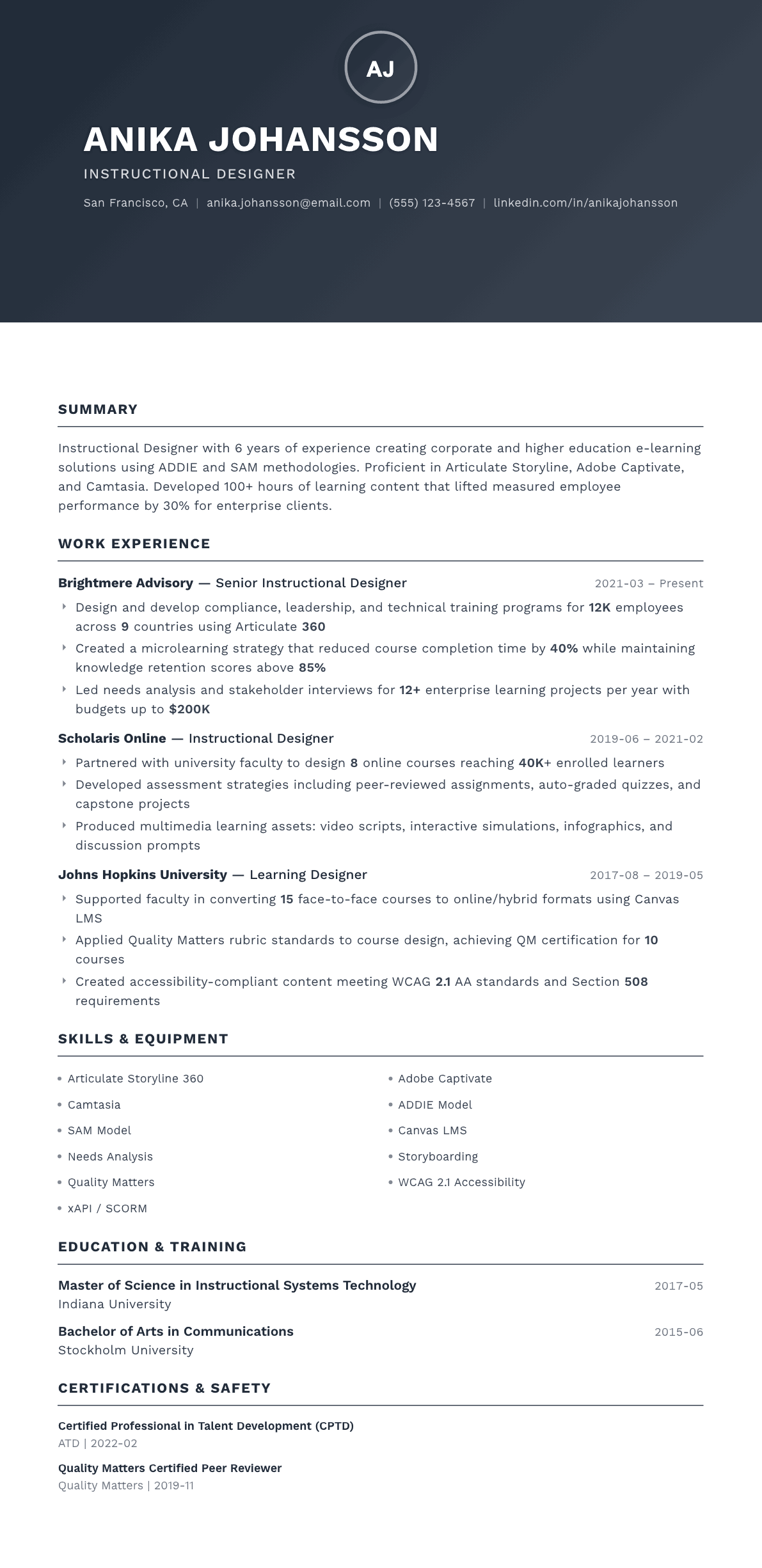
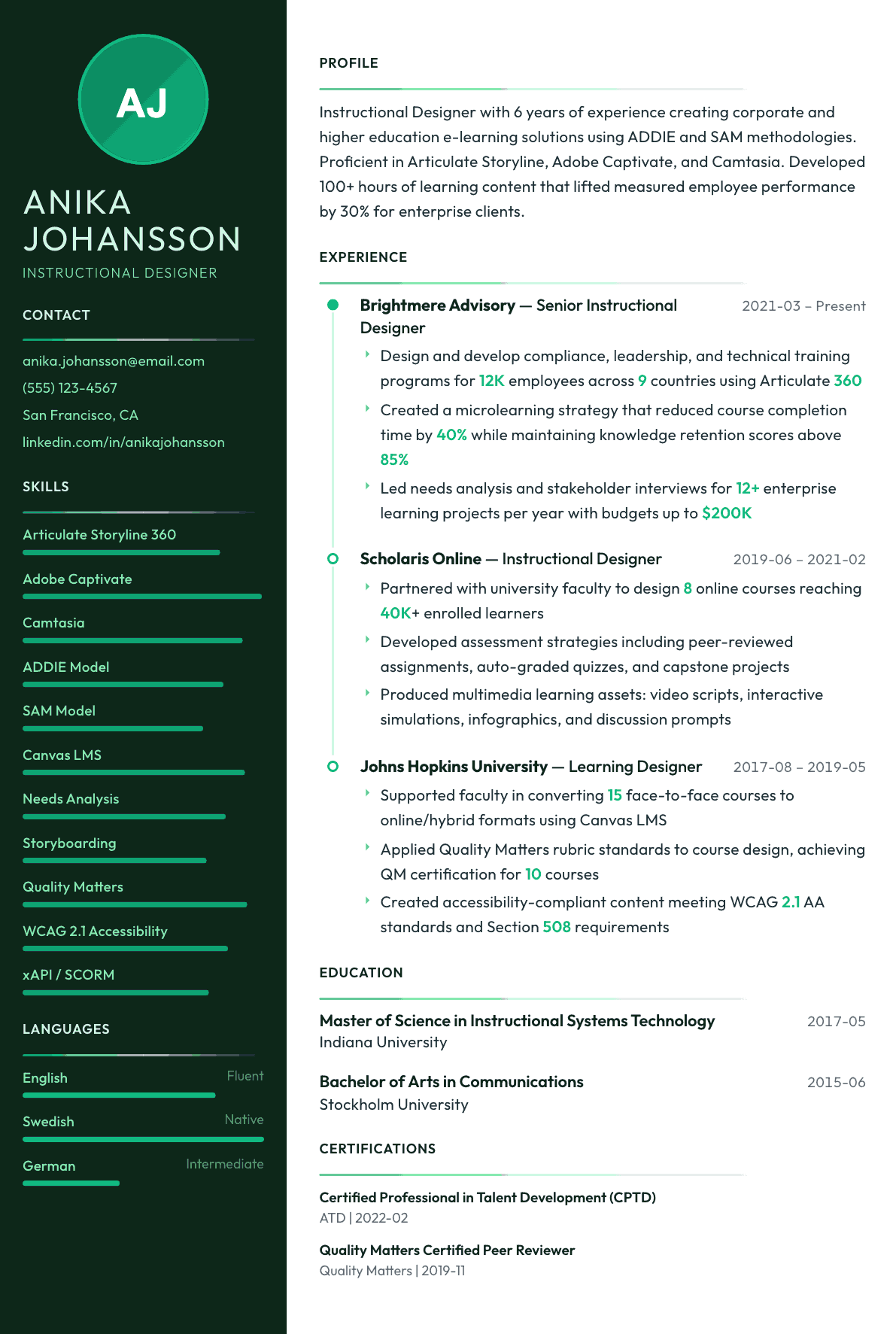
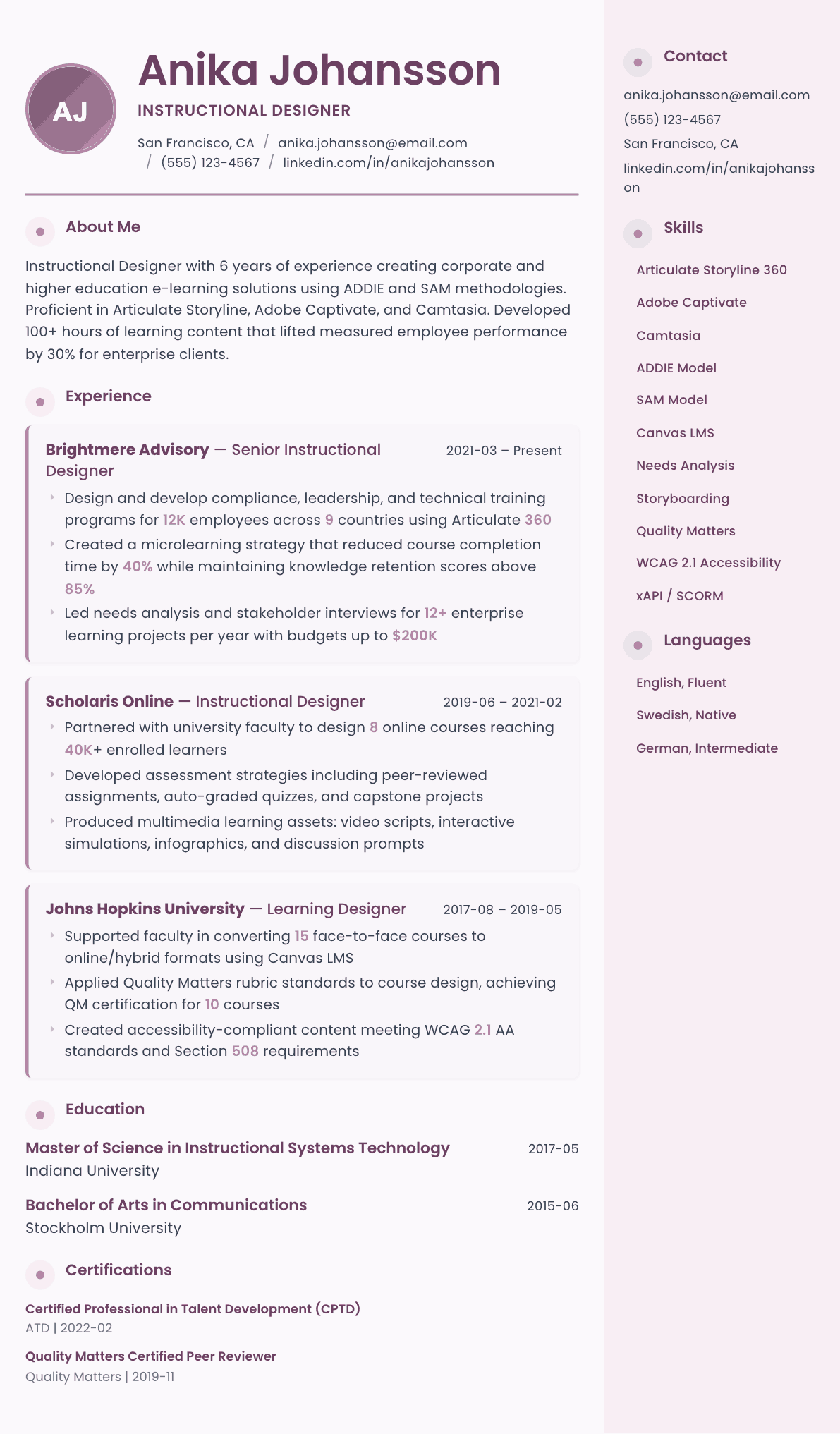
Example Instructional Designer summary
Instructional Designer with 6 years of experience creating corporate and higher education e-learning solutions. Expert in Articulate 360, ADDIE methodology, and Quality Matters standards. Developed 100+ hours of learning content that lifted measured employee performance by 30% for enterprise clients in finance and healthcare.
Skills to list on a Instructional Designer resume
- Articulate Storyline 360
- Adobe Captivate
- Camtasia
- ADDIE / SAM Models
- Needs Analysis
- Storyboarding
- Canvas / Blackboard LMS
- Quality Matters Standards
- SCORM / xAPI
- WCAG 2.1 Accessibility
- Video Scripting & Production
- Kirkpatrick Evaluation
- Microlearning Design
- Stakeholder Management
What actually gets this resume read
- List authoring tools: Articulate Storyline/Rise, Adobe Captivate, Camtasia, Vyond, Canva.
- Reference design models: ADDIE, SAM, Kirkpatrick, Bloom's Taxonomy, Gagne's Nine Events.
- Include LMS experience: Canvas, Blackboard, Moodle, Cornerstone, Workday Learning, Docebo.
- Quantify learning impact: completion rates, assessment scores, performance improvements, learner reach.
- Mention accessibility standards: WCAG, Section 508, and inclusive design practices.
- Describe content types: e-learning modules, microlearning, video, simulations, job aids.
How to write a instructional designer resume
Instructional design hiring is portfolio-first. A learning manager opens your resume, looks for the link to your work samples, and forms an opinion about your craft in the first minute. The resume's job is to survive that minute: it has to prove you can run a needs analysis, build in the authoring tool the team already owns, and hand a finished course to an administrator without breaking the tracking.
The confusion in most of these resumes is that the title covers two different jobs. Corporate instructional design serves a business problem: onboarding time, compliance completion, error rates on a process. Higher education and K-12 design serves faculty and accreditation: course mapping, rubric alignment, accessibility review. A resume that does not declare which one it is asks the reader to sort it out, and readers rarely do.
What follows is the section order hiring managers in learning and development expect, how to write project bullets when the outcome belonged to the business rather than to you, sample summaries at three stages, and the questions instructional designers ask when they move between sectors.
Format: one page early, two once you have shipped real programs
Use reverse-chronological order with a projects section only if you are freelance or your work does not map cleanly to employers. Keep it text-based. Designers are tempted to art-direct their own resume, and the result often parses badly in the applicant tracking system, which is a poor first impression from someone whose job includes accessibility.
Put the portfolio link in the header, next to your email, and make sure the samples behind it match the roles you are applying for. A corporate learning manager who lands on three university course pages will assume you are aiming somewhere else.
- Header: name, target title, city, email, phone, portfolio link, and a professional profile link.
- Order: summary, tools, experience, selected projects if freelance, education, certifications.
- A career changer from teaching or writing leads with a projects section and puts the classroom job below it.
Summary: sector, modalities, tools, scale
Say what kind of learning you build and for whom. Compliance and technical training for a regulated employer, sales enablement, onboarding, university courses, or customer education are all different crafts, and the tools follow from that. Then name your primary authoring tool and your delivery modalities: self-paced e-learning, virtual instructor-led, blended programs, job aids, video, simulation.
Scale matters more than years here. The number of learners a program reached, the number of courses in the catalog you own, and the size of the audience for a launch tell a manager whether you have worked at their level.
Experience: analysis, design, build, evaluation
Write each project as a short arc. What the business or the faculty member actually needed, what you learned in the analysis that changed the plan, what you built, and what happened afterward. The analysis step is the one candidates skip and the one that separates a designer from a course builder, because anyone can convert slides into a module.
Name your process without hiding behind it. ADDIE, SAM, Action Mapping and backward design are recognizable, but a manager cares more about how you handled a subject matter expert who would not release content, or a rebuild after a pilot went badly. Storyboards, prototypes, review cycles and sign-off are the daily work; say how many rounds you ran and how you kept them from multiplying.
Evaluation closes the loop. Kirkpatrick levels one and two are common and easy to evidence. If you have level three or four evidence, say how you got it, because most designers have never been given access to the business data that would prove it.
- Give each major project the audience size, the modality, the seat time, and the build window.
- State the authoring tool and the learning platform the course was published to.
- Note accessibility work explicitly: captions, keyboard navigation, alternative text, screen reader testing.
Tools: list them as a manager would search for them
A tools block near the top does more for you than a skills list at the bottom, because instructional design postings are written around specific software and recruiters search on the product names. Group them so the reader can scan: authoring, video and audio, graphics, platforms, and collaboration.
Be honest about depth. Building variables, states and branching scenarios in an authoring tool is a different level of skill from assembling linear slides, and an interview will find the difference in ten minutes. Say which tools you build in daily and which you have used on a project.
Standards and accessibility: the part that gets checked
Publishing standards decide whether a course tracks correctly, so name the ones you have actually published to: SCORM, xAPI, AICC, and the platform you tested them in. A designer who has debugged a completion status that would not post is a designer a team can rely on at launch.
Accessibility belongs in the same place. Web Content Accessibility Guidelines conformance, Section 508 requirements for public sector work, and the Quality Matters rubric in higher education are the review frameworks that gate a course before release. Say which you have worked to and whether you ran the review or responded to it.
Instructional Designer resume summary examples
First design role
Instructional designer with a graduate degree in learning design and a portfolio of five self-paced modules built in Articulate Storyline, including a branching scenario on customer escalation. Experienced in storyboarding, subject matter expert interviews and publishing SCORM packages for testing in an open source learning platform.
Five years in
Instructional designer with five years building compliance and technical training for a regulated manufacturer, roughly 40 courses across 6,000 employees. Works end to end in Storyline and Camtasia, runs needs analysis with operations leads, and cut average onboarding time to first solo shift by two weeks.
Lead designer
Lead instructional designer running a team of four and a catalog of 120 courses for a global services firm. Owns the design standard, the accessibility review process and the xAPI reporting model, and partners with business leaders to scope programs before any content is written.
Work experience bullets: before and after
Before: Created e-learning courses using Articulate Storyline.
After: Built 14 self-paced Storyline modules averaging 25 minutes of seat time for a field service audience of 2,300, including two branching scenarios with scored decision paths and remediation feedback.
Volume, seat time, audience and the hardest interaction you built show the actual level of the craft.
Before: Worked with subject matter experts to gather content.
After: Ran structured interviews with eight subject matter experts, converted their source documents into an action map of 11 tasks, and cut the requested content by about a third before storyboarding began.
Cutting content is the design decision; gathering content is a meeting anyone can attend.
Before: Made courses accessible.
After: Brought a 30-course catalog to WCAG 2.1 AA by adding captions and transcripts, rebuilding keyboard focus order in every module, and testing the ten highest-traffic courses with a screen reader.
A standard, a scope and a testing method turn a claim into evidence a reviewer can trust.
Before: Evaluated training effectiveness.
After: Built a level two knowledge check and a 60-day manager observation for a new safety program, then reported completion and observed practice back to plant leadership each quarter.
Naming the evaluation level and the reporting rhythm shows you closed the loop rather than sent a survey.
Before: Managed multiple projects at once.
After: Carried six concurrent builds on staggered timelines, held review to two rounds per module with a fixed feedback template, and delivered all six inside their launch windows.
The mechanism you used to control review cycles is what a hiring manager wants to hear about.
Hard skills
- Needs analysis and task analysis
- Articulate Storyline and Rise
- Adobe Captivate
- Camtasia and video production
- Storyboarding and prototyping
- ADDIE and SAM design processes
- Action mapping
- Assessment and rubric design
- SCORM and xAPI publishing
- Learning management system administration
- WCAG 2.1 and Section 508 accessibility
- Quality Matters course review
- Figma and graphic asset production
- Learning evaluation and reporting
Soft skills
- Stakeholder interviewing
- Managing subject matter experts
- Scope negotiation
- Written feedback
- Project sequencing
- Cross-functional facilitation
Certifications worth listing
- Certified Professional in Talent Development (CPTD) (Association for Talent Development)
- Associate Professional in Talent Development (APTD) (Association for Talent Development)
- Quality Matters Peer Reviewer Certification (Quality Matters)
- Certified Professional in Accessibility Core Competencies (CPACC) (International Association of Accessibility Professionals)
- Project Management Professional (PMP) (Project Management Institute)
Mistakes that cost instructional designer candidates the interview
- Leaving the portfolio link off the header, which forces a reviewer to judge visual design work from a text document.
- Writing bullets that stop at the build, so the reader never learns why the course existed or whether it worked.
- Listing a dozen authoring tools at equal weight when you build in one and have opened the rest twice.
- Using the same resume for corporate learning and higher education roles, when the two read for opposite evidence.
- Claiming a business result you cannot connect to the training, such as a revenue number a sales team also touched.
- Designing an elaborate visual resume that the applicant tracking system parses into nonsense before a human sees it.
Instructional Designer resume questions
Do I need a portfolio to get an instructional design job?
For nearly every opening, yes. Hiring managers want to click through two or three finished samples that show interaction design, not screenshots. Three strong pieces beat ten weak ones, and at least one should be a branching or scenario-based module rather than a linear click-through.
How do I move from teaching into instructional design?
Lead with a projects section built from work you can show, not from classroom duties. Rewrite school experience in design language: curriculum you authored, assessments you validated, the online conversion you ran. Then name the authoring tool you have learned, because that is the gap a hiring manager screens on first.
Should I list ADDIE on my resume?
Name it once, in context, alongside how you actually work. Listing a model on its own signals coursework rather than practice. What earns attention is a bullet showing you shortened an analysis phase, ran an iterative build, or piloted before launch and changed the design afterward.
How do I write bullets when the client owned the results?
Report what you can evidence and attribute the rest honestly. Completion rates, assessment pass rates, reduced time to competence and reduced support tickets are usually available to you. When the business metric was shared, say the program contributed and name the other levers involved.
Is a graduate degree required for instructional design roles?
Not universally. Higher education and government postings often require a master's in instructional design, educational technology or a related field. Corporate teams weigh the portfolio and tool depth more heavily, so a strong sample set and a talent development credential can carry an application without the degree.