Customer Support Specialist Resume Examples: free score
Write a Customer Support Specialist Resume for Product Teams
By Mustafa Tarabya, founder of CVBooster · Published · Updated
Customer support specialist resume examples with SaaS ticket metrics, escalation keywords, sample bullets and a guide to writing each section.
Sample resumes for a customer support specialist
The same customer support specialist content laid out in three CVBooster templates, so you can see what the finished document looks like before you write a word.
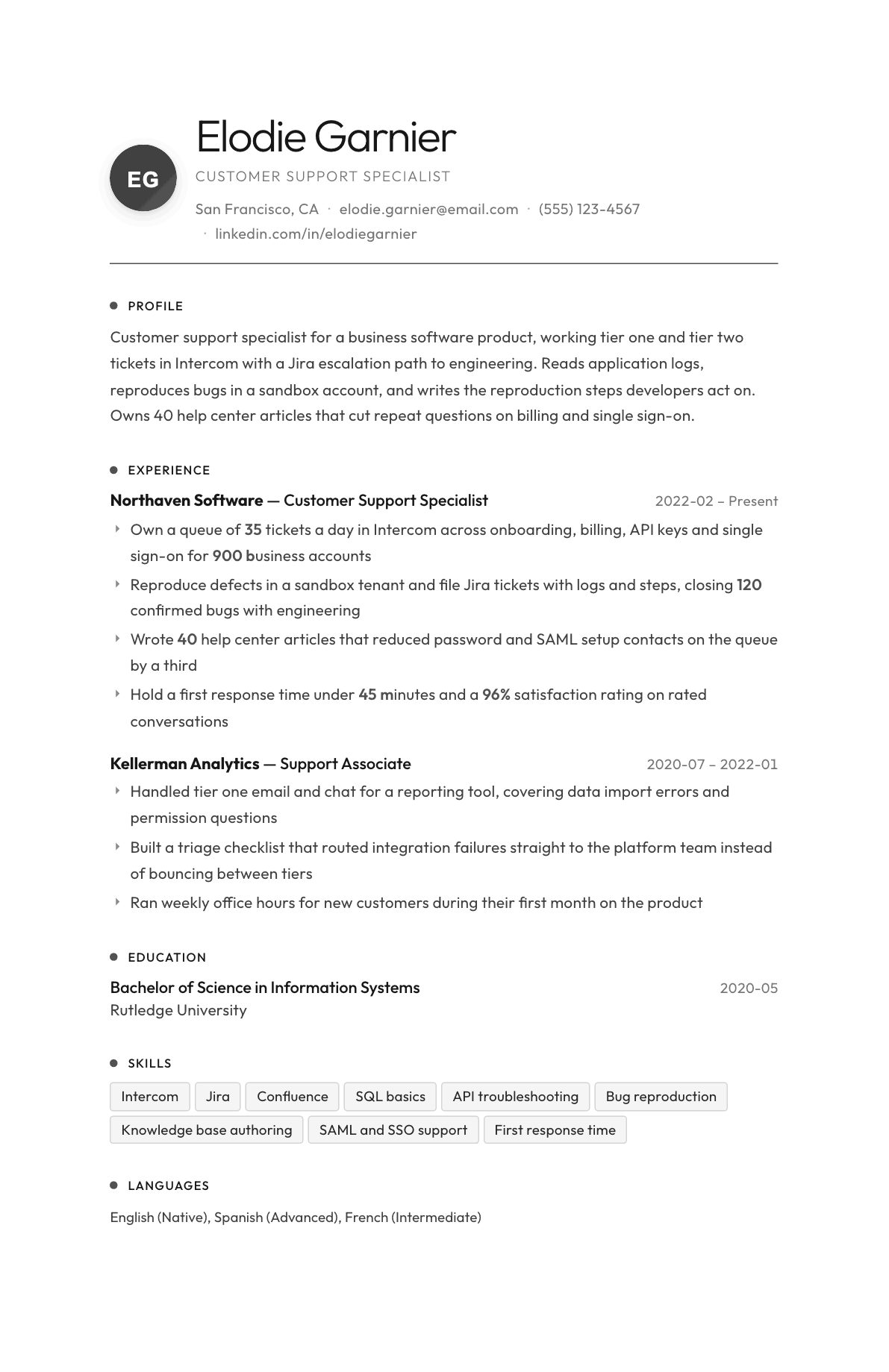
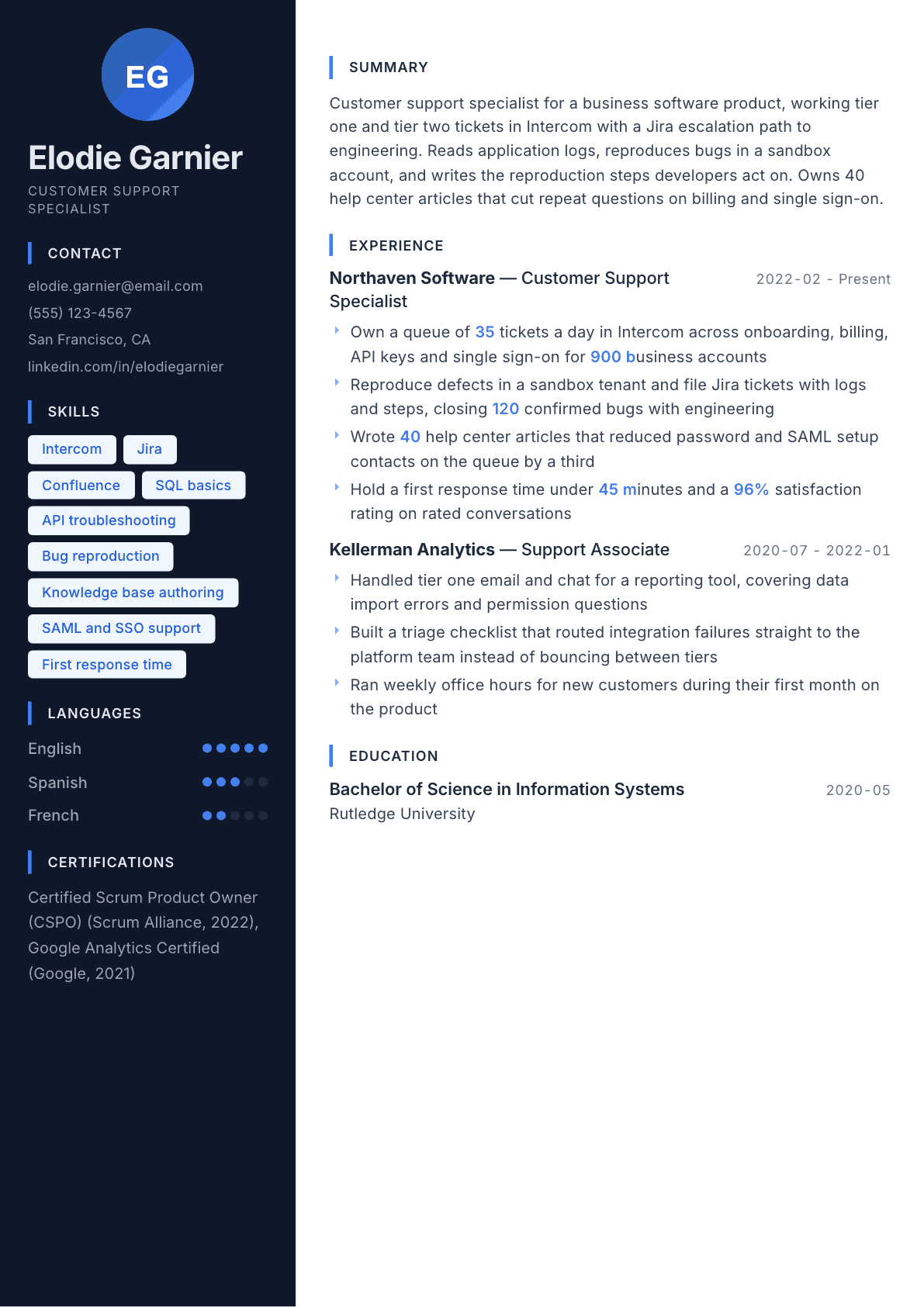
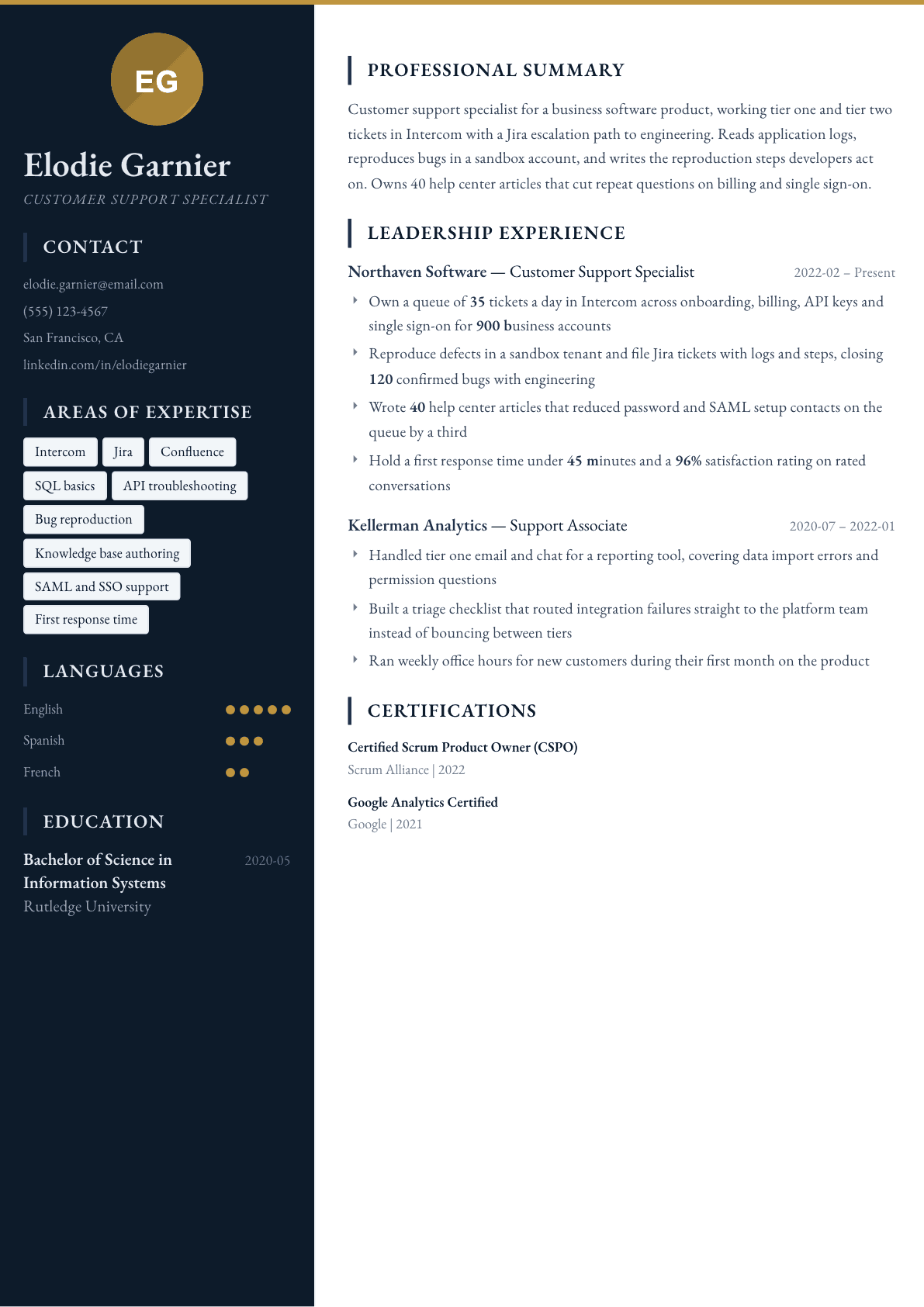
Example Customer Support Specialist summary
Customer support specialist with four years on business software, covering tier one and tier two tickets in Intercom for 900 accounts. Reproduces defects in a sandbox, files Jira issues engineers can act on, and closed 120 confirmed bugs alongside the platform team. Wrote 40 help center articles that cut single sign-on contacts by a third. Holds a 45 minute first response time and a 96% satisfaction rating.
Skills to list on a Customer Support Specialist resume
- Technical support
- Intercom
- Zendesk
- Jira
- Confluence
- API troubleshooting
- Bug reproduction
- Log analysis
- SQL queries
- Knowledge base authoring
- SSO and SAML support
- Ticket escalation
- First response time
- Customer onboarding
- Postman
What actually gets this resume read
- Say what the product actually does, because support for an API platform and support for a shopping app are different jobs.
- Show your escalation path: the tool you file in and what a good handoff to engineering contains.
- Count the help center articles you wrote and what they removed from the queue, not just that you wrote docs.
- Include technical depth signals such as reading logs, running SQL queries or testing endpoints in Postman.
- Report first response time and resolution time separately, since support leads track them as different problems.
- Mention the account type you served, whether self-serve consumers, small business admins or enterprise IT contacts.
How to write a customer support specialist resume
A customer support specialist at a software company is not doing the same job as a service representative at a retailer, and the resume has to make that separation on the first line. The queue here is full of API keys, single sign-on failures, permission errors, failed data imports and billing questions from an account administrator who already read the documentation. The reader is checking whether you can hold a technical conversation without handing it straight to engineering.
The support manager screening the file has a specific test in mind. She wants to see that you can reproduce a defect, describe it in terms a developer will accept, and file it where the engineering team already works. A specialist who writes reproduction steps with logs attached saves a build engineer an hour per ticket, and that is the whole argument for hiring one candidate over another.
This guide sets out the section order for a software support resume, how to write technical depth without overstating it, three summaries covering different stages, before and after bullets from a real product queue, and the questions specialists ask when the resume has to work for both a support lead and a hiring engineer.
Format: one page, product described before the metrics
Reverse chronological and one page until you have led a team. Software companies use applicant tracking systems that parse plain layouts cleanly, and the reviewers are often engineers who will scan for tool names rather than read paragraphs. Keep headings standard and skip the graphics.
Give one short line under each employer that says what the product does and who used it. A reporting tool for finance teams or an identity platform for school districts costs eight words and changes how every bullet beneath it reads.
- Section order: summary, technical skills, experience, education, certifications.
- Name the support platform, the issue tracker and the documentation tool separately; they are three different habits.
- State the account type you served: self-serve consumers, small business admins, or enterprise information technology contacts.
- Report first response time and resolution time as two separate numbers, because support leads track them as different problems.
Summary: product, tiers, escalation path, technical range
Four lines. Name the product category, the tiers you covered, the number of accounts behind the queue, and the technical work you actually did. A specialist who reads application logs, reproduces in a sandbox tenant and queries a database is describing a job that pays differently from one who forwards tickets with a note.
Be honest about the ceiling of your technical range. Claiming database administration when you ran three saved queries collapses in the first screening call. Saying you read logs, run read-only queries against a reporting replica and test endpoints in Postman is precise, defensible and enough.
Experience: reproduce, escalate, document, prevent
The first bullet carries the queue: daily ticket count, the topics, the platform and the account count behind it. Onboarding, billing, API keys and single sign-on across 900 business accounts is a specific job. A queue of unspecified customer issues is not.
The second bullet is the escalation path, and this is the one most candidates leave out. Say where you filed, what a handoff contained, and how many issues were confirmed. Filing Jira tickets with logs and reproduction steps and closing 120 confirmed defects alongside engineering shows that developers accepted your work rather than sending it back.
The third bullet is prevention. Help center articles only matter when you say what they removed from the queue. Forty articles that cut password and single sign-on setup contacts by a third is an argument. Wrote knowledge base documentation is a task.
Keep response and resolution times separate and give both against their targets. A first response under 45 minutes paired with a satisfaction rating drawn from rated conversations is the kind of evidence a support lead can use in a staffing plan.
Technical skills: prove the depth, do not inflate it
List the support platform by name, whether Intercom, Zendesk, Front or Help Scout, then the issue tracker, usually Jira or Linear, then the documentation home, usually Confluence or a hosted help center. After the tools, list the technical verbs: log analysis, bug reproduction, API troubleshooting, read-only database queries, browser developer tools, webhook debugging.
Where a protocol matters to the product, name it. Single sign-on work means SAML and OpenID Connect, and an identity-heavy posting will search for those exact strings. The same applies to REST, OAuth and webhooks on an integrations queue.
Education, certifications and the engineer who reads second
A degree in information systems, computer science or a related field helps, and a support specialist without one is still hired constantly on the strength of the queue evidence. Put education at the bottom in two lines and let the technical section carry the weight.
Certifications matter here more than in general support, because they signal that you learned a stack rather than a script. Cloud fundamentals, a vendor administrator credential or a scripting course all read as investment. Whatever you list, expect the interviewer to ask you to describe something you did with it.
Customer Support Specialist resume summary examples
Moving from tier one
Support associate covering tier one email and chat for a reporting tool, handling data import errors and permission questions for small business administrators. Built a triage checklist that routed integration failures straight to the platform team, and ran weekly office hours for customers in their first month.
Four years on a product queue
Customer support specialist covering tier one and tier two for a business software product, working 35 tickets a day in Intercom across onboarding, billing, API keys and single sign-on for 900 accounts. Reproduces defects in a sandbox tenant and files Jira issues engineers act on. Holds a 45 minute first response.
Senior specialist and escalation owner
Senior customer support specialist owning tier two escalations for an integrations platform, closing 120 confirmed defects with engineering over two years. Runs the reproduction standard the team files against, owns 40 help center articles, and mentors three tier one specialists through their first quarter on the queue.
Work experience bullets: before and after
Before: Answered technical support tickets for software customers.
After: Owned a queue of 35 tickets a day in Intercom across onboarding, billing, API keys and single sign-on for 900 business accounts on a workflow platform.
The topics and the account count tell a support lead exactly which body of product knowledge you already carry.
Before: Escalated bugs to the engineering team.
After: Reproduced defects in a sandbox tenant and filed Jira tickets with request logs, environment details and numbered steps, closing 120 confirmed bugs with engineering.
The confirmed count proves developers accepted the reports rather than returning them for more detail.
Before: Wrote help center documentation.
After: Wrote 40 help center articles covering password resets and SAML setup, cutting single sign-on contacts on the queue by roughly a third over two quarters.
Documentation only counts when you say what it removed from the queue and over what period.
Before: Responded to customers quickly.
After: Held first response under 45 minutes and a 96% satisfaction rating on rated conversations while carrying the second highest ticket volume on a six person team.
Two separate metrics plus the workload context stop a fast response time from reading as a light queue.
Before: Helped new customers get set up on the product.
After: Ran weekly office hours for accounts in their first 30 days, walking administrators through user provisioning, role permissions and their first data import.
Naming the onboarding steps shows the technical content of the session instead of the calendar entry.
Hard skills
- Intercom
- Zendesk
- Jira
- Confluence
- API troubleshooting
- Postman
- Bug reproduction
- Log analysis
- SQL queries
- SAML and single sign-on support
- Webhook debugging
- Knowledge base authoring
- Ticket escalation
- Customer onboarding
Soft skills
- Translating technical detail for non-technical users
- Written precision
- Curiosity about root cause
- Working across support and engineering
- Patience with ambiguous reports
- Knowing when to escalate
Certifications worth listing
- AWS Certified Cloud Practitioner (Amazon Web Services)
- Microsoft Certified: Azure Fundamentals (Microsoft)
- Salesforce Certified Administrator (Salesforce)
- HubSpot Service Hub Software Certification (HubSpot Academy)
- ITIL 4 Foundation (PeopleCert)
Mistakes that cost customer support specialist candidates the interview
- Never saying what the product does, which leaves the reader unable to judge whether your domain knowledge transfers.
- Merging first response and resolution time into one vague claim about being fast, when support leads track them separately.
- Claiming database or engineering skills you cannot demonstrate, which fails on the first technical screening question.
- Describing escalation as forwarding, with no mention of the tracker you filed in or what a good report contained.
- Counting help center articles without saying what they removed from the queue.
- Leaving out the account type served, so an enterprise employer cannot tell whether you have ever worked with an information technology contact.
Customer Support Specialist resume questions
How technical does a customer support specialist resume need to be?
Technical enough to be checked. Name the logs you read, the queries you ran, the endpoints you tested and the tracker you filed in. Every claim should survive an interviewer asking you to describe the last time you did it.
What is the difference between a support specialist and a support representative resume?
The specialist resume carries product depth and an escalation path. It names the issue tracker, the reproduction habit and the technical protocols involved. A representative resume leads with channel volume and satisfaction instead of defect handling.
Should I list the number of accounts I supported?
Yes, because account count and account type together describe the queue better than ticket volume alone. Nine hundred business accounts with administrators is a very different job from a hundred thousand self-serve consumer users.
Do certifications help for a software support role?
They help when they map to the stack in the posting. Cloud fundamentals, a vendor administrator credential or an information technology service management foundation all read as investment. Be ready to describe something you built or fixed using what you learned.
How do I move from support into a support engineer or product role?
Lead with the work closest to the target job. For support engineering, put reproduction, log analysis and confirmed defect counts first. For product, lead with the call driver analysis you produced and the feature requests you turned into a documented pattern.
Related resume examples
- Technical Support Specialist Resume example
- Support Engineer Resume example
- Help Desk Technician Resume example
- Customer Onboarding Specialist Resume example
- Technical Support Representative Resume example
- Customer Service Resume example