Data Entry Operator Resume Examples: what gets the call
Write a Data Entry Operator Resume That Clears the Screen
By Mustafa Tarabya, founder of CVBooster · Published · Updated
Data entry operator resume example with throughput bullets, keyboard skills, system keywords and a guide to writing each section.
Sample resumes for a data entry operator
The same data entry operator content laid out in three CVBooster templates, so you can see what the finished document looks like before you write a word.
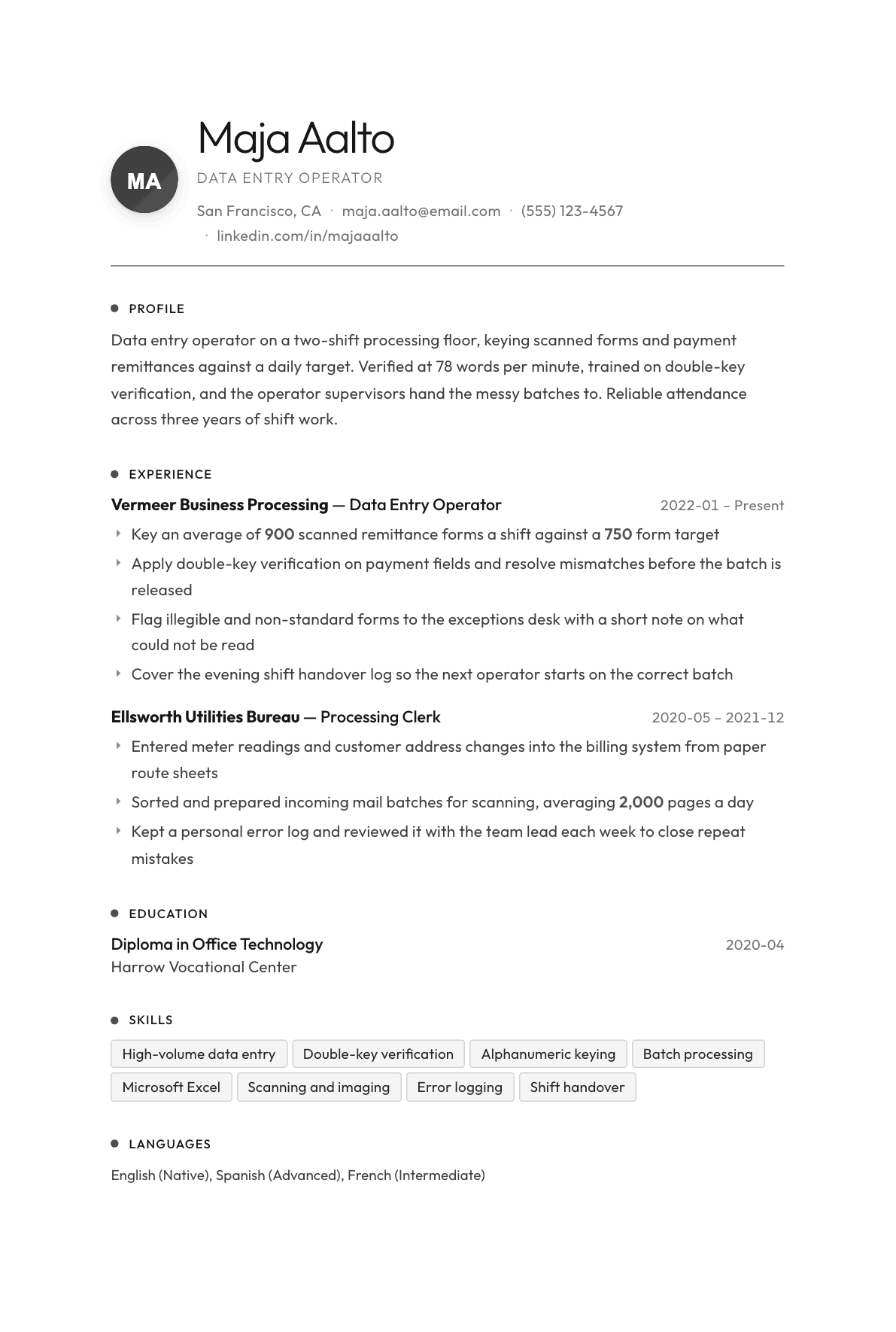
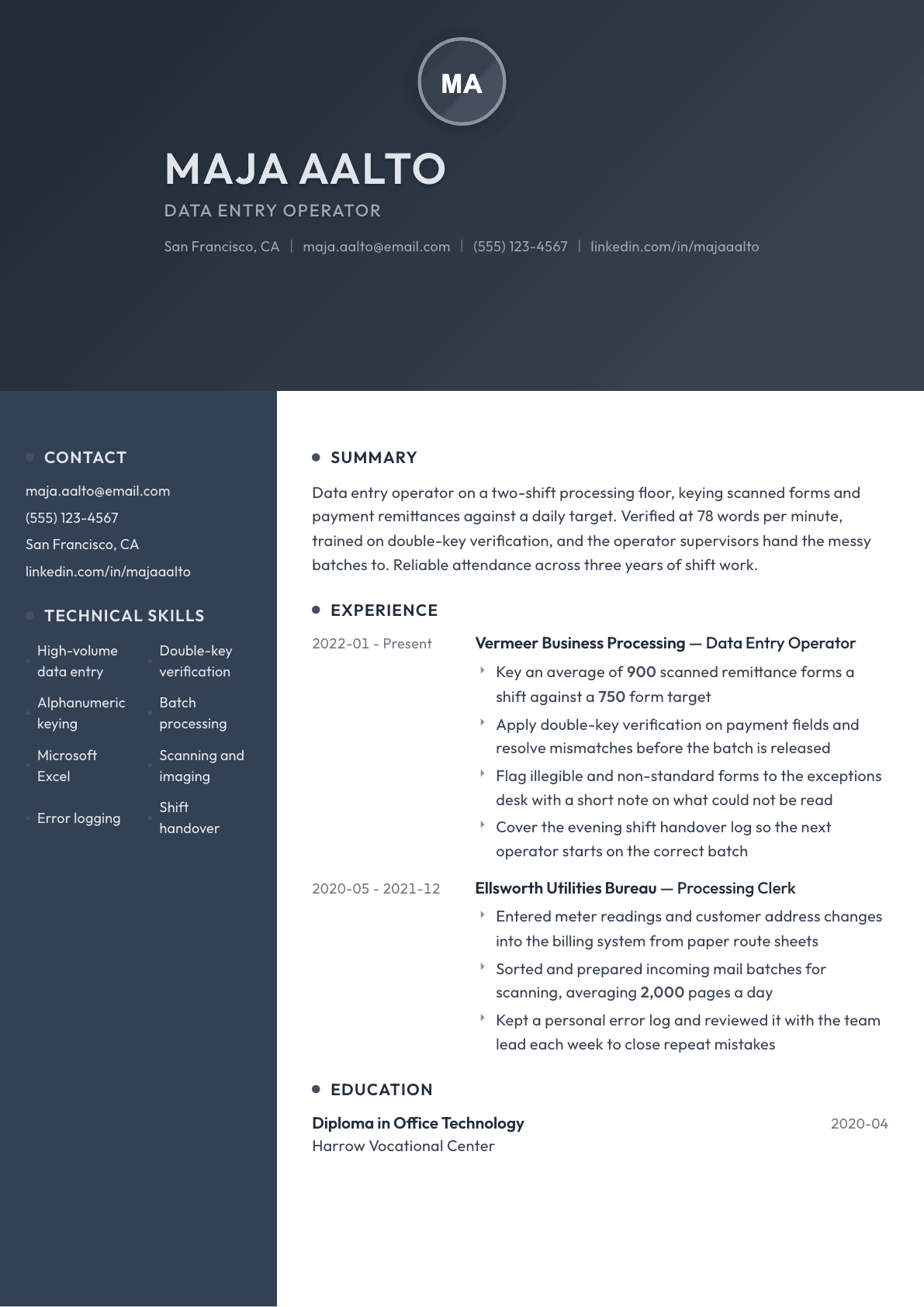
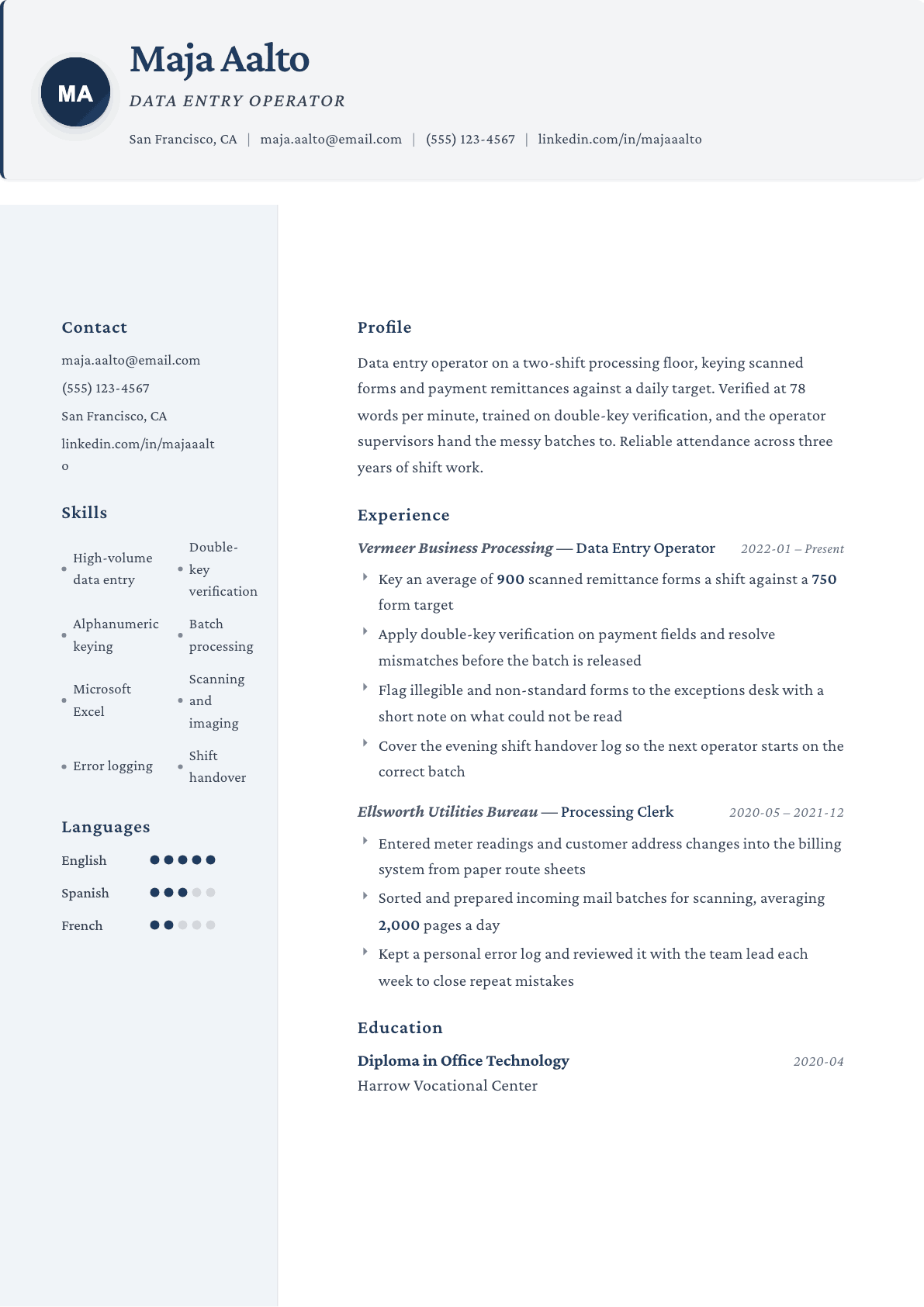
Example Data Entry Operator summary
Data entry operator with four years on high-volume processing floors in business services and utilities. Beats a daily batch target on scanned remittance forms, works under double-key verification on payment fields, and routes unreadable documents to the exceptions desk with clear notes. Available for evening shifts. Seeking an operator position where throughput and a clean error log are measured every week.
Skills to list on a Data Entry Operator resume
- High-volume data entry
- Keystrokes per hour
- Alphanumeric keying
- Numeric keypad entry
- Double-key verification
- Batch processing
- Scanning and imaging
- Exception handling
- Microsoft Excel
- Billing system entry
- Error logging
- Shift handover notes
- Mail sorting
- Confidential data handling
What actually gets this resume read
- Lead with keystrokes per hour or words per minute, since operator postings screen on a measured number first.
- State your daily batch target and whether you met or beat it, because that comparison is what a supervisor wants.
- Explain any verification method you worked under, such as double-key or blind verification, using the employer term.
- Mention shift patterns you can work, as evening and weekend availability moves an operator resume up the list.
- Include attendance and reliability with a plain fact, since processing floors staff to a headcount every single day.
- Name the systems and scanners you operated rather than writing computer literate, which tells a reader nothing.
How to write a data entry operator resume
Operator hiring on a processing floor works differently from office hiring. The team lead is staffing a shift to a headcount every day against a batch target, so the resume is read for three things in this order: your measured keying rate, whether you hit the daily target, and whether you turn up. Everything else on the page is secondary to those.
That is why a data entry operator resume should look almost mechanical. Keystrokes per hour or words per minute, the target you worked to and whether you beat it, the verification method you worked under, the shifts you can cover, and the systems and scanners you operated. A floor supervisor is comparing you against six other applicants on exactly those lines.
This guide shows how to write those numbers so they are believed, how to describe double-key and blind verification correctly, how to present shift availability as an advantage, and how to make exception handling and a clean error log part of your case.
Format: one page, target and rate above the fold
Keep the whole document to one page and put your keying rate and your batch performance in the top third. A processing floor supervisor reads dozens of these between shifts and will not hunt through paragraphs for the number that decides the interview.
Use plain text throughout with no charts, no icons and no rating bars. Business process outsourcing employers run high-volume automated screening, and a rate written as text is the only version guaranteed to survive it.
- Top block: keystrokes per hour, words per minute, and the daily batch target you worked to.
- Availability line: shifts you can cover, including evenings, nights and weekends.
- Employer lines that name the industry, since remittance, claims and utility billing each read differently.
Summary: rate, target, verification, availability
Four facts, one short paragraph. The measured rate with the assessment behind it. The document type you key, such as scanned remittance forms, meter readings or claim documents. The target and your performance against it. The shifts you can work.
Leave adjectives out entirely. On a processing floor the currency is throughput and reliability, and a summary that opens with hardworking and motivated wastes the one line that could have said you beat a 750 form target every shift.
Throughput: the target is the story
A rate alone means little without the standard it was measured against. Give the target and your typical output together, and note whether the target was per shift, per hour or per batch. Beating a stated target is the clearest evidence a supervisor can act on, because it is exactly how they will manage you.
Add the conditions. Keying from clean typed forms is easier than keying from handwritten route sheets or poor scans, so say which you worked with. An operator who holds pace on messy source documents is worth more, and supervisors know it. If your team handed you the difficult batches, that is a line worth writing plainly.
Verification, exceptions and the error log
Use the employer vocabulary for the checking method you worked under. Double-key verification means the field is keyed twice and mismatches are resolved before release. Blind verification means a second operator keys without seeing the first entry. Sight verification means a visual check against the source. Naming the right one signals you have worked in a controlled environment.
Then describe exception handling: what you do with an illegible or non-standard form, the note you attach, and where it goes. A form pushed through with a guess causes a downstream correction and, in payment work, a real problem for a customer. An operator who flags rather than guesses is describing judgment.
Mention your error log if you kept one. A weekly review with a team lead that closed repeat mistakes shows you treat quality as a routine rather than an occasional scolding.
Shifts, attendance and equipment
Say which shifts you can work and say it early. Evening, night and weekend availability moves an operator resume up the list faster than an extra hundred keystrokes an hour, because those are the slots that are hardest to fill. Add reliable transport for a night shift if that is relevant to the site.
Attendance is a legitimate resume fact in this work. Stated plainly, without boasting, a line noting reliable attendance across three years of shift work answers the question a supervisor is really asking. Finish with the equipment: the scanners you operated, the mail preparation you did before scanning, the billing or capture system you keyed into, and the shift handover log you maintained.
Data Entry Operator resume summary examples
First processing floor job
Office technology diploma holder tested at 62 words per minute with numeric keypad entry by touch, trained on batch scanning and document preparation during a college placement. Available for evening and weekend shifts and comfortable working to a stated hourly target. Seeking a first data entry operator position.
Two years on shift
Data entry operator keying an average of 900 scanned remittance forms a shift against a 750 form target, verified at 78 words per minute. Trained on double-key verification for payment fields and routes illegible forms to the exceptions desk with a written note. Available for evening shifts with reliable attendance.
Senior operator
Senior data entry operator with six years across business processing and utility billing floors, handling the batches other operators escalate. Works under double-key verification, keeps a personal error log reviewed weekly with the team lead, and writes the shift handover so the next operator starts on the correct batch.
Work experience bullets: before and after
Before: Entered data from scanned documents.
After: Keyed an average of 900 scanned remittance forms a shift against a 750 form target, working from mixed quality scans and handwritten annotations.
Output against a stated target, plus the source condition, is the exact comparison a floor supervisor makes.
Before: Checked my work for errors.
After: Applied double-key verification on payment fields and resolved every mismatch against the source image before the batch was released.
The named verification method and the release gate show controlled processing rather than self-checking.
Before: Reported problems with documents.
After: Flagged illegible and non-standard forms to the exceptions desk with a short note on the specific field that could not be read.
Describing the note tells a supervisor you prevent downstream corrections instead of guessing to keep your rate up.
Before: Worked evening shifts.
After: Covered the evening shift handover log so the incoming operator started on the correct batch with open exceptions listed.
Turning availability into a handoff responsibility shows the shift discipline the role is actually staffed for.
Before: Entered meter readings and address changes.
After: Entered meter readings and customer address changes into the billing system from paper route sheets, preparing 2,000 pages a day for scanning.
Naming the source documents, the destination system and the preparation volume shows the full process, not one step.
Hard skills
- High-volume keying
- Keystrokes per hour rate
- Numeric keypad entry
- Double-key verification
- Blind verification
- Batch processing
- Scanning and imaging
- Document preparation and mail sorting
- Exception handling
- Billing system entry
- Error logging
- Shift handover notes
- Confidential data handling
Soft skills
- Endurance over a full shift
- Consistent attendance
- Steady rhythm without rushing
- Flagging rather than guessing
- Clean handover to the next shift
- Taking correction without friction
Certifications worth listing
- Microsoft Office Specialist: Excel Associate (Microsoft)
- IC3 Digital Literacy Certification (Certiport)
Mistakes that cost data entry operator candidates the interview
- Giving a keying rate with no target beside it, leaving the supervisor unable to judge whether the number is good.
- Filling the top of the page with adjectives when the rate and the shift availability decide the screen.
- Using the wrong verification vocabulary, which tells an experienced lead you have not worked under a controlled process.
- Hiding shift flexibility at the bottom of the page when evening and weekend cover is the hardest slot to staff.
- Never mentioning exception handling, so it looks like you push doubtful forms through to protect your rate.
- Adding decorative charts to a resume that will be screened automatically before any person sees it.
Data Entry Operator resume questions
Should I list keystrokes per hour or words per minute?
List both if you have them, because alphanumeric and numeric work are tested separately and postings ask for different units. If the posting names one unit, put that number first and give the other in the same line so nothing has to be converted by the reader.
How important is shift availability on a data entry operator resume?
It is often the deciding factor between two candidates with similar speeds, since processing floors run to a headcount on every shift and evening and night cover is the hardest to fill. State the shifts you can work near the top and be specific about weekends.
What does double-key verification mean on a resume?
It means critical fields are keyed twice, by you or by a second operator, and the system holds the batch until the two entries agree. Naming it correctly shows you have worked in an environment where errors were caught before release rather than after a customer complained.
Do I need a diploma for data entry operator work?
A high school diploma or an office technology qualification is usually enough, and the assessment on the day carries more weight than the certificate. Keep education to two lines and use the space for your measured rate, your target performance and your availability.
How do I explain a break between processing jobs?
Give the plain reason in one clause and keep the dates honest, since attendance and reliability are exactly what this role is screened for. Temporary and agency assignments are normal in processing work, so group short agency placements under one heading with the agency named.
Related resume examples
- Data Entry Clerk Resume example
- Office Clerk Resume example
- Data Entry Specialist Resume example
- Inventory Clerk Resume example
- File Clerk Resume example
- Clerical Assistant Resume example