Office Clerk Resume Examples: free ATS score and gap list
A Clerk Resume Sample That Proves Speed and Accuracy
By Mustafa Tarabya, founder of CVBooster · Published · Updated
A clerk resume sample for general office work, written out in full, plus filing, data entry and mail bullets and the keywords clerk postings scan for.
Sample resumes for a office clerk
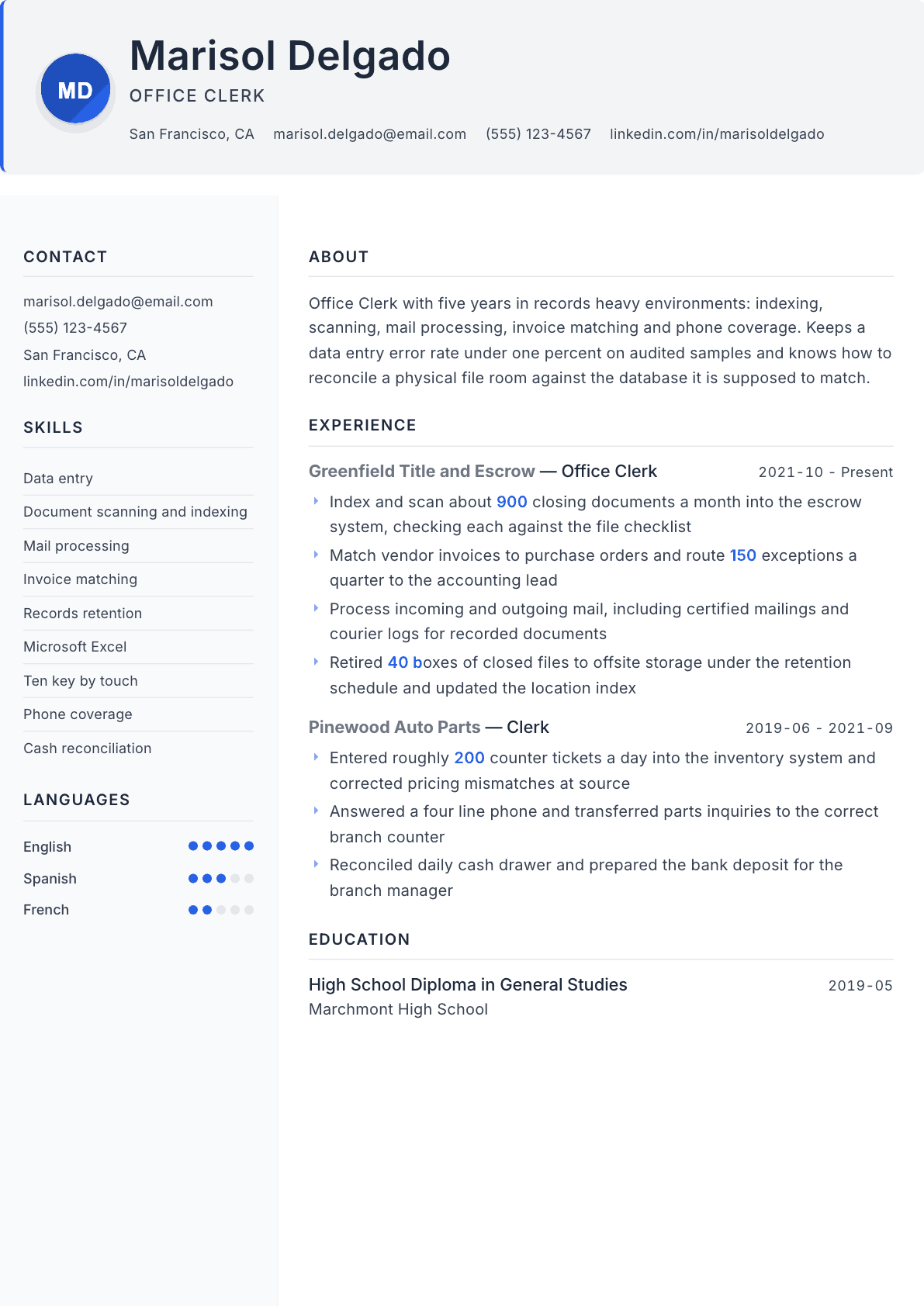
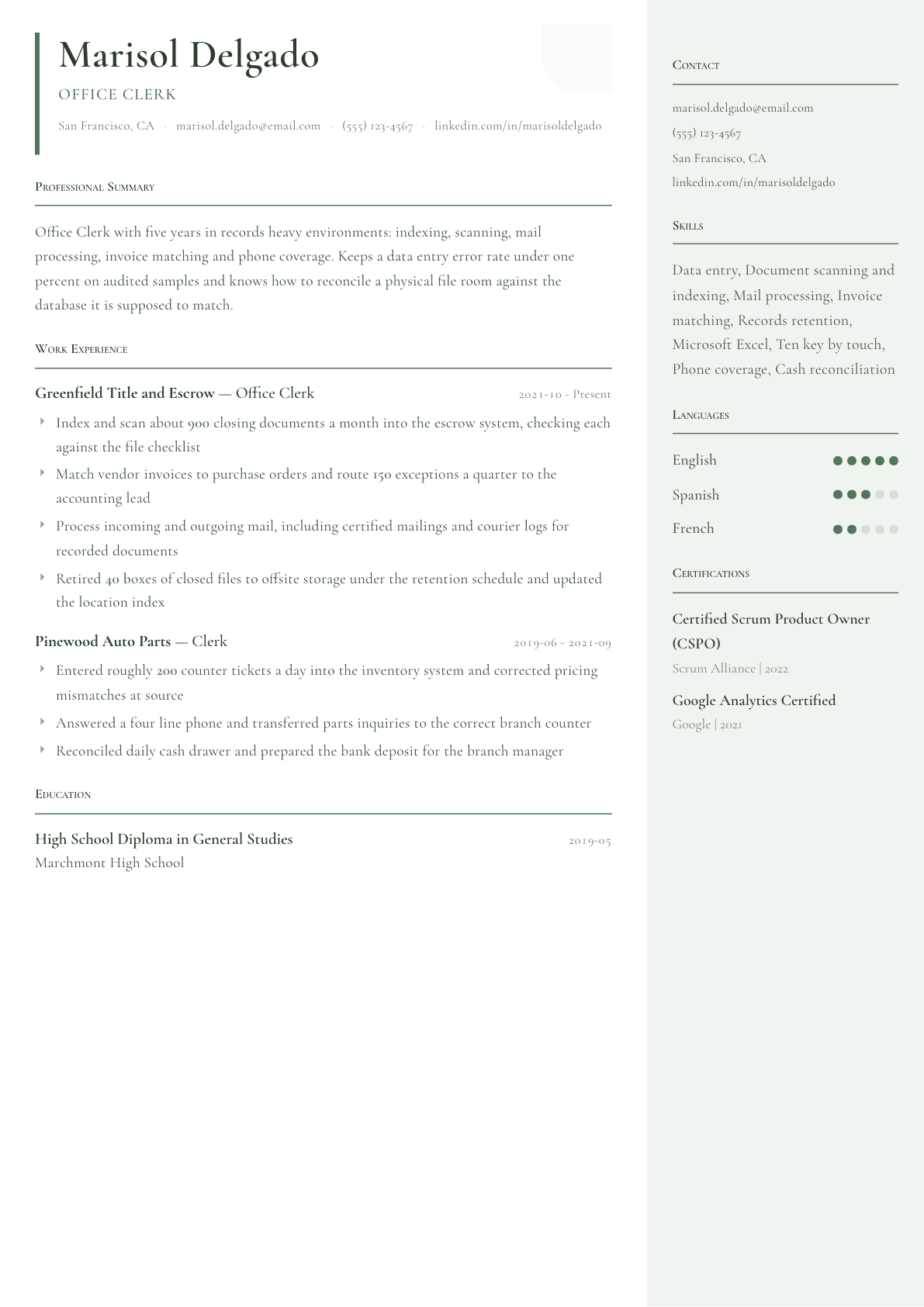
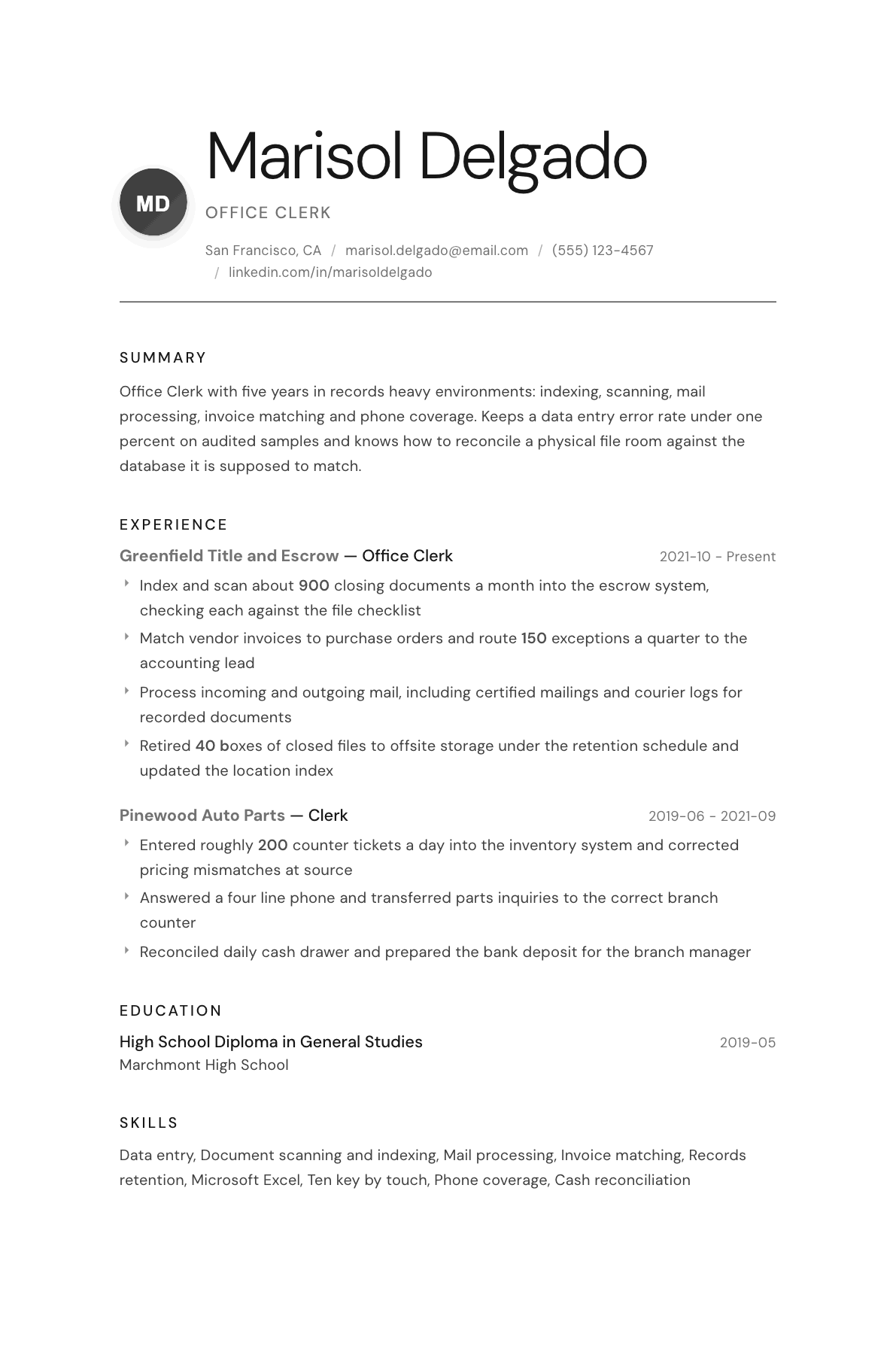
The same office clerk content laid out in three CVBooster templates, so you can see what the finished document looks like before you write a word.
Example Office Clerk summary
Office Clerk with five years in records heavy offices, indexing and scanning about 900 documents a month, matching vendor invoices to purchase orders, and processing certified mail and courier logs. Audited data entry error rate stays under one percent. Experienced with retention schedules and offsite storage transfers. Seeking a clerk role in a title, legal or medical records office.
Skills to list on a Office Clerk resume
- Data entry
- Ten key by touch
- Document scanning and indexing
- Filing systems
- Mail sorting and metering
- Invoice matching
- Records retention
- Microsoft Excel
- Microsoft Word
- Copy and print operation
- Phone coverage
- Cash drawer reconciliation
- Inventory entry
- Document routing
What actually gets this resume read
- Clerk work is measured in throughput, so give a volume and a time unit in every bullet: documents per month, tickets per day.
- Add an accuracy figure if you have ever been audited or spot checked, because accuracy is the single thing a clerk is trusted for.
- Name the document types you handled, since closing files, medical charts and shipment manifests each imply different training.
- List ten key by touch and your typing speed, as many clerk postings still test both before the interview stage.
- Mention records retention and offsite storage work if you have it, because that experience moves you toward records clerk pay bands.
- Keep the resume to one page and put the software list high, since clerk screening is often a keyword match against the posting.
How to write a office clerk resume
Clerk work is measured in throughput and trusted for accuracy. That is the entire job, and it should be the entire resume. A hiring manager in a title company, a claims office or a parts counter wants to know how many documents you move in a day or a month, how often you get them wrong, and which document types you have handled before. Everything else is decoration.
Most office clerk resumes never give a single number. They say responsible for filing, data entry and general clerical duties, which describes the job description rather than the person doing it. Since clerk postings are often filtered by keyword match first and read by a supervisor second, a resume with volumes, an accuracy figure and named systems stands out on both passes.
This guide covers how to write throughput bullets, when and how to state accuracy, why the document types you handled matter more than the employer names, and how records retention experience moves you toward better paid records clerk work.
Format: one page, dense, software near the top
One page and a plain single column. Clerk screening is often a mechanical keyword match against the posting, so a design template with columns or graphics costs you matches without gaining anything. Reverse chronological with month and year dates, because clerk employment gaps get asked about and it is better to answer them on the page.
Put a short technical line high: the systems you have entered data into, ten key by touch, your typing speed, and any scanner or indexing platform. Many clerk employers still administer a data entry and ten key test before the interview, so listing both invites the test rather than avoiding it.
- Order: summary, systems and speed, experience, education, then certificates.
- Give every bullet a volume with a time unit: per day, per month, per quarter.
- Name the document types you handled, not only the employer.
- Keep the education line simple; a high school diploma is a perfectly normal entry here.
Summary: environment, throughput, accuracy
Say what kind of records environment you came from in the first clause. Title and escrow, medical records, insurance claims, shipment manifests and parts counters all involve different checklists and different consequences for a mistake, and a supervisor hiring for one of them wants a clerk who has already seen that paperwork.
Then give one throughput figure and one accuracy statement. An audited error rate under one in a hundred entries, or a spot check result your supervisor ran, is the strongest single sentence a clerk can put on a resume, because accuracy is the one thing a clerk is trusted for and almost nobody quantifies it.
Experience: volume, verification, and what happens to exceptions
Write each bullet as volume plus verification. Indexing about 900 closing documents a month is a volume. Checking each one against the file checklist before release is the verification. Together they show a supervisor that speed and care are not competing in your work, which is exactly the worry she has about a fast clerk.
Exceptions deserve their own bullet. Matching vendor invoices to purchase orders is routine, but routing the exceptions to the accounting lead with the discrepancy identified is judgment. Clerks who only process and never escalate create quiet problems, and hiring managers know it.
Mail, courier and records retention work is undervalued by candidates and valued by employers. Certified mailings, courier logs for recorded documents, retiring closed files to offsite storage under a retention schedule and updating the location index are all specific, verifiable and directly relevant to records clerk and document control roles that pay better.
- Pair each throughput figure with the check you perform before the work is released.
- Describe the exception path: how many, who they went to, what you attached.
- Include cash drawer or deposit work if you have it, with the balancing routine.
- Mention retention schedules and offsite storage transfers when they apply.
Skills: the testable ones first
Lead with what can be tested: data entry, ten key by touch, typing speed, Excel and Word. Then the operational skills: document scanning and indexing, filing systems, mail sorting and metering, invoice matching, records retention, document routing, inventory entry, copy and print operation, phone coverage and cash drawer reconciliation.
Name the specific systems you have entered records into, whether that is an escrow platform, an inventory system or a claims database. Even if the new employer runs something different, a supervisor reads system experience as proof you can learn screens and follow an entry standard.
Clerk resume sample: a full general office clerk page
Most people searching for a clerk resume sample want to see a whole page before they write their own, so here is one for a general office clerk with four years in a distribution company office, applying to a larger office with records and billing work. The name and employers are invented. Notice that the systems line sits under the summary, and every bullet carries a volume or an accuracy check.
The same layout works for the other clerk resume examples people ask for: a file clerk swaps the billing bullet for a retention schedule, a mail room clerk leads with daily piece counts, and a records clerk leads with the system and the audit result. Keep the page to one sheet and use the clerk title the posting uses.
- Header: Dana Whitfield, General Office Clerk. City, phone, email, LinkedIn.
- Summary: General office clerk with four years in a sixty person distribution office. Enters around three hundred orders and invoices a week with spot checked accuracy, keeps the paper and electronic files for two departments, and covers the front desk and mail every afternoon.
- Systems: Microsoft 365 (Excel lookups and filters, Outlook shared mailboxes), QuickBooks Online, a document scanning and indexing tool, multi line phone system. Typing speed 65 words a minute, tested this year.
- Office Clerk, Northgate Supply, four years. Entered purchase orders and supplier invoices into QuickBooks and matched them to delivery notes before payment. Scanned, named and indexed incoming documents the same day under the department naming rules. Sorted and logged incoming mail and courier packages for sixty staff. Answered the main line in the afternoon and routed calls to five departments.
- Earlier: Retail Cashier, two years. Balanced the register daily against the sales report and handled returns and refunds at the service desk.
- Education: High school diploma; office administration certificate covering records management and spreadsheets.
Office Clerk resume summary examples
First clerical job
Recent high school graduate with a semester of business office coursework and six months of seasonal counter work. Entered about 120 counter tickets a day into an inventory system, corrected pricing mismatches at source, and reconciled a daily cash drawer. Ten key by touch and comfortable in Excel. Seeking a full time office clerk role.
Five years in
Office Clerk with five years in records heavy offices, indexing and scanning about 900 documents a month, matching vendor invoices to purchase orders, and processing certified mail and courier logs. Audited data entry error rate stays under 1%. Experienced with retention schedules and offsite storage transfers.
Lead clerk
Lead Office Clerk with nine years in title, escrow and claims environments. Trains and spot checks three clerks, owns the monthly retention transfer to offsite storage, and maintains the location index for roughly 600 archived boxes. Handles exception routing for invoice mismatches and recorded document corrections.
Work experience bullets: before and after
Before: Scanned and filed documents for the office.
After: Indexed and scanned about 900 closing documents a month into the escrow system, checking each file against the closing checklist before marking it complete.
A monthly volume plus the checklist step shows throughput and the control that keeps it accurate.
Before: Matched invoices to purchase orders.
After: Matched vendor invoices to purchase orders and routed roughly 150 exceptions a quarter to the accounting lead with the price or quantity discrepancy noted on each.
The exception count and the note you attach show judgment rather than mechanical matching.
Before: Did data entry every day.
After: Entered roughly 200 counter tickets a day into the inventory system and corrected pricing mismatches at source rather than leaving them for month end cleanup.
A daily volume and fixing errors upstream turn data entry into a habit a supervisor can trust.
Before: Handled the mail.
After: Processed incoming and outgoing mail including certified mailings and courier logs for recorded documents, tracking receipts until each recorded copy returned.
Naming certified mail and the tracking of recorded documents shows familiarity with legally sensitive mail.
Before: Archived old files.
After: Retired 40 boxes of closed files to offsite storage under the retention schedule and updated the location index so any box could be recalled the same day.
Retention vocabulary and the retrievability outcome point toward records work rather than general filing.
Hard skills
- Data entry
- Ten key by touch
- Document scanning and indexing
- Filing systems
- Mail sorting and metering
- Certified and courier mail handling
- Invoice to purchase order matching
- Records retention schedules
- Microsoft Excel
- Microsoft Word
- Copy and print operation
- Cash drawer reconciliation
- Inventory entry
- Document routing
Soft skills
- Sustained concentration
- Consistency across long batches
- Catching what does not match
- Escalating discrepancies promptly
- Reliability on daily deadlines
- Care with confidential documents
Certifications worth listing
- Microsoft Office Specialist: Excel Associate (Microsoft)
- Certified Records Analyst (CRA) (Institute of Certified Records Managers)
- Certified Records Manager (CRM) (Institute of Certified Records Managers)
- Notary Public commission (State commissioning authority)
- Information Governance Professional (IGP) (ARMA International)
Mistakes that cost office clerk candidates the interview
- Writing general clerical duties, which repeats the job description instead of describing your throughput.
- Omitting volumes and time units so a supervisor cannot compare your pace with the other applicants.
- Never mentioning accuracy, when accuracy is the single quality a clerk is actually trusted for.
- Hiding the document types you handled behind employer names the reader does not recognize.
- Leaving ten key and typing speed off, when many clerk employers test both before the interview.
- Treating retention and offsite storage work as unimportant, when it is the bridge to records clerk pay.
- Using a designed template with columns that keyword screening tools read out of order.
Office Clerk resume questions
Where can I find clerk resume examples for my exact clerk title?
Start from the full sample on this page, then open the guide for your title: file clerk, records clerk, data entry clerk, mail room clerk, court clerk and accounting clerk each have their own page with bullets and keywords. Keep the same structure, change the systems line and the volumes to match your work.
What is the difference between an office clerk and an administrative assistant?
Clerk work centers on processing volume: entry, indexing, matching, mail and filing. Assistant work centers on supporting people: calendars, travel and correspondence. Write to whichever the posting describes, because the two are screened by different keywords entirely.
How do I state an accuracy rate honestly?
Only use a figure that came from a real audit or supervisor spot check, and say where it came from. If nobody ever measured you, describe the verification step you perform instead, such as checking each entry against a source document before release.
Do I need a degree to be an office clerk?
Usually not. A high school diploma with demonstrated speed and accuracy is the standard entry point, and a short business office course helps. Employers care far more about tested data entry, ten key and system familiarity than about a degree.
How do I move from office clerk to records clerk?
Build the retention vocabulary into your bullets: retention schedules, destruction dates, offsite transfers, location indexing and legal holds. Then look at the records credentials from ARMA International and the Institute of Certified Records Managers as the next step.
Related resume examples
- Data Entry Clerk Resume example
- Mail Room Clerk Resume example
- File Clerk Resume example
- Clerical Assistant Resume example
- Data Entry Operator Resume example
- Shipping Clerk Resume example