Clerical Assistant Resume Examples: the lines they read
A Clerical Assistant Resume Built on Volume, Accuracy and Systems
By Mustafa Tarabya, founder of CVBooster · Published · Updated
Clerical assistant resume example with concrete bullets, the software and keywords screeners look for, and a guide to every section of the page.
Sample resumes for a clerical assistant
The same clerical assistant content laid out in three CVBooster templates, so you can see what the finished document looks like before you write a word.
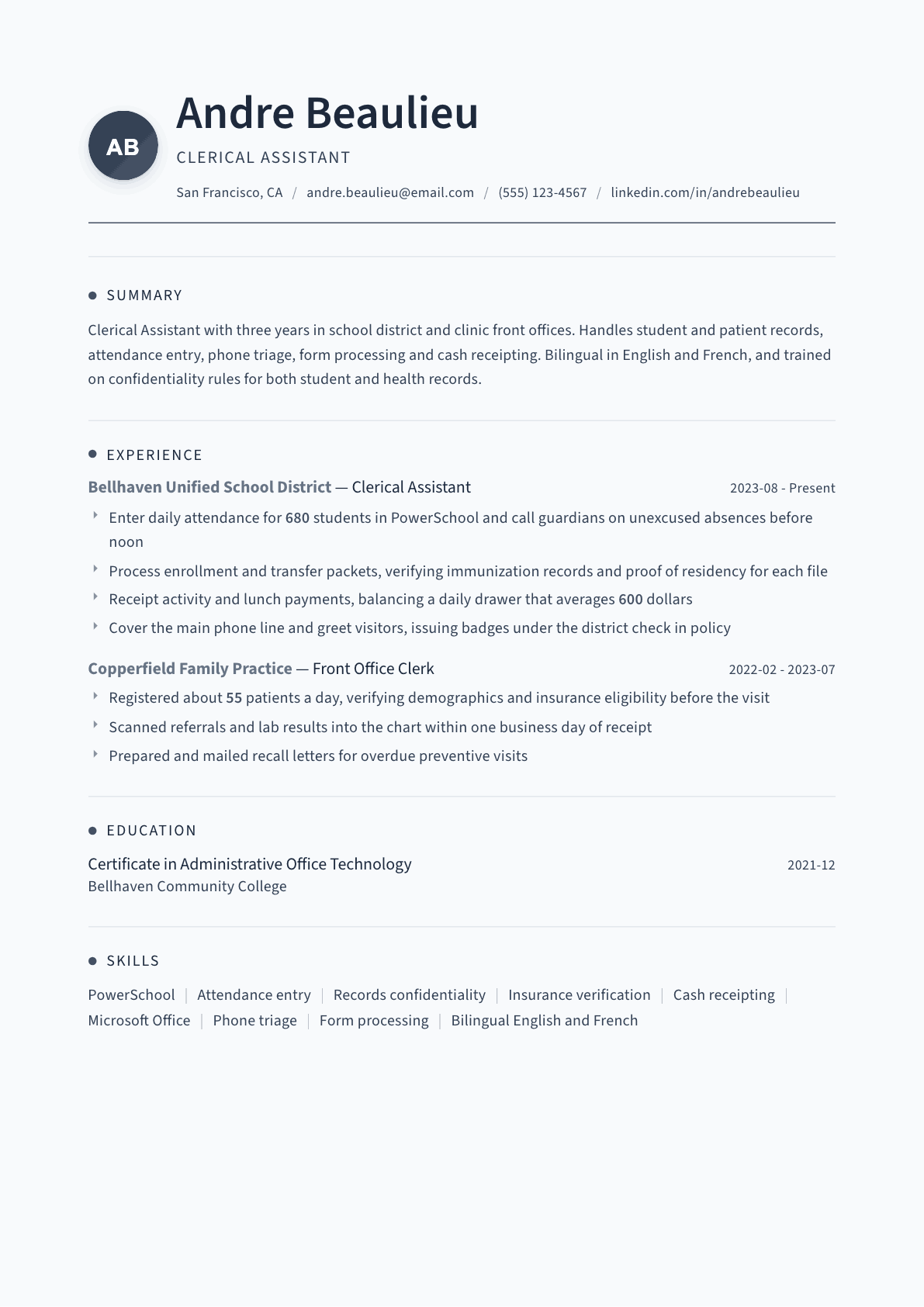
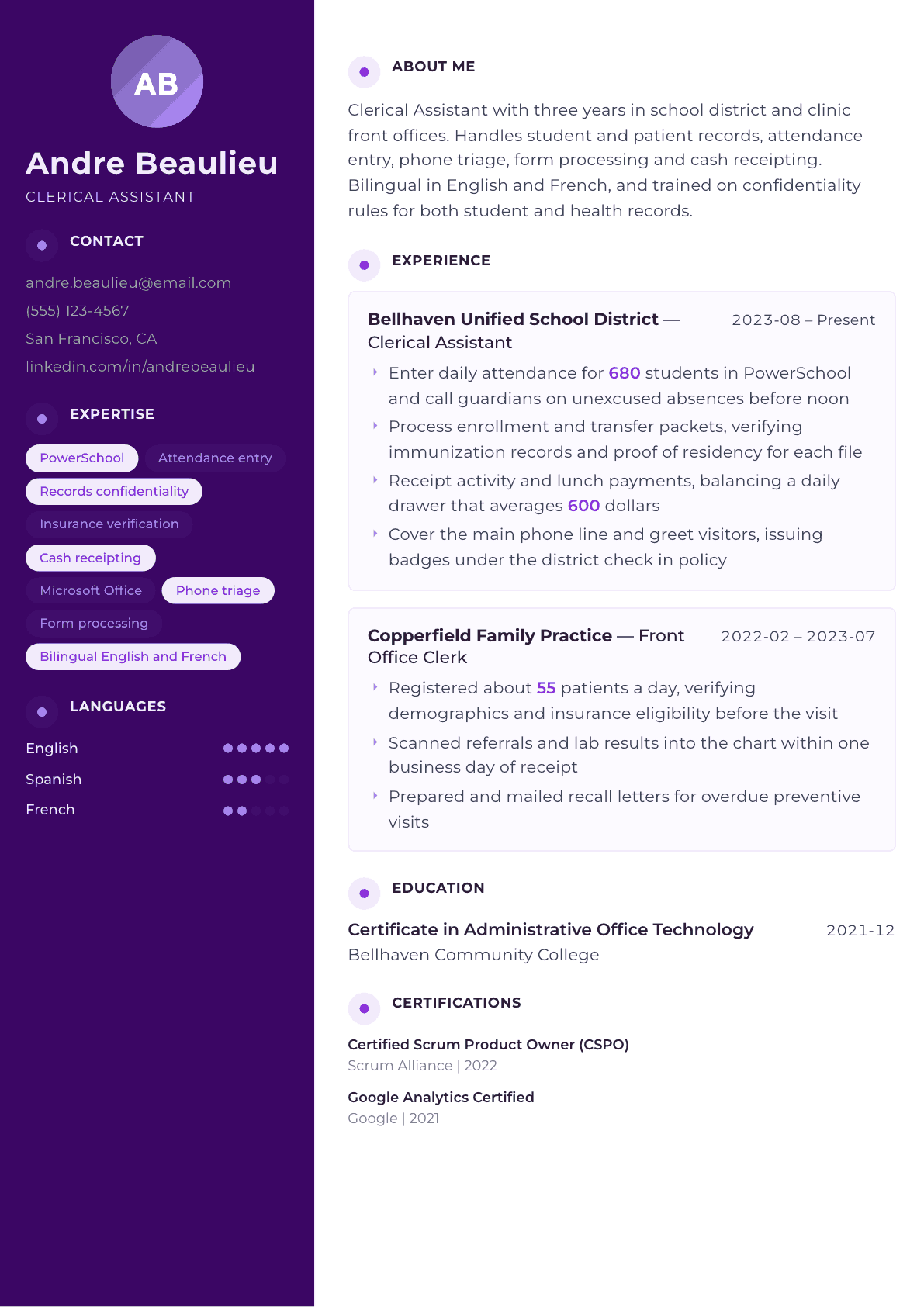
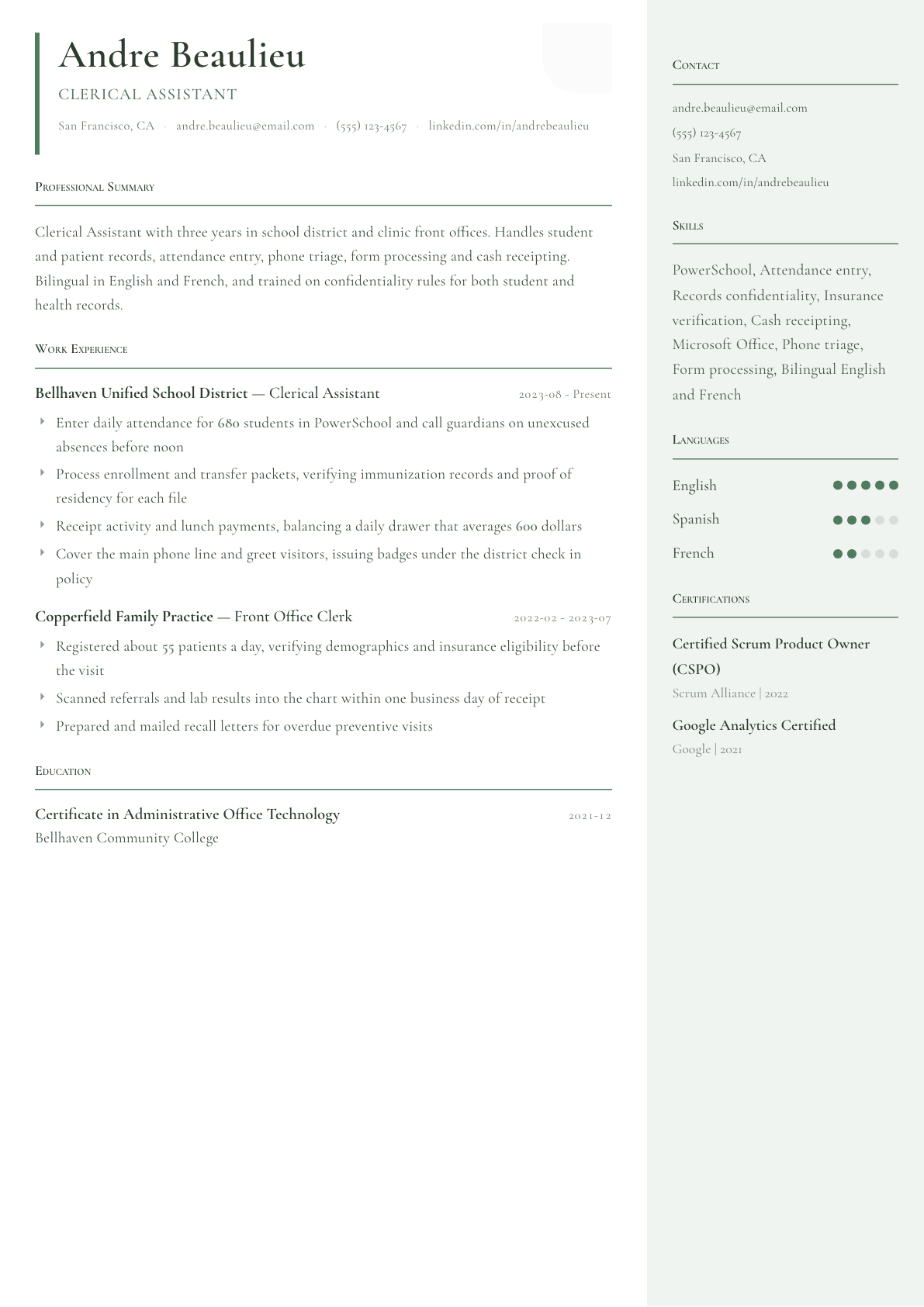
Example Clerical Assistant summary
Clerical Assistant with three years across school district and family practice front offices. Enters daily attendance for 680 students in PowerSchool, processes enrollment packets with immunization and residency checks, and balances a daily receipting drawer. Previously registered about 55 patients a day with insurance verification. Bilingual in English and French and trained on student and health record confidentiality.
Skills to list on a Clerical Assistant resume
- Data entry
- Attendance and enrollment records
- PowerSchool
- Insurance eligibility verification
- Cash receipting and balancing
- Filing and scanning
- Microsoft Word
- Microsoft Excel
- Phone triage and routing
- Form and packet processing
- Visitor check in
- Mail preparation
- Confidential recordkeeping
- Bilingual communication
What actually gets this resume read
- Clerical assistant covers many settings, so name yours in the first line: school office, clinic front desk, court, warehouse or agency.
- Confidentiality is a hiring requirement in school and health settings, so state the training you hold and the record types you handle.
- Give the population size you serve, such as students enrolled or patients registered per day, rather than describing duties in the abstract.
- Name the record system directly, because PowerSchool, Infinite Campus, Athena and Epic each signal a different learning curve to the manager.
- If you speak a second language used by the community, put it in the summary and the skills list, since it often decides shortlists.
- Show cash handling with a balancing routine, because employers want proof you close a drawer correctly, not that you touched money.
How to write a clerical assistant resume
Clerical assistant is a title that travels across very different buildings. The same words describe the person entering daily attendance in a school office, the one registering patients at a family practice, the one taking filings at a court counter, and the one logging deliveries in a warehouse office. The hiring manager reading your resume works in exactly one of those and wants to know whether you have worked in hers.
The second thing she is checking is confidentiality. School and health settings hand a clerical assistant student records, immunization documents, insurance details and family contact information on the first morning. A resume that names the record types you handle and the training you completed answers a question she would otherwise have to spend the interview asking.
This guide covers how to name your setting, how to size the population you serve, which record systems to list by product, how to present cash receipting and bilingual ability, and the mistakes that keep otherwise strong front office candidates out of the shortlist.
Format: one page, single column, setting named in line one
One page and no design flourishes. School districts and clinics run applicant tracking systems that read plain documents reliably, and both often require an online application form that copies your resume text, which mangles anything with columns or graphics.
Name your setting in the first line of the summary. School office, clinic front desk, court clerk counter, agency reception or warehouse office. Everything a reader assumes about your pace, your paperwork and your public contact follows from that one phrase, so do not make them work it out from the employer names.
- Order: summary, systems, experience, education and certificate, then languages.
- Use month and year dates, since school year hiring cycles make timing meaningful.
- Put confidentiality training near the systems, not buried at the bottom.
- Keep languages visible; in many districts and clinics they decide the shortlist.
Summary: population size, systems, and record types
Give the reader a population figure rather than a description of duties. Daily attendance for 680 students, about 55 patients registered a day, a counter serving a town of a given size. Population is the closest thing this role has to a workload measure and it lands instantly with anyone who has run the desk.
Then name the record system by product. PowerSchool, Infinite Campus, Athenahealth and Epic each mean a different learning curve, and a manager who runs one of them will always shortlist someone who already knows the screens. Finish with the record types you are trusted with and the confidentiality training that goes with them.
Experience: intake, verification, money, and the phone
Front office work has four repeating streams and your bullets should touch all of them. Intake is entering attendance, registering patients or processing enrollment packets. Verification is the part candidates leave out: checking immunization records and proof of residency, confirming insurance eligibility before the visit, validating demographics against the record on file.
Money needs a balancing routine attached. Receipting activity and lunch payments is a duty. Balancing a daily drawer that averages a stated amount, and reporting the variance to the office manager, is proof you close it correctly. Employers are not asking whether you touched money. They are asking whether the drawer reconciled.
The phone is the fourth stream and the one most likely to be underwritten. Calling guardians on unexcused absences before noon, triaging clinical questions to the nurse line under a practice protocol, or issuing visitor badges under a district check in policy all show that you work inside rules rather than improvising at the counter.
- Give the population you serve: students enrolled, patients registered daily, cases filed.
- Show verification, not just entry: residency, immunization, eligibility, referral requirement.
- Attach a balancing routine to any cash receipting bullet.
- Name the protocol you follow for triage, check in or badge issuing.
Skills, languages and confidentiality
Keep the skills list operational: data entry, attendance and enrollment records, insurance eligibility verification, cash receipting and balancing, filing and scanning, phone triage and routing, form and packet processing, visitor check in, mail preparation, Word and Excel.
Put your second language in both the summary and the skills list, with an honest level. In districts and clinics serving a large language community, coverage at the front counter is a real operational need, and it frequently decides which of two similar candidates gets called.
State confidentiality training plainly. If you have completed student records privacy training or health information privacy training, name it and the employer who provided it. If you have not, say that you handle confidential student and health records daily, which is still a truthful signal of what you are used to.
Clerical resumes examples: two complete pages
Clerical resumes examples help most when they are complete, so here are two finished pages, an entry level office clerk and an experienced clerical assistant. The people and employers are invented; the order is what to copy. Office clerks, records clerks and general clerical staff can all use one of these two.
Entry level example. Profile: Kayla Johnson, Office Clerk. One year of part time front desk work at a community center plus a business office certificate. Types about fifty words a minute, comfortable with Microsoft Office and phones, and available full time.
- Front Desk Assistant, Eastside Community Center, one year part time: answered a four line phone, signed in visitors and took program registrations.
- Entered registrations and payments into the center database and balanced the cash box with the coordinator at close.
- Filed and scanned membership forms and kept the paper files in order for the yearly audit.
- Skills: Microsoft Word, Excel and Outlook, data entry, filing, scanning, multi line phones, cash handling.
Clerical resume example: experienced clerical assistant
The second of the clerical resumes examples is a clerical assistant with eight years in a county office. Notice the volume, the systems and the confidentiality line in the opening, the three things a public employer screens for.
Profile: Gloria Martinez, Clerical Assistant III. Eight years in a county permits office serving the public at the counter and by phone. Processes permit applications and fees, maintains records under retention rules and trains new clerks. Bilingual English and Spanish.
- Clerical Assistant III, Permits and Inspections, Riverside County, five years: process about forty permit applications a day at the counter, by mail and online.
- Check applications for missing documents, collect and reconcile fees and enter every permit in the county permitting system the same day.
- Pull and refile records for public records requests under the retention schedule, and redact private information before release.
- Trained four new clerks on intake, fee handling and the permit system.
- Earlier role, Clerk Typist, Riverside County Assessor, three years: data entry and filing for property records.
Clerical Assistant resume summary examples
First front office role
Administrative office technology certificate holder with one year of clinic reception experience. Registered about 30 patients a day, verified demographics and insurance before the visit, and scanned referrals into the chart within one business day. Bilingual in English and Spanish. Seeking a clerical assistant role in a school or clinic front office.
Three years in
Clerical Assistant with three years across school district and family practice front offices. Enters daily attendance for 680 students in PowerSchool, processes enrollment packets with immunization and residency checks, and balances a daily receipting drawer. Bilingual in English and French and trained on student and health record confidentiality.
Senior clerical assistant
Senior Clerical Assistant with eight years in district offices, now training two clerical staff and coordinating registration week for a school of 900 students. Owns cumulative file transfers between campuses, the visitor and volunteer clearance log, and the daily receipting reconciliation for activity and lunch accounts.
Work experience bullets: before and after
Before: Took attendance and entered it into the system.
After: Entered daily attendance for 680 students in PowerSchool and called guardians on every unexcused absence before noon, logging each contact against the student record.
The enrollment figure, the deadline and the logging step show a complete daily process rather than data entry.
Before: Handled enrollment paperwork for new students.
After: Processed enrollment and transfer packets, verifying immunization records and proof of residency for each file before the student was scheduled into classes.
Naming the two verifications proves you know the compliance checks that make an enrollment valid.
Before: Collected money from students and parents.
After: Receipted activity and lunch payments at the counter, balancing a daily drawer that averaged several hundred dollars and reporting any variance to the office manager before close.
A balancing routine and an escalation step turn cash handling into a control the employer can trust.
Before: Checked in patients at the front desk.
After: Registered about 55 patients a day, verifying demographics and insurance eligibility before the visit and flagging referral requirements to the scheduler.
Daily volume and the eligibility check show you prevent claim problems rather than just greeting arrivals.
Before: Answered the phone and helped visitors.
After: Covered the main line and the front counter, issuing visitor badges under the district check in policy and routing clinical questions to the nurse line within the practice protocol.
Working inside a named policy shows the reader that you follow safeguarding and triage rules under pressure.
Hard skills
- Data entry
- Attendance and enrollment records
- PowerSchool
- Insurance eligibility verification
- Cash receipting and balancing
- Filing and scanning
- Microsoft Word
- Microsoft Excel
- Phone triage and routing
- Form and packet processing
- Visitor check in and badging
- Mail preparation and recall letters
- Confidential recordkeeping
- Bilingual communication
Soft skills
- Calm with anxious families
- Discretion about student and patient information
- Switching tasks without losing the counter
- Clear phone manner
- Reliability during registration peaks
- Working within written policy
Certifications worth listing
- Microsoft Office Specialist: Word Associate (Microsoft)
- Certified Administrative Professional (CAP) (International Association of Administrative Professionals)
- Certified Medical Administrative Assistant (CMAA) (National Healthcareer Association)
- Basic Life Support (BLS) (American Heart Association)
- Notary Public commission (State commissioning authority)
Mistakes that cost clerical assistant candidates the interview
- Leaving the setting unnamed so the reader cannot tell a school office from a warehouse counter.
- Describing duties without a population figure, which is the only workload measure this role has.
- Writing student information system instead of naming PowerSchool, Infinite Campus, Athenahealth or Epic.
- Mentioning cash handling with no balancing routine, which leaves the employer guessing about controls.
- Omitting confidentiality training when the job hands you student and health records on day one.
- Burying a second language at the bottom when it is often the deciding factor at a public facing counter.
- Listing verification steps as if they were entry steps, which hides the compliance part of the work.
Clerical Assistant resume questions
What do good clerical resumes examples have in common?
They open with the setting and the volume you handled, name the software and systems, and show accuracy and confidentiality with real tasks rather than adjectives. They fit on one page and list typing speed or certificates only when the posting asks. The two complete examples on this page show an entry level and an experienced version.
How do I write a clerical assistant resume for a school district?
Lead with enrollment size, the student information system you use, and the compliance checks you run on enrollment packets. Districts also value guardian contact discipline, cash receipting for activity accounts, and any clearance or confidentiality training you have completed.
Does clinic front office experience transfer to a school office?
It transfers well because both are regulated intake counters with confidential records, verification steps and anxious members of the public. Say so explicitly, map your patient registration work onto enrollment processing, and name the privacy training you already hold.
Should I include my second language on the resume?
Yes, in the summary and the skills list, with an honest level such as conversational or fluent. Front counters in districts and clinics serving a language community treat coverage as an operational requirement, so it often separates two otherwise equal candidates.
Do I need a certificate for clerical assistant work?
Not usually, though an administrative office technology certificate helps a first time applicant. What carries more weight is naming the record system you already know and showing that you handle confidential files under a written policy every day.
Related resume examples
- Administrative Assistant Resume example
- Data Entry Clerk Resume example
- Office Clerk Resume example
- File Clerk Resume example
- Office Assistant Resume example
- Program Assistant Resume example