Deckhand Resume Examples: free score, then the gap list
Build a Deckhand Resume That Gets You on the Crew List
By Mustafa Tarabya, founder of CVBooster · Published · Updated
Deckhand resume example with sea time, documents, line handling and deck maintenance bullets, keywords and a guide to landing your first hitch.
Sample resumes for a deckhand
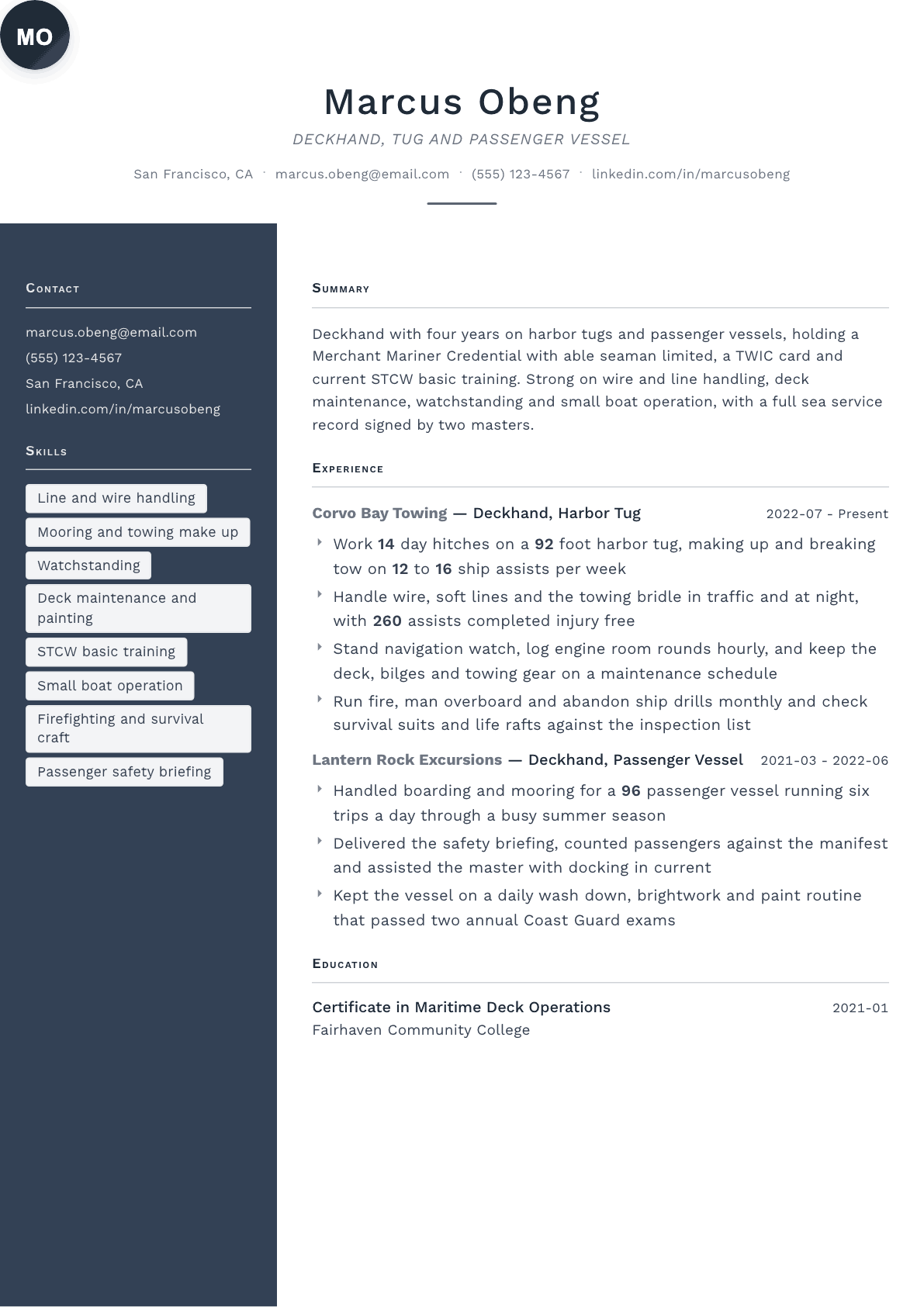
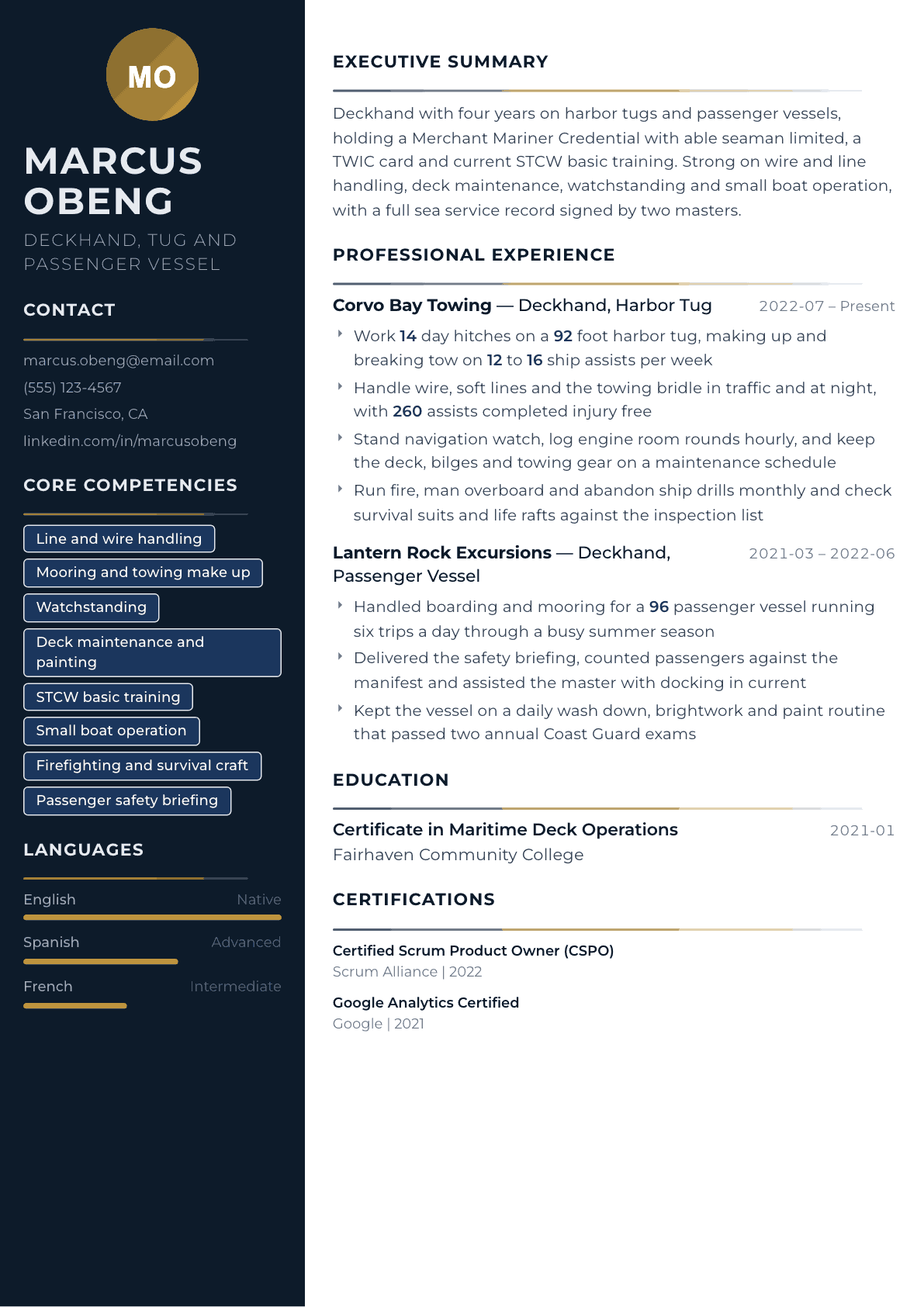
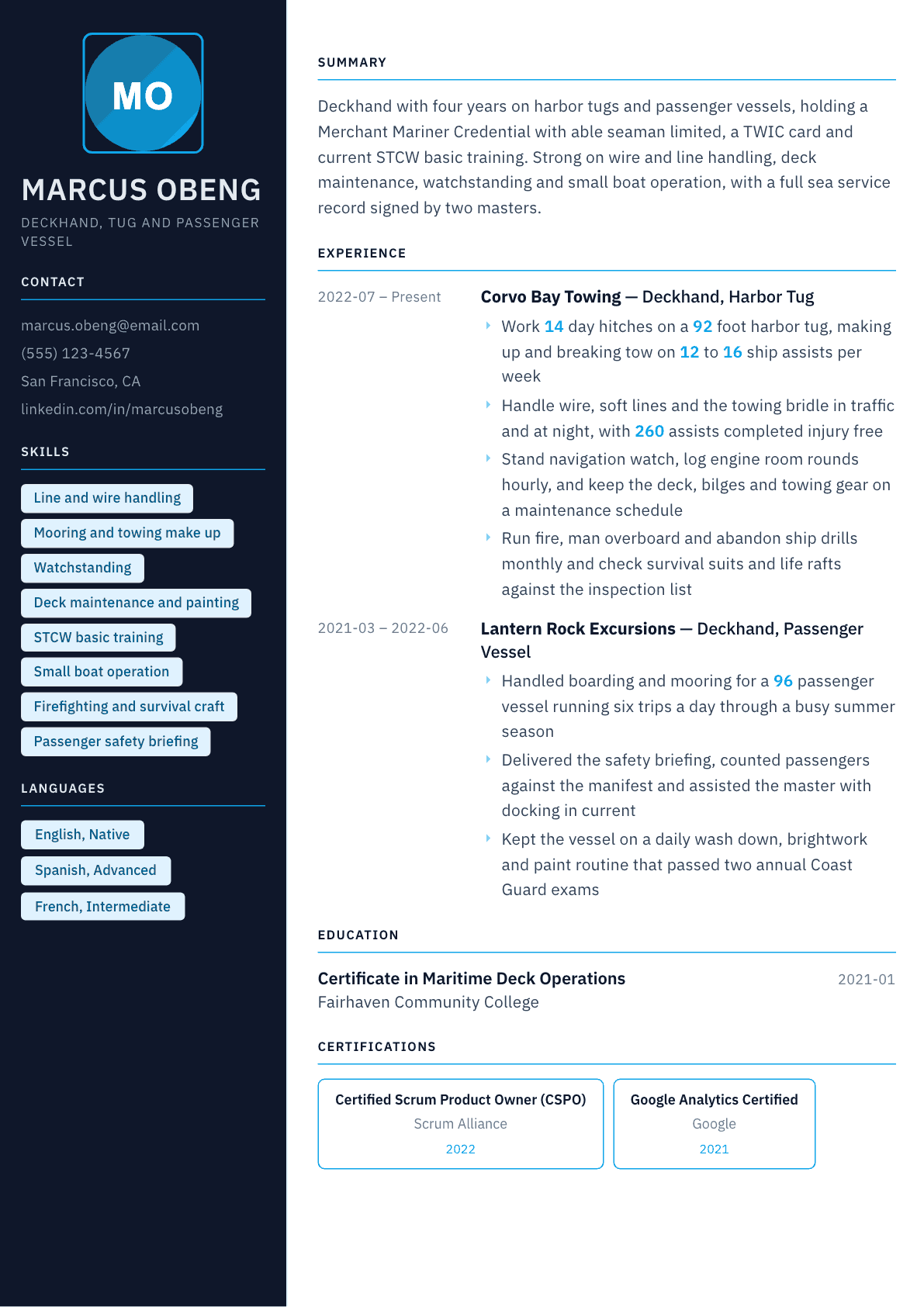
The same deckhand content laid out in three CVBooster templates, so you can see what the finished document looks like before you write a word.
Example Deckhand summary
Deckhand with four years on harbor tugs and passenger vessels, holding a Merchant Mariner Credential with able seaman limited, a TWIC card and current STCW basic training. Handles wire, soft lines and towing bridles on night ship assists, stands navigation watch, and keeps deck gear on a documented maintenance schedule. Two masters have signed sea service letters covering more than 700 days at sea.
Skills to list on a Deckhand resume
- Line and wire handling
- Mooring and unmooring
- Towing gear make up
- Anchor handling
- Navigation watchstanding
- Deck maintenance and preservation
- Chipping, priming and painting
- Rigging and splicing
- Fire and abandon ship drills
- Survival craft handling
- Small boat operation
- Cargo and stores handling
- Passenger boarding and briefing
- Engine room rounds
What actually gets this resume read
- Put the Merchant Mariner Credential, TWIC card, STCW basic training and medical certificate at the top with expiry dates.
- Count sea days honestly and show them by vessel type, because a mate signs your sea service letter against them.
- Describe the deck work in real terms: line handling, chipping and painting, rigging, sounding tanks, standing watch.
- Name the vessel size, horsepower or passenger capacity for each job so a captain knows the scale you have worked at.
- Show a clean safety record with drills, near miss reports and injury free time, since crews are hired on reliability.
- If you are new, list boating, fishing, rope work or trade skills that transfer, and say you are ready for hitch work.
How to write a deckhand resume
Hiring a deckhand is a bet on reliability. A captain is deciding whether to put a stranger on a moving deck with wire under tension, then live with that person in a small space for two weeks. He reads the resume for three signals: your documents are current, you have handled lines before, and you show up. Everything else is trainable and he knows it.
That is why the document block matters so much on this resume. Merchant Mariner Credential, TWIC card, STCW basic training if the vessel requires it, and a current medical certificate are what let a crewing office add your name to a crew list. A candidate with a full folder can sail next week. A candidate whose card is in process cannot, no matter how strong the experience section is.
This guide covers the credential block, how to count and present sea time, what real deck work bullets look like, how to write the resume when you are new to the water, and the questions that come up when a deckhand starts working toward an able seaman endorsement or a mate license.
Format: one page, documents at the very top
One page, single column, no design. A crewing coordinator often reads this on a phone while filling a berth that sails tomorrow, so the credentials need to be visible without scrolling and the phone number needs to be answered.
Order the page: header with documents, sea service summary, vessel experience, safety and training, then education or trade background. Add a short availability line saying what hitch pattern you can work, because rotation compatibility decides a lot of these hires.
- Documents: Merchant Mariner Credential with any endorsement, TWIC card, STCW basic training, medical certificate, all with expiry.
- Sea service summary: total days at sea, vessel types, and the waters you have worked.
- Availability: hitch length you can take, notice period, passport status and whether you can travel to join a vessel.
Sea time: count it honestly, break it out by vessel
A day of sea service has a specific meaning and a master signs a letter attesting to it. Present the number your letters support, split by vessel type, and name the captains or companies who can verify it. Overstating sea time is the fastest way to end an application, because the letters are requested during onboarding.
If you are working toward an able seaman endorsement or a mate license, say where you are in the day count and which endorsement you are building toward. Operators like crew who are climbing, because a deckhand on a license track is one they can promote instead of replace.
Deck work bullets: gear, watch, maintenance, drills
Write about what your hands did. Making up and breaking tow. Handling wire, soft line and the towing bridle at night in traffic. Heaving lines, working the capstan, setting and hauling the anchor. Rigging and splicing. Sounding tanks and taking engine room rounds. Standing lookout and navigation watch.
Maintenance is half the job and belongs on the page. Chipping, priming and painting, wash downs, greasing gear, changing zincs, keeping the bilges clean, servicing the towing gear on a schedule. A captain reads deck preservation experience as evidence you will do the work nobody is watching.
Then safety. Fire, man overboard and abandon ship drills, survival suit and life raft checks, personal protective equipment discipline, and injury free time on the deck. If you have made a near miss report or stopped a job that felt wrong, that is a bullet worth the space.
- Give the vessel scale: length, horsepower, passenger capacity or barge size, so a captain can picture the gear you handled.
- Give a work volume: assists per week, trips per day, hitches per year, cargo moves per shift.
- Give the conditions: night work, traffic, current, ice, fog, offshore transits, tight berths.
Writing the resume when you have no sea time yet
Nobody expects a first hitch applicant to have deck experience, but they do expect evidence that you will last. Commercial fishing, boatyard work, rigging, construction, roofing, farm work, welding, warehouse and military service all transfer, because they prove you can work outdoors, follow a foreman and stay on your feet through a long day.
Then remove the obstacles for the hiring office. Say your TWIC card and Merchant Mariner Credential are in hand, that you have completed the drug testing program requirement, that you have a passport, and that you can drive to the vessel. A green deckhand with a complete folder beats an experienced one who cannot join for six weeks.
Deckhand resume summary examples
First hitch
Entry level deckhand with a Merchant Mariner Credential, TWIC card and current medical certificate, seeking a first hitch on a tug or supply vessel. Four years of commercial roofing and rigging work with a clean attendance record, comfortable with heights, hand tools, rope work and long days outdoors.
Two seasons in
Deckhand with four years on harbor tugs and passenger vessels holding able seaman limited, a TWIC card and current STCW basic training. Handles wire, soft lines and towing bridles on night ship assists, stands navigation watch, and keeps deck gear on a documented maintenance schedule.
Lead deckhand on a license track
Lead deckhand with more than nine hundred days of documented sea service on tugs and offshore supply vessels, holding able seaman unlimited and lifeboatman endorsements. Runs the deck maintenance plan, trains new crew on rigging and drills, and is completing sea time toward a mate of towing vessels license.
Work experience bullets: before and after
Before: Worked on deck of a harbor tug.
After: Work 14 day hitches on a 92 foot harbor tug, making up and breaking tow on 12 to 16 ship assists a week in a busy container terminal.
Hitch length, vessel size and assist volume tell a captain exactly how much deck time you actually have.
Before: Handled lines safely.
After: Handled wire, soft lines and the towing bridle at night and in traffic, completing 260 assists with no line failure and no reportable injury.
The gear types, the conditions and an injury free count turn a safety claim into a record.
Before: Did maintenance on the boat.
After: Kept the deck, bilges and towing gear on a written maintenance schedule, including chipping, priming, painting and greasing wire on a weekly rotation.
Naming the maintenance rotation shows self direction on work nobody assigns each morning.
Before: Participated in safety drills.
After: Ran monthly fire, man overboard and abandon ship drills with the mate and checked survival suits and life rafts against the inspection list before each hitch.
Drill frequency plus equipment checks proves involvement in the safety system rather than attendance at it.
Before: Helped passengers board the vessel.
After: Handled boarding and mooring for a 96 passenger vessel on six trips a day, delivering the safety briefing and counting passengers against the manifest each departure.
Passenger count, trip frequency and the manifest detail show responsibility a captain can verify.
Hard skills
- Line and wire handling
- Mooring and unmooring
- Towing gear make up and break out
- Anchor handling
- Navigation watchstanding and lookout
- Deck preservation and painting
- Rigging, knots and splicing
- Tank sounding and engine room rounds
- Fire and abandon ship drills
- Survival craft and life raft checks
- Small boat handling
- Cargo, stores and gear loading
Soft skills
- Reliability across long hitches
- Taking direction from the mate
- Living well in close quarters
- Stamina in poor weather
- Speaking up about a hazard
- Passenger courtesy
Certifications worth listing
- Merchant Mariner Credential, Ordinary Seaman (United States Coast Guard)
- Able Seaman Endorsement (United States Coast Guard)
- STCW Basic Training (United States Coast Guard)
- Lifeboatman Endorsement (United States Coast Guard)
- Transportation Worker Identification Credential (Transportation Security Administration)
Mistakes that cost deckhand candidates the interview
- Applying without saying whether the credential and TWIC card are in hand, which is the first thing a crewing office checks.
- Rounding sea days upward when the signed service letters will be requested during onboarding.
- Writing assisted with deck operations instead of naming the lines, the gear and the maneuvers you handled.
- Leaving off vessel size, horsepower or passenger capacity, so a captain cannot judge the scale of the work.
- Hiding a shore trade like rigging, welding or roofing that proves you can do heavy outdoor work.
- Skipping the availability line, when hitch compatibility often decides which of two candidates gets called.
- Listing hobbies and personal interests on a page where document expiry dates would be more useful.
Deckhand resume questions
What documents do I need before applying for a deckhand job?
A Merchant Mariner Credential, a TWIC card and a medical certificate at minimum, plus STCW basic training for many offshore and larger vessels. Put each on the resume with its expiry, because a crewing office cannot add you to a crew list without them.
How do I get a deckhand job with no sea time?
Apply to harbor tug, passenger vessel and dinner cruise operators who train green crew, and lead your resume with outdoor trade work, attendance record and a complete document folder. State plainly that you can travel to join a vessel on short notice.
How is sea service counted for an able seaman endorsement?
The Coast Guard counts days of service documented by a master or company letter, with requirements that differ by endorsement and route. Track your days as you go and ask for the letter when you leave a vessel rather than years later.
Should a deckhand resume list every vessel worked on?
List each vessel type and the days served, but group short relief trips into a single line rather than giving each one an entry. A captain wants to see the range of gear you have handled without reading a page of two week jobs.
How do I show I will last on a long hitch?
Show attendance and continuity: length of each hitch, how many you completed, whether you returned to the same vessel, and any injury free record. Captains screen hardest for people who leave mid rotation, so evidence of finishing matters more than variety.
Related resume examples
- Ship Captain Resume example
- Marine Engineer Resume example
- Harbor Pilot Resume example
- Warehouse Worker Resume example
- Crane Operator Resume example
- Delivery Driver Resume example