Ship Captain Resume Examples: free ATS score and gap list
Write a Ship Captain Resume That Shows License, Tonnage and Route
By Mustafa Tarabya, founder of CVBooster · Published · Updated
Ship captain resume example with USCG license detail, tonnage, sea time, vessel types, STCW endorsements, keywords and a complete writing guide.
Sample resumes for a ship captain
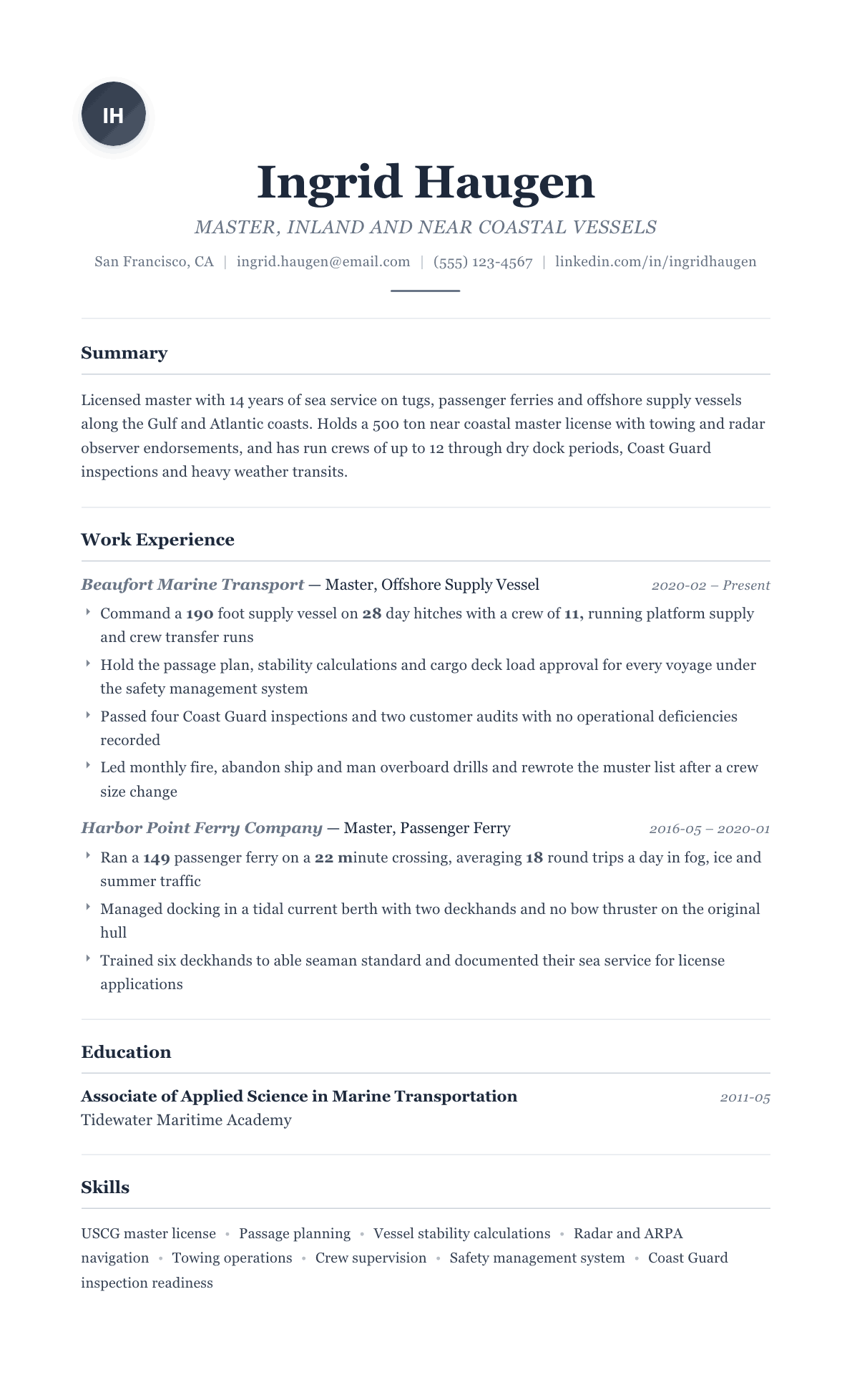
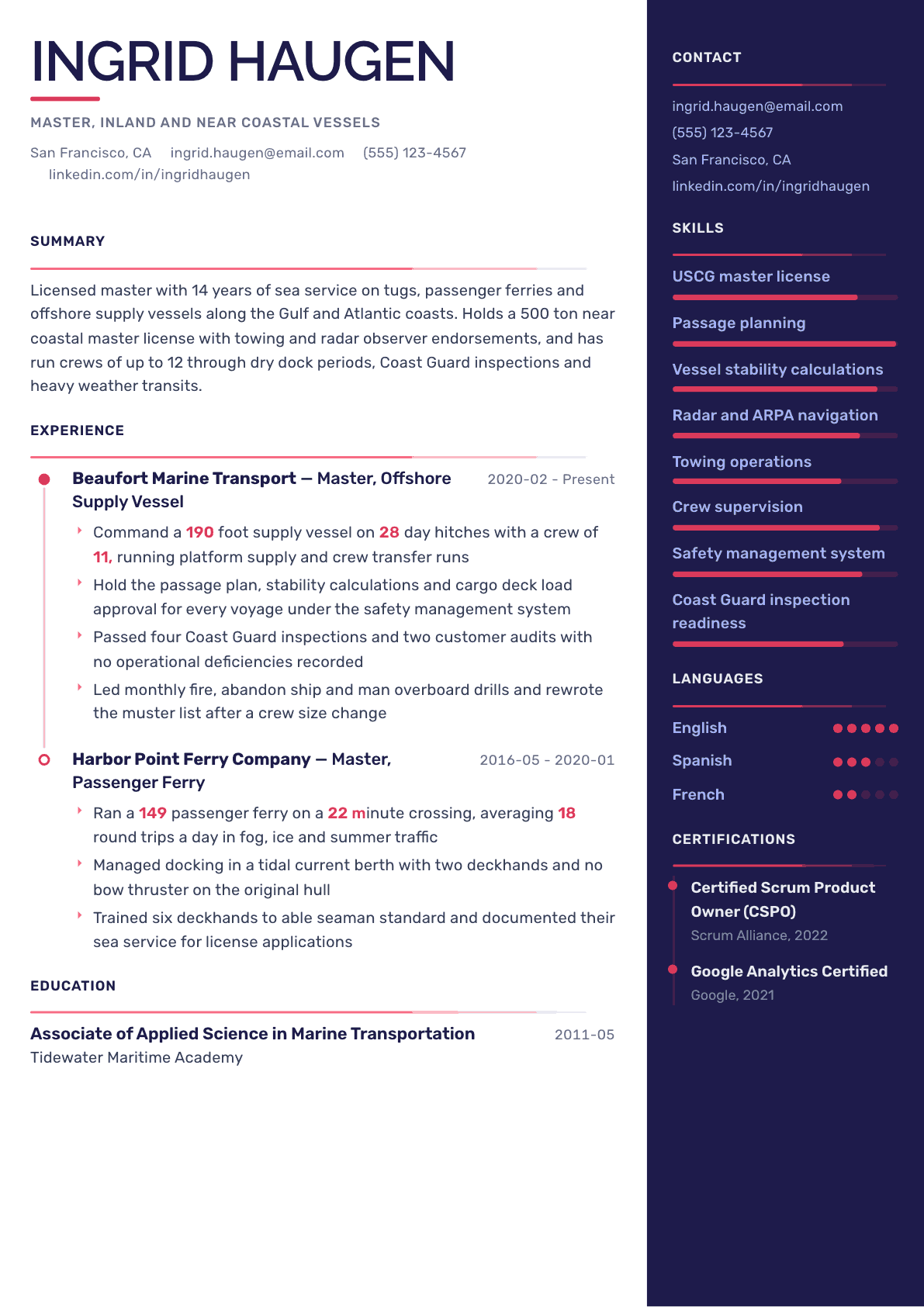
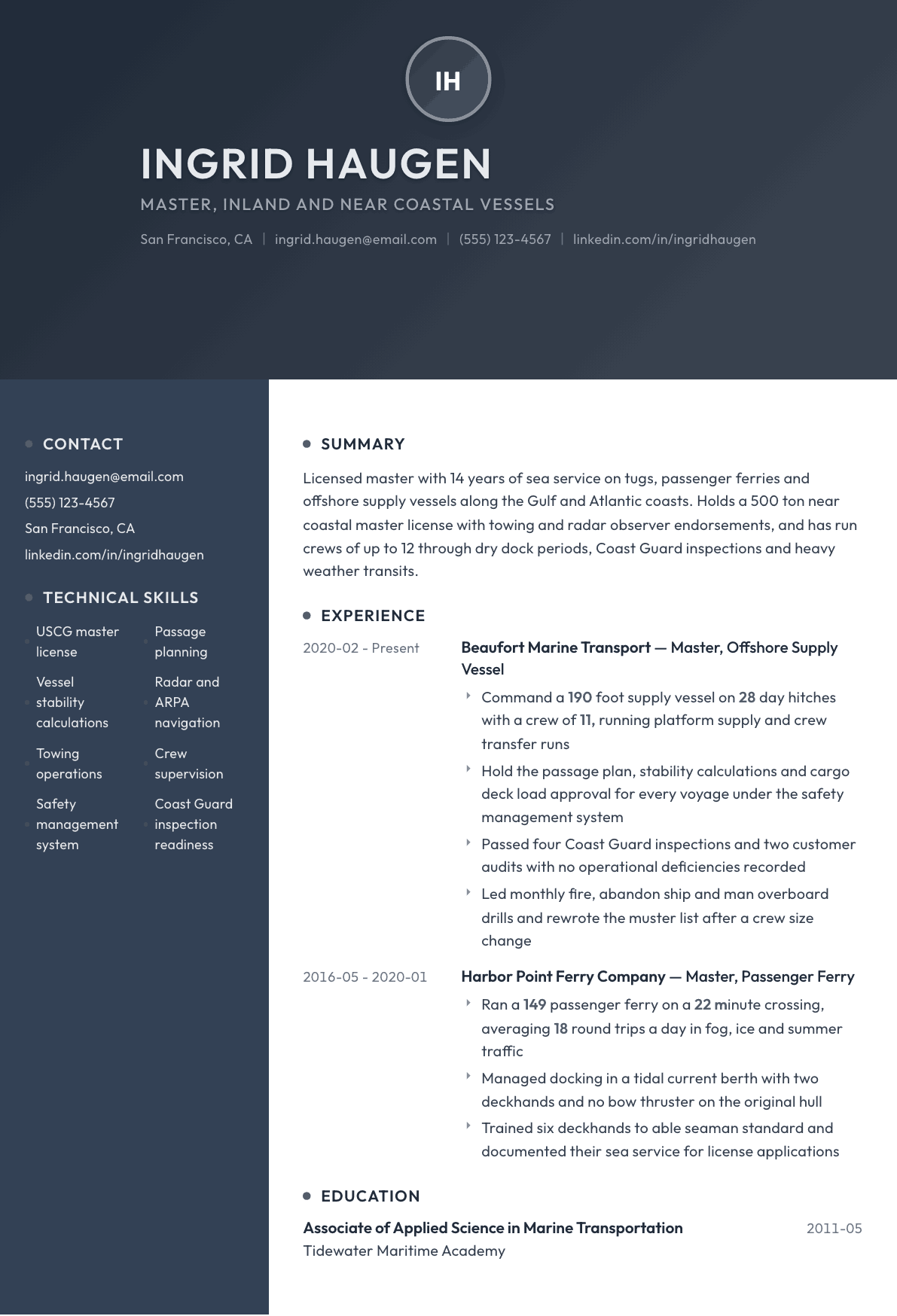
The same ship captain content laid out in three CVBooster templates, so you can see what the finished document looks like before you write a word.
Example Ship Captain summary
Licensed master with 14 years of documented sea service on offshore supply vessels, tugs and passenger ferries in Gulf and Atlantic waters. Holds a 500 ton near coastal master license with towing and radar observer endorsements and a current medical certificate. Commands crews of up to 12, owns the passage plan and stability calculations, and has cleared four Coast Guard inspections with no deficiencies.
Skills to list on a Ship Captain resume
- Master license and endorsements
- Passage and voyage planning
- Stability and load calculations
- Radar and ARPA plotting
- Electronic chart systems
- Towing and barge handling
- Docking and mooring operations
- Crew scheduling and supervision
- Safety management system compliance
- Coast Guard inspection preparation
- Emergency drills and muster
- Heavy weather decision making
- Bridge resource management
- Sea service documentation
What actually gets this resume read
- Put the license grade, tonnage limit, route and any towing endorsement in the header where a port captain sees it.
- List STCW endorsements, radar observer, medical certificate and TWIC card with the dates they expire.
- Give each vessel a line of specifications: length, tonnage, propulsion, crew size and the trade it operated in.
- Quantify sea time in days per year and name the waters, since inland, near coastal and oceans time are not equal.
- Show inspection and audit results plainly, because a clean record with the Coast Guard is a hiring signal.
- Describe drills, muster lists and safety management duties, not just navigation, since the master owns the whole system.
How to write a ship captain resume
A ship captain resume is checked against a license before it is read as a career story. The port captain or crewing manager opening it wants the grade of the master license, the tonnage limit, the route it covers, the endorsements attached to it and the expiry dates. If a vessel needs a master with towing on a near coastal route, everything else on the page is irrelevant until that line is confirmed.
Once the license clears, the reading changes completely. Now the question is whether you can run the whole vessel, not just the bridge: the crew, the safety management system, the drills, the maintenance plan, the customer or charterer relationship and the inspection record. Masters are hired for accountability, and the resumes that win are the ones that show a candidate who owned outcomes rather than watches.
This guide covers the license and document block, how to describe vessels and sea service, what a hiring office reads in an inspection record, the credentials worth listing, and the questions that come up when a mate moves into command or a master changes trade.
Format: license block, vessel history, then command detail
Two pages is normal for a master with a full career, one page for a newly licensed captain. Order it: header with license and documents, a vessel history block, employment entries with command responsibilities, training and endorsements, education.
Keep the page plain and printable. Crewing offices email these files around, print them for a port captain and staple them to a crew list, so a design heavy layout loses information the moment it leaves the screen.
- Header: name, location, phone, email, license grade and tonnage, route, towing endorsement, and the expiry month.
- Documents: Merchant Mariner Credential, STCW endorsements, medical certificate, TWIC card, passport, each with an expiry.
- Sea service: days per year by route, since inland, near coastal and oceans service upgrade a license differently.
Vessel history: specifications a port captain can picture
Give each vessel a specification line: length, gross tonnage, propulsion and horsepower, crew size, and the trade it worked. A 190 foot offshore supply vessel with a crew of eleven on 28 day hitches is a different command from a 149 passenger ferry on a 22 minute crossing, and a crewing manager makes an immediate judgment from those numbers.
Say what the vessel actually did. Platform supply, crew transfer, harbor ship assist, articulated tug and barge, dinner cruise, research charter, fishing. The trade determines the regulatory regime, the customer, the paperwork and the crew culture, so it belongs beside the specification rather than buried in a bullet.
Command experience: the whole vessel, not the wheelhouse
Write bullets around the things only the master owns. The passage plan and the stability calculation. The decision to sail, delay or shelter. The cargo deck load approval. The muster list and the drill schedule. The dry dock scope and the repair list. The relationship with the charterer when weather cost them a day.
Then show the record. Coast Guard inspections passed, customer or vetting audits cleared, deficiencies recorded and how they were closed, injury free days, and near miss reports raised into the safety management system. A master with a clean inspection history is buying the operator lower risk, and the resume should say so in numbers.
Include crew development. Deckhands trained to able seaman standard, sea service documented for their license applications, mates coached toward their own upgrade. Operators short of licensed people notice a captain who produces them.
- Name the safety management system and your role in audits, corrective actions and procedure revisions.
- Name the navigation equipment: electronic chart display, radar with automatic plotting, dynamic positioning if you hold it.
- Name the hard conditions: tidal berths without a bow thruster, ice, fog, restricted visibility traffic, heavy weather transits.
Endorsements, training and keeping the license alive
List STCW endorsements, radar observer, basic and advanced firefighting, medical care provider, ship security officer and any dynamic positioning or towing endorsement, each with the issuing school and the expiry. Renewals lapse quietly and a hiring office will not chase you for a certificate that has expired.
Add the assessments and refreshers you keep current, because many vessels cannot legally sail if a required certificate is out of date. A captain whose whole document folder is in date can join a vessel this month, and that is a hiring advantage worth putting on the page.
Ship Captain resume summary examples
Newly licensed master
Master of 100 ton near coastal vessels with seven years of sea service as mate and deckhand on passenger ferries and small tugs. Holds STCW basic training, radar observer and a current medical certificate, and has run relief captain trips on a 149 passenger vessel through a full summer season.
Working master
Licensed captain with 14 years of documented sea service on offshore supply vessels, tugs and ferries in Gulf and Atlantic waters. Holds a 500 ton near coastal master license with towing and radar observer endorsements, commands crews of up to 12, and has cleared four Coast Guard inspections with no deficiencies.
Senior master and port captain candidate
Senior master with 22 years at sea and an unlimited oceans license, most recently commanding articulated tug and barge units on coastwise petroleum trade. Has run three dry dock periods, chaired the fleet safety committee, and rewritten the company safety management system after a vetting audit.
Work experience bullets: before and after
Before: Captain of an offshore supply vessel.
After: Command a 190 foot offshore supply vessel on 28 day hitches with a crew of 11, running platform supply and crew transfer voyages on a fixed field rotation.
Length, hitch pattern, crew size and trade let a crewing manager place the command instantly.
Before: Responsible for vessel safety and compliance.
After: Passed four Coast Guard inspections and two customer vetting audits with no operational deficiencies recorded, and closed every observation before the vessel sailed.
Inspection counts and a clean outcome are the compliance evidence a port captain actually checks.
Before: Handled navigation and voyage planning.
After: Held the passage plan, stability calculation and cargo deck load approval for every voyage under the safety management system, with weather routing revisited at each watch change.
Naming the documents the master signs shows ownership rather than participation.
Before: Docked the vessel in difficult conditions.
After: Docked a passenger ferry in a tidal current berth with two deckhands and no bow thruster on the original hull, averaging 18 round trips a day through fog and ice seasons.
The equipment limitation and the trip volume prove boat handling under real constraint.
Before: Trained crew members.
After: Trained six deckhands to able seaman standard and documented their sea service so each could apply for a credential upgrade within the same year.
The outcome for the crew, not the act of training, is what an operator short of licensed people values.
Hard skills
- Master license and route endorsements
- Passage and voyage planning
- Vessel stability and load calculation
- Radar and automatic plotting navigation
- Electronic chart display operation
- Towing and barge handling
- Docking and mooring in current
- Safety management system compliance
- Coast Guard inspection preparation
- Emergency drill and muster management
- Dry dock scoping and repair oversight
- Sea service documentation for crew
Soft skills
- Command decision making
- Bridge resource management
- Crew discipline and welfare
- Charterer and customer communication
- Composure in heavy weather
- Mentoring mates toward upgrade
Certifications worth listing
- Merchant Mariner Credential, Master (United States Coast Guard)
- STCW Basic Training (United States Coast Guard)
- Radar Observer Endorsement (United States Coast Guard)
- Master of Towing Vessels Endorsement (United States Coast Guard)
- Transportation Worker Identification Credential (Transportation Security Administration)
- Ship Security Officer (United States Coast Guard)
Mistakes that cost ship captain candidates the interview
- Writing captain with no license grade, tonnage or route, which makes the file unusable to a crewing office.
- Leaving expiry dates off the credential block, so a hiring manager cannot tell whether you could join a vessel this month.
- Describing vessels by name only, when a port captain needs length, tonnage, propulsion and crew size.
- Listing watchkeeping duties that a mate performs instead of the decisions and documents a master signs.
- Omitting the inspection and audit record, which is the closest thing the industry has to a performance review.
- Merging inland, near coastal and oceans sea service into one number when they carry different upgrade value.
- Ignoring the shoreside work, such as dry dock oversight and safety management revisions, that qualifies a master for a port captain role.
Ship Captain resume questions
What license details belong at the top of a ship captain resume?
The license grade, the tonnage limit, the route, every endorsement such as towing or radar observer, and the expiry month. A crewing office matches those four items against the vessel before reading anything else on the page.
How do I document sea service on a resume?
Give days of service per year by route and vessel type, matching what your sea service letters say. Never estimate upward, because the Coast Guard and the hiring office both work from the signed letters and any mismatch stops the file.
How does a chief mate write a resume when applying for a first command?
Lead with the license that authorizes command, then show relief captain trips, watches stood in charge, cargo and stability work you owned, and drills you led. Make it easy to see that you have already been doing the job without the title.
Should I list vessels I served on years ago?
Keep anything that adds a trade, a tonnage class or a route you do not otherwise show, and compress the rest into one early career line. A varied vessel history is an asset, but it should not crowd out the last decade of command.
What does a hiring office look for besides the license?
A clean inspection and audit record, no reportable incidents, a full and current document folder, evidence you ran drills and closed corrective actions, and proof you retained and developed crew. Those are the risks an operator is buying down when hiring a master.
Related resume examples
- Deckhand Resume example
- Harbor Pilot Resume example
- Marine Engineer Resume example
- Logistics Manager Resume example
- Fleet Manager Resume example
- Drone Pilot Resume example