Marine Engineer Resume Examples: the lines they read
Navigate Your Marine Engineer Resume to Shore Up Interviews
By Mustafa Tarabya, founder of CVBooster · Published · Updated
Create a marine engineer resume showcasing naval architecture, propulsion systems, and maritime regulatory expertise with industry-standard formatting.
Sample resumes for a marine engineer
The same marine engineer content laid out in three CVBooster templates, so you can see what the finished document looks like before you write a word.
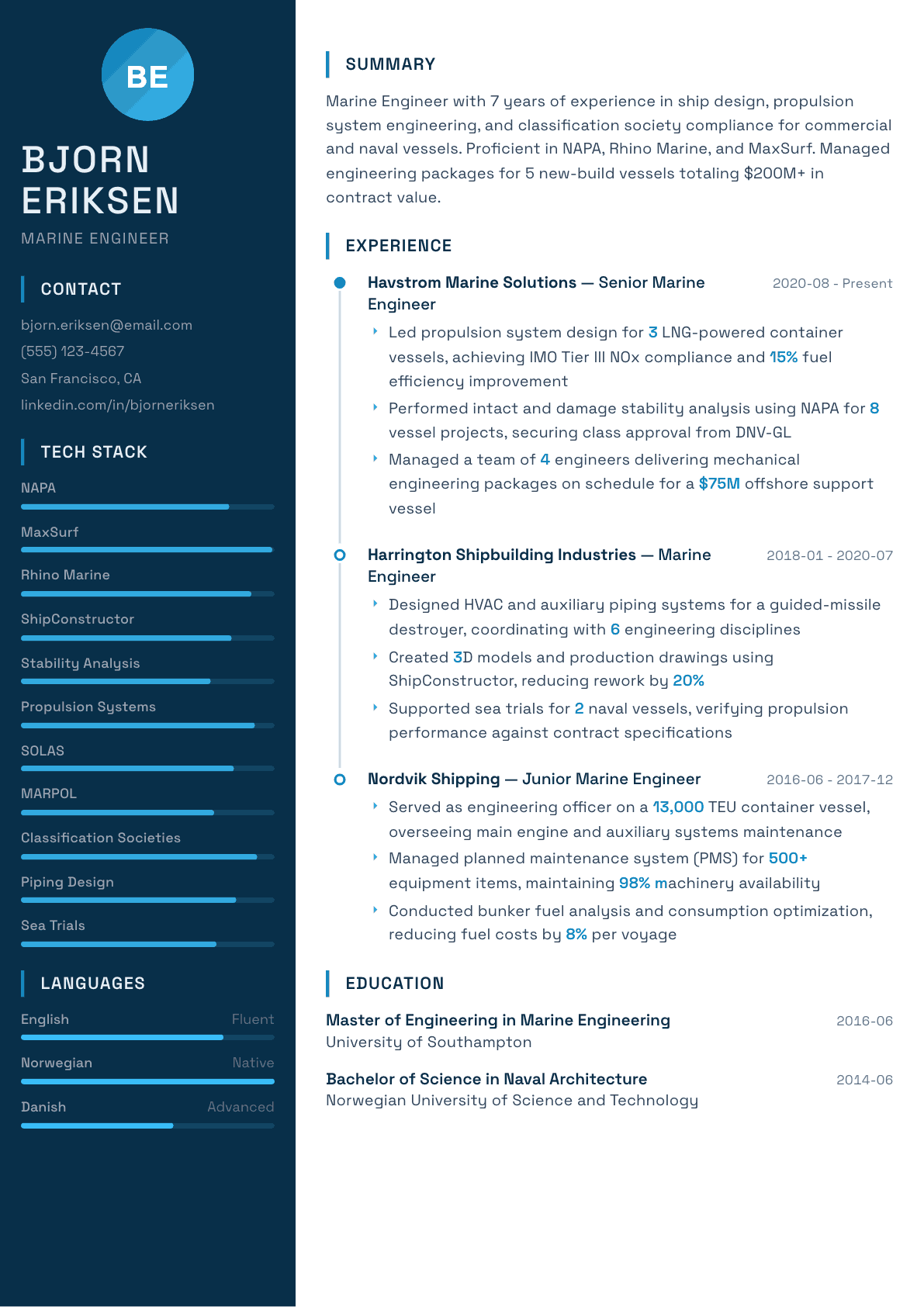
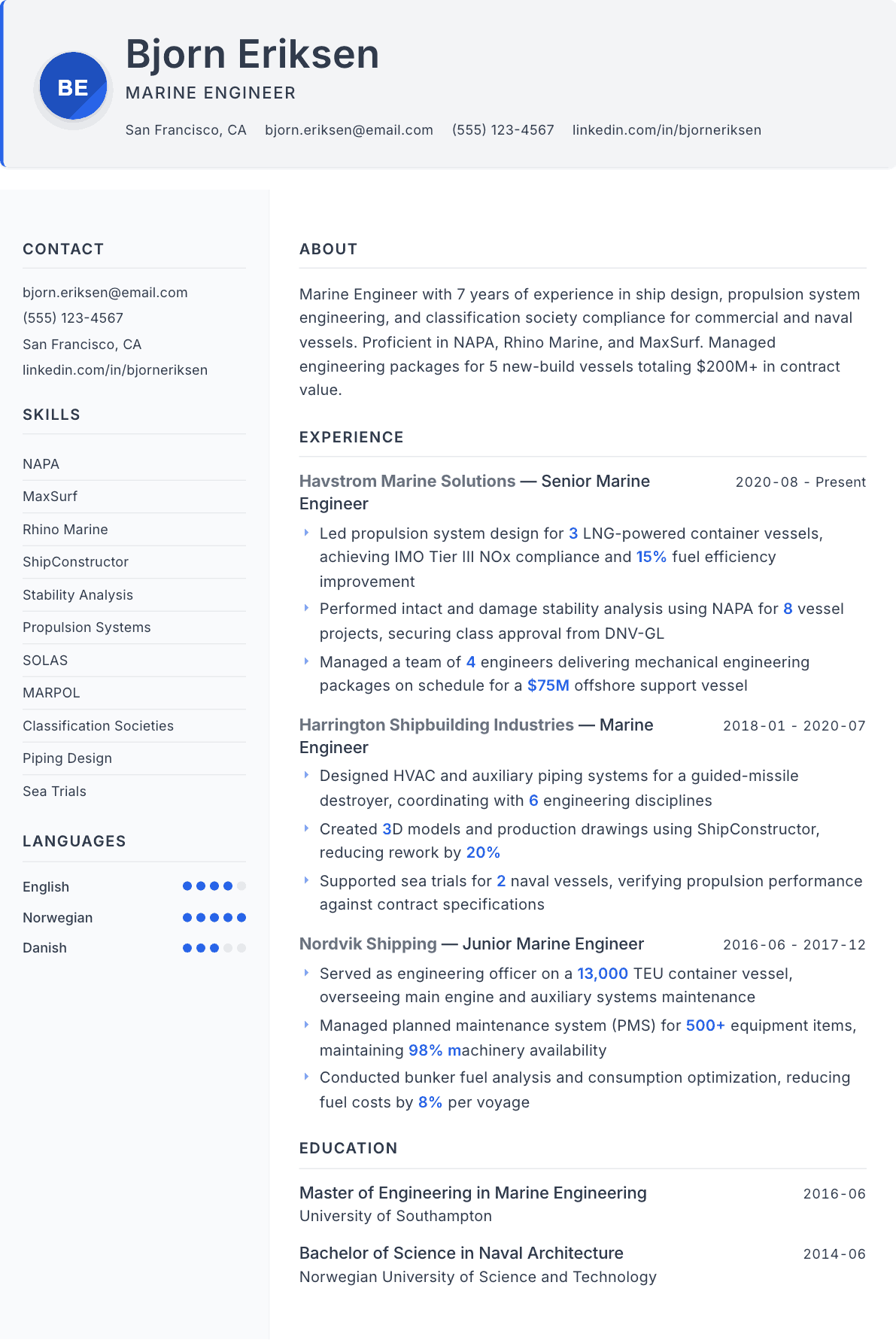
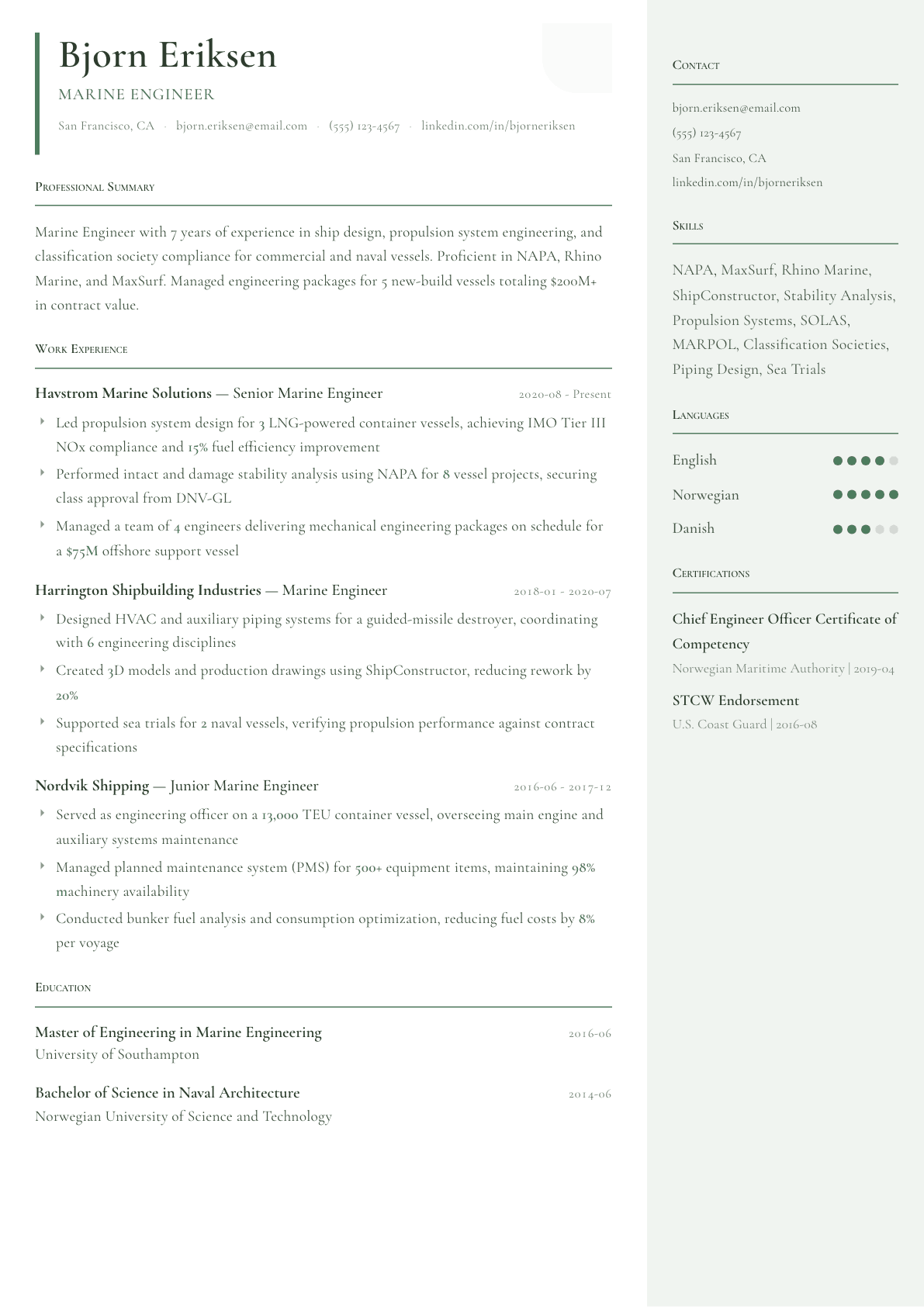
Example Marine Engineer summary
Marine Engineer with 7 years of experience in ship design, propulsion engineering, and regulatory compliance. Expert in NAPA, MaxSurf, and classification society requirements with both sea-going and shore-based experience. Managed engineering packages for 5 new-build vessels worth $200M+ with on-time delivery.
Skills to list on a Marine Engineer resume
- NAPA
- MaxSurf
- ShipConstructor
- Rhino Marine
- Stability Analysis
- Propulsion Systems
- SOLAS
- MARPOL
- Classification Society Rules
- Piping Design
- HVAC Systems
- Structural Analysis
- Sea Trials
- Planned Maintenance System
- Naval Architecture
What actually gets this resume read
- Highlight marine design software: NAPA, MaxSurf, Rhino Marine, ShipConstructor, AutoCAD Marine.
- Reference maritime regulations: SOLAS, MARPOL, ISM Code, classification society rules (DNV, ABS, Lloyds).
- Include vessel types: container ships, tankers, offshore platforms, naval vessels, yachts.
- Quantify fleet management or project outcomes: vessel count, contract values, fuel savings.
- Mention sea-going experience and certificates of competency (STCW, CoC).
- Describe systems expertise: propulsion, HVAC, ballast, piping, electrical distribution.
How to write a marine engineer resume
Marine engineer covers two careers that share a name. One is the sailing engineer who stands watch in an engine room, holds a certificate of competency, and keeps main propulsion and auxiliaries running at sea. The other is the shoreside engineer who designs vessels and their systems, works to classification society rules, and delivers drawing packages for new builds and conversions. A resume that does not make clear which one you are gets set aside by both kinds of employer.
Once that is settled, the reader is checking a short list: your licenses and endorsements, the vessel types and tonnage or power ratings you have worked with, the systems you own, and the regulatory regime you operate under. Marine hiring is heavily credential driven because flag state and class requirements are not negotiable.
This guide covers how to structure a sea going or a design resume, how to present vessel and machinery experience so a superintendent can size it up, summaries at three career stages, and the questions engineers ask when moving from ship to shore or between commercial, offshore and naval work.
Format: credentials first, then vessels or projects
Use a single column reverse chronological layout with a licenses and certificates block immediately under the summary. For a sea going engineer this block is the resume: the certificate of competency and its grade, the flag state or issuing authority, the propulsion and tonnage limitations, and the basic safety and advanced training endorsements with expiry dates.
For a shoreside marine engineer the equivalent block is projects. List new builds, conversions and repair packages with vessel type, principal dimensions or capacity, the yard, and the classification society. A naval architecture or engineering manager reads that list before the bullets.
- Header: name, city and country, phone, email, nationality or right to work if you sail internationally.
- Sea going order: summary, licenses and endorsements, sea service record, machinery experience, education, training courses.
- Shoreside order: summary, software and technical skills, projects, experience, education, professional registration.
Summary: which side of the industry, which vessels, which systems
Open by naming the segment and the hardware. Container and bulk carriers, tankers with their cargo specific training, offshore support and drilling units, cruise and ferry operations, naval surface combatants, and workboats each have their own culture and machinery. A superintendent hiring for chemical tankers reads a chemical tanker background very differently from a ferry background.
Then name your systems. Medium speed and slow speed diesel main engines, dual fuel and gas engines, steam plant, diesel electric propulsion, controllable pitch systems, auxiliary boilers, purifiers, refrigeration, ballast water treatment and exhaust gas cleaning. On the design side, name your discipline: propulsion and shafting, machinery arrangement, piping and heating and ventilating systems, structural or stability work.
Sea service and machinery experience: rank, vessel, plant, availability
Every sea going entry needs the rank held, the vessel type and size, the main engine make and output, the trading area and the sea time completed. Ranks and vessel particulars are the industry currency for experience, and leaving them out forces the crewing manager to write and ask.
Describe what you kept running and how well. Overhauls performed and their scope, unplanned stoppages avoided, planned maintenance completed against schedule, machinery availability, fuel consumption managed, and any dry dock or survey you prepared for. Emissions and fuel handling work deserves its own bullet given how much of the modern job is compliance with sulphur and nitrogen oxide limits.
For shoreside roles, describe the deliverable rather than the watch. A calculation set, a system diagram, a machinery arrangement, a stability booklet, a piping isometric package, or a factory acceptance test protocol. Say which classification society approved it and whether it went through first submission or a comment cycle, because approval efficiency is a real measure of a design engineer.
Regulation, class and the words screeners look for
Name the frameworks you have actually worked to rather than reciting an alphabet. The international convention for safety of life at sea, the marine pollution convention and its emission annexes, the international safety management code and the ballast water management convention are the ones that recur in postings, alongside the classification society rules of whichever society approved your vessels.
For a licensed engineer, the training convention for seafarers and its associated courses form the keyword set. State the endorsements: basic safety training, advanced firefighting, medical care, engine room resource management, high voltage where held, and tanker familiarization or advanced tanker training where relevant.
Software, education and moving ashore
Shoreside marine engineering runs on named packages, so list them: naval architecture and stability software, three dimensional ship modeling, general computer aided design, finite element analysis if you do structural work, and thermal or piping calculation tools. Add the planned maintenance and procurement systems you have used at sea, since operators and technical managers value that continuity when hiring a superintendent.
A degree in marine engineering, naval architecture or mechanical engineering, or a maritime academy license program, goes below experience once you are established. If you are moving from sea to a technical superintendent or design role, use the summary to say so plainly and lead each vessel entry with the systems knowledge and the survey and dry dock experience that a shore team needs.
Marine Engineer resume summary examples
Cadet to third engineer
Marine engineering graduate and newly licensed third engineer with 12 months of cadet sea time on a container vessel and a product tanker. Stood engine room watches, assisted purifier and auxiliary engine overhauls, and logged all planned maintenance tasks. Holds basic safety training and advanced firefighting endorsements.
Second engineer
Second engineer with seven years at sea on handysize bulk carriers and offshore support vessels, running slow speed and medium speed diesel plant. Led three main engine unit overhauls and prepared two vessels for intermediate survey with no outstanding conditions. Maintained machinery availability above 98% across the last two contracts.
Shoreside design lead
Senior marine engineer with 12 years in machinery and propulsion design for commercial new builds. Led engineering packages for 5 vessels including two dual fuel container ships, secured classification approval for machinery and piping systems, and manages a discipline team of four engineers and two draftsmen.
Work experience bullets: before and after
Before: Responsible for engine room maintenance and watchkeeping.
After: Stood unmanned machinery space watches on a bulk carrier with a slow speed main engine of about 9 megawatts, and owned the maintenance of purifiers, air compressors and the fresh water generator.
Vessel type, plant rating and the named auxiliaries let a superintendent match your experience to their fleet.
Before: Carried out repairs during dry dock.
After: Prepared the machinery work list for a scheduled dry dock, supervised tailshaft withdrawal and stern tube seal renewal with the yard, and closed the docking with no outstanding class conditions.
Naming the docking scope and the clean class outcome demonstrates project ownership rather than attendance.
Before: Worked on ship design projects.
After: Produced the machinery arrangement, shafting alignment calculation and piping diagrams for a 90 metre offshore support vessel, and cleared classification society review with one comment round.
Listing the actual deliverables and the approval cycle shows exactly what a design manager would be buying.
Before: Managed fuel consumption on board.
After: Tracked daily consumption against the vessel performance model, corrected a fouled turbocharger and adjusted trim guidance with the master, cutting main engine fuel use by about 6% over the voyage.
The diagnosis, the two corrective actions and the measured result turn a routine duty into an engineering win.
Before: Ensured compliance with maritime regulations.
After: Implemented the ballast water treatment system operating procedures and crew training on two vessels, and passed port state control inspection in three jurisdictions with no deficiencies raised.
A named system, the training you delivered and inspection outcomes make compliance verifiable.
Hard skills
- Diesel main engine operation and overhaul
- Auxiliary machinery and purifier maintenance
- Planned maintenance system administration
- Propulsion and shafting design
- Intact and damage stability analysis
- Piping and machinery arrangement drawings
- Classification society rule application
- Boiler and steam plant operation
- Electrical and high voltage systems
- Fuel and lubricating oil analysis
- Dry dock and survey preparation
- Ballast water and exhaust gas cleaning systems
- Naval architecture and ship modeling software
- Factory and sea trial testing
Soft skills
- Watchkeeping discipline
- Multinational crew leadership
- Calm fault diagnosis at sea
- Handover and log discipline
- Working with yards and vendors
- Long contract endurance
Certifications worth listing
- Certificate of Competency, Engineer Officer (Flag state maritime administration under the STCW Convention)
- Merchant Mariner Credential with Engineer Officer endorsement (United States Coast Guard National Maritime Center)
- STCW Basic Safety Training (Approved maritime training center)
- Advanced Firefighting (Approved maritime training center under STCW)
- Engine Room Resource Management (Approved maritime training center under STCW)
- Chartered Engineer (Engineering Council through the Institute of Marine Engineering, Science and Technology)
- Professional Engineer, Mechanical (State licensing board, NCEES examination)
Mistakes that cost marine engineer candidates the interview
- Not stating whether you are a licensed sea going engineer or a shoreside design engineer, which leaves both types of employer unsure what they are reading.
- Omitting vessel particulars. Type, size and main engine output are how the industry compares experience, and a resume without them cannot be evaluated.
- Listing certificates without issuing authority, limitations or expiry, which forces a crewing manager to chase documents before they can shortlist you.
- Describing watchkeeping duties that are identical for every engineer instead of the overhauls, breakdowns and surveys you personally handled.
- Ignoring emissions and environmental systems, which now dominate technical questions in interviews for both sea and shore roles.
- Applying to a shore role with a pure sea service list. Translate watch and maintenance work into budget, planning, vendor and survey language that a technical superintendent recognizes.
Marine Engineer resume questions
How do I list sea service on a marine engineer resume?
Give each contract the rank, the vessel name or type, gross tonnage or length, main engine make and output, the trading area and the months served. Crewing departments verify sea time against a discharge book, so keep the resume consistent with the record.
How do I move from sailing to a shore-based marine engineering job?
State the move in your summary and rewrite the sea entries around what a shore team buys: dry dock and survey preparation, spare parts and budget control, vendor management, troubleshooting reports and compliance. Add the maintenance and procurement software you administered on board.
Which certificates matter most for a marine engineer?
The certificate of competency and its grade come first, with the issuing authority and any propulsion power limitation. After that, the mandatory safety endorsements and any vessel specific training such as tanker, gas carrier, high voltage or dynamic positioning that the posting names.
Do marine engineers need a professional engineering license?
Sea going engineers do not, since the certificate of competency is the operative license. Shoreside design work occasionally asks for professional registration or chartered status, particularly for consultancy, survey or government work, so list it when you hold it.
What software should a shoreside marine engineer list?
Name the naval architecture and stability packages, the ship structural modeling tool used by your yard, general computer aided design, and any finite element or thermal analysis software you run. Adding the classification society rule tools you have worked with is a useful extra signal.
Related resume examples
- Mechanical Engineer Resume example
- Structural Engineer Resume example
- Petroleum Engineer Resume example
- Naval Architect Resume example
- Aerospace Engineer Resume example
- Agricultural Engineer Resume example