Warehouse Worker Resume Examples: the lines they read
Warehouse Worker Resume Samples With Rates, Equipment and Shifts
By Mustafa Tarabya, founder of CVBooster · Published · Updated
Warehouse worker resume samples: a complete sample resume for warehouse jobs, plus summaries and bullets with pick rates, forklift classes and WMS names.
Sample resumes for a warehouse worker
The same warehouse worker content laid out in three CVBooster templates, so you can see what the finished document looks like before you write a word.
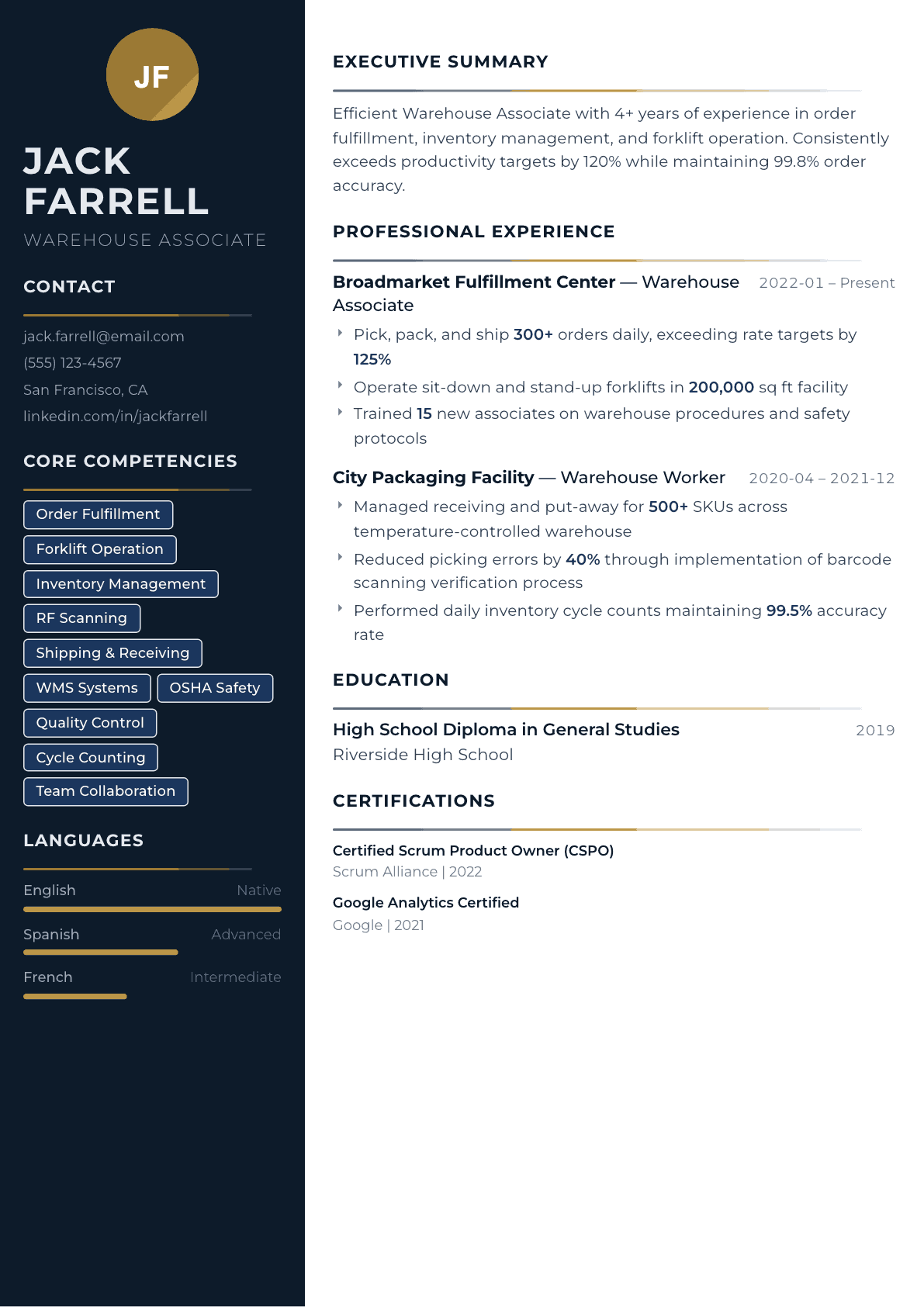
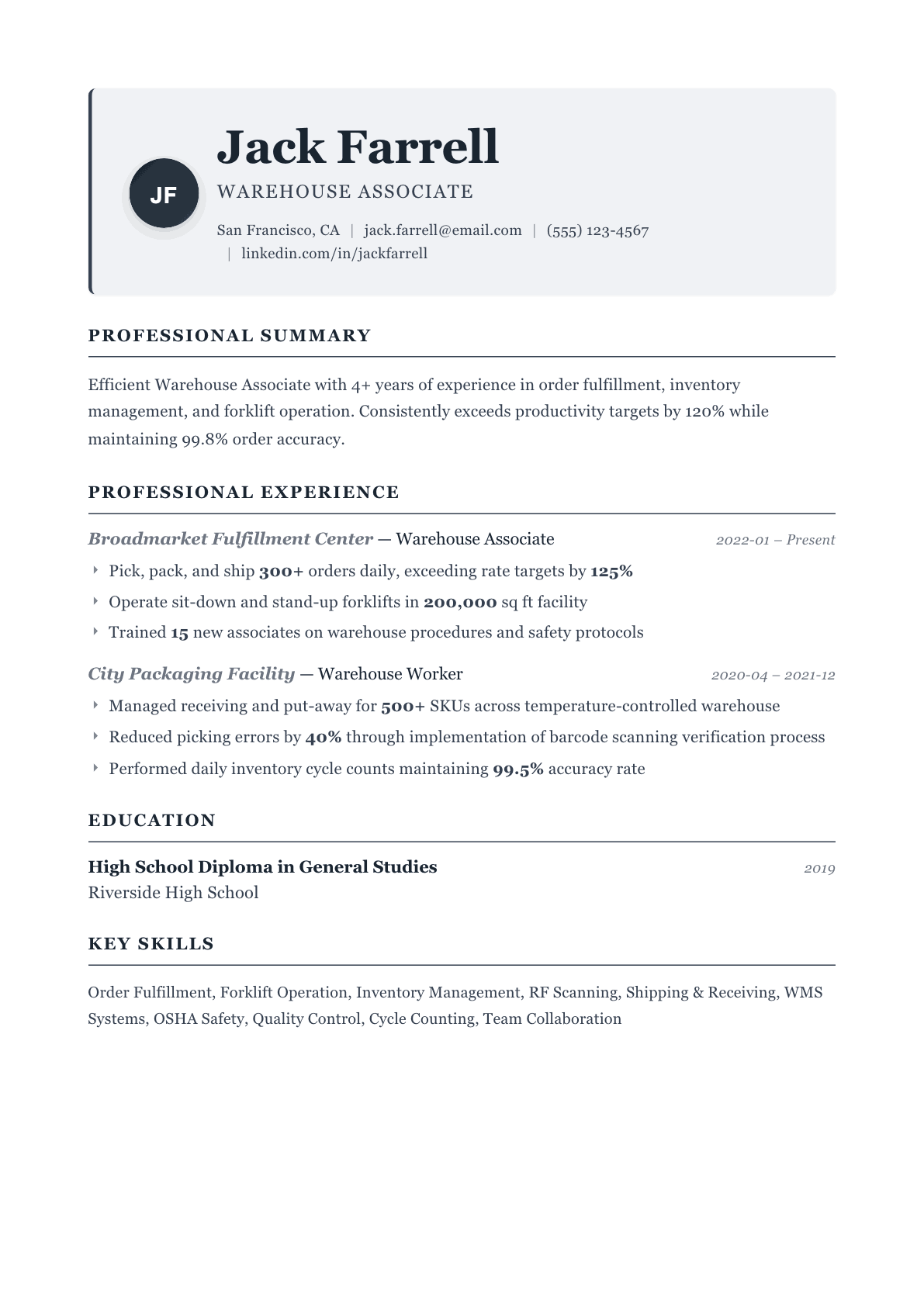
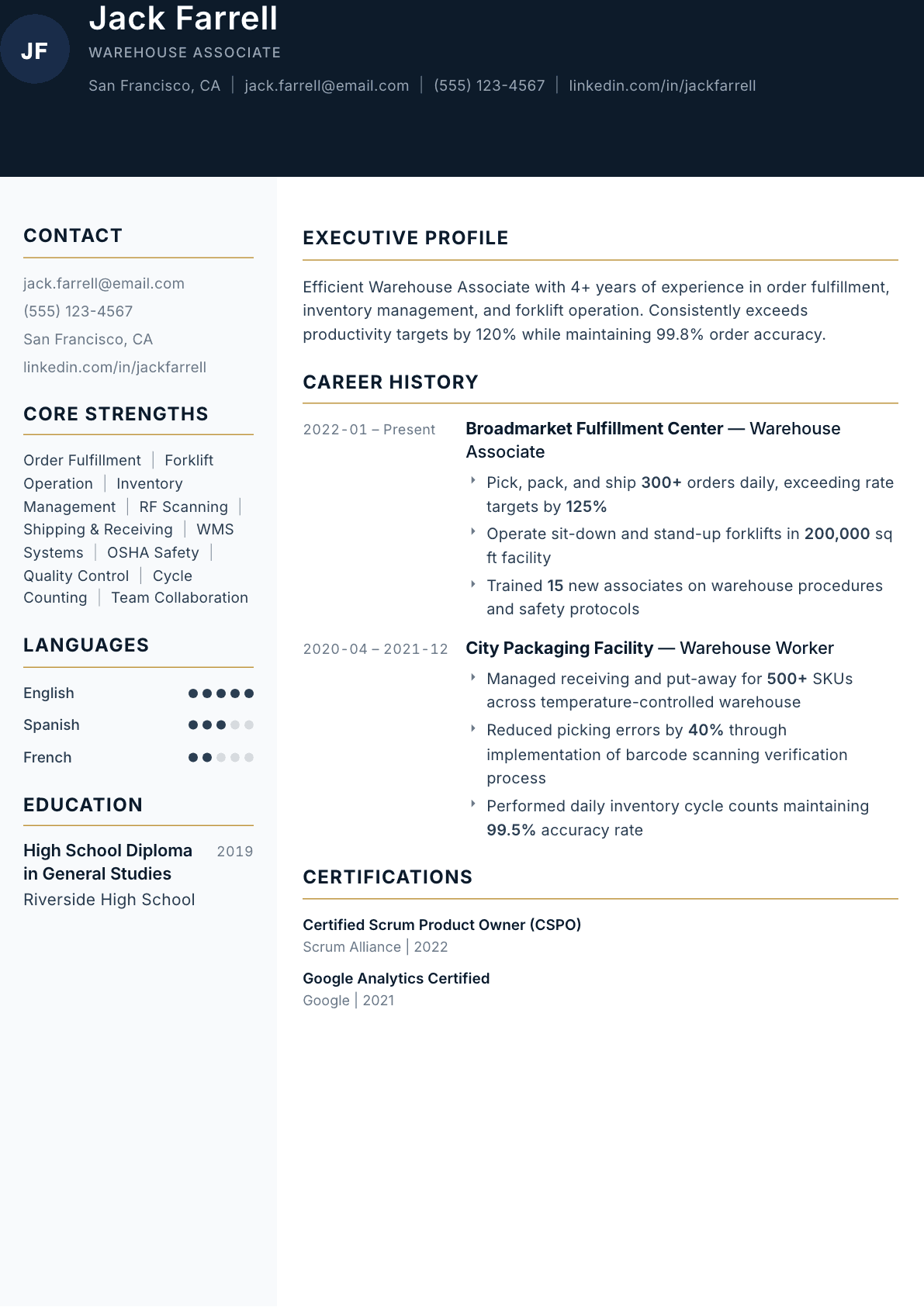
Example Warehouse Worker summary
Warehouse associate, 4 years, picking and packing 300 orders a day at 125% of rate and 99.8% accuracy. Certified on sit-down and stand-up forklifts, cut picking errors 40% by pushing barcode verification at the pack station, and has trained 15 new associates.
Skills to list on a Warehouse Worker resume
- Order Fulfillment
- Forklift Operation
- Inventory Management
- RF Scanning
- Shipping & Receiving
- WMS Systems
- OSHA Safety
- Quality Control
- Cycle Counting
- Team Collaboration
What actually gets this resume read
- Highlight productivity metrics: orders per hour, accuracy rates.
- List forklift certifications and equipment types operated.
- Include warehouse management systems (WMS) experience.
- Show safety compliance and zero-incident records.
- Mention any leadership roles: training, shift lead, team captain.
How to write a warehouse worker resume
Warehouse hiring runs on throughput and safety, and a warehouse worker resume that ignores both will lose to one that quantifies them. An operations supervisor reads for units picked per hour, order accuracy, equipment you are certified on, and whether you have worked in a building anything like theirs. Those four answers decide the interview.
Building type matters more than candidates expect. A parcel sortation hub, a grocery cold storage facility, a third party logistics site running multiple clients and a manufacturing stockroom all use the word warehouse and demand different habits. Naming yours, with the square footage, the shift pattern and the volume, tells a supervisor how much training you will need.
This guide covers the layout that survives a high volume screen, how to write bullets with real productivity numbers, the equipment and system detail that gets you shortlisted, sample summaries from a first warehouse job to a shift lead, and the questions warehouse workers ask when they want to move up.
Format: one page, metrics and equipment visible immediately
One page, reverse-chronological, no exceptions until you are supervising. Warehouse recruiters work through large stacks quickly, so the top third of your resume must carry the function you perform, the equipment you operate and one productivity number.
Keep it plain. Distribution employers use applicant tracking systems that filter on words like forklift, reach truck, cherry picker, RF scanner and the name of the warehouse management system, and a decorative template is the most common reason those words fail to register.
- Header: name, city and state, phone, email, and the shift you are available for.
- Order: summary, equipment and certifications, experience, systems, education or training.
- Say plainly whether you can work nights, weekends or a compressed schedule, because shift availability decides many of these hires.
Summary: function, environment, rate, equipment
Name the function you perform: picking, packing, receiving, put-away, replenishment, loading, cycle counting or a combination. Then the environment, including ambient, refrigerated or frozen, and the building size or volume. Then your rate and your accuracy. Then the equipment you are certified to run.
Cold storage, hazardous materials handling and high bay reach truck work are all worth stating in the summary, because they narrow the candidate pool sharply and a supervisor filtering for them will not read to the second job to find out.
Experience: rate, accuracy, safety, and what you were trusted with
Lead each role with the numbers the building measured you on. Lines or units picked per hour against the standard, order accuracy, cases loaded per shift, receipts processed, cycle count variance. If you do not remember exact figures, use the range your supervisor quoted in reviews rather than inventing a precise number you cannot defend.
Then show what you were trusted with beyond the base task. Training new hires, running a pick zone, handling problem orders, operating multiple equipment types, working returns or damaged goods, and covering receiving when the shift ran short. Those lines are what move you from picker to lead.
Add the safety record with substance: consecutive incident-free time, participation in safety walks or committee work, correct lockout and pallet stacking practice, and any near miss reporting. Warehouses carry real injury cost, and a worker who talks about safety in specifics is a lower risk hire.
Equipment and systems: exact names, exact certification
List each powered industrial truck class you are trained on separately: sit-down counterbalance, stand-up reach truck, order picker or cherry picker, pallet jack, walkie rider, turret truck and clamp attachment. Say who trained and evaluated you, since powered industrial truck certification is employer-specific and a new employer must evaluate you again.
Name the warehouse management system, such as Manhattan, Blue Yonder, HighJump, SAP Extended Warehouse Management or a client-specific tool, plus the handheld or voice picking technology you used. A worker who already knows the system and the voice headset ramps up in days rather than weeks.
Words the posting will scan for
Warehouse postings reuse the same terms: order picking, packing, receiving, put-away, replenishment, cycle counting, inventory accuracy, RF scanning, pallet jack, forklift certification, loading and unloading, safety compliance, standard work and productivity standards. Put the true ones in your experience section rather than in an isolated keyword block at the bottom, since a human supervisor reads the page next.
Sample resume for warehouse jobs: a complete one, section by section
A sample resume for warehouse work is only useful if every line in it carries a number, a piece of equipment or a system name, because that is what a shift supervisor scans for. The complete sample below is for a warehouse worker with three years in an ambient distribution center, written top to bottom in the order a recruiter reads it. Swap in your own building, rate and equipment.
Date your forklift line. The OSHA standard for powered industrial trucks says: "An evaluation of each powered industrial truck operator's performance shall be conducted at least once every three years." A supervisor who sees the month and year of your last evaluation knows at once whether you are current.
- Header: Marcus Hill, Memphis, TN 38118, (901) 555-0142, marcus.hill@email.com. Available for nights and weekend overtime.
- Summary: Warehouse worker with three years in a 600 thousand square foot ambient distribution center, picking, packing and loading retail store orders. Averages 165 cases an hour against a standard of 150, with pick accuracy above the site target every month of the last year. Trained and evaluated on sit-down forklift, reach truck and electric pallet jack.
- Equipment and certifications: Sit-down counterbalance forklift and stand-up reach truck, employer training and evaluation completed in March of this year. Electric pallet jack and walkie rider. OSHA 10 hour General Industry card.
- Experience, current role: Warehouse Associate, regional grocery distribution center, Memphis, TN, three years, current role. Pick full case orders on voice picking for 14 store routes a night. Load trailers to the load plan with zero damage claims in the last twelve months. Cover receiving and put-away when the inbound shift runs short.
- Experience, earlier role: Seasonal Package Handler, parcel sortation hub, Memphis, TN, one peak season before that. Scanned and sorted around twelve hundred packages an hour on the outbound belt during peak.
- Systems: Manhattan WMS, Zebra RF scanners, voice picking headset, cycle count tasks on the handheld.
- Education and training: High school diploma. Forklift safety refresher completed this year.
Warehouse Worker resume summary examples
First warehouse job
Warehouse associate with 10 months in a 200 thousand square foot ambient distribution center, picking and packing e-commerce orders on an RF scanner. Averages 90 units per hour against a standard of 80, trained on electric pallet jack, and available for nights and weekends.
Four years in
Warehouse worker with four years across receiving, put-away and order selection in a refrigerated grocery facility. Certified on sit-down forklift, stand-up reach truck and order picker, holds 99.8% pick accuracy, and has trained 12 new associates on RF scanning and safe stacking.
Shift lead
Warehouse shift lead with eight years, running a 14 person outbound team across two pick zones on nights. Balances labor against wave volume in the warehouse management system, holds the zone above standard, and has kept the shift incident free for two consecutive years.
Work experience bullets: before and after
Before: Picked and packed orders in the warehouse.
After: Picked 90 units per hour against an 80 unit standard on RF scanner across three pick zones, packing and labeling e-commerce orders for same day cutoff.
A rate against the published standard is the single most useful number a warehouse supervisor can read.
Before: Operated a forklift safely.
After: Operated sit-down counterbalance forklift and stand-up reach truck to put away pallets at 30 foot high bay racking, with no damage claims across four years.
Naming the equipment classes, the rack height and a damage record proves certification rather than claiming it.
Before: Helped keep inventory accurate.
After: Ran daily cycle counts on 60 locations, researched variances against the warehouse management system, and corrected the put-away errors causing repeat mismatches.
Counting is a task; finding and fixing the cause of the variance is the part worth hiring.
Before: Trained new employees on warehouse procedures.
After: Trained 12 new associates on RF scanning, pick path discipline and safe pallet stacking, taking them to standard rate within their first three weeks.
Trainee count plus a time to standard turns a mentoring claim into a measurable contribution.
Before: Followed all safety rules.
After: Completed two years with no recordable incidents, participated in weekly safety walks, and reported three near misses that led to aisle marking changes.
Incident-free time and near miss reporting show a safety culture participant, not a rule follower.
Hard skills
- Order picking and packing
- Receiving and put-away
- Sit-down and stand-up forklift operation
- Order picker and reach truck
- Electric pallet jack and walkie rider
- RF scanning and voice picking
- Warehouse management systems
- Cycle counting and inventory accuracy
- Loading and unloading trailers
- Pallet building and load stability
- Returns and damaged goods processing
- OSHA safety practices
Soft skills
- Physical stamina across a full shift
- Consistency under rate pressure
- Attention to label and location detail
- Teamwork across zones
- Reliability and attendance
- Willingness to cross train
Certifications worth listing
- Powered Industrial Truck Operator Certification (Employer evaluation under the OSHA powered industrial truck standard)
- OSHA 10-Hour General Industry (OSHA Training Institute authorized trainer)
- Certified Logistics Associate (CLA) (Manufacturing Skill Standards Council)
- Certified Logistics Technician (CLT) (Manufacturing Skill Standards Council)
- First Aid and CPR (American Red Cross)
Mistakes that cost warehouse worker candidates the interview
- Writing the resume with no rate or accuracy figure, which makes you indistinguishable from every other applicant.
- Saying forklift certified without naming the equipment classes and who evaluated you.
- Leaving out the building type and environment, so a supervisor cannot tell cold storage experience from a small stockroom.
- Omitting shift availability when the shift is often the reason the position is open.
- Listing the warehouse management system as a generic term instead of naming the platform you used every day.
- Ignoring the trusted extras such as training, zone coverage and problem orders, which are the evidence for a lead role.
Warehouse Worker resume questions
What if I do not know my pick rate?
Use the range your supervisor gave in reviews or the standard your building set, and say you consistently met or exceeded it. Never invent a precise figure, because interviewers in this field regularly ask how the rate was measured and against what standard.
Does forklift certification transfer between employers?
The training knowledge transfers but the certification does not, because each employer must evaluate operators on their own equipment and site. List your training and evaluation history anyway, since it means the new employer only has to evaluate rather than train you from scratch.
How do I move from picker to warehouse lead?
Show the supervisory work you already do: training new hires, covering a zone, balancing labor when the shift runs short, and resolving problem orders. Then add any system access beyond picking, such as running reports or releasing waves in the warehouse management system.
Should I list temporary agency assignments?
Yes, with the agency and the client site named. Agency work is normal in distribution and hiding it creates gaps that look worse than the assignments do. Group short assignments under one agency heading to keep the page readable.
Where can I find a sample resume for a warehouse job?
This page has a complete warehouse worker sample above, plus summaries and bullets for first jobs, experienced associates and leads. Use the sample for its order and its numbers: function, building, rate, accuracy, equipment with evaluation dates and the system you used. Then replace every figure with your own, kept to one page.
Related resume examples
- Truck Driver Resume example
- Logistics Coordinator Resume example
- Store Manager Resume example
- Baggage Handler Resume example
- Warehouse Lead Resume example
- Receiving Clerk Resume example