Harbor Pilot Resume Examples: free ATS score and gap list
Navigate Your Career with a Harbor Pilot Resume
By Mustafa Tarabya, founder of CVBooster · Published · Updated
Build a harbor pilot resume showcasing your vessel navigation expertise, maritime certifications, and port operations experience.
Sample resumes for a harbor pilot
The same harbor pilot content laid out in three CVBooster templates, so you can see what the finished document looks like before you write a word.
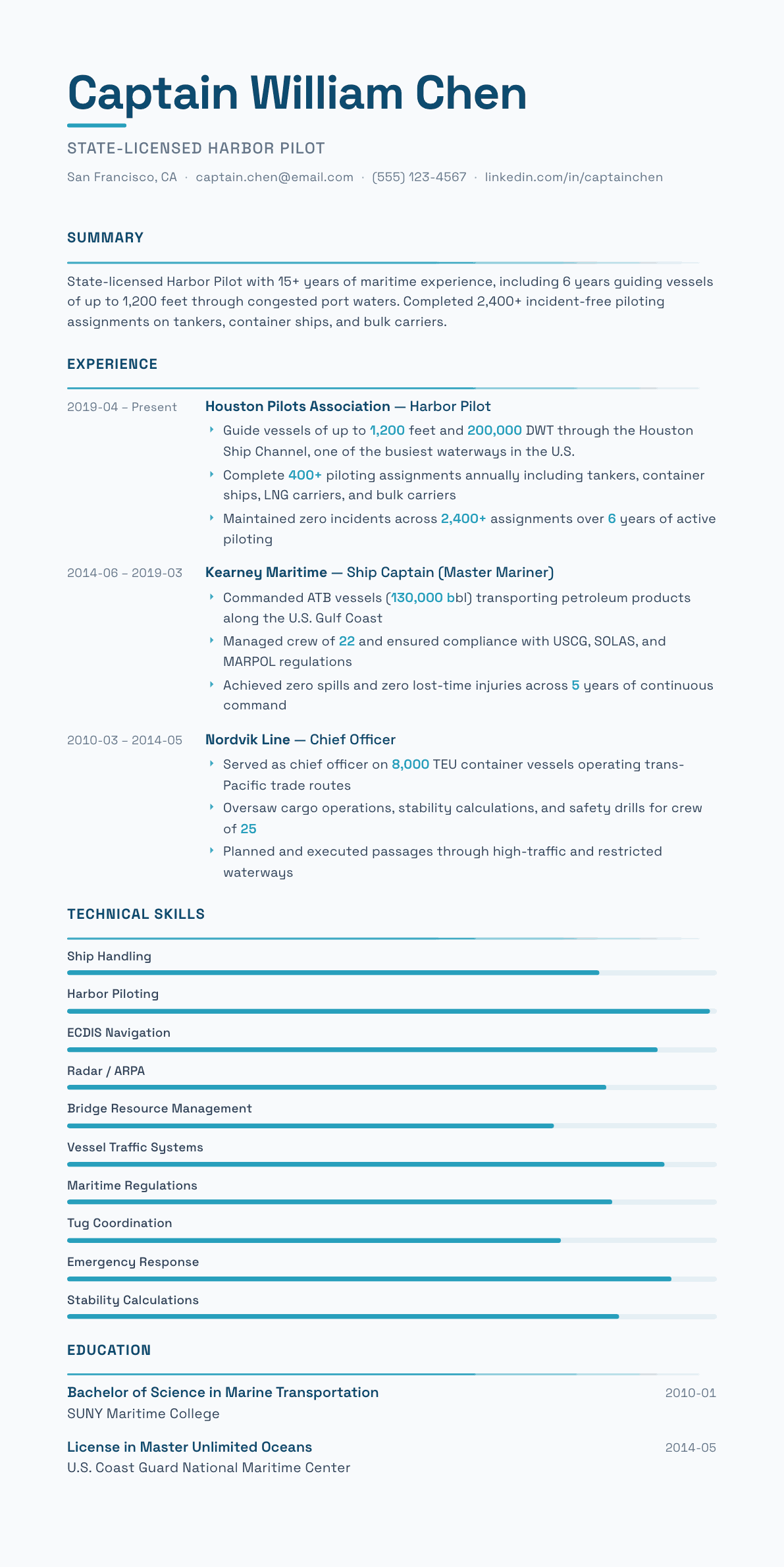
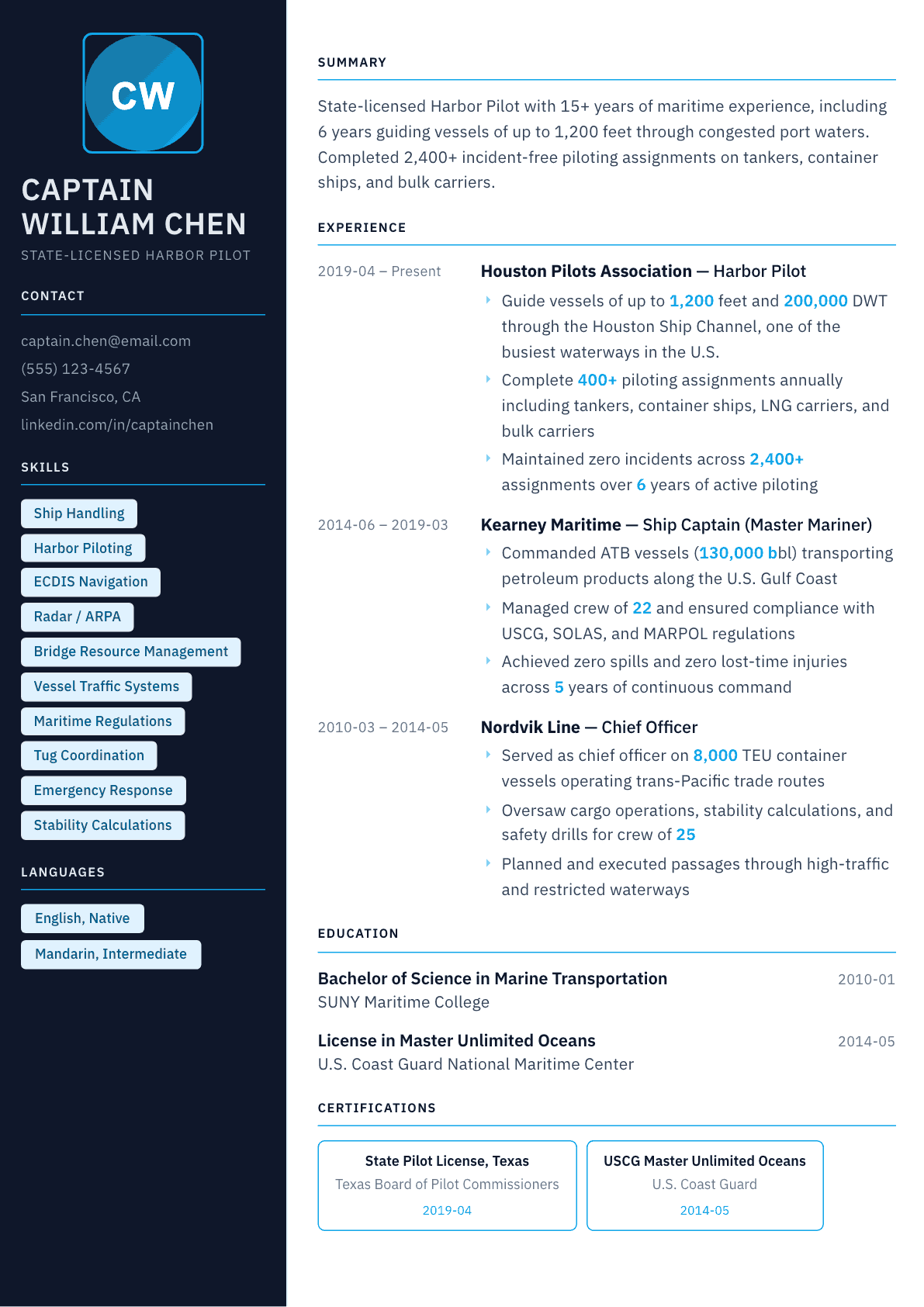
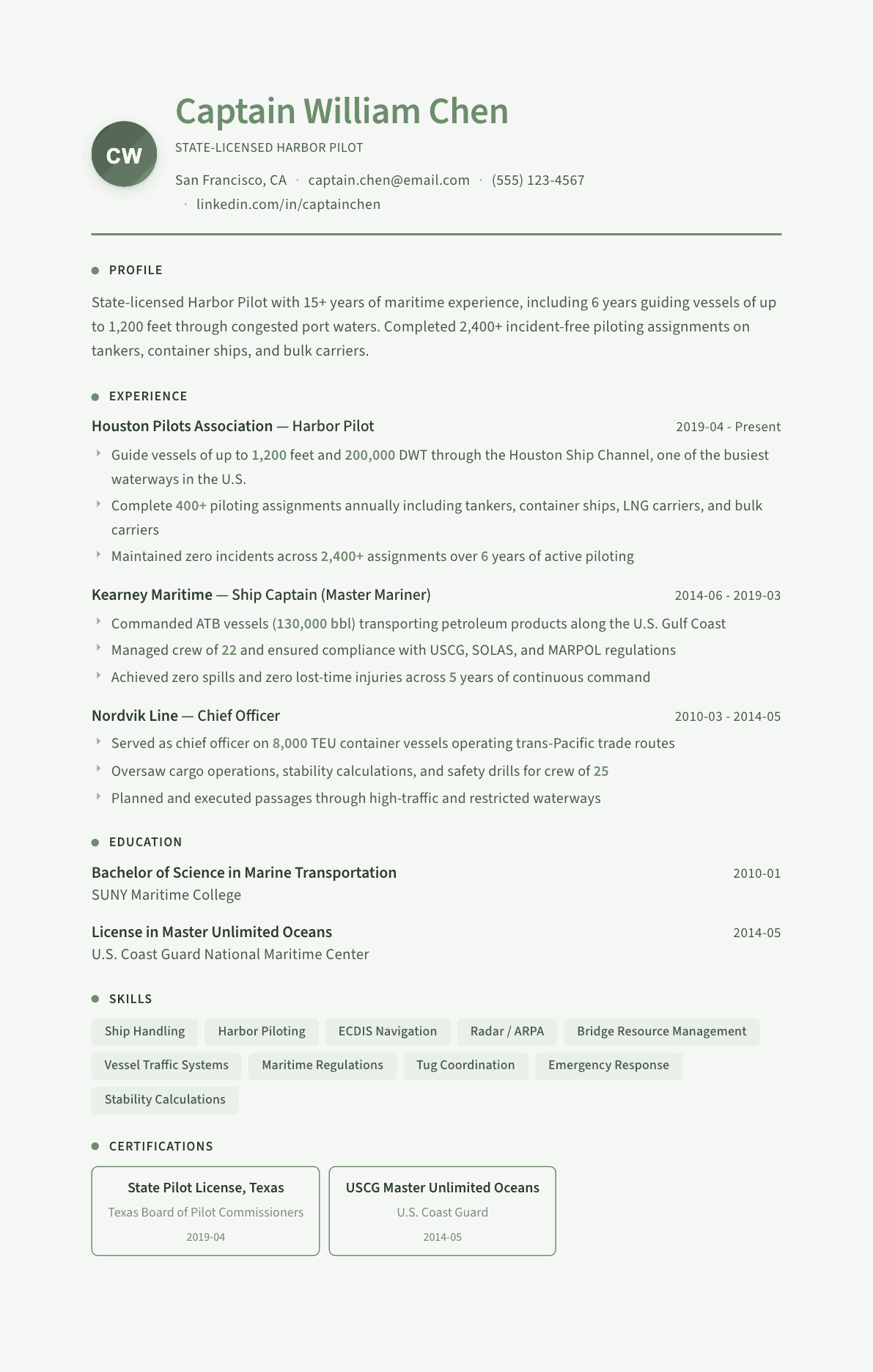
Example Harbor Pilot summary
State-licensed Harbor Pilot with 15 years of maritime experience and 2,400+ incident-free piloting assignments. Expert in navigating vessels of up to 1,200 feet through congested port waters. Seeking a senior pilot position with a major port authority.
Skills to list on a Harbor Pilot resume
- Harbor Piloting
- Ship Handling
- ECDIS Navigation
- Radar / ARPA
- Bridge Resource Management
- Vessel Traffic Service
- Tug Coordination
- Maritime Regulations (SOLAS, MARPOL)
- Emergency Response
- Stability & Trim
- Passage Planning
- Crew Management
- Weather Routing
- Port Operations
What actually gets this resume read
- List your state pilot license and USCG credentials (Master Unlimited, Chief Mate) prominently.
- Quantify your piloting record: total assignments, vessel sizes handled, and incident-free statistics.
- Specify vessel types you have piloted: tankers, container ships, LNG carriers, cruise ships, bulk carriers.
- Include the port or waterway where you operate and its unique challenges.
- Mention bridge resource management, tug coordination, and electronic navigation equipment proficiency.
How to write a harbor pilot resume
A harbor pilot resume is read by a pilot association board or a port authority panel, not by a general recruiter, and those readers start at the credentials. State pilot license, federal first class pilot endorsement, the routes it covers, the tonnage limits, and the sea time behind it. If those are not unambiguous in the first inch of the page, the rest of the document does not get a fair reading.
The second thing the board looks for is your handling record: the classes of vessel you have conned, the maximum length overall and draft you have taken through the channel, the berths and turning basins you know, and whether your record is clean. Piloting is a profession where a single allision ends a career, so the resume has to read as disciplined rather than promotional.
This guide sets out how to structure the document for an apprentice pilot application, a licensed deputy pilot and a full branch pilot, what belongs in a sea service record, and the questions mariners ask when they move from a command at sea to a pilot license ashore.
Format: credentials block first, sea service as a table of fact
Two pages is normal and expected here, because the license history and sea service record are long and a board wants them complete. Use reverse-chronological order for vessels and positions, and put a credentials block directly under your name so the license class, endorsements and expiry dates are read before anything else.
Keep the layout plain and single-column. Pilot associations and port authorities often circulate applications as printed packets to a selection committee, so a design that depends on color or a sidebar loses information the moment it goes through a copier.
- Header: name, mariner reference number if you choose to include it, port or waterway, phone, email.
- Credentials block: state pilot license and its route, USCG Merchant Mariner Credential with tonnage and route, radar observer, STCW endorsements, medical certificate status.
- Then: piloting or command summary, sea service record, training and simulator courses, education, professional memberships.
The credentials block: exactly what the board verifies
Write the license the way the issuing authority writes it. "Master of Steam or Motor Vessels of Any Gross Tons Upon Oceans" is the full phrasing, and abbreviating it invites a verification question. Give the state pilot license with the commission that issued it and the named waters it covers, because a license for one bay does not transfer to the next port.
List the federal first class pilotage endorsement separately with each route on it, including any draft limitation. Add radar observer unlimited, the STCW endorsements you hold, and your ECDIS type-specific training. A board reads a missing renewal date as either an expired document or a careless applicant, and neither helps you.
Sea service and handling record: tonnage, draft, and what you conned
For each vessel give the name or type, gross tonnage, length overall, the trade, your position aboard, and the dates. A board can read years of qualification from that alone. Where you served as master or chief mate, say how many port entries and departures you performed and under what pilotage arrangement.
Then quantify the handling itself. Number of assignments piloted, the largest length overall and deepest draft you have taken to a berth, the vessel classes you are comfortable with, and the tug configurations you routinely order. Tankers, gas carriers, container vessels, bulkers, car carriers and cruise vessels each handle differently, and a panel wants to see which of them you have actually conned.
State your record plainly and without decoration: number of assignments completed without incident, damage or pollution event. Understatement is the register of this profession, and a resume that oversells reads as a risk.
Training and simulation: the part that shows currency
Manned model ship handling at a recognized center, full mission bridge simulator time, bridge resource management for pilots, and escort tug or azimuth stern drive familiarization all belong in their own section with the provider and the hours. Pilot boards care that your handling training is recent, not only that it happened.
Add the local knowledge work: chart and channel examinations passed, tide and current study, berth and terminal familiarization trips, and any apprenticeship or observation trips logged in the port you are applying to. Where a port requires a hand-drawn chart examination, say you have sat it.
Language a pilot application panel expects
Use the professional vocabulary precisely: passage plan, master pilot exchange, under keel clearance, squat, set and drift, bank effect, turning basin, dead slow ahead, escort tug, vessel traffic service, pilot ladder rigging, SOLAS and MARPOL compliance. These are not keywords for software, they are the terms the panel uses among themselves, and getting them exactly right is part of the interview before the interview.
Harbor Pilot resume summary examples
Apprentice pilot applicant
Unlimited master mariner with eight years of deep sea service, the last three as chief mate on Panamax bulk carriers, seeking an apprentice pilot position. Holds radar observer unlimited and ECDIS type training, and has logged 60 observation trips in the port under licensed pilots.
Deputy pilot, five years
Deputy harbor pilot with five years and 1,900 assignments on a state license, currently limited to 900 feet length overall and 40 feet draft. Regular work on container vessels, product tankers and car carriers, with escort tug operations in a confined channel and a clean record.
Branch pilot
Full branch harbor pilot with 18 years and more than 7,000 assignments, unrestricted on tonnage and draft in the bay and river approaches. Trains apprentice pilots, sits on the association safety committee, and has conned LNG carriers and cruise vessels to berth without incident.
Work experience bullets: before and after
Before: Piloted large ships in and out of the harbor.
After: Piloted 420 assignments a year on container vessels, product tankers and bulk carriers up to 1,100 feet length overall and 45 feet draft through a dredged channel with a tidal window.
Assignment count, vessel classes and the physical limits you have worked to are the numbers a pilot board actually verifies.
Before: Worked with tugboats during docking.
After: Ordered and directed escort and docking tugs in three and four tug configurations, including azimuth stern drive units, for berthings in a turning basin with 200 feet of clearance.
The tug count, propulsion type and the tightness of the basin show handling judgment rather than a generic docking claim.
Before: Followed all safety and environmental regulations.
After: Completed 1,900 consecutive assignments with no allision, grounding or pollution event, and reported two near misses to the association safety committee for review.
A clean record stated with a number, plus voluntary near miss reporting, is what a safety-driven board wants to read.
Before: Used navigation equipment on the bridge.
After: Worked portable pilot unit, ARPA radar and ECDIS alongside the bridge team, cross checking under keel clearance against predicted squat before each channel transit.
Naming the equipment and the calculation it feeds shows technical practice instead of equipment familiarity.
Before: Trained new pilots in the port.
After: Supervised four apprentice pilots through their observation trips and chart examinations, riding as check pilot on their first 50 unassisted assignments each.
The training structure and the number of supervised assignments make the mentoring claim concrete.
Hard skills
- Ship handling and berthing
- Passage planning
- Under keel clearance and squat calculation
- Escort and docking tug direction
- ECDIS and portable pilot unit
- ARPA radar navigation
- Bridge resource management
- Vessel traffic service coordination
- Master pilot exchange
- Stability and trim assessment
- Heavy weather and restricted visibility transits
- SOLAS and MARPOL compliance
Soft skills
- Command presence on a foreign bridge
- Clear helm and engine orders
- Decision making under time pressure
- Cross cultural bridge communication
- Risk assessment
- Mentoring apprentices
Certifications worth listing
- State Pilot License (State Board of Pilot Commissioners)
- Merchant Mariner Credential, Master Unlimited Oceans (U.S. Coast Guard)
- First Class Pilot Endorsement (U.S. Coast Guard)
- Radar Observer Unlimited (U.S. Coast Guard approved course provider)
- STCW Basic Training (U.S. Coast Guard)
- ECDIS Type Specific Training (Equipment manufacturer approved center)
Mistakes that cost harbor pilot candidates the interview
- Abbreviating the license instead of quoting the exact wording, tonnage and route the issuing authority printed on it.
- Leaving out renewal and medical certificate dates, which a board reads as an expired document until proven otherwise.
- Giving vessel names with no gross tonnage, length overall or trade, so the panel cannot size the experience.
- Claiming ship handling experience without saying whether you had the conn or were observing.
- Padding the record with promotional language, which reads as a safety risk in a profession built on understatement.
- Omitting local knowledge work such as observation trips, chart examinations and berth familiarization in the port you are applying to.
Harbor Pilot resume questions
How much sea time should a harbor pilot resume show?
Show the full service record, not a summary. Pilot boards work backward through years of documented sea time to confirm you meet the license requirement, so list every vessel with tonnage, position and dates rather than condensing early years into one line.
Do I list my USCG license or my state pilot license first?
List the state pilot license first when you are applying inside that state, because it is the license that authorizes the work. Put the federal credential and the first class pilotage endorsement immediately below it with the routes and any draft limitation.
How do I move from ship master to harbor pilot on paper?
Reframe the command experience around port work: pilotage waters transited, port entries and departures conned, berthings performed and local knowledge gained. A board wants evidence you have handled vessels in confined water, not a summary of ocean passages.
Should I include incidents on the resume?
Do not narrate incidents on the resume itself, but never state a clean record that a marine casualty investigation would contradict. Give the assignment count and let the disclosure and background process handle the detail, where you can explain context properly.
What simulator training matters for a pilot application?
Manned model ship handling and full mission bridge simulator work at a recognized center carry the most weight, especially courses covering escort tug work, emergency maneuvers and large vessel handling. List the provider, the course name and the year you last attended.
Related resume examples
- Air Traffic Controller Resume example
- Fleet Manager Resume example
- Logistics Coordinator Resume example
- Ship Captain Resume example
- Pilot Resume example
- Deckhand Resume example