Dental Hygienist Resume Examples: the lines they read
Dental Hygiene Resume Templates and a Hygienist Example
By Mustafa Tarabya, founder of CVBooster · Published · Updated
Dental hygiene resume templates and a full hygienist example: license block, patient volume, perio and recare numbers, plus summaries for each career stage.
Sample resumes for a dental hygienist
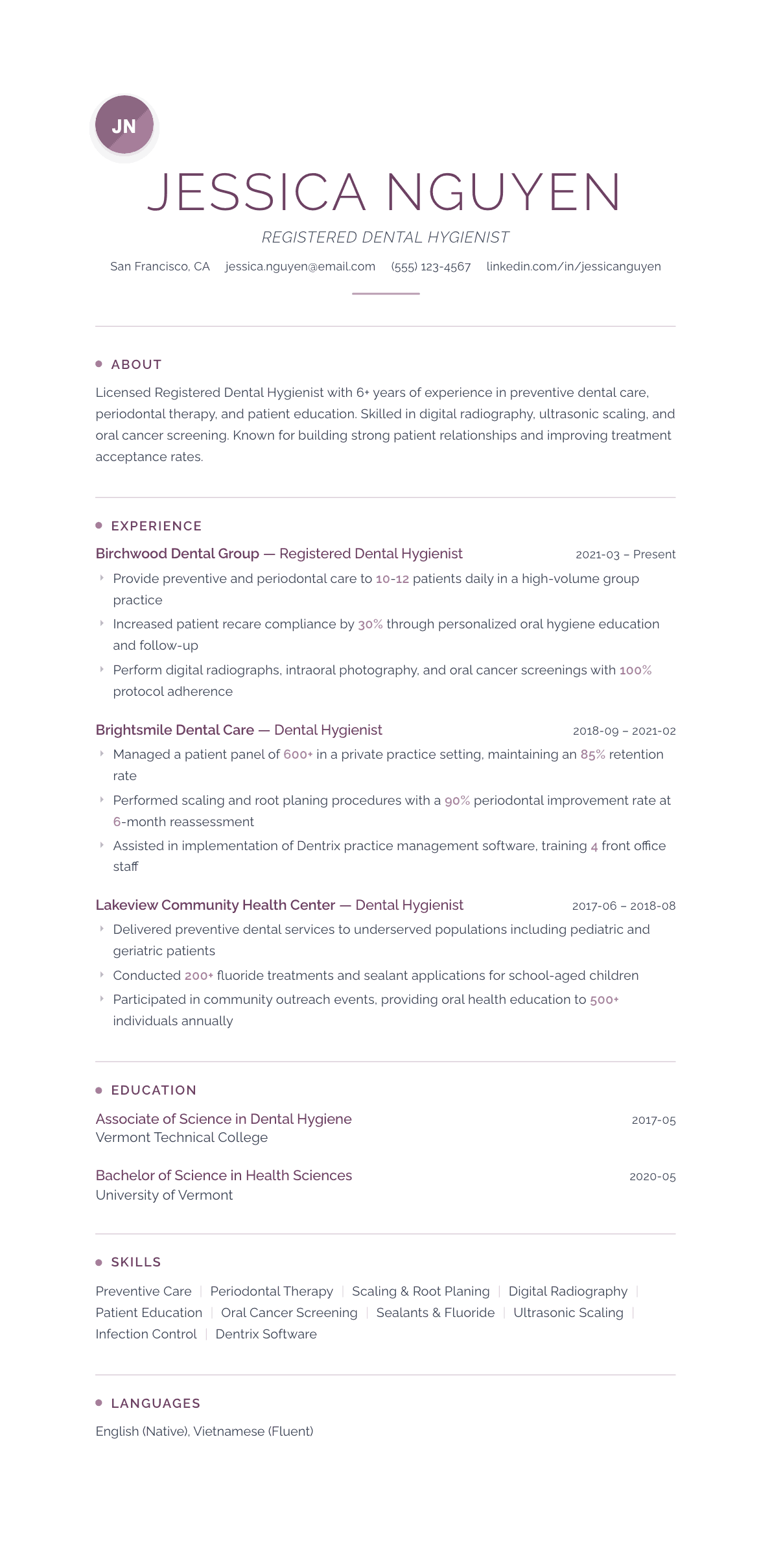
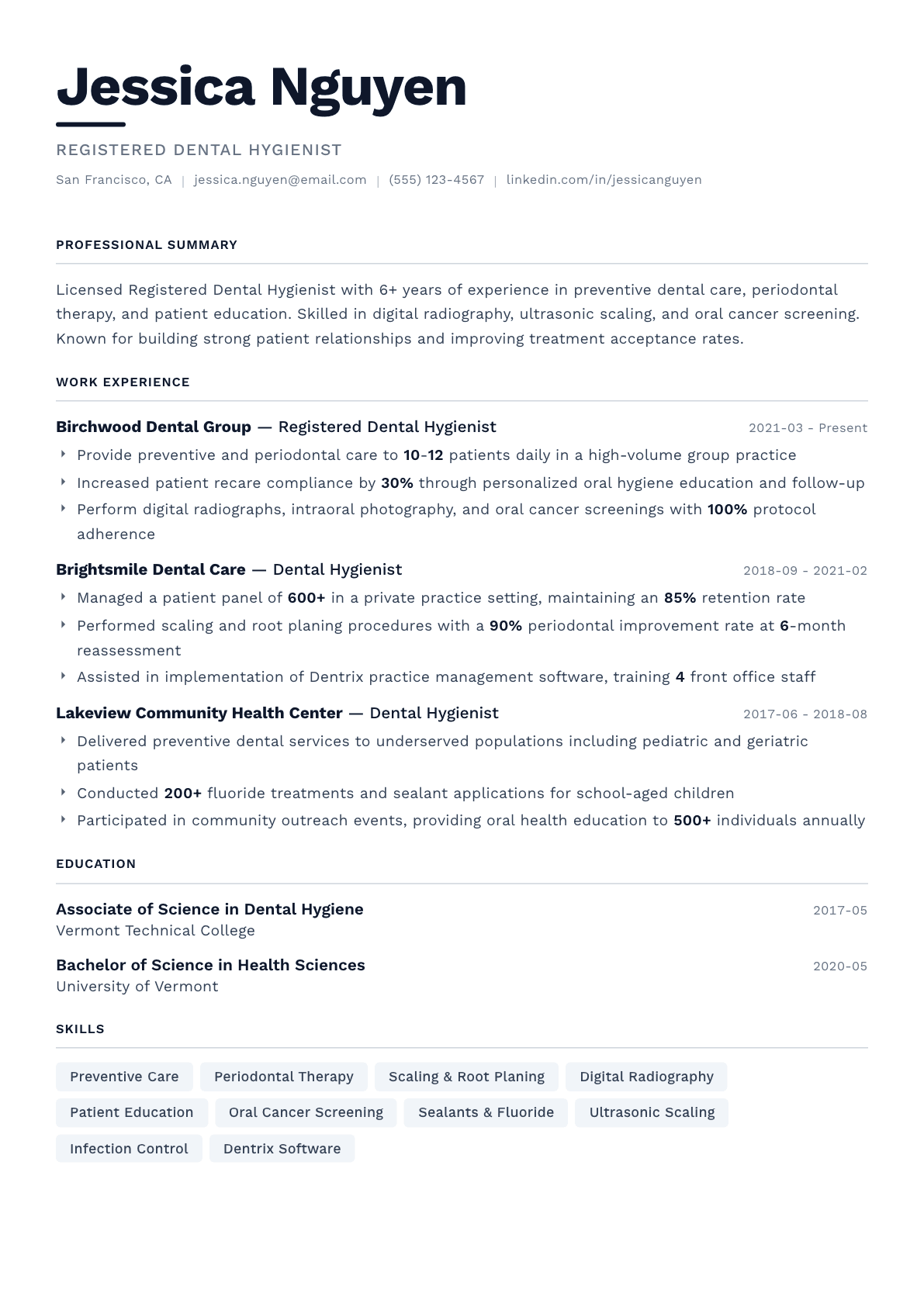
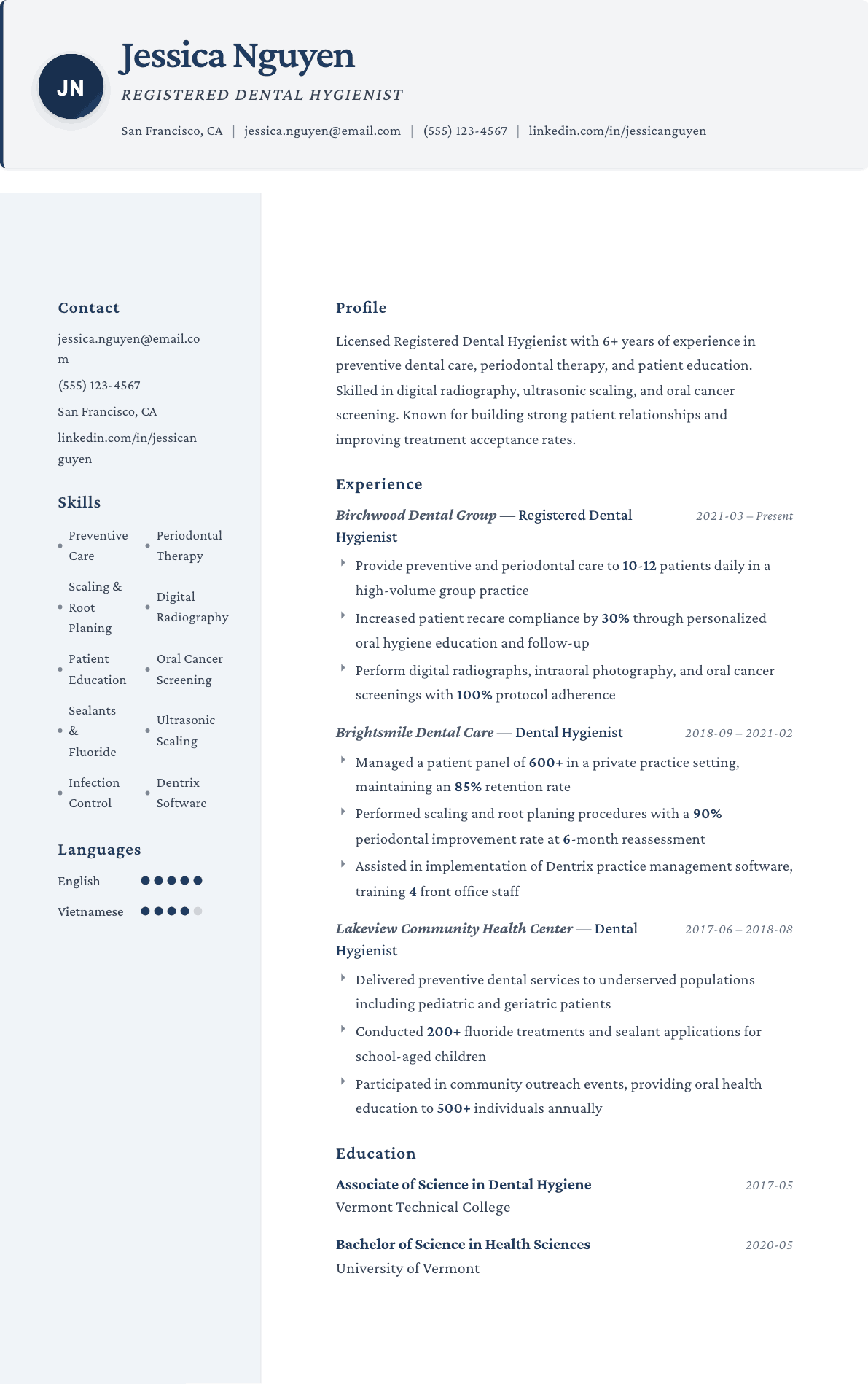
The same dental hygienist content laid out in three CVBooster templates, so you can see what the finished document looks like before you write a word.
Example Dental Hygienist summary
Licensed RDH with 6 years of experience in preventive dental care and periodontal therapy. Increased patient recare compliance by 30% and maintained an 85% patient retention rate. Seeking a dental hygienist position in a patient-focused private practice.
Skills to list on a Dental Hygienist resume
- Preventive Care
- Periodontal Therapy
- Scaling & Root Planing
- Digital Radiography
- Patient Education
- Oral Cancer Screening
- Sealants
- Fluoride Application
- Local Anesthesia
- Infection Control
- Ultrasonic Scaling
- Dentrix
- Eaglesoft
- Intraoral Photography
What actually gets this resume read
- Include your RDH license and state permit information near the top of your resume.
- Quantify patient volumes, recare rates, and periodontal outcomes.
- List specific equipment and software you are trained on (e.g., Cavitron, Dentrix, Eaglesoft).
- Highlight patient education and treatment acceptance achievements.
- Mention local anesthesia and nitrous oxide permits if applicable.
- Show community outreach and public health experience if you have it.
How to write a dental hygienist resume
A dental hygienist resume is usually read by the practice owner or the office manager, not by a recruiter, and it is read in about a minute between patients. The three things they check first are the state license and its status, whether you hold a local anesthesia or nitrous oxide permit, and how many patients you can see in a day without running the schedule late.
That last point is where most hygienist resumes go quiet. Practices hire on production and retention. A hygienist who can show the daily patient count, the recare percentage of the panel she kept on schedule, and comfort with adult prophylaxis alongside scaling and root planing is answering the owner's real question, which is whether the hygiene column will pay for itself.
Below is the section order private practices, group practices and community clinics expect, how to pick between dental hygiene resume templates, three summaries at different career stages, before and after bullets drawn from the phrases that show up on nearly every hygiene application, and the questions hygienists ask when they update their resume.
Format: one page, license block near the top
One page is right for almost every hygienist, including those with fifteen years of practice, because the work is consistent across employers and the reader does not need three versions of the same duties. Reverse chronological order, plain fonts, no icons, and no two column layout, since many dental service organizations run resumes through an applicant tracking system before an office manager ever sees them.
Put a licensure block directly under the summary: RDH license with the state and expiration, local anesthesia permit if your state grants one, nitrous oxide monitoring certification, radiography certification, and current CPR. An owner who has to email you to ask whether you can administer local anesthesia will often just move to the next resume.
- Header: name with RDH after it, city and state, phone, email.
- Order: summary, licensure and permits, clinical experience, education, software and equipment, continuing education.
- Recent graduates add a clinical block with board exam status and the patient types treated during their program.
Dental hygiene resume templates: which layout to pick
The right dental hygiene resume template is the plainest one that still puts the license block where an owner can see it. Pick a single column template with clear section headings, standard fonts and room for a licensure block directly under the summary. Dental service organizations and larger group practices often take applications through an online portal, and single column layouts carry over into those forms cleanly.
Avoid templates built around a photo, skill bars or a sidebar that holds your license and permits. A sidebar is the first thing some screening software reads out of order, and the license is the one item you cannot afford to lose. A small accent color in the headings is fine for a private practice application; keep it to one.
Whichever template you choose, fill it in the same order: name with RDH, contact line, a two or three sentence summary, licensure and permits, clinical experience, education and boards, software, and continuing education. New graduates swap clinical experience for a clinical block from their program with patient counts and board status.
- Private practice: single column, one accent color, license block under the summary, one page.
- Group practice or DSO portal: plain single column, no tables or text boxes, standard headings such as Experience and Education.
- Community health or hospital dental clinic: same plain layout, with a line on patient populations and languages spoken.
- New graduate: education and clinical block above any non-dental jobs, board exam status stated with dates.
Summary: setting, patient volume, and what you are permitted to do
Two or three sentences. Name the practice type you have worked in, general private practice, periodontal specialty, pediatric, group practice or community health, the daily patient load, and the expanded functions your license allows. Practices differ enormously in pace, and a hygienist who has run a ten patient day in a group practice is a different hire from one who ran six in a periodontal office.
If you are moving between practice types, say it plainly and name the transferable part. A hygienist coming out of community health into a private office should point at the volume and the range of ages treated rather than hoping the reader infers it.
Experience: volume, procedures, and the periodontal side
Open each job with the practice type and size: number of operatories, number of dentists and hygienists, and the patient panel. Then give the daily patient count and the appointment length you worked to, since a sixty minute recare column and a forty minute column are different jobs.
Devote at least one bullet to periodontal therapy. Scaling and root planing per quadrant, periodontal charting and case typing, ultrasonic and hand instrumentation, localized antimicrobial placement, and the reevaluation appointment. Owners want to know whether you can identify periodontal disease and present the treatment, because that is the difference between a hygiene column that only cleans teeth and one that treats.
Add the adjacent duties honestly: digital radiographs and panoramic imaging, intraoral photography, oral cancer screening, sealants and fluoride varnish, impressions or scanning if your state permits, and the perio charting handoff to the dentist during the exam.
Case acceptance and recare: the business half of hygiene
Hygiene drives the recare engine of a practice. If you have numbers for reappointment rate at the chair, the share of your panel that stayed on a three or four month interval, or periodontal case acceptance after you presented findings, those belong on the resume. They are unusual on hygienist resumes, which is exactly why they work.
Also name the practice management software you have charted in: Dentrix, Eaglesoft, Open Dental, Curve or Denticon. Switching software costs an office real chair time in the first weeks, so a match is worth mentioning in the skills block.
Education, boards and continuing education
List the dental hygiene program and the accrediting status, the national board result, and the regional clinical examination you passed, because states recognize different regional boards and an owner in a border state will check. Then add a short continuing education line with the courses that matter to the practice you are applying to: laser therapy, implant maintenance, myofunctional or orofacial screening, nitrous oxide, or local anesthesia if you completed it after graduation.
Dental Hygienist resume summary examples
New graduate
Registered Dental Hygienist licensed in Ohio, graduated from an accredited program with 500 clinical hours and 120 completed patient cases including 14 scaling and root planing quadrants. Radiography and CPR certified, trained on Dentrix, and seeking a general practice recare column.
Six years in practice
Registered Dental Hygienist with six years in a four operatory general practice, seeing nine to eleven patients daily on 50 minute appointments. Holds a local anesthesia permit, keeps 88% of the recare panel reappointed at the chair, and presents periodontal therapy alongside the doctor.
Lead hygienist
Lead Registered Dental Hygienist with thirteen years across periodontal specialty and group practice, now coordinating a three hygienist column and the recare system for a panel of 2,400 patients. Experienced with implant maintenance, laser adjunct therapy and onboarding new hygienists to Eaglesoft.
Work experience bullets: before and after
Before: Cleaned teeth and provided preventive care to patients.
After: Treated nine to eleven patients daily on 50 minute appointments in a four operatory general practice, covering adult prophylaxis, pediatric recare and periodontal maintenance.
Daily volume, appointment length and practice size let an owner judge whether you can hold their schedule.
Before: Performed scaling and root planing.
After: Completed roughly 20 quadrants of scaling and root planing per month with ultrasonic and hand instrumentation, followed by four to six week reevaluation and periodontal maintenance intervals.
Volume plus the reevaluation step shows you deliver a full course of therapy rather than a single appointment.
Before: Educated patients on oral hygiene.
After: Presented periodontal charting findings chairside with intraoral photos, lifting acceptance of recommended scaling and root planing to 71% of diagnosed cases.
Education becomes measurable when it is tied to what patients agreed to and how you showed them.
Before: Took X-rays as needed.
After: Captured digital bitewings, periapicals and panoramic images on a Dexis sensor, retaking under 3% of exposures and flagging findings for the doctor before the exam.
Naming the system and the retake rate proves radiographic competence instead of assuming it.
Before: Helped keep patients on their recall schedule.
After: Reappointed 88% of the recare panel at the chair and rebuilt the overdue list in Dentrix, returning 140 lapsed patients to a three or four month interval over one year.
Recare is the production side of hygiene, so a rate and a recovered patient count speak directly to the owner.
Hard skills
- Adult and pediatric prophylaxis
- Scaling and root planing
- Periodontal charting and case typing
- Ultrasonic instrumentation
- Digital radiography
- Panoramic imaging
- Oral cancer screening
- Sealants and fluoride varnish
- Local anesthesia administration
- Nitrous oxide monitoring
- Implant maintenance
- Dentrix
- Eaglesoft
- Open Dental
Soft skills
- Chairside patient education
- Treatment presentation
- Schedule discipline
- Anxious patient management
- Doctor and assistant coordination
Certifications worth listing
- Registered Dental Hygienist (RDH) license (State dental board)
- National Board Dental Hygiene Examination (Joint Commission on National Dental Examinations)
- Dental Hygiene Clinical Examination (Commission on Dental Competency Assessments)
- Basic Life Support (BLS) for Healthcare Providers (American Heart Association)
- Local Anesthesia Permit (State dental board)
- Nitrous Oxide Monitoring Certification (State dental board)
Mistakes that cost dental hygienist candidates the interview
- Leaving off the license state and expiration, which stalls the file while the office manager emails to ask.
- Not saying whether you hold a local anesthesia permit, when that permit decides which practices can even consider you.
- Writing provided preventive care with no daily patient count, so the owner cannot tell if you can hold a full column.
- Skipping periodontal therapy entirely, which reads as a hygienist who only polishes and refers everything to the doctor.
- Omitting the practice management software, guaranteeing slower onboarding and a weaker match against the posting.
- Stretching to two pages by repeating the same duties under four employers when one page covers the whole career.
Dental Hygienist resume questions
How long should a dental hygienist resume be?
One page in almost every case. The duties repeat across employers, so a second page adds no information. Use the space you save to add the licensure block, the daily patient volume and the periodontal and recare numbers that actually differ between candidates.
Where do I put my RDH license and permits?
In their own block right under the summary, before experience. List the license type, the state, the expiration, plus radiography certification, current CPR, and any local anesthesia or nitrous oxide permit. Owners screen on these before they read a single job description.
What numbers should a hygienist put on a resume?
Patients treated per day, appointment length, operatory and doctor count, quadrants of scaling and root planing per month, reappointment rate at the chair, and periodontal case acceptance. These are the figures an owner uses to picture your column in their practice.
What is the best dental hygiene resume template?
A single column template with standard headings, a readable font and space for a licensure block right under the summary. Skip photos, skill bars and sidebars, because portals used by group practices can misread them. One page is enough, and a single accent color is the most decoration a practice owner needs to see.
How do I write a resume for a temporary or part time hygiene role?
Lead with adaptability across software and practice styles, name every practice management system you have charted in, and give the range of daily volumes you have worked. Temp agencies and practices hiring for coverage care most about how little training you will need on day one.