Emergency Room Nurse Resume Examples: what gets the call
An ER Nurse Resume for the Emergency Department You Want
By Mustafa Tarabya, founder of CVBooster · Published · Updated
ER nurse resume example and emergency nurse resume samples for experienced and new graduate ED RNs, with triage, trauma and charge bullets.
Sample resumes for a emergency room nurse
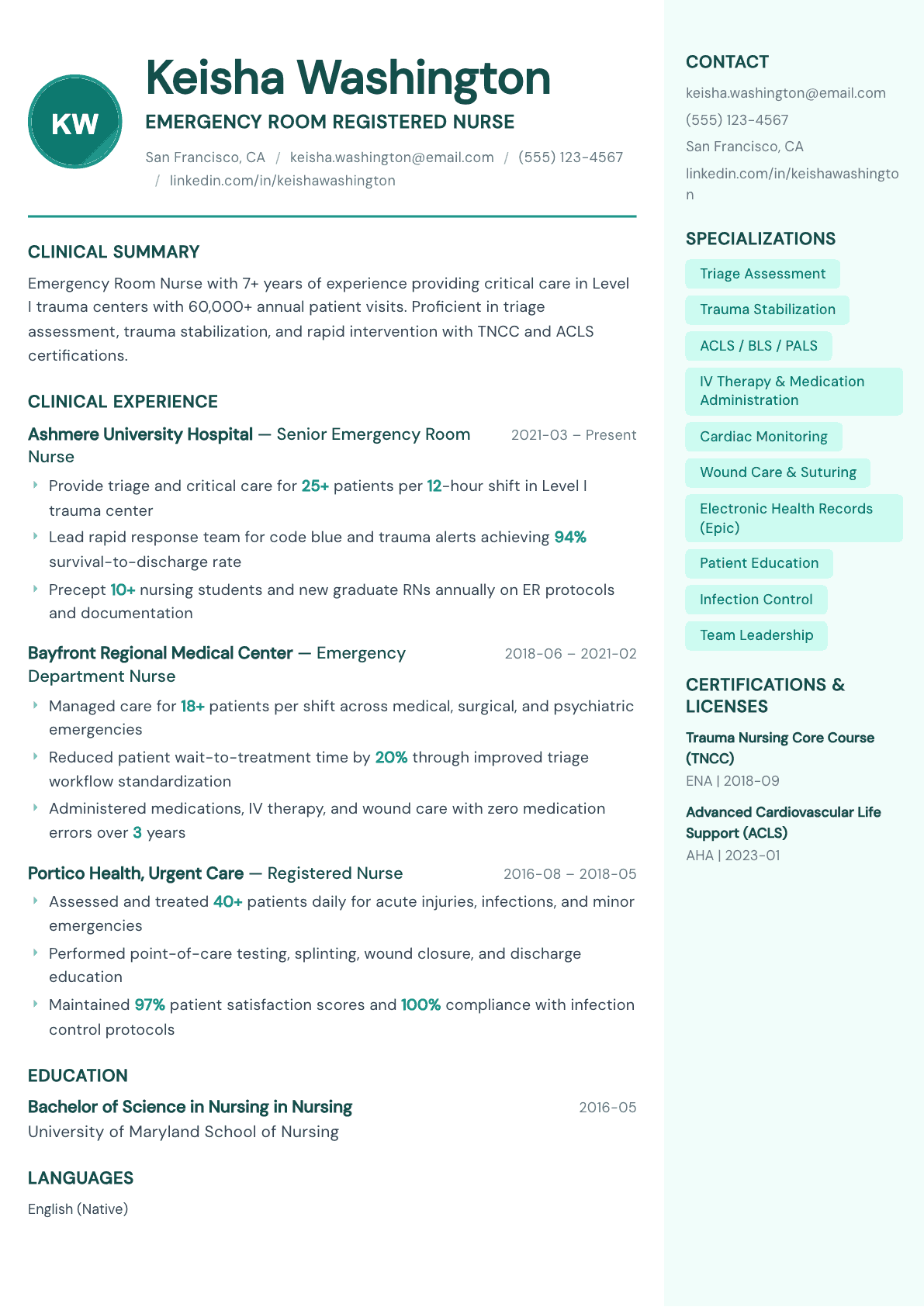
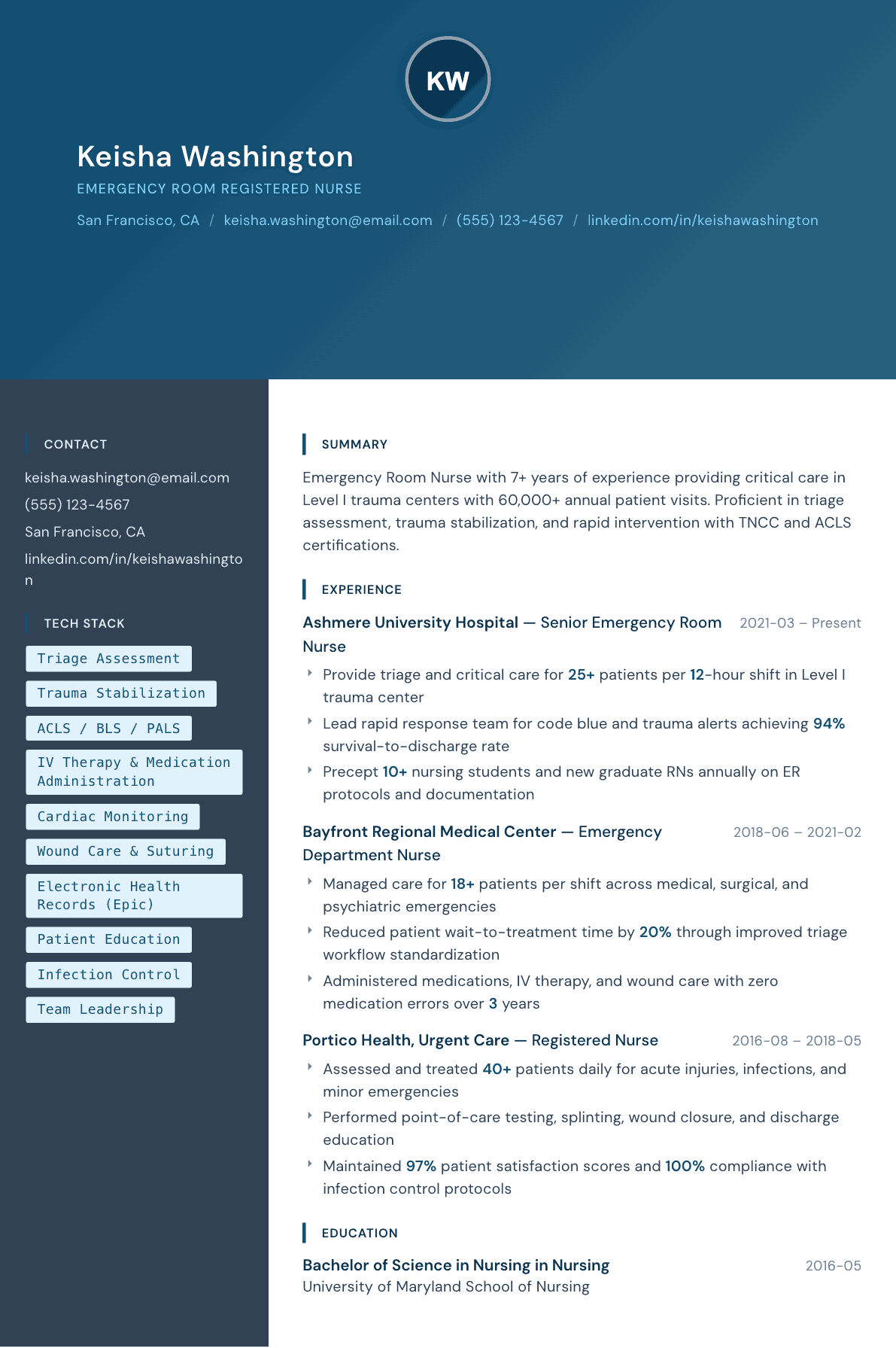
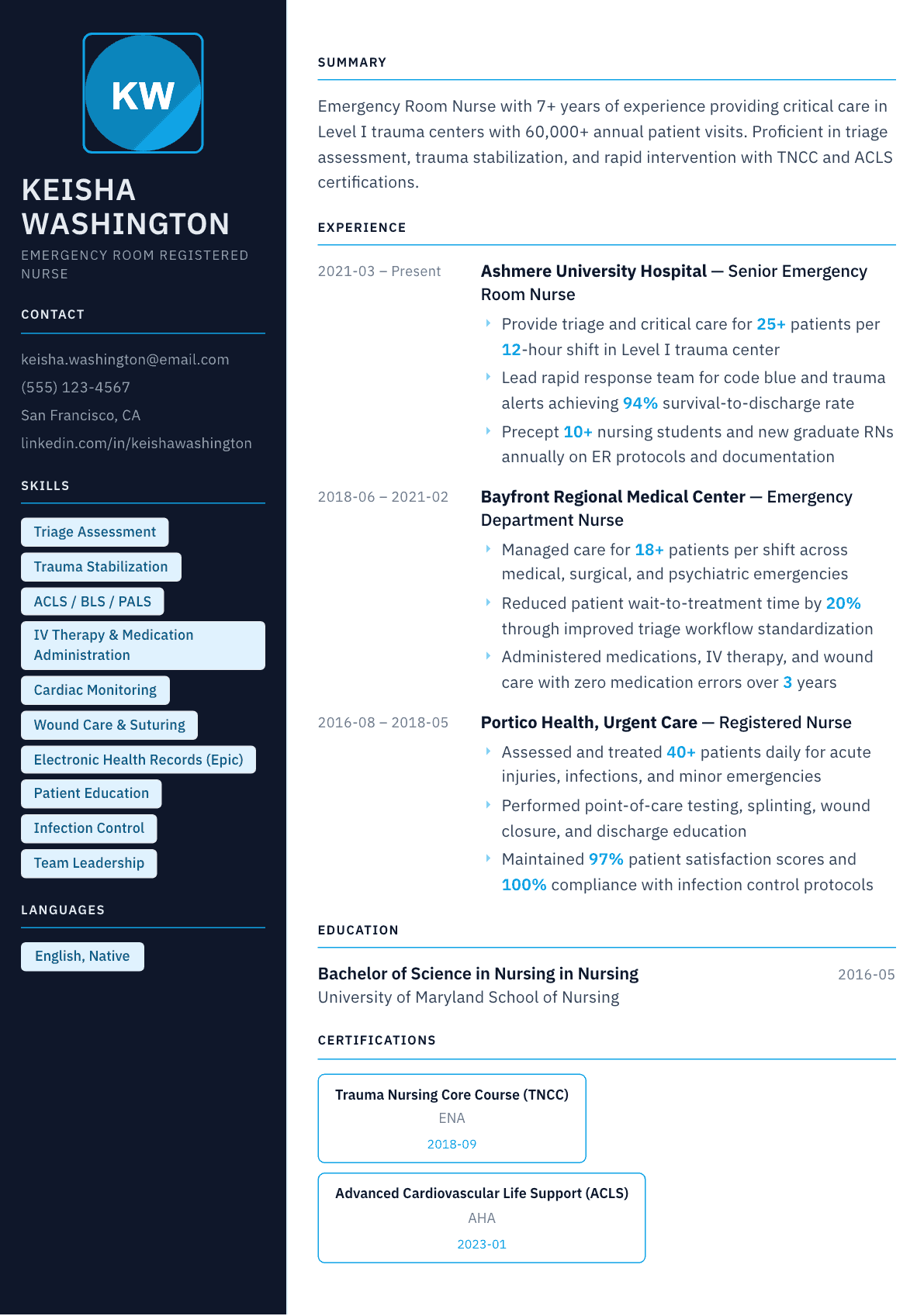
The same emergency room nurse content laid out in three CVBooster templates, so you can see what the finished document looks like before you write a word.
Example Emergency Room Nurse summary
Emergency Room Nurse with 7 years of Level I trauma experience managing 25+ patients per shift. TNCC and ACLS certified with 94% survival-to-discharge rate and zero medication errors across 10,000+ patient encounters.
Skills to list on a Emergency Room Nurse resume
- Triage Assessment (ESI)
- Trauma Stabilization
- ACLS / BLS / PALS
- IV Therapy
- Cardiac Monitoring
- Wound Care & Suturing
- Epic / Cerner EHR
- Patient Education
- Infection Control
- Rapid Response
- Medication Administration
- Critical Thinking
What actually gets this resume read
- Specify your trauma center level (I-V) and annual patient volume to convey acuity and pace.
- Include patient-to-nurse ratios and shift patient loads to quantify your workload capacity.
- List all active certifications prominently. TNCC, ACLS, BLS, PALS, and CEN are essential.
- Highlight zero medication error streaks and infection control compliance to show safety focus.
- Mention precepting, charge nurse, or rapid response roles that demonstrate leadership.
How to write a emergency room nurse resume
An emergency room nurse resume is judged on department type before anything else. A Level I trauma center, a community department with a fast track, a freestanding emergency department and a critical access hospital are four different jobs, and the ED manager reading your file is working out whether your last department looks like hers. Annual visit volume, trauma designation, bed count and whether the department has its own pediatric or behavioral health area answer that in one line.
The second thing she checks is your certification stack. BLS and ACLS are assumed. PALS is usually required. TNCC, ENPC, NIHSS and CEN are the ones that tell her you can take a trauma bay, a sick child, a stroke alert or a full assignment without a preceptor beside you.
This guide covers a complete emergency nurse resume sample, how ED managers and travel agencies read the file, how to write triage and resuscitation experience so it is believable, three summaries covering a nurse moving into the ED, a nurse several years in and a charge nurse, and the bullets that need rewriting on nearly every emergency nursing application.
Format: put the department profile in the job header
Reverse chronological, one page under five years, two pages after. Do not use a two column layout, because hospital applicant tracking systems commonly reorder columns and drop the dates that credentialing needs.
The important structural move for an ED nurse is the job header line. Under each employer, write the department profile before the bullets: annual visit volume, trauma designation, treatment bed count, whether there is a dedicated pediatric or psychiatric area, and whether the department holds admitted patients. That single line does more work than three bullets.
- Header: name with credentials, city and state, phone, email, license state and compact status.
- Order: summary, licensure and certifications, emergency department experience, other clinical experience, education, skills.
- Travel and per diem nurses group assignments under one agency heading with the facility, department profile and contract length for each.
Certifications: the stack that decides your assignment
Give certifications their own block near the top, each with the issuing organization and expiration. Order them by what the posting requires rather than alphabetically, so the required ones are read first.
Trauma Nursing Core Course and Emergency Nursing Pediatric Course are the two that separate a general acute care nurse from an emergency nurse on paper. NIH Stroke Scale certification matters to any department with stroke center designation. Certified Emergency Nurse is the specialty credential that carries the most weight for charge and lead roles, and a hazardous materials or disaster response course is worth listing if the department runs decontamination.
Triage: name the system and the level of independence
Triage is the skill most often described in a way that proves nothing. Name the acuity system you used, most commonly the five level Emergency Severity Index, say whether you triaged independently or in a team model, give the patients per hour you triaged during a shift, and mention the standing orders you initiated from the triage desk such as laboratory panels, electrocardiograms, imaging and analgesia.
If your department ran provider in triage, pivot nursing, split flow or a rapid assessment zone, name the model. Managers rebuilding front end flow specifically look for nurses who have worked inside one, because the change is as much cultural as procedural.
Resuscitation, throughput and charge: what you actually ran
Write bullets that show the acuity you carried: trauma activations as the recording or primary nurse, medical resuscitations, stroke alerts with door to needle involvement, ST elevation myocardial infarction activations with door to balloon handoff, sepsis bundle initiation, procedural sedation monitoring, and rapid sequence intubation assistance.
Add the technical work that not every nurse does: chest tube and central line assist, intraosseous access, ultrasound guided peripheral intravenous lines, massive transfusion protocol, transcutaneous pacing and cardioversion, ventilator management for boarded patients, and restraint and de escalation for behavioral health holds.
Give assignment ratios and the zone you covered. Carrying four resuscitation beds is a different claim from carrying eight fast track patients, and both are legitimate; the resume needs to say which.
Emergency departments live on flow measures. If you contributed to door to provider time, left without being seen rate, door to electrocardiogram time or sepsis bundle compliance, say what you did and where the number went. Charge experience needs its own bullets: assignment making, boarding with bed control, diversion decisions, mid shift staffing and supporting new graduates.
ER nurse and emergency department RN resume example
An ER (emergency room) nurse resume, an ED RN resume and an emergency department nurse resume are the same document; hospitals simply name the unit differently, so copy the posting's wording into your header and summary. It is easier to write when you can see a whole one, so here is a complete page for a staff nurse in a busy emergency department. The nurse and hospitals are invented; the order is what to copy. Nurses from a Level I trauma center keep the same order and move trauma certifications and resuscitation work higher.
Header and summary: Jordan Ellis, RN, BSN, CEN. Emergency room nurse with six years of acute care, the last four in a Level II trauma center with a pediatric area and a fast track. Triages independently with the Emergency Severity Index, takes charge on nights and precepts new graduates.
- Current role, Staff Nurse, Emergency Department, Riverbend Crossing Medical Center, four years: Level II trauma center with about sixty beds, a fast track and a pediatric pod.
- Triage independently with the Emergency Severity Index and start protocol orders for chest pain, stroke and sepsis from the triage desk.
- Work as primary nurse in resuscitation for trauma activations, cardiac arrests and stroke alerts, including massive transfusion and rapid sequence intubation support.
- Charge nurse on nights two shifts a week: bed flow with the house supervisor, staffing calls and care of boarding patients.
- Previous role, Staff Nurse, Medical Surgical Unit, Fernhill Community Hospital, two years: telemetry patients, rapid response calls and discharge teaching.
- Certifications: CEN, TNCC, ACLS, PALS, BLS and NIH Stroke Scale, each listed with the issuing body and the expiration month.
- Education and license: BSN; active multistate RN license under the Nurse Licensure Compact.
Emergency nursing resume for a new graduate ED RN
Many emergency departments hire new graduates into a residency, and the emergency nursing resume for that application is built differently. With no ED job to describe, the page leads with license status, the emergency specific courses you have already finished, and your clinical rotations written with the same department profile line an experienced nurse would use.
Put your preceptorship or capstone first if it was in an emergency department, with the unit profile, the hours and what you did independently by the end. Then add any patient care technician, emergency department technician, scribe or EMT work, because managers read that as proof you already know the pace. The person and hospitals below are invented.
- Header and summary: Alicia Moreno, RN, BSN. New graduate registered nurse seeking an emergency department residency, with a capstone in a Level II trauma center and two years as an emergency department technician. BLS, ACLS and PALS current; TNCC scheduled.
- Capstone, Emergency Department, Brookhollow Valley Medical Center, 180 hours: carried two to three acute patients with a preceptor by the final weeks, completed triage observation shifts, and documented in Epic.
- Emergency Department Technician, Larkspur Point Community Hospital, two years: electrocardiograms, phlebotomy, splinting, wound care setup and patient transport during trauma activations.
- Clinical rotations: medical surgical, critical care and pediatrics, each with the unit type and hours.
- Education and license: BSN, graduated with honors; RN license issued, multistate under the Nurse Licensure Compact.
Emergency Room Nurse resume summary examples
Moving into the ED
Registered Nurse with two years of telemetry experience transferring into emergency nursing, holding BLS, ACLS, PALS and a completed Trauma Nursing Core Course. Comfortable with rhythm interpretation, rapid response participation and high turnover assignments, and seeking an emergency department residency position.
Five years in the ED
Emergency Room Nurse with five years in a Level II department seeing 62 thousand annual visits, working the resuscitation and acute zones at a four patient assignment. TNCC, ENPC and NIHSS certified, primary nurse on trauma activations, and preceptor for six new graduate nurses.
Charge nurse
Certified Emergency Nurse with eleven years in Level I trauma centers, the last three as night charge for a 48 bed department. Runs assignments, boarding and diversion decisions, leads the sepsis bundle audit, and has precepted 20 nurses through emergency department orientation.
Work experience bullets: before and after
Before: Worked in a busy emergency room caring for patients of all ages.
After: Staffed the acute and resuscitation zones of a Level II emergency department with 62 thousand annual visits, carrying a four patient assignment across adult, pediatric and behavioral health presentations.
Trauma level, visit volume, zone and assignment ratio tell a manager exactly what workload you have carried.
Before: Performed triage on incoming patients.
After: Triaged eight to twelve patients per hour using the five level Emergency Severity Index, initiating standing order laboratory panels, electrocardiograms and analgesia before a provider assessment.
The acuity system, the rate and the standing orders show independent triage judgment rather than a desk assignment.
Before: Assisted with trauma and codes.
After: Served as primary or recording nurse on roughly 15 trauma activations per month, including massive transfusion protocol activation, rapid infuser setup and chest tube assist.
Naming the role in the resuscitation and the specific interventions proves you ran the bay rather than stood in it.
Before: Followed sepsis and stroke protocols.
After: Initiated the sepsis bundle at triage with lactate draw and antibiotic administration inside the one hour window, and ran stroke alerts from arrival through computed tomography and thrombolytic decision.
The time window and the pathway steps convert protocol compliance into a demonstrated clinical sequence.
Before: Acted as charge nurse when needed.
After: Held night charge for a 48 bed department, making assignments for 14 nurses, managing 20 boarded admissions with bed control, and adjusting staffing during two ambulance diversion events.
Department size, staff count and boarding load turn an occasional duty into a leadership record.
Hard skills
- Emergency Severity Index triage
- Trauma resuscitation
- Advanced cardiac life support interventions
- Rhythm interpretation and cardioversion
- Rapid sequence intubation assistance
- Sepsis bundle initiation
- Stroke alert management
- Intraosseous and ultrasound guided intravenous access
- Massive transfusion protocol
- Procedural sedation monitoring
- Wound closure assistance and splinting
- Behavioral health de escalation and restraint policy
- Point of care testing
- Epic and Cerner emergency documentation
Soft skills
- Rapid prioritization
- Composure during resuscitation
- Handoff to inpatient teams
- Family presence communication
- Team leadership in the bay
- Precepting under pressure
Certifications worth listing
- Certified Emergency Nurse (CEN) (Board of Certification for Emergency Nursing)
- Trauma Certified Registered Nurse (TCRN) (Board of Certification for Emergency Nursing)
- Trauma Nursing Core Course (TNCC) (Emergency Nurses Association)
- Emergency Nursing Pediatric Course (ENPC) (Emergency Nurses Association)
- Advanced Cardiovascular Life Support (ACLS) (American Heart Association)
- Pediatric Advanced Life Support (PALS) (American Heart Association)
- NIH Stroke Scale Certification (American Heart Association)
Mistakes that cost emergency room nurse candidates the interview
- Naming the hospital but not the department profile, leaving the manager unable to tell a critical access department from a Level I trauma center.
- Writing triaged patients with no acuity system, no rate and no standing orders, which reads as a shift assignment rather than a skill.
- Listing BLS first and burying TNCC, ENPC or CEN, when those are the credentials the posting screens on.
- Claiming trauma experience without saying which role you held in the activation or how often they occurred.
- Leaving out the assignment ratio and the zone, so four resuscitation beds and eight fast track patients look identical on paper.
- Skipping behavioral health and boarding work, which is now a large share of emergency nursing and a real differentiator.
- For travel nurses, listing agencies without the facility, department profile and contract dates that credentialing has to verify anyway.
Emergency Room Nurse resume questions
What does an ER nurse resume look like?
One or two pages that open with your name, credentials and a summary naming the department type, trauma level, and your triage and charge experience. Each job header gives the hospital and the department profile, then bullets for triage, resuscitation and throughput. Certifications sit in their own block. The complete ER nurse resume on this page shows the order.
What certifications does an emergency room nurse resume need?
BLS, ACLS and PALS as the baseline, then TNCC and ENPC as the emergency specific courses most departments expect. NIH Stroke Scale certification matters at stroke centers, and CEN is the specialty credential that carries weight for charge, lead and educator positions.
How do I move from a medical surgical floor into the emergency department?
Complete TNCC before you apply, lead the summary with the transfer, and rewrite your floor bullets toward emergency work: rapid response participation, rhythm interpretation, high turnover assignments, admissions from the ED, and any float time you spent in observation or step down units.
How should a travel emergency nurse organize the resume?
Group assignments under each agency, then list every facility with its state, department profile, contract length and the zone you worked. Recruiters need the dates for credentialing and managers need the department profiles to see how quickly you would orient.
Can a new graduate write an ED RN resume?
Yes. Lead with your license status, BLS, ACLS and PALS, any completed or scheduled TNCC, and a capstone or preceptorship in an emergency department written with the unit profile and hours. Add emergency department technician, scribe or EMT work, and apply to departments that run a new graduate residency.