Personal Shopper Resume Examples: the lines they read
Write a Personal Shopper Resume That Wins Client-Facing Retail Roles
By Mustafa Tarabya, founder of CVBooster · Published · Updated
Personal shopper resume example with clienteling keywords, appointment and repeat-client bullets, and a writing guide for styling roles.
Sample resumes for a personal shopper
The same personal shopper content laid out in three CVBooster templates, so you can see what the finished document looks like before you write a word.
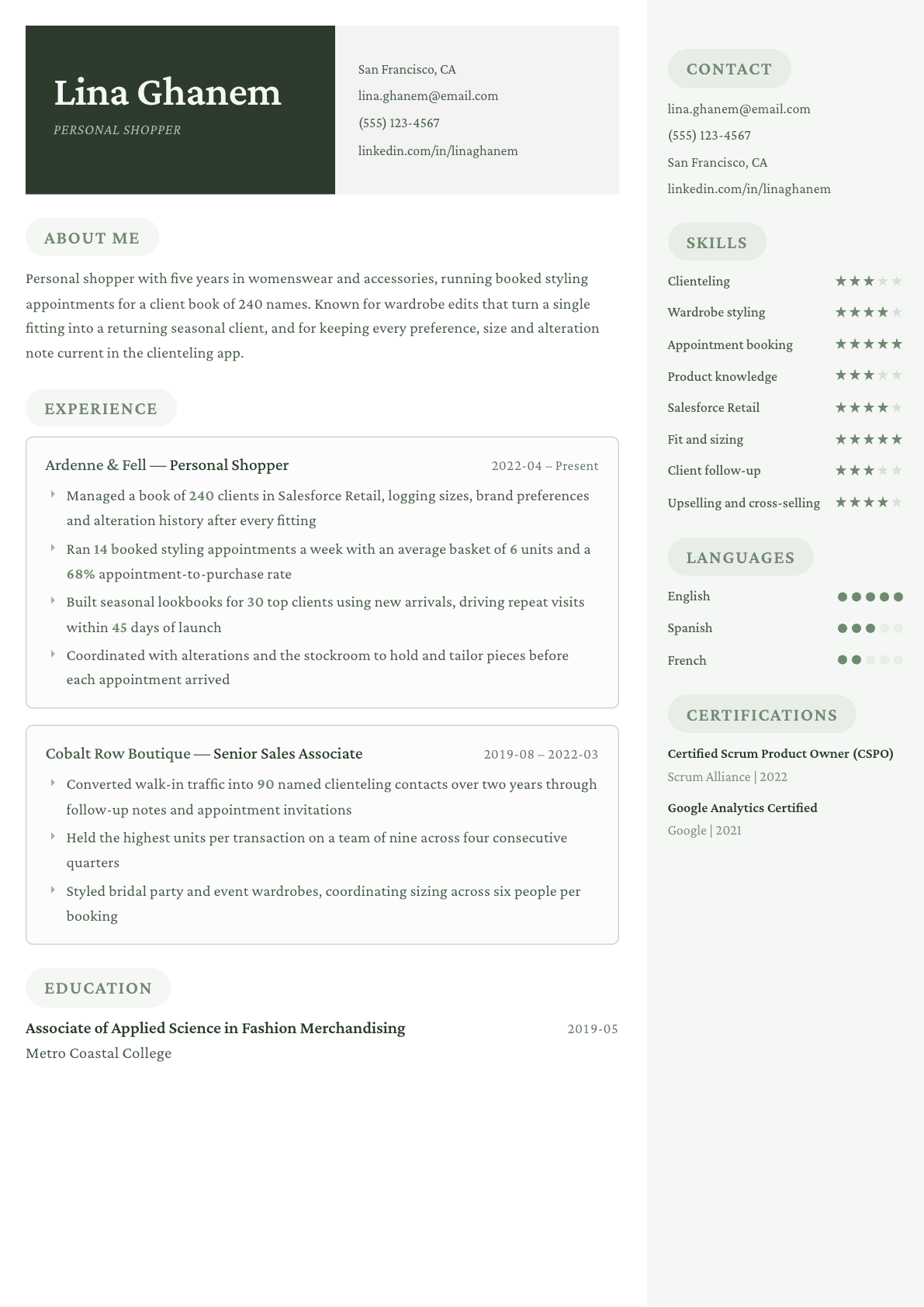
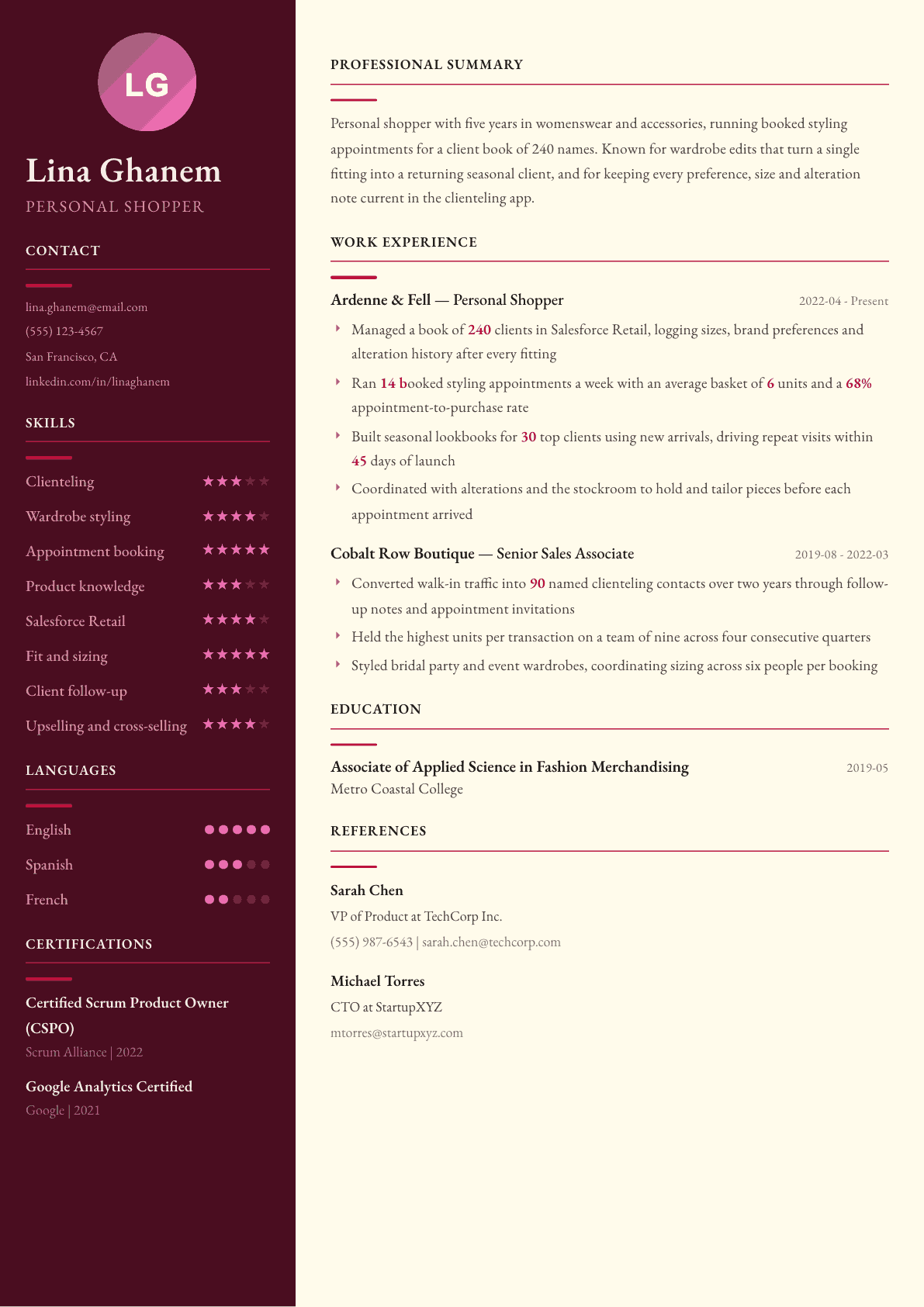
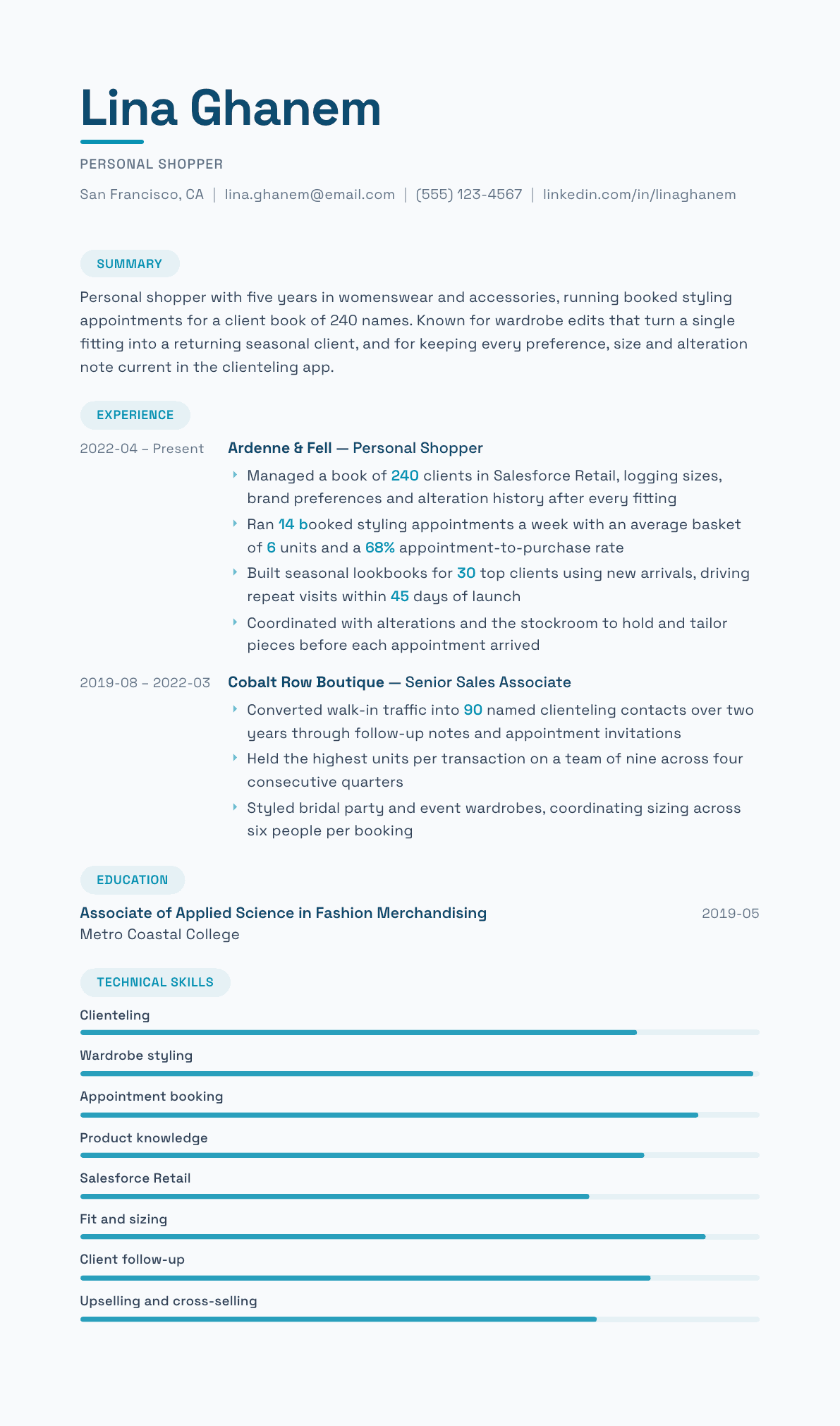
Example Personal Shopper summary
Personal shopper with five years styling womenswear and accessories for a booked client book of 240 names. Runs fourteen appointments a week, keeps preference and alteration notes current in a retail CRM, and turns first fittings into seasonal returns. Looking for a styling role in a store where clienteling is measured rather than assumed.
Skills to list on a Personal Shopper resume
- Clienteling
- Personal styling
- Wardrobe consultation
- Client book management
- Appointment selling
- Product knowledge
- Fit and alterations coordination
- CRM follow-up
- Upselling
- Visual presentation
- Stock transfers and holds
- Point of sale systems
- Gift and event styling
- Client retention
What actually gets this resume read
- Give the size of your client book and how many of those clients came back within a season.
- Name the clienteling system you worked in, whether that is Salesforce Retail, Tulip, Endear or a store-built CRM.
- Show appointment volume per week and the share that ended in a purchase, since managers hire on booked business.
- Describe the categories you style: womenswear, menswear, denim, occasion, bridal, footwear or fine jewelry.
- Include one bullet on how you work with alterations, stockroom holds and transfers, because that is half the job.
- Keep the resume to one page and put the client book and appointment numbers in the first job, not the summary alone.
How to write a personal shopper resume
A personal shopper resume is judged on one question: can you bring business with you, or do you need the store to hand you traffic? Everything else on the page is context. The selling manager who reads it wants the size of your client book, how often those clients come back, and what you keep on them in the system when they are not standing in front of you.
That is why a page full of warm adjectives fails here. Attentive, passionate and detail-oriented describe the whole applicant pile. The client book number, the weekly appointment count and the categories you can style credibly are the details that separate one applicant from the next.
This guide covers the format the selling floor expects, how to write the client book without exaggerating it, the appointment and follow-up bullets that read as real work, and the questions stylists ask when they move between a department store, an independent boutique and a private styling practice.
Format: one page, book and appointment numbers above the fold
Reverse chronological, one page unless you have more than a decade in luxury selling. Put the numbers that matter into the first job rather than saving them for an interview, because the reader is comparing your first job against someone else's first job.
Keep the layout single column and plain. Stylist resumes are often forwarded as attachments through a store's hiring portal, and a two-column design with icons tends to arrive with the dates in the wrong order.
- Header: name, city, phone, email, and a link to a styling portfolio only if the images are yours.
- Order: summary, experience, categories styled, systems, education, credentials.
- Add a short line naming the price points you have sold, from contemporary through designer.
The client book: say the number, then say what it does
A book of 240 names means nothing on its own. Say how many of those clients bought in the last season, how you contact them, and what triggers an outreach: new arrivals in their size, a preorder, an event, or a replenishment on something they wear out. That is what a manager is buying.
Be honest about portability. Many stylists cannot take a book with them, and a hiring manager knows it. What transfers is the method: how you capture a name at the register, what you record after a fitting, and how quickly you follow up. Write the method and the book number stops sounding like a boast.
Experience: appointments, baskets and the work behind the fitting
Lead each job with the store type and the categories: womenswear, menswear, denim, occasion, footwear, fine jewelry. Then give the weekly appointment count and what an average appointment looks like in units. A stylist doing fourteen booked fittings a week is running a different job from one taking whoever walks in.
The strongest bullets are the ones nobody thinks to write: pulling a room before the client arrives, holding pieces across sizes, arranging alterations and a pickup, sending a wear-and-care note after delivery. That preparation is the difference between a sale and a return, and experienced managers look for it.
Add one bullet on the events and moments you own. Trunk shows, preorder appointments, gifting weeks and bridal parties all produce dates and numbers you can use.
Systems and credentials: name the tools, skip the adjectives
Name the clienteling platform you worked in, whether that was Salesforce Retail, Tulip, Endear, Yotpo or a store-built tool, and say what you did inside it. Add the point of sale, the appointment scheduler and any remote selling channel you used, such as video appointments or a text-based outreach queue.
Formal credentials in styling are thin and that is fine. Image consulting certifications exist and are worth listing if you hold one, but no store rejects a stylist for not having one. What replaces a credential here is category depth: fabric, fit, tailoring vocabulary and the ability to talk about construction without reading a tag.
Keywords the store systems and the manager both scan
Large retailers screen applications before a human opens them, and the phrases repeat: clienteling, client book, styling appointments, units per transaction, average transaction value, client outreach, product knowledge, remote selling. Use each one where it is true, once in the summary or systems block and once inside a bullet with a real number attached.
Avoid stacking every luxury house name you have ever sold into a keyword strip. Name the brands you genuinely know well, because a selling manager will ask you to talk about one of them in the interview.
Personal Shopper resume summary examples
First styling role
Sales associate with two years in contemporary womenswear, moving into styling. Built 90 named clients from walk-in traffic through follow-up notes and appointment invitations, and held the highest units per transaction on a nine-person team for four quarters. Trained on fit, alterations intake and a store clienteling app.
Five years in
Personal shopper with five years across womenswear and accessories, running fourteen booked appointments a week for a book of 240 clients. Averages six units per fitting with a 68% appointment-to-purchase rate, and keeps sizes, preferences and alteration history current after every visit.
Lead stylist
Lead stylist with eleven years in designer and occasion wear, carrying a book of 400 clients and mentoring four junior stylists. Owns trunk show and preorder appointments, runs video styling sessions for out-of-market clients, and rebuilt the store outreach calendar around delivery dates rather than blanket sends.
Work experience bullets: before and after
Before: Provided excellent customer service to clients.
After: Ran 14 booked styling appointments a week, pulling a fitting room in advance from each client's recorded sizes, brand preferences and past purchases.
The rewrite names the volume and the preparation, which is the part of the job a manager cannot see from the sales floor.
Before: Built strong relationships with customers.
After: Grew a client book to 240 names and brought 60% of them back within the same season through new-arrival outreach in the clienteling app.
A relationship claim becomes evidence once it has a book size, a return rate and the channel that produced it.
Before: Helped increase store sales.
After: Averaged six units per appointment and led the department in average transaction value for three consecutive quarters.
Two selling metrics that stores actually track replace a claim no reader can verify.
Before: Assisted with alterations and special orders.
After: Coordinated alterations and stock transfers so pieces were tailored and ready at pickup, cutting returns on occasion wear to a handful a season.
It shows the operational half of styling and ties it to an outcome the store cares about.
Before: Worked with VIP customers.
After: Managed 30 top clients on a seasonal lookbook cycle, opening each season with a personal edit and a held appointment slot.
Naming the segment size and the cadence turns a vague status word into a repeatable program.
Hard skills
- Clienteling and client book management
- Styling appointment selling
- Wardrobe consultation
- Fit and alterations coordination
- Product and fabric knowledge
- Salesforce Retail
- Point of sale systems
- Stock transfers and holds
- Remote and video selling
- Seasonal lookbook building
- Trunk show and preorder events
- Sales reporting and daily goals
Soft skills
- Discretion with client information
- Reading a client quickly
- Follow-up discipline
- Honest fit feedback
- Composure at peak
- Cross-department coordination
Certifications worth listing
- AICI First Level Certification (FLC) (Association of Image Consultants International)
- AICI Certified Image Consultant (CIC) (Association of Image Consultants International)
- RISE Up Customer Service and Sales (National Retail Federation Foundation)
Mistakes that cost personal shopper candidates the interview
- Claiming a client book without a number, a return rate or a description of how it is maintained.
- Filling the page with adjectives about passion for fashion instead of appointment volume and basket size.
- Leaving out the clienteling system, which is the first tool question in a styling interview.
- Listing every designer house sold rather than the few you can discuss in real depth.
- Hiding the operational work: holds, transfers, alterations and pickups are what keep a client returning.
- Sending the same resume to a designer floor and an independent boutique when the price points and pace differ.
Personal Shopper resume questions
How big does a client book need to be for a personal shopper role?
There is no threshold, and stores know books do not always transfer. What matters is that you can state the size, the share who bought recently, and the outreach method behind it. A small, active book reads better than a large, dormant one.
Should a personal shopper resume include a portfolio link?
Only if the images are of work you actually styled and you have permission to show them. A link to a general mood board adds nothing. If you have styled editorial, events or bridal parties, a small gallery of those looks is worth including.
How do I move from sales associate to personal shopper?
Write the associate job as clienteling work. Count the named clients you captured, describe the follow-up notes you kept, and show any appointments you booked yourself. Then say plainly in the summary that you are moving into a booked styling role.
Do I need a certification to work as a personal shopper?
No. Stores hire on selling record, category knowledge and the ability to keep clients. An image consulting certification can help a freelance stylist look established to private clients, but it will not outweigh a weak selling history on a retail application.
What should a freelance personal shopper put in place of employers?
Run your practice as the employer entry with your business name, the years, and the client count you serve. Then describe the services by type, such as closet edits, seasonal refreshes and event styling, with the number of engagements delivered each year.