IT Consultant Resume Examples: free ATS score and gap list
Shape an IT Consultant Resume That Wins Client Confidence
By Mustafa Tarabya, founder of CVBooster · Published · Updated
Build a persuasive IT consultant resume showcasing strategic advisory skills, digital transformation expertise, and measurable business outcomes.
Sample resumes for a it consultant
The same it consultant content laid out in three CVBooster templates, so you can see what the finished document looks like before you write a word.
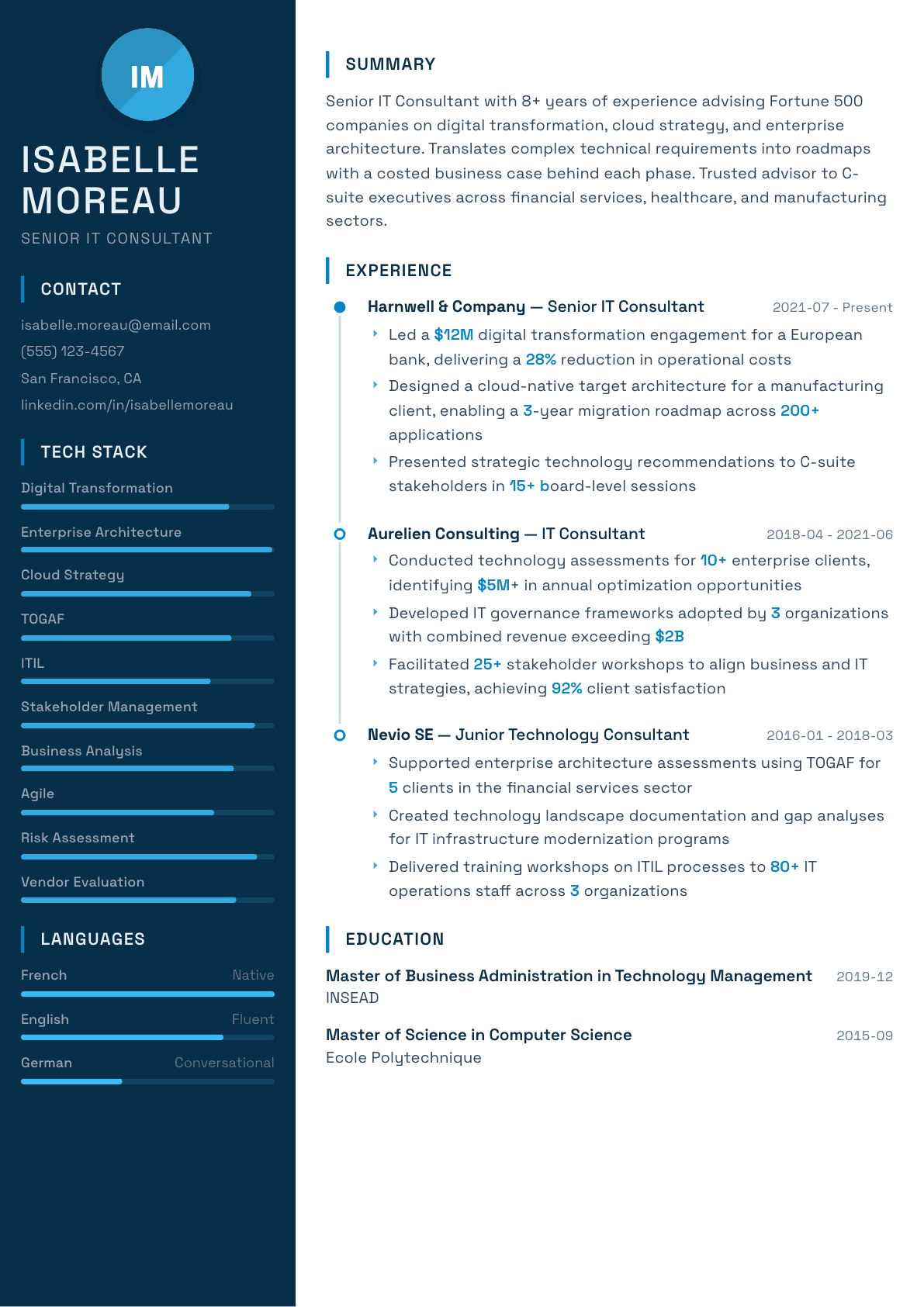
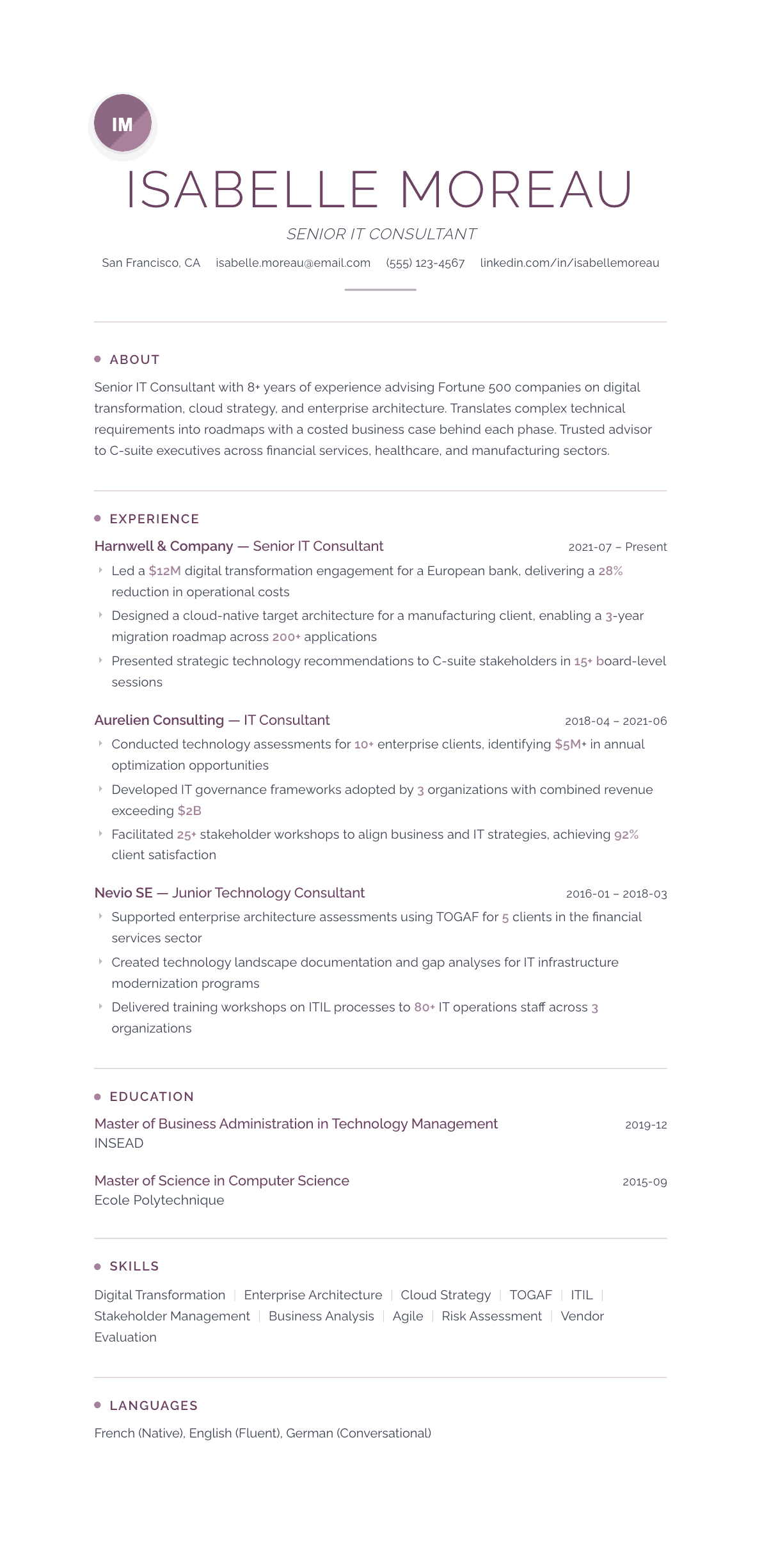
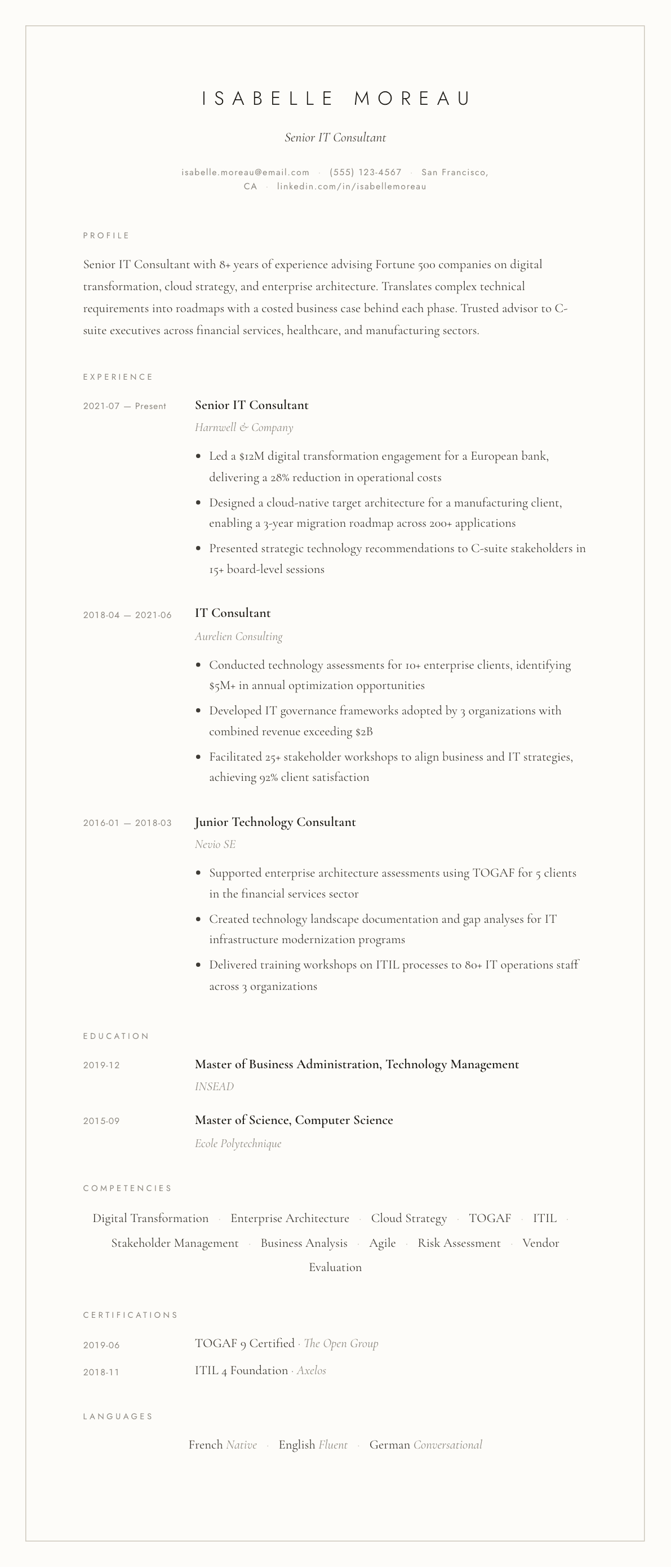
Example IT Consultant summary
IT Consultant with 8 years of experience advising Fortune 500 clients on digital transformation and cloud strategy. TOGAF-certified enterprise architect with a track record of delivering $12M+ engagements and 28% operational cost reductions. Trusted advisor to C-suite executives across financial services, healthcare, and manufacturing.
Skills to list on a IT Consultant resume
- Digital Transformation
- Enterprise Architecture
- Cloud Strategy
- TOGAF
- ITIL
- COBIT
- Stakeholder Management
- Business Analysis
- Agile
- Risk Assessment
- Vendor Evaluation
- Change Management
What actually gets this resume read
- Lead with business impact: cost savings, revenue growth, and ROI metrics from consulting engagements.
- Highlight framework expertise: TOGAF, ITIL, COBIT, or Zachman to establish enterprise architecture credibility.
- Show client diversity by naming industries and company scales you have advised.
- Include C-suite and board-level presentation experience to demonstrate executive communication skills.
- Mention specific transformation outcomes: cloud migrations, digital modernization, or process automation.
How to write a it consultant resume
An IT consultant is paid for judgment that a client acts on, so the resume has to prove the client acted. Anyone can describe an assessment or a roadmap. What a consulting partner or an internal hiring manager wants to see is a recommendation that was adopted, a system that changed as a result, and a business number that moved. Without that final link, an impressive engagement list reads like attendance.
The second thing a screener needs is your shape. Consulting spans infrastructure and migration work, enterprise architecture, package implementation, security advisory, service management, and change and adoption. Each has a different buyer inside the client. A resume that says technology consultant without naming the practice makes the reader guess, and guessing usually ends the review.
This guide covers how to structure engagements so a reader can scan them, how to write recommendations and outcomes without breaching client confidentiality, three summaries from analyst to principal, before and after bullets, and the questions consultants ask when moving between firms or into industry.
Format: two pages, engagements as the unit, not job titles
Two pages is standard for a consultant with several years of engagements. Reverse chronological by employer, then engagements nested underneath. Single column, no graphics, because consultancies and their clients both run applicant tracking systems and the parsing losses fall on the details that matter.
Each engagement gets a compact header: client sector, client size, your role, duration, and the team you worked in or led. Then two or three bullets. This structure is the fastest way for a partner to answer the question she is actually asking, which is whether you can be put in front of her clients next month.
- Header: name, city, email, professional profile link, and work authorization if you are crossing borders.
- Order: summary, practice areas as a short grouped block, experience with engagements, certifications, education.
- Where the client name is confidential, use a sector and size description that still lets a reader judge complexity.
Summary: practice, sectors, and the level you operate at
Three lines. Name the consulting practice you belong to, the sectors you know, and the level of client stakeholder you work with. Advising a chief information officer on a multi-year plan and running a workstream inside a delivery program are different jobs, and stating which one you do prevents both over-pitching and under-pitching.
Add one line of proof rather than an adjective. A named platform you have implemented repeatedly, a regulated sector you know the constraints of, or a method you can run from discovery through to a signed business case is worth more than any claim of being a trusted advisor.
Write the engagement as problem, work, decision, result
The strongest consulting bullet has four parts compressed into one sentence: what the client was struggling with, what you did, what they decided, and what changed. Most resumes stop at the second part, which is why they read as activity rather than impact.
Deliverables count as evidence when you name them and say who signed them off: a current state assessment, a target operating model, a target architecture, a business case, a vendor selection scorecard, a migration plan, or a risk register. Deliverables that were approved at a steering committee carry the weight, so say when they were.
Do not hide the commercial side. Scoping a statement of work, running a workstream to a budget, managing a vendor, presenting at a steering committee, and supporting a proposal that was won are all things consultancies hire for and most candidates omit entirely.
Depth: name the technology you are actually credible in
A consultant with no technical anchor is hard to place. Name the ground you can hold in a room full of client engineers: cloud migration on a specific provider, enterprise resource planning implementation, identity and access, network and connectivity, data platform work, service management under an established framework, or security and compliance against a named standard.
Then say what depth means. Having designed the target architecture, run the discovery workshops, built the migration wave plan, or led the vendor evaluation are all different, and clients ask which of them you personally did. Being straight about this is also protection, because consultancies check references against exactly these claims.
- Give client scale in users, sites, applications or countries, because complexity is what a consulting reader is pricing.
- Name the frameworks you have applied, such as ITIL for service management or TOGAF for architecture, only where you genuinely used them.
- Include workshop facilitation and stakeholder counts, since running a room is a core consulting skill and it is measurable.
Keywords in IT consulting postings
These postings repeat a recognizable vocabulary: digital transformation, cloud migration, enterprise architecture, stakeholder management, requirements gathering, gap analysis, target operating model, vendor selection, business case, governance, and the client-facing word advisory. Mirror the wording once in the practice block and once inside an engagement bullet. Also mirror the sector words, because consultancies staff by industry as much as by skill.
IT Consultant resume summary examples
Analyst or junior consultant
Technology consultant with two years on cloud migration and service management engagements in the public sector, running application discovery and building the dependency mapping behind two migration wave plans. Facilitates requirement workshops and produces the current state documentation that architects design against.
Six years in consulting
IT consultant with six years advising financial services and retail clients on cloud migration and enterprise architecture. Leads workstreams of up to eight people, owns the business case and vendor evaluation, and has taken three clients from assessment through to an approved multi-year technology roadmap.
Managing or principal consultant
Principal IT consultant with thirteen years across manufacturing, banking and healthcare, owning engagements from proposal through delivery. Advises executive sponsors on technology strategy and operating model, manages a team of twelve consultants, and has led two data center exits and one core platform replacement.
Work experience bullets: before and after
Before: Advised clients on digital transformation initiatives.
After: Ran a current state assessment across 180 applications for a mid-sized insurer, recommended retiring 40 of them, and the client approved the rationalization plan at the following steering committee.
The scope, the recommendation and the approval prove advice that was accepted, which is the whole product of consulting.
Before: Helped a client move to the cloud.
After: Built the migration wave plan for a retail client moving 90 applications to a public cloud, sequencing by dependency and business criticality so the peak trading period was excluded from every wave.
A sequencing decision made for a business reason shows consulting judgment rather than technical activity.
Before: Facilitated stakeholder workshops.
After: Facilitated 12 requirement workshops across four business units and reconciled conflicting priorities into a single ranked backlog that both the operations and finance sponsors signed.
Reconciling conflict between sponsors is the hard part of facilitation, and naming the sign-off makes it verifiable.
Before: Worked on vendor selection.
After: Ran a structured vendor evaluation for a service management platform, defining weighted criteria with the client, scoring four vendors against a scripted demonstration, and documenting the recommendation the board accepted.
The method is the value in a selection engagement, so describing the criteria and the process beats naming the winning vendor.
Before: Delivered projects on time and within budget.
After: Delivered a nine-month identity and access workstream to the approved budget, absorbing two scope changes through a formal change request rather than schedule slip, with monthly reporting to the program board.
Naming how scope change was handled is more credible than a general claim of hitting time and budget.
Hard skills
- Current state assessment
- Target operating model design
- Enterprise architecture
- Cloud migration planning
- Business case development
- Vendor selection and evaluation
- Requirements gathering
- Gap and dependency analysis
- IT governance frameworks
- ITIL service management
- Risk and issue management
- Statement of work scoping
- Data and application rationalization
- Executive reporting
Soft skills
- Client relationship building
- Workshop facilitation
- Structured communication
- Influencing without authority
- Handling ambiguity
- Managing difficult stakeholders
Certifications worth listing
- TOGAF Enterprise Architecture Practitioner (The Open Group)
- ITIL 4 Foundation (PeopleCert)
- Project Management Professional (PMP) (Project Management Institute)
- PRINCE2 Practitioner (PeopleCert)
- AWS Certified Solutions Architect, Associate (Amazon Web Services)
- Microsoft Certified: Azure Solutions Architect Expert (Microsoft)
- Certified Information Systems Security Professional (CISSP) (ISC2)
- Certified Information Systems Auditor (CISA) (ISACA)
Mistakes that cost it consultant candidates the interview
- Listing engagements without saying what the client decided afterward, which turns a career of advice into a list of meetings attended.
- Using the phrase trusted advisor instead of naming an executive sponsor you actually presented to and what they approved.
- Hiding behind client confidentiality entirely, when sector, size and complexity can be described without naming anyone.
- Claiming every practice area, so a staffing manager cannot see which client conversation to put you into.
- Leaving out team size and role on each engagement, making it impossible to tell whether you led the workstream or contributed to it.
- Writing an industry-style resume for a consultancy application, with job titles and duties instead of engagements and outcomes.
IT Consultant resume questions
How do I write about clients I cannot name?
Describe the sector, the approximate size, and the complexity that matters, such as the number of applications, sites or countries. Consulting reviewers read this format constantly and care about the work rather than the logo.
Should an IT consultant resume list every engagement?
No. Keep the last three to five in detail and group older ones in a short line by sector and type. A reviewer wants depth on recent, relevant work rather than a complete chronology of short assignments.
How do I move from IT consulting into an industry role?
Translate engagements into ownership language and emphasize the parts that continued after you left, such as an implemented platform or an adopted operating model. Industry hiring managers worry consultants leave before consequences arrive, so answer that directly.
Do certifications matter for IT consultants?
They help at screening and in client-facing proposals, where firms list credentials to justify rates. Architecture, service management and cloud platform certifications carry the most weight, but engagement outcomes still decide the interview.
What if my consulting work was mostly documentation?
Name the deliverable, who approved it and what it enabled. An assessment that led to a funded program is a real outcome, and framing documents by the decision they supported separates you from candidates who list document names alone.
Related resume examples
- Solutions Architect Resume example
- IT Project Manager Resume example
- Systems Architect Resume example
- Chief Digital Officer Resume example
- IT Director Resume example
- IT Business Analyst Resume example