Chief Digital Officer Resume Examples: read this first
Position a Chief Digital Officer Resume for Board Level Hiring
By Mustafa Tarabya, founder of CVBooster · Published · Updated
A chief digital officer resume guide with an executive sample, the transformation numbers boards ask about, keyword lists, and section by section advice.
Sample resumes for a chief digital officer
The same chief digital officer content laid out in three CVBooster templates, so you can see what the finished document looks like before you write a word.
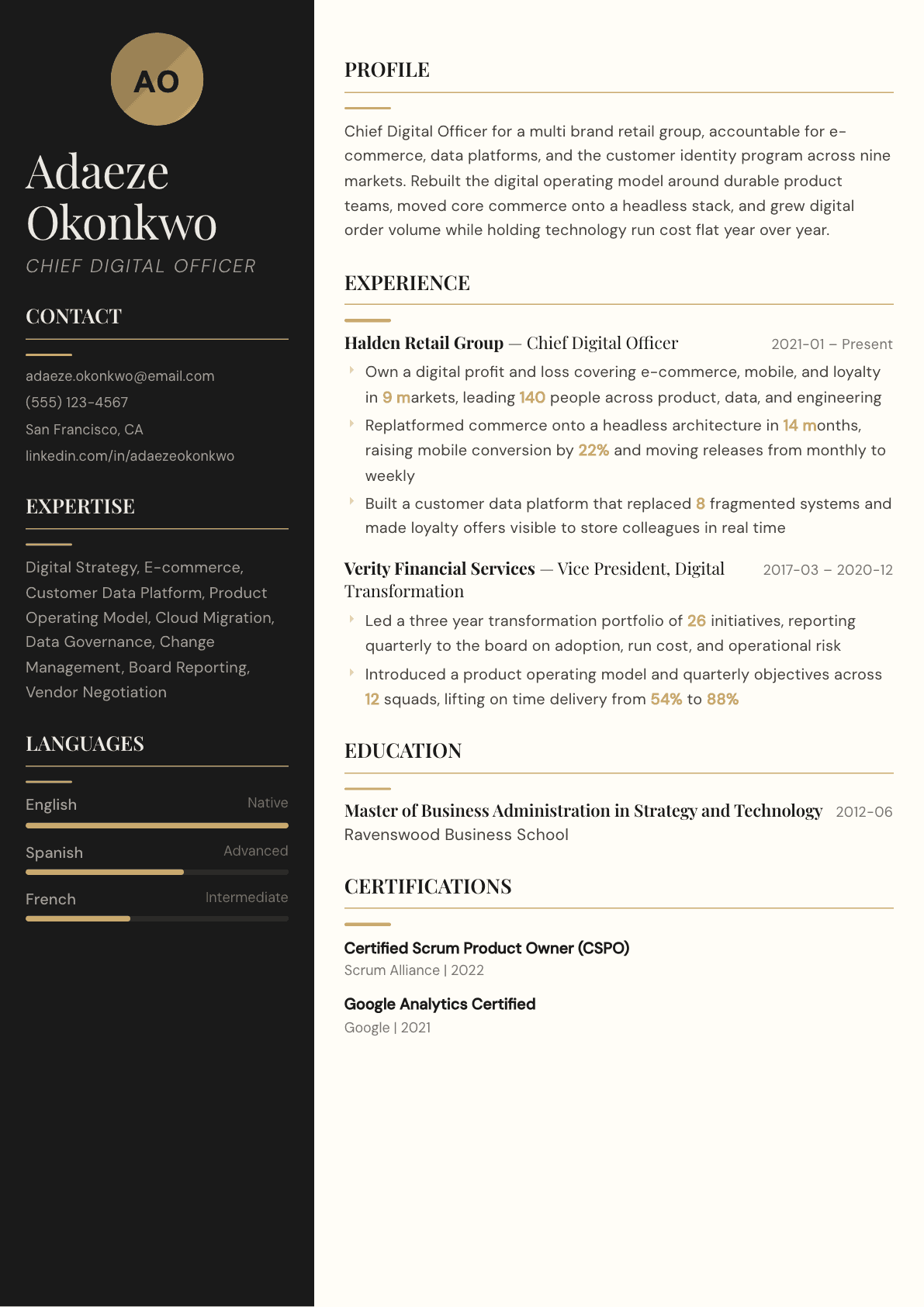
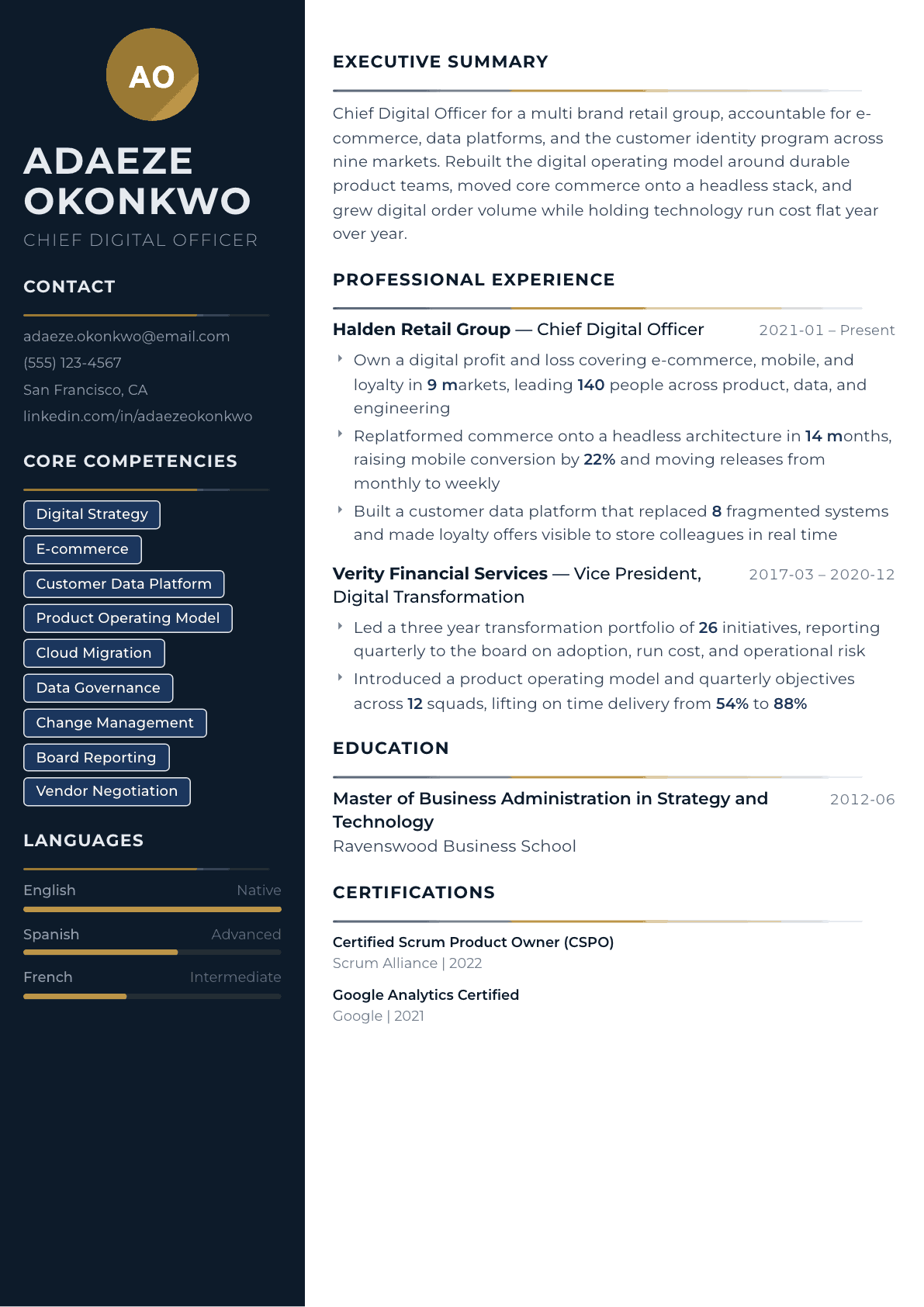
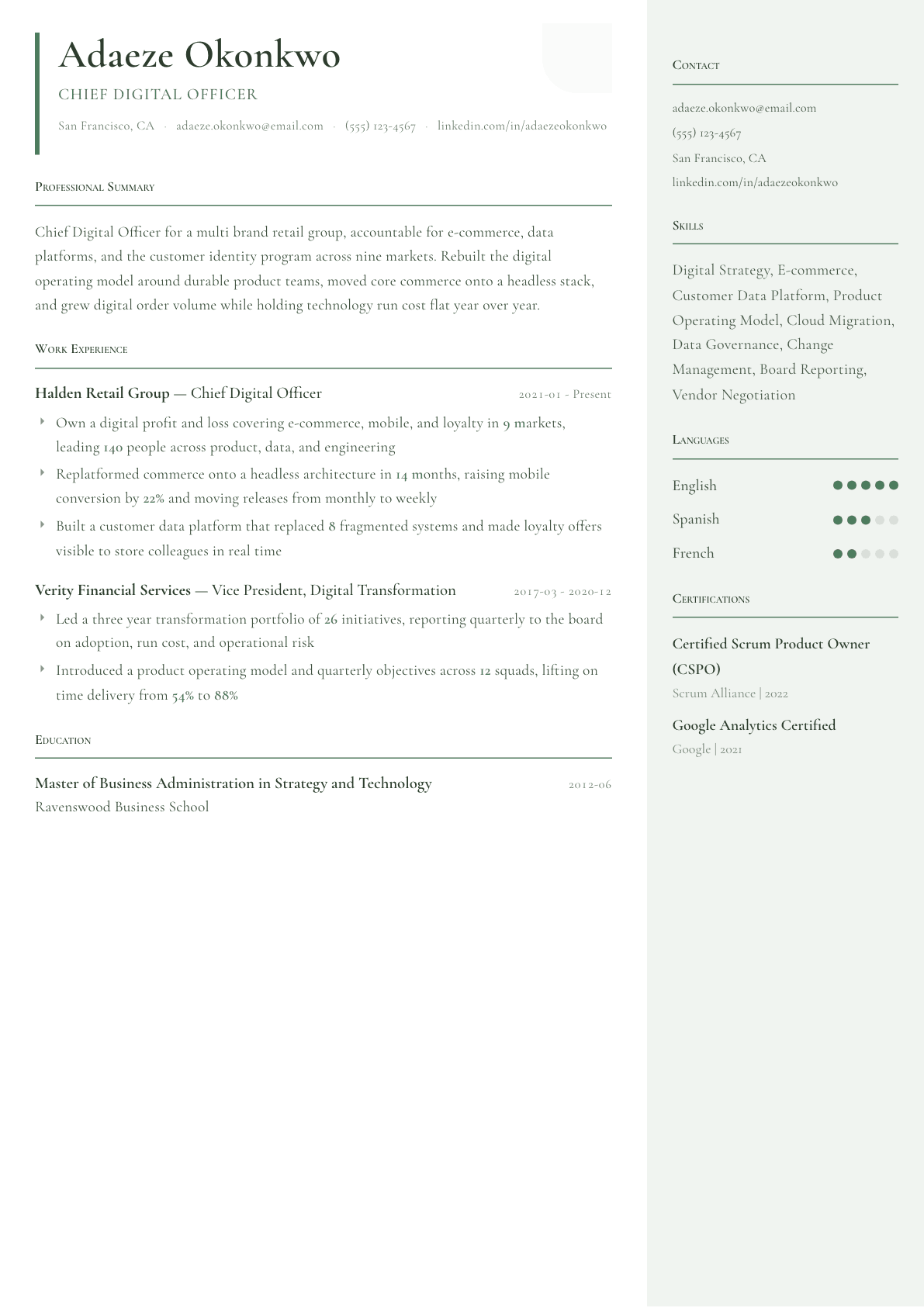
Example Chief Digital Officer summary
Chief Digital Officer with twelve years leading digital and technology change across retail and financial services. Carries a digital profit and loss in nine markets, replatformed commerce onto a headless stack, and consolidated customer data into one platform used by store and contact center teams alike. Reports to the board on adoption, run cost, and digital risk, and has coached four direct reports into director roles.
Skills to list on a Chief Digital Officer resume
- Digital Strategy
- Digital Transformation
- E-commerce Growth
- Product Operating Model
- Customer Data Platform
- Data Governance
- Cloud Migration
- Omnichannel Experience
- Marketing Technology
- Vendor Management
- Board Reporting
- Change Management
- Digital Profit and Loss Ownership
- Agile Portfolio Governance
- Cybersecurity Oversight
What actually gets this resume read
- Open with the digital profit and loss you carry, the market count, and the team size, because those three numbers set your operating altitude.
- Frame transformation as business outcomes such as digital revenue mix and cost to serve, never as a count of completed projects.
- Name the platforms you selected and the reason, since a board wants evidence of judgment on build against buy decisions.
- Show the operating model change you led, including team structure, funding model, and how decision rights were rewired.
- Include audit committee and board exposure, because this role is partly hired to be a credible technology voice in that room.
- Balance customer facing wins against data governance and cyber risk work, since regulators and directors will probe both areas.
How to write a chief digital officer resume
A chief digital officer resume is rarely read by a recruiter first. It is read by an executive search consultant preparing a shortlist for a nomination committee, and by the chief executive who has to decide whether digital sits beside the business or inside it. Both are asking the same question: has this person changed how a company earns money, or only run a program of projects that finished on time?
The title is also inconsistent across companies. In one group it owns e-commerce revenue and a real profit and loss. In another it is a change function with influence and no budget. Because of that ambiguity, the first six lines of the resume have to define the mandate you held, or every reader will assume the smaller version.
This guide sets out the section order search consultants expect, three summaries covering different routes into the seat, before and after bullets that survive a board reading, the credentials worth listing, and the questions candidates ask when they move from a divisional role into an enterprise one.
Format: two pages, executive profile first
Two pages is the ceiling. A search consultant reads the first half of page one to decide whether to open the file properly. Use a single column, a conservative typeface, and a short profile block that names your scope: markets, revenue responsibility, team size, and the functions reporting to you.
Underneath the profile, add three or four selected achievements written as outcomes rather than initiatives. This is the block that survives being pasted into a candidate summary document, so make each line stand alone without the context of the job it came from.
- Header: name, city, phone, email, and a public professional profile link.
- Order: executive profile, selected achievements, experience, board and advisory roles, education.
- Keep a governance line naming the committees you presented to and the risk areas you owned.
Profile: mandate, scope, and the model you built
State whether your mandate was growth, turnaround, or building a capability that did not exist. Then give the scope in numbers a director recognizes: markets, digital revenue share, headcount across product, data, and engineering, and whether the budget was yours or borrowed from the technology function.
Add one line on the operating model you built. Directors have watched enough transformation programs to know that a set of squads without funding reform or clear decision rights collapses back within two years, so naming what you changed structurally carries weight.
Experience: business outcomes, not project completions
Write each role with the same three part rhythm: the scope you held, the two or three moves you made, and what changed in the business as a result. Digital revenue mix, cost to serve, customer retention, and time to market are the outcomes that read as leadership. A count of delivered initiatives reads as portfolio administration.
Platform decisions deserve a bullet each, with the constraint behind them. Choosing a headless commerce architecture because the group runs nine markets on three legacy stacks is a judgment call worth explaining. Naming the vendor with no reasoning is not.
Include the harder half. Consolidating fragmented customer data, retiring systems, renegotiating a large vendor agreement, and closing audit findings are the work that makes the customer facing wins possible, and experienced readers look for them specifically.
Governance, risk, and the board relationship
A digital leader at this level is expected to speak credibly about data protection, cyber posture, and the regulatory obligations attached to customer data. Give one short block that names the committees you reported into, the risk areas you owned, and any external audit or regulatory review you carried the organization through.
If you have held a non executive or advisory seat, list it separately near the end. It signals that you have sat on the other side of the table and understand what a board actually wants to hear in twenty minutes.
Keywords search consultants and systems both look for
Executive searches still run through databases, and the terms are predictable. Digital transformation, digital strategy, e-commerce, omnichannel, customer data platform, product operating model, data governance, cloud migration, and marketing technology all appear in the briefs. Use them once in the profile and once inside a bullet where they are attached to a result, and never in a keyword block that a human reader will find hollow.
Chief Digital Officer resume summary examples
First enterprise level digital seat
Digital leader stepping up from a divisional role, previously accountable for e-commerce and customer experience in two markets with a team of 40. Rebuilt the online journey, raised digital order share by 9 points, and now leads group digital strategy across six markets reporting to the chief executive.
Established in the role
Chief Digital Officer with six years in the seat across retail and consumer services. Owns digital revenue in nine markets, replatformed commerce onto a headless architecture, and consolidated eight source systems into one customer data platform. Reports quarterly to the board on adoption, run cost, and data risk.
Group level and board facing
Group Chief Digital Officer for a multi brand organization, accountable for digital revenue, data, and the technology partnership model across three business units. Led a four year transformation that moved digital from a channel to a profit center, and now chairs the group data governance forum.
Work experience bullets: before and after
Before: Led the digital transformation program for the group.
After: Led a three year transformation across nine markets that moved digital from 11% to 27% of group revenue while holding technology run cost flat.
A revenue mix shift with a cost constraint is a business outcome; a program name is only an activity.
Before: Implemented a new e-commerce platform.
After: Replatformed commerce onto a headless architecture in 14 months to unify three legacy stacks, lifting mobile conversion by 22% and moving releases from monthly to weekly.
The reason for the choice and two operational effects show judgment rather than procurement.
Before: Introduced agile ways of working across the technology teams.
After: Replaced project funding with persistent product teams across 12 squads, published decision rights and quarterly objectives, and raised on time delivery from 54% to 88%.
Naming the funding and decision rights change explains why the delivery number moved and held.
Before: Improved the use of customer data across the business.
After: Consolidated 8 fragmented customer systems into a single data platform with a consent model reviewed by the group privacy officer, making loyalty offers available to store colleagues in real time.
Consolidation count, the privacy review, and a concrete use case make a vague data claim verifiable.
Before: Managed relationships with technology vendors.
After: Renegotiated the two largest platform agreements into outcome based contracts with exit clauses, cutting annual run cost by 15% and removing a single supplier dependency flagged in the audit review.
The contract structure and the audit link show commercial and risk literacy, not vendor administration.
Hard skills
- Digital strategy and roadmap
- E-commerce and marketplace growth
- Product operating model design
- Customer data platform delivery
- Data governance and consent management
- Cloud and platform migration
- Marketing technology architecture
- Digital profit and loss ownership
- Vendor and contract negotiation
- Agile portfolio governance
- Cyber and privacy oversight
- Omnichannel customer journey design
Soft skills
- Board and committee communication
- Executive peer influence
- Change leadership at scale
- Talent attraction and succession
- Commercial negotiation
- Comfort with ambiguity
Certifications worth listing
- Certified Information Privacy Manager (CIPM) (International Association of Privacy Professionals)
- Chartered Director (Institute of Directors)
- Certified in the Governance of Enterprise IT (CGEIT) (ISACA)
Mistakes that cost chief digital officer candidates the interview
- Leaving the mandate undefined, so a reader assumes the influence only version of the role rather than the accountable one.
- Listing transformation programs by name and budget without saying what changed in customer behavior or margin.
- Writing three pages of narrative when a search consultant will read half of page one before deciding.
- Omitting data governance, privacy, and cyber work, which nomination committees now treat as core to the seat.
- Crediting a whole leadership team for every result, which makes it impossible to see what you personally decided.
- Using vendor product names as achievements, when the reader wants the constraint you solved by choosing them.
Chief Digital Officer resume questions
How is a chief digital officer resume different from a chief information officer resume?
The digital resume leads with revenue, customer behavior, and the operating model, while the information officer resume leads with infrastructure, service reliability, and enterprise systems. If your history is mostly internal technology, reframe it around customer and commercial outcomes before applying.
Should I include a digital profit and loss figure?
Include the scope in relative terms, such as digital share of group revenue or the number of markets you carried, rather than an absolute figure that may be commercially sensitive. Search consultants care about proportion and accountability more than the exact number.
How long should this resume be?
Two pages, with a separate one page board biography for nomination committees. Anything longer competes with the candidate report the search firm writes about you, and the extra detail rarely survives into that document anyway.
What do I do if my transformation was cut short?
Say what was delivered before the change in direction and what you learned about sequencing. Directors have all seen programs stopped by a merger or a funding reset, and a candid line reads far better than an achievement that quietly overstates what reached customers.
Do I need an advanced degree for this role?
It is common but not decisive. A business degree helps when you are moving from a technology background into a commercially accountable seat, though evidence of owning revenue and rebuilding an operating model outweighs any qualification on the page.
Related resume examples
- CTO Resume example
- IT Director Resume example
- Digital Transformation Consultant Resume example
- Innovation Director Resume example
- IT Consultant Resume example
- CISO Resume example