Diversity & Inclusion Manager Resume Examples: free score
Create a Diversity & Inclusion Manager Resume That Drives Change
By Mustafa Tarabya, founder of CVBooster · Published · Updated
Build a compelling D&I Manager resume showcasing inclusive culture initiatives, measurable representation improvements, and ERG leadership experience.
Sample resumes for a diversity & inclusion manager
The same diversity & inclusion manager content laid out in three CVBooster templates, so you can see what the finished document looks like before you write a word.
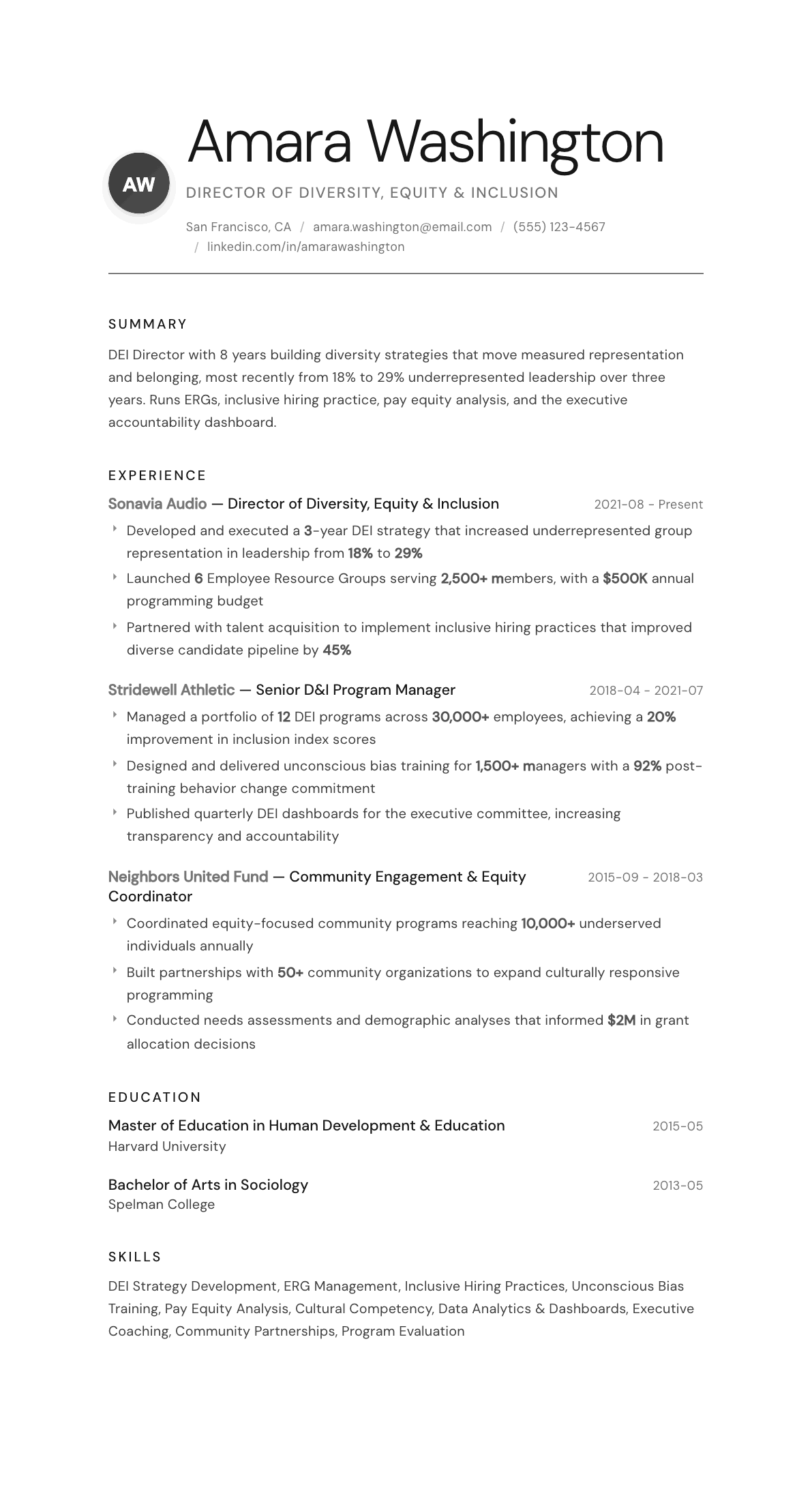
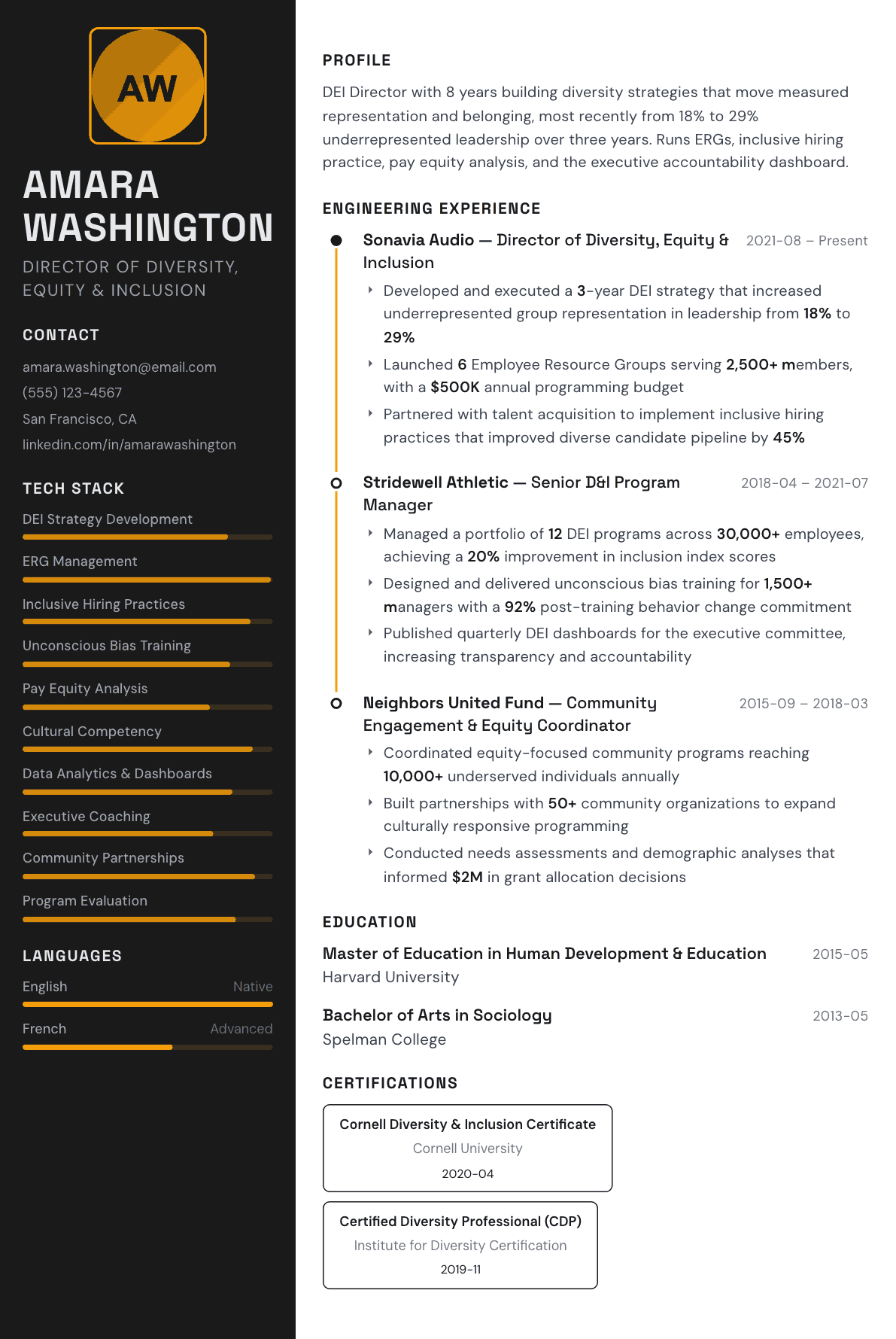
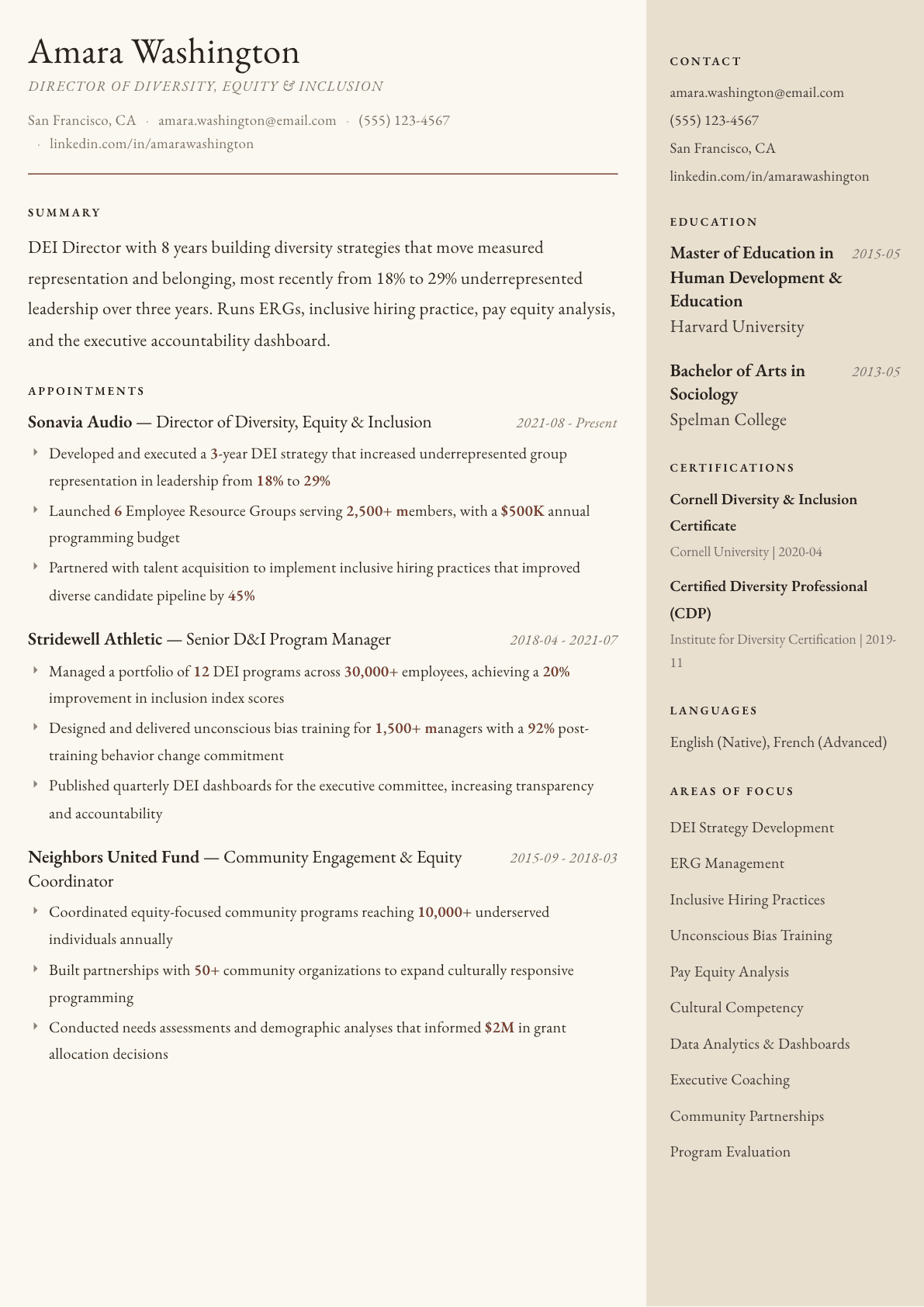
Example Diversity & Inclusion Manager summary
DEI leader, 8 years, building inclusion programs at organizations of up to 30,000 staff. Moved underrepresented leadership representation from 18% to 29%, launched 6 ERGs serving 2,500 members, and raised the inclusion index 20 points. Looking for a mission-aligned organization.
Skills to list on a Diversity & Inclusion Manager resume
- DEI Strategy
- ERG/BRG Management
- Inclusive Hiring
- Unconscious Bias Training
- Pay Equity Analysis
- Cultural Competency
- Belonging & Engagement
- Data-Driven DEI Metrics
- Executive Accountability
- Community Partnerships
- Supplier Diversity
- Accessibility & ADA
- Intersectionality Frameworks
- Program Evaluation
What actually gets this resume read
- Lead with measurable representation data: percentage increases in underrepresented groups at all levels, especially leadership.
- Highlight ERG/BRG leadership, membership growth, and programming budgets managed.
- Showcase inclusive hiring initiatives with specific pipeline and conversion metrics.
- Include training delivery experience with participation numbers and behavior change outcomes.
- Demonstrate business alignment by connecting DEI initiatives to retention, engagement, innovation, or revenue impact.
- Mention pay equity analysis work and accountability frameworks for leadership.
How to write a diversity & inclusion manager resume
A diversity and inclusion manager resume is read by a chief people officer, a head of talent or a hiring committee that has usually been burned once already, either by a program that produced a lot of activity and no measurable change, or by one that moved numbers without ever winning over the managers who had to live with it. They are screening for a candidate who can do both halves.
The strongest resumes for this role read like program management rather than like a statement of values. Population and structure of the organization, where the representation gaps sat, which levers you pulled, who owned the outcome, what the measurement instrument was, and what moved. Values belong in the interview. The page has to show a practitioner who can design a program, get budget approved, hold executives to a commitment and report an honest number.
This guide sets out the sections a people leader expects, how to write inclusion work so it survives a skeptical reader, the metrics that hold up, three summaries at different levels, and the mistakes that make an experienced practitioner look like an enthusiast.
Format: one page under eight years, organization profile under each role
Reverse chronological, one clean column. Resist the urge to decorate a resume for this role with color blocks and icons; the reader is checking rigor, and a plain page that parses cleanly through an applicant tracking system is the better choice.
Under each employer, write an organization profile: sector, headcount, sites and countries, workforce composition in broad terms such as corporate against frontline, whether the function reported into human resources or to the chief executive, and the budget and team you had. Where the role sat in the reporting line matters enormously in this field and readers look for it.
- Header: name, city and state, phone, email, and a plain link to a professional profile.
- Order: summary, program experience with organization profiles, measurement and analytics, education, certifications, speaking and publications.
- A short block for programs designed and delivered is useful when your work spans several employers or a consulting practice.
Summary: the population, the lever, the movement
Three lines. The scale and type of workforce, the strategy horizon you owned, the levers you specialize in, and one measured outcome. Specialization is real in this field: some practitioners are strongest in hiring and pipeline work, some in employee resource group and belonging programs, some in pay equity and data, some in supplier diversity or accessibility.
Do not open with a personal mission statement. A people leader reading a stack of these has seen fifty and they all sound alike; the outcome sentence is what makes the reader keep going.
Experience: levers, ownership and honest measurement
Organize your bullets by lever rather than by activity. Hiring: structured interviews, panel composition, requirement rewrites, sourcing partnerships and slate requirements, with the effect on the pipeline and on offer acceptance. Advancement: calibration processes, sponsorship programs, promotion rate analysis and succession slates. Retention: exit and stay interview themes, inclusion index by group, and manager behavior change. Pay: equity analysis and remediation done with the compensation team.
Employee resource groups belong here, but write them as an operating program: number of groups, membership, budget, executive sponsorship, leader development for the group chairs, and the business contributions the groups made to recruiting, product or community work. A group count with no structure behind it reads as a social calendar.
Show governance. Who was accountable for the targets, how often the executive team reviewed them, what the dashboard contained, and what happened when a business unit missed. The credibility of this role rests almost entirely on whether accountability was real, so say how it worked.
- Hiring levers: structured interviewing, requirement and job posting rewrites, diverse slate practices, partnership pipelines, offer and acceptance analysis.
- Advancement levers: calibration review, sponsorship pairing, promotion rate analysis, succession slate composition.
- Culture levers: inclusion index measurement, manager capability programs, employee resource group operations, accessibility and accommodation processes.
- Governance: executive dashboards, business unit targets, quarterly review cadence, external reporting where the organization publishes it.
Measurement: the part that decides whether you are believed
Name the instrument and the population every time. Representation at a level, an inclusion index from a named engagement survey, promotion rate by group, regretted attrition by group, and pay gap analysis run with the compensation team are all defensible. Training completion counts and event attendance are activity, not outcome, and an experienced reader discounts them.
Be careful and precise with representation figures. Give the level, the population and the timeframe, and never present a number in a way that implies more precision than the underlying self identification data supports. A candidate who is careful on paper is trusted with sensitive data in the job.
Working with the business, including the skeptics
The hardest part of this job is not designing programs, it is getting line leaders to run them when they are busy. Show that you have done it: joint ownership with a business unit head, a change built into an existing management routine rather than added beside it, a manager training that was measured on behavior rather than attendance, and a difficult conversation that ended in a commitment.
Where you have handled resistance, say so plainly. A candidate who can describe holding a program together through a budget cut or a change in executive appetite is far more employable than one whose record only covers the easy years.
Diversity & Inclusion Manager resume summary examples
Program specialist
Inclusion program specialist supporting a 4,000-person organization, coordinating four employee resource groups with 1,200 members and a modest programming budget. Rebuilt the interview guide library into structured formats for 60 hiring managers and produced the quarterly representation dashboard for the leadership team.
Inclusion manager
Diversity and inclusion manager for a 9,000-person company, running a portfolio of 12 programs across hiring, advancement and belonging. Lifted the inclusion index by 20% over two survey cycles, delivered manager capability training to 1,500 leaders, and published the quarterly dashboard that made business unit targets visible.
Head of inclusion
Head of diversity, equity and inclusion setting a three-year strategy for a global workforce, reporting to the chief people officer. Raised representation of underrepresented groups in leadership from 18% to 29%, launched six employee resource groups serving 2,500 members, and built the executive accountability model behind both.
Work experience bullets: before and after
Before: Led diversity and inclusion initiatives across the company.
After: Owned a portfolio of 12 inclusion programs across hiring, advancement and belonging for a 9,000-person organization, with a defined budget, two direct reports and a quarterly review at the executive committee.
Portfolio size, population, resources and governance turn a broad claim into a job a reader can size.
Before: Increased diversity in leadership positions.
After: Raised representation of underrepresented groups at director level and above from 18% to 29% over three years by requiring balanced interview panels, adding sponsorship pairings for 40 senior managers and reviewing every promotion slate before approval.
The three named levers explain how the movement happened, which is what a skeptical reader is looking for.
Before: Launched employee resource groups.
After: Launched six employee resource groups reaching 2,500 members, each with an executive sponsor, an annual plan tied to recruiting or community goals, and a leadership development track for the group chairs.
Structure, sponsorship and a business link separate a real program from a set of social committees.
Before: Delivered unconscious bias training to managers.
After: Delivered inclusive hiring workshops to 1,500 managers, replacing a single awareness session with a three-part sequence tied to the interview guide and measured by panel composition and structured interview use rather than attendance.
Measuring behavior change instead of completion is the difference between training as activity and training as intervention.
Before: Reported on diversity metrics to leadership.
After: Published a quarterly dashboard showing representation, promotion rate, regretted attrition and inclusion index by business unit, and ran the review where each leader explained their movement to the executive committee.
Naming the metrics and the accountability forum shows the reporting had consequences attached.
Hard skills
- Inclusion strategy design
- Representation and workforce analytics
- Structured interviewing and hiring process design
- Employee resource group operations
- Inclusion index and survey measurement
- Pay equity analysis partnership
- Accessibility and accommodation programs
- Supplier diversity programs
- Manager capability program design
- Executive dashboard and reporting
- Succession and promotion slate review
- Community and campus partnership development
Soft skills
- Persuading skeptical leaders
- Facilitating difficult conversations
- Program discipline
- Discretion with identity data
- Coalition building across functions
- Steadiness when priorities shift
Certifications worth listing
- Certified Diversity Professional (CDP) (Institute for Diversity Certification)
- Certified Diversity Executive (CDE) (Institute for Diversity Certification)
- Inclusive Workplace Culture Specialty Credential (Society for Human Resource Management)
- Diversity and Inclusion Certificate Program (Cornell University ILR School)
- SHRM Senior Certified Professional (SHRM-SCP) (Society for Human Resource Management)
Mistakes that cost diversity & inclusion manager candidates the interview
- Opening with a personal mission statement instead of an outcome, which is how every resume in this field begins.
- Counting activity as results. Training sessions delivered and events held are inputs, and experienced readers discount them.
- Leaving out the reporting line, the budget and the team, so the reader cannot tell whether you had the authority to change anything.
- Presenting representation figures without the level, the population or the timeframe attached.
- Describing employee resource groups as a count with no sponsorship, budget or business link behind them.
- Avoiding any mention of resistance or setbacks, which makes a record read as untested rather than successful.
Diversity & Inclusion Manager resume questions
What metrics belong on a diversity and inclusion manager resume?
Representation at named levels, promotion rate and regretted attrition by group, inclusion index movement from a named survey, and pay equity outcomes worked with the compensation team. Always attach the population and the timeframe so the figure can be interpreted.
How do I write this resume if my programs did not move representation?
Show the levers you built and the intermediate results: structured interviews adopted, slate composition, manager capability measured by behavior, employee resource groups operating with real sponsorship. Building durable infrastructure is a legitimate outcome and honest reporting is a hiring signal in itself.
Should I include volunteer and community work in this field?
Yes, when it is substantial and relevant: board service for a community organization, a mentoring program you built, or a partnership you brokered. Keep it to a short section with the organization, your role and what you actually delivered.
Do I need a diversity certification to be competitive?
It is not required, and operating results outweigh it. A recognized diversity practitioner credential or a university certificate does help when you are moving into the field from another human resources discipline and need to signal formal grounding rather than only conviction.
How do I show I can work with leaders who are resistant to this work?
Write one bullet about a program you got adopted by a business unit that did not ask for it: how you attached it to an existing management routine, what the leader was accountable for afterwards, and what changed. That single bullet is often the most persuasive line on the page.
Related resume examples
- HR Manager Resume example
- Employee Relations Specialist Resume example
- Chief People Officer Resume example
- Employee Engagement Manager Resume example
- HR Data Analyst Resume example
- Human Resources Resume example