Employee Engagement Manager Resume Examples: free score
Write an Employee Engagement Manager Resume Built on Survey Evidence
By Mustafa Tarabya, founder of CVBooster · Published · Updated
Create an employee engagement manager resume with a worked example, the survey and retention detail HR leaders check, keywords and a full guide.
Sample resumes for a employee engagement manager
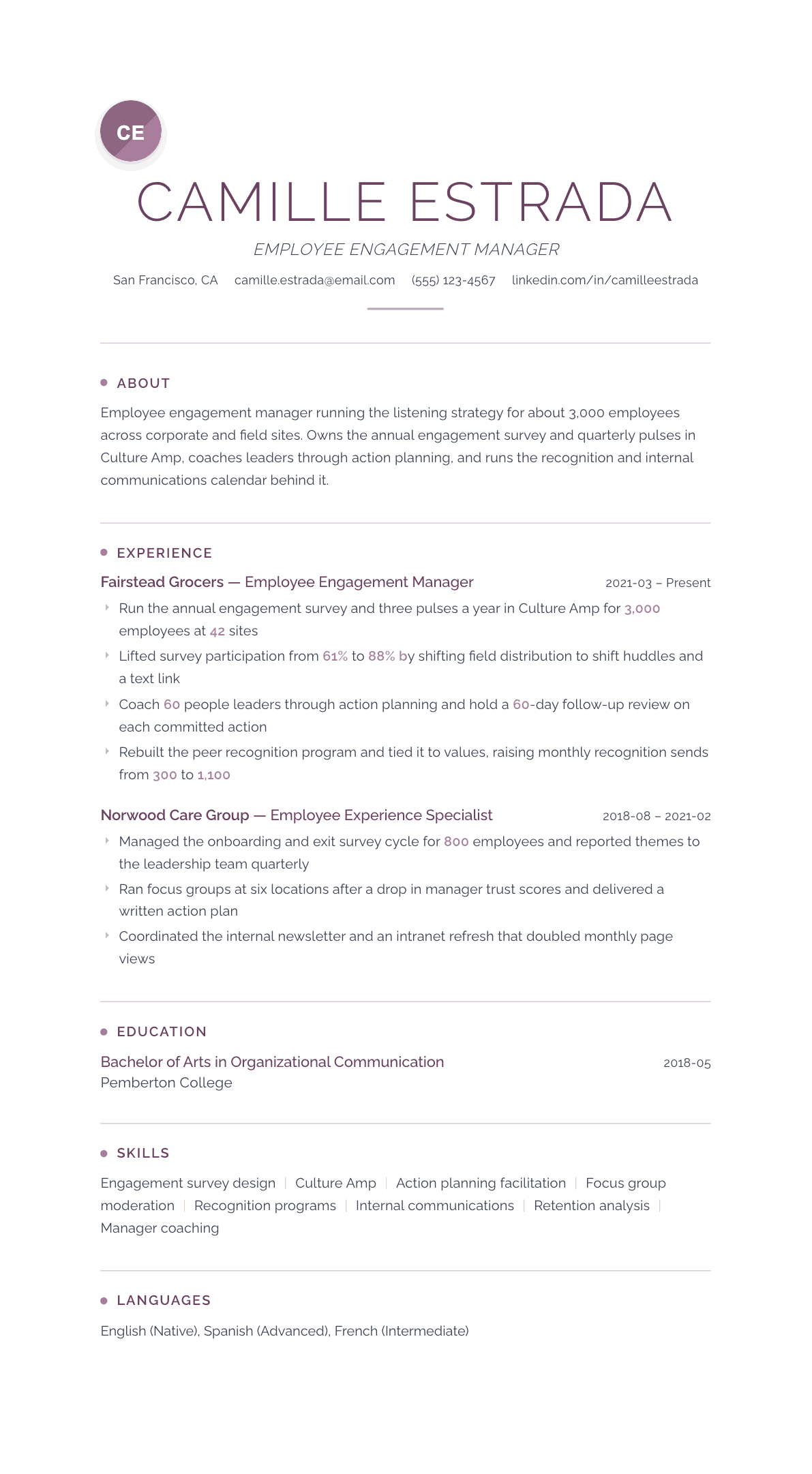
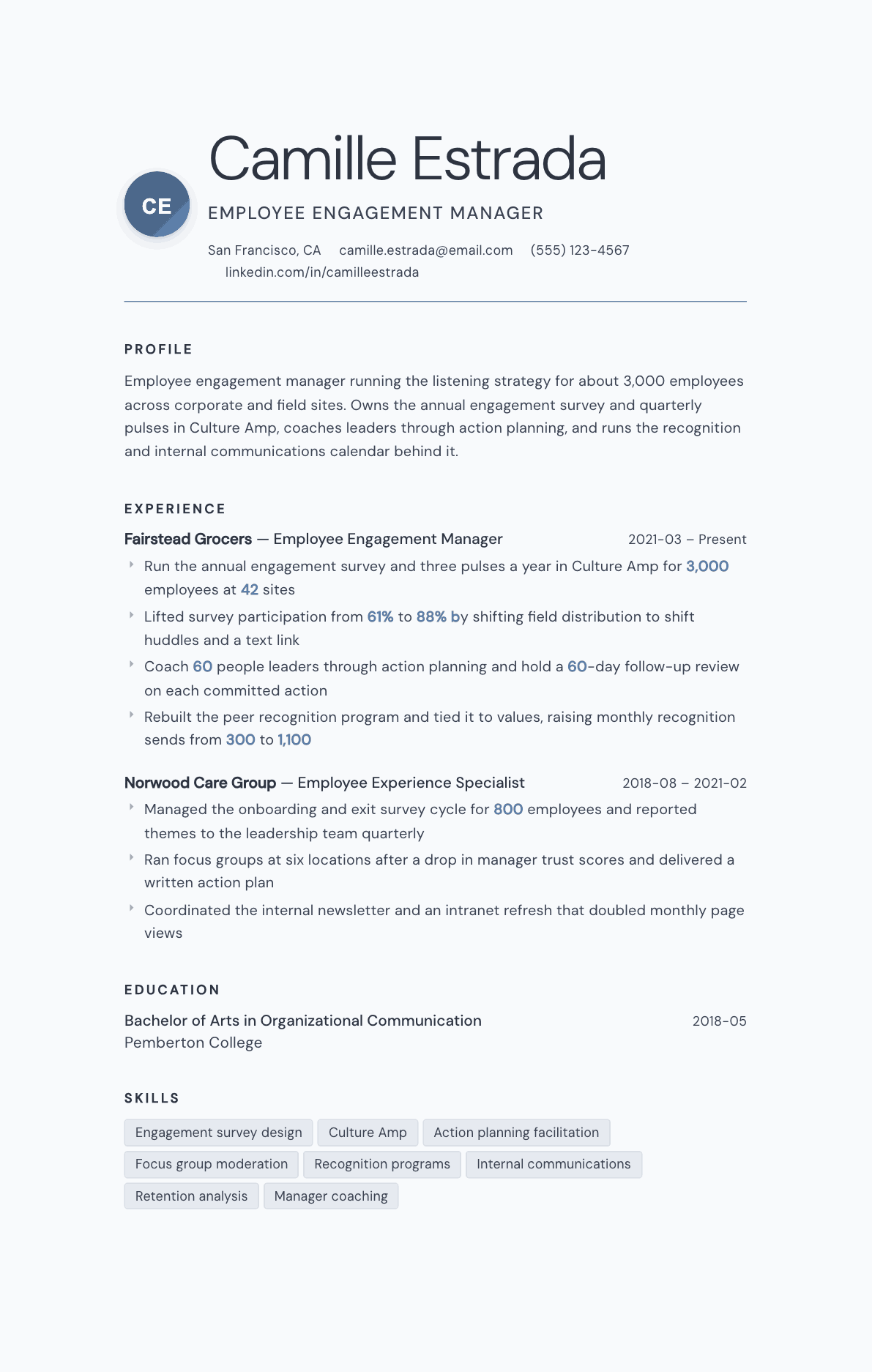
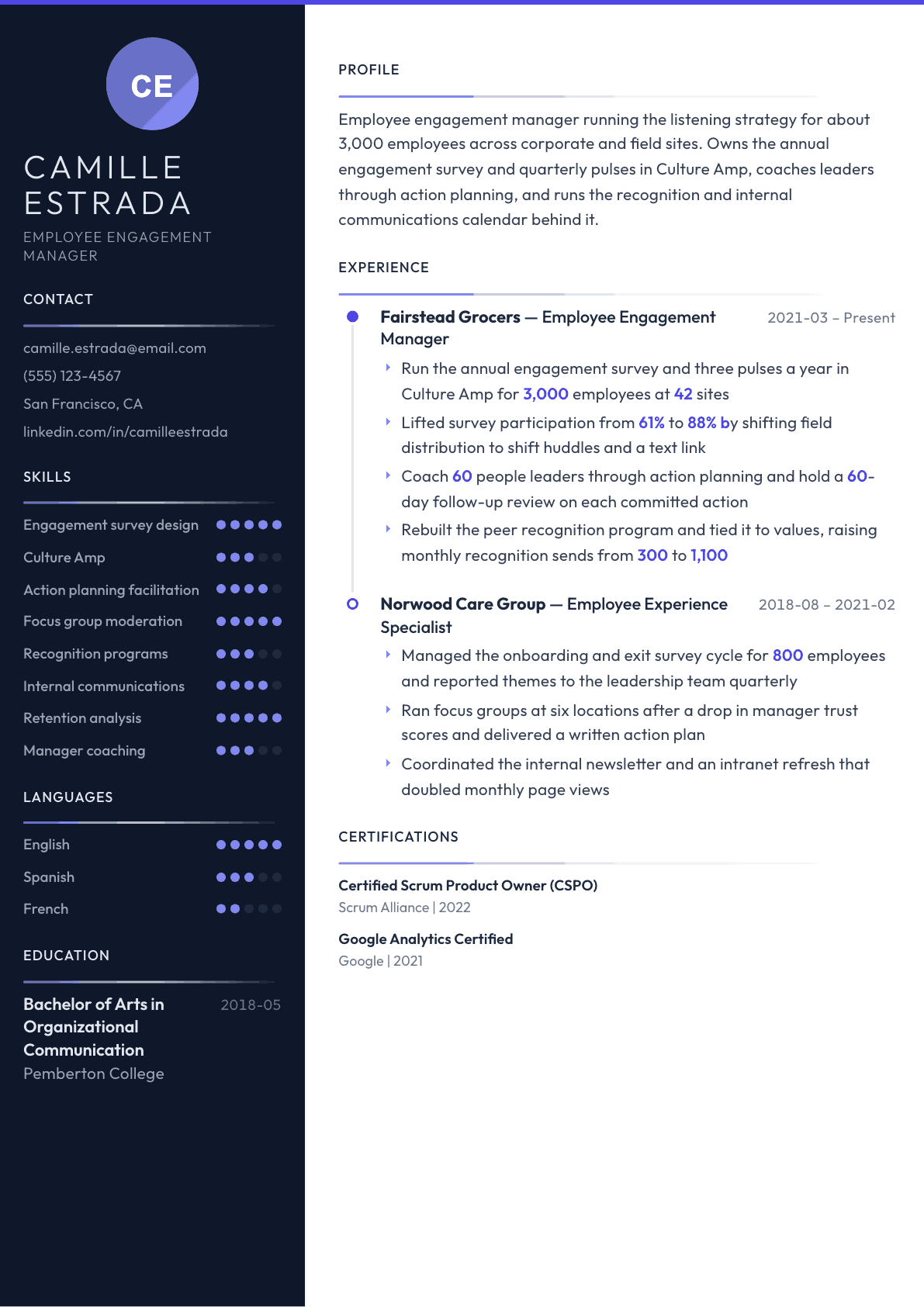
The same employee engagement manager content laid out in three CVBooster templates, so you can see what the finished document looks like before you write a word.
Example Employee Engagement Manager summary
Employee engagement manager owning the listening strategy for three thousand employees across corporate offices and more than forty field sites. Runs the annual survey and quarterly pulses in Culture Amp, coaches sixty people leaders through action planning, and reviews every committed action at sixty days. Raised field participation by moving distribution into shift huddles.
Skills to list on a Employee Engagement Manager resume
- Employee engagement strategy
- Survey design and analysis
- Culture Amp
- Qualtrics
- Action planning facilitation
- Focus groups
- Recognition program design
- Internal communications
- Retention and turnover analysis
- Manager coaching
- Change management
- Employee resource group support
- Onboarding and exit surveys
- Executive reporting
What actually gets this resume read
- Anchor every claim to a measurement: survey scores, participation rates, turnover or internal mobility.
- Name the listening platform you ran, such as Culture Amp, Qualtrics or Glint, and the cadence you kept.
- Show the action side, not just the survey side, because engagement leaders are hired to close the loop.
- Give the population split between corporate and frontline, since reaching field employees is a distinct skill.
- Include manager enablement work: how many leaders you coached and what they were expected to produce.
- Tie recognition or communication programs to a behavior change rather than to the launch date.
How to write a employee engagement manager resume
Employee engagement is the HR role most likely to be dismissed as event planning, and the resume is where that impression gets formed or corrected. A chief people officer reading it wants proof that you ran a listening cycle, produced action from it, and can point to a score, a retention number or a behavior that moved.
The engagement resumes that fail are full of launches: a new recognition platform, a wellbeing week, a values campaign, an intranet refresh. None of those say whether anything changed. The ones that work show the loop closing, which means survey, analysis, manager action planning, follow-up and a second measurement.
What follows is the structure this role needs, three summaries at different stages, before-and-after bullets from survey and action planning work, credentials worth holding, and the questions engagement managers ask when they try to make culture work look measurable.
Format: one to two pages, evidence before activities
Reverse chronological. Under each employer give the population you served, split between corporate and frontline or field if that applies, the number of sites, the listening platform, and the survey cadence. Then order bullets by evidence strength: measured outcomes first, program design second, event and communication work last.
Resist a heavily designed template even though the role is creative. Engagement candidates are often screened by an HR leader who is skeptical of the discipline, and a clean analytical page does more to answer that skepticism than a color palette.
- Header: name, city and state, phone, email, and a credential such as SHRM-CP or a Prosci change certification.
- Order: summary, experience, skills and platforms, education, certifications.
- Add a short line naming survey tools, analysis methods and the communication channels you owned.
Summary: population, cadence, platform, and one number that moved
State how many employees you cover, how many sites, the listening rhythm you run, and one result. Participation rate, an engagement score change, voluntary turnover in a target group, or internal mobility all work, as long as the number belongs to something you can explain.
If your organization is mostly frontline, say it. Reaching people without company email, without a desk and on rotating shifts is a distinct competency, and most engagement candidates have only ever surveyed office workers.
Listening: design the survey, then defend the data
Show the mechanics. How many items, what construct the survey measures, how you protect confidentiality with a minimum group size, how you handle open text analysis, and how you distribute to people who never open a laptop. Participation rate is the first quality check a reader applies, so give it and give what you did to move it.
Add the analysis layer: cuts by function, tenure and manager, comparison across cycles, and the link between engagement and an outcome the business already tracks such as turnover, absence or safety incidents. Engagement work earns credibility when it is joined to a metric leaders already care about.
Action: the half of the job that gets skipped
A survey without action planning is a report. Describe the manager enablement you built: the debrief materials, the training on reading results without defensiveness, the expectation that each leader commits to a small number of actions, and the follow-up review that checks whether anything happened.
Then show enterprise action. When results named a systemic problem such as scheduling, career visibility or manager quality, say what you escalated, who owned it, and what changed. Bullets that end with a recommendation delivered are weaker than bullets that end with a change made.
Programs and keywords
Recognition, employee resource groups, onboarding and exit surveys, internal communications and wellbeing all belong here, but each needs a result. Recognition sends per month, group membership and event attendance, newsletter open rates, or exit themes that led to a policy change.
The phrases postings use include employee engagement strategy, employee listening, pulse survey, action planning, employee experience, retention, recognition program, internal communications, focus groups, employee resource groups and change management. Place each inside a bullet where it is demonstrated.
Employee Engagement Manager resume summary examples
Experience specialist
Employee experience specialist running onboarding and exit surveys for 800 employees, reporting themes to leadership each quarter. Facilitated focus groups at six locations after a drop in manager trust scores and delivered the written action plan. Coordinates the internal newsletter and intranet content.
Owning the listening cycle
Employee engagement manager covering 3,000 employees at 42 sites, running an annual survey and three pulses a year in Culture Amp. Lifted participation from 61% to 88% by moving field distribution into shift huddles, and coaches 60 people leaders through action planning with a 60-day follow-up.
Engagement leader
Engagement and experience leader for a 9K-employee healthcare group with two specialists reporting in. Owns the listening strategy, the manager enablement curriculum and the recognition program, and reports quarterly to the executive team on engagement, turnover and internal mobility together.
Work experience bullets: before and after
Before: Ran the annual employee engagement survey.
After: Run the annual survey and three pulses a year in Culture Amp for 3,000 employees at 42 sites, including item design, confidentiality thresholds and open text analysis.
Naming cadence, population, platform and the design decisions shows ownership of the instrument, not just the calendar.
Before: Increased survey participation.
After: Lifted participation from 61% to 88% by moving field distribution into shift huddles, replacing email links with a text link, and giving each site a live completion board.
A before and after with three concrete tactics proves the increase was engineered rather than lucky.
Before: Helped managers with their survey results.
After: Coach 60 people leaders through result debriefs and action planning, then hold a 60-day review on every committed action and report completion to their directors.
The follow-up review is the difference between distributing reports and running an accountability loop.
Before: Launched a recognition program.
After: Rebuilt peer recognition around company values with manager nudges and a monthly leader scoreboard, raising recognition sends from 300 to 1,100 a month.
The mechanism and the usage change show a program people adopted instead of a platform that went live.
Before: Worked to reduce turnover.
After: Traced first-year exits to a scheduling practice at three sites, presented the pattern with exit survey evidence, and supported the operations change that followed.
Connecting listening data to a specific operational cause is how engagement work earns executive attention.
Hard skills
- Engagement survey design
- Culture Amp
- Qualtrics
- Pulse and lifecycle surveys
- Open text and theme analysis
- Action planning facilitation
- Focus group moderation
- Turnover and retention analysis
- Recognition program design
- Internal communications
- Employee resource group support
- Change management
Soft skills
- Facilitation
- Executive storytelling
- Coaching managers
- Listening without defensiveness
- Influence across functions
- Follow-through
Certifications worth listing
- SHRM Certified Professional (SHRM-CP) (Society for Human Resource Management)
- Professional in Human Resources (PHR) (HR Certification Institute)
- Prosci Change Management Certification (Prosci)
- Certified Professional in Talent Development (CPTD) (Association for Talent Development)
Mistakes that cost employee engagement manager candidates the interview
- Listing programs launched with no participation, score or retention figure attached to any of them.
- Reporting a survey score without the participation rate, which is the first quality question a reader asks.
- Stopping at the report, so the resume never shows a manager doing anything different because of the results.
- Writing only about office populations when the posting is for a workforce that is mostly frontline.
- Treating recognition and wellbeing as the whole role, which reads as perks rather than engagement strategy.
- Using culture language with no mechanism, such as fostering a culture of belonging, in place of what you built.
Employee Engagement Manager resume questions
How do I prove engagement work had business impact?
Join your data to a metric the business already tracks. Compare turnover, absence, safety incidents or internal mobility between higher and lower scoring teams, then point to a specific action taken after the survey and what moved in the following cycle.
What if my engagement scores went down while I was there?
Say what happened around it, such as a restructure or a merger, and focus the bullets on participation, response quality and the actions you drove. A candid account of a hard cycle with visible follow-through often reads stronger than an untroubled record.
Which survey platform should I name?
The one you actually administered, whether that is Culture Amp, Qualtrics, Glint or an in-house tool. Add what you did inside it: item libraries, confidentiality thresholds, reporting hierarchies and dashboard access for managers, since configuration is what employers screen for.
Is employee engagement a communications job or an HR job?
It sits between them, and the resume should show both. Communications skills carry the campaign and the survey launch, while HR skills carry the analysis, the manager coaching and the connection to retention, performance and mobility data.
How do I reach frontline employees in a survey?
Describe the channels that worked: shift huddles, printed codes at the time clock, text links, tablets in break rooms and site champions who reminded people. Employers with distributed workforces treat this as the deciding competency, so give it its own bullet.
Related resume examples
- Human Resources Resume example
- Organizational Development Consultant Resume example
- Employee Experience Manager Resume example
- HR Business Partner Resume example
- Talent Development Manager Resume example
- Diversity & Inclusion Manager Resume example