Gig Worker Resume Examples: free ATS score and gap list
Turn Platform Gig Work Into a Resume That Gets Interviews
By Mustafa Tarabya, founder of CVBooster · Published · Updated
Gig worker resume example, keyword list and writing guide covering platform ratings, completion rates, route volume and moving into a steady job.
Sample resumes for a gig worker
The same gig worker content laid out in three CVBooster templates, so you can see what the finished document looks like before you write a word.
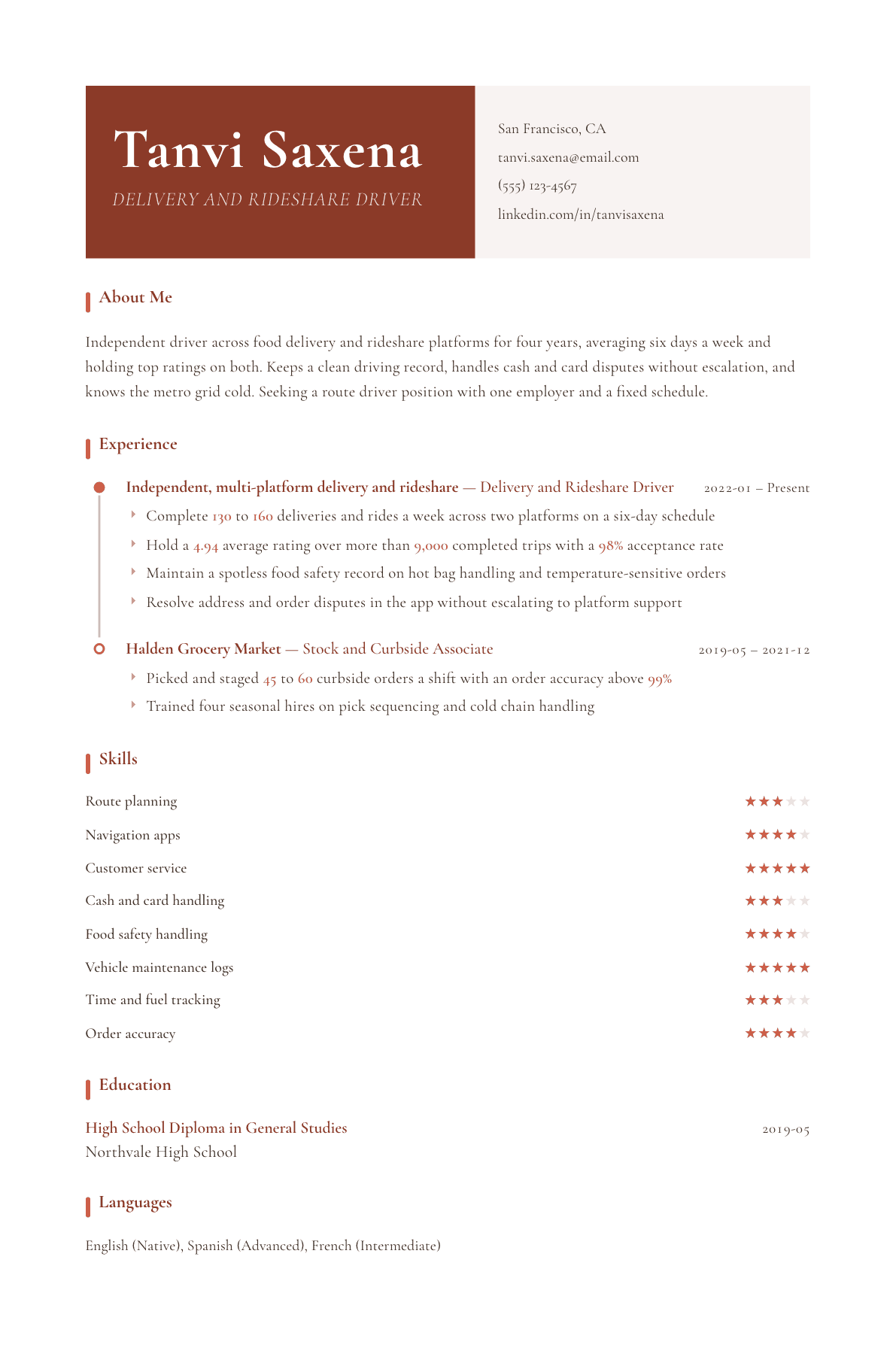
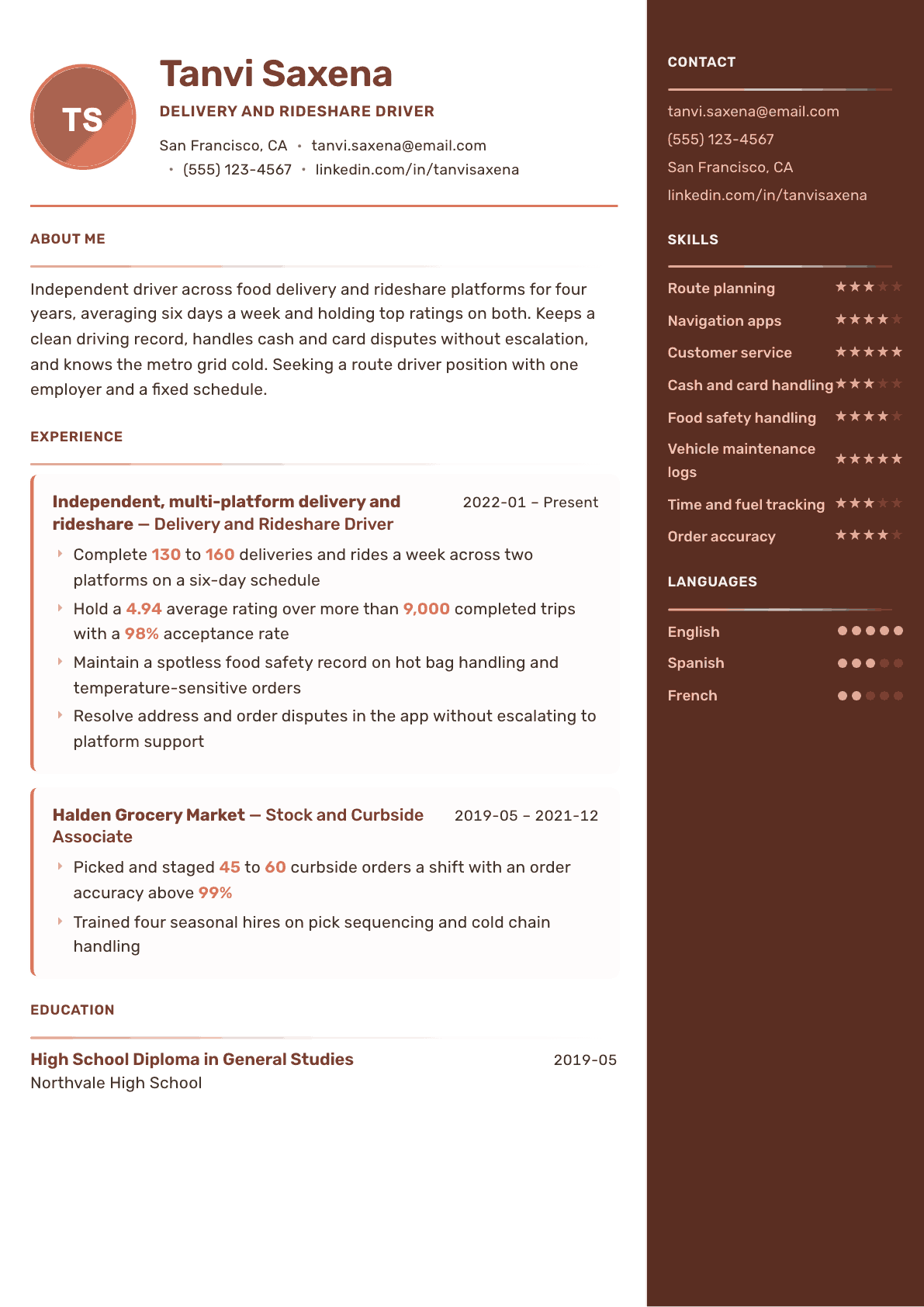
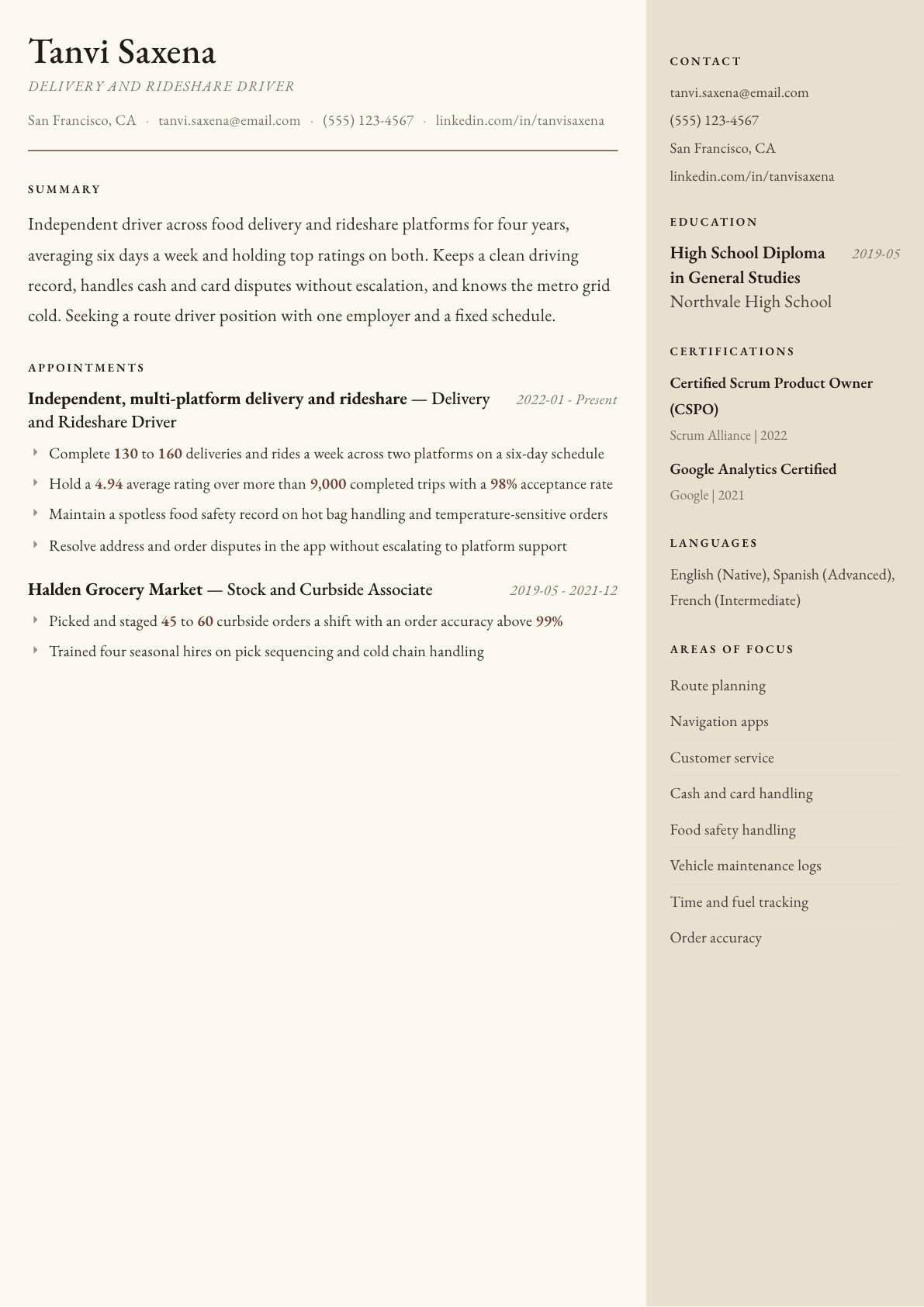
Example Gig Worker summary
Independent driver with four years across delivery and rideshare platforms, running 130 to 160 trips a week on a six-day schedule and holding a 4.94 rating over more than 9,000 completed jobs. Clean driving record, disciplined on cold chain and hot bag handling, and used to resolving order disputes without escalation. Seeking a fixed route driver position with a single employer.
Skills to list on a Gig Worker resume
- Route optimization
- Navigation and dispatch apps
- Delivery volume management
- Customer rating maintenance
- Cash reconciliation
- Food safety handling
- Cold chain awareness
- Vehicle inspection and upkeep
- Mileage and expense logs
- Independent contractor tax records
- Conflict de-escalation
- Peak-hour scheduling
- Order accuracy checks
What actually gets this resume read
- Group all platforms under one independent driver entry with a single date range and no employment gap.
- Give the numbers the platforms already give you: trips completed, rating, acceptance rate and weekly volume.
- State the hours you actually worked each week, since employers assume gig work means casual availability.
- Name your vehicle class, license status and driving record, the first three things a fleet manager checks.
- Show handling skills that transfer: cold chain, fragile goods, cash reconciliation and dispute resolution.
- Say clearly that you want a fixed schedule with one employer, which answers the loyalty question up front.
How to write a gig worker resume
Platform work leaves a strange footprint. A gig worker can have four years of continuous six-day weeks, thousands of completed jobs and a rating most employees would envy, and still hand a hiring manager a resume that says driver for various apps. The evidence exists, it just lives inside the apps rather than in a personnel file, and nobody transfers it to the page.
The manager screening you is not hostile to platform work, she is uncertain about three things. Whether you will show up to a fixed shift after years of choosing your own hours. Whether the record is verifiable. Whether anything you did transfers to her operation. All three can be answered on one page, because the platforms hand you exactly the numbers a supervisor cares about: completion, acceptance, ratings, volume, and a clean record on the things that cause complaints.
This guide covers grouping platforms into a single unbroken entry, which app metrics to publish and which to leave out, how to describe the parts of the work that transfer to warehouse, route, dispatch and service jobs, and how to answer the reliability question that follows every gig-heavy application.
One entry, one date range, platforms listed inside it
Do not give each app its own job block. Create a single entry titled with the work you actually did, for example Independent Delivery and Rideshare Driver, mark the employer as independent across the platforms you used, and run one continuous date range. Doing this removes every apparent gap and stops the page reading as a sequence of abandoned jobs, which is what a list of separate app entries looks like.
Inside that entry, state the schedule you really worked. Days per week, hours per day, and the shift pattern if you ran nights or peak windows. This is the single most useful sentence on a gig resume, because the assumption a hiring manager starts with is that the work was occasional pocket money rather than a full week.
- Job title describing the work, not the app: driver, courier, task worker, home cleaner.
- Employer field: Independent, followed by the platforms you worked through.
- A schedule line: days per week, typical hours, and whether you covered peak or overnight windows.
- Any traditional employment before or during the platform years, in normal reverse chronological order.
- License class, vehicle type and driving record where the target job involves a vehicle.
The metrics the apps already calculated for you
Open the app and copy the numbers across. Completed trips or tasks, average customer rating, acceptance rate, completion rate, on-time rate, and tenure on the platform. These are not soft claims. They are performance measures recorded by a third party, and most of them can be shown from a screen in an interview, which makes them more verifiable than the average bullet on the average resume.
Choose which ones serve you. A high acceptance rate is the strongest signal for a dispatch or route job, because it is a direct measure of showing up for assigned work. A high rating serves a customer-facing role. Volume serves anything operational. Leave out any measure that is weak, and leave out earnings entirely, since gross platform pay is not comparable to a wage and confuses the conversation.
Round honestly and describe the base. A rating of 4.94 means something different across two hundred trips than across several thousand, so give the count alongside it.
- Completed trips, deliveries or tasks, with the period they were completed over.
- Average rating, always paired with the number of ratings behind it.
- Acceptance and completion rates, the closest platform equivalent of attendance.
- Peak-period performance: holiday volume, weather conditions, late-night coverage.
- Incident record: damage claims, food safety complaints, at-fault accidents.
Translating platform work into the job you are applying for
Every gig has an operational skeleton that a hiring manager recognizes once you name it. Delivery driving is route sequencing, time window management, cold chain handling, proof of delivery and customer contact. Rideshare is defensive driving, cash and card handling, conflict de-escalation and vehicle upkeep. Task platforms are estimating, materials, site tidiness and scope conversations. Home cleaning is chemical handling, key security and recurring client retention.
Write the bullet in the destination job's language. Applying to a food distributor means leading with temperature-sensitive handling and time window compliance. Applying to a passenger transport operator means leading with the driving record, the license class and the passenger handling. The underlying work is identical, the framing decides whether the screener sees a fit.
Include the paperwork side too. A serious gig worker tracks mileage, keeps fuel and maintenance records, files quarterly estimated taxes and reconciles platform statements. That is small-scale operational administration and it belongs on the page.
Answering the reliability and commitment question
The doubt is that someone who chose their own hours for four years will struggle with a rostered shift and will disappear when demand rises on the apps. Take it on directly. Say in the summary that you are seeking a fixed schedule with one employer, and give a reason a manager finds believable: benefits, predictable income, a route you can learn properly, a team.
Then evidence it. A high acceptance rate is attendance. A six-day pattern held for years is stamina. Working the peak windows nobody wants is exactly the availability a dispatcher is trying to fill. And if you held a traditional job before the platform years, keep it on the page, because it proves you have already worked a supervised shift.
Gig Worker resume summary examples
First year on the platforms
Delivery courier with 14 months on two food platforms, completing around 90 deliveries a week on evening and weekend shifts while holding a 4.9 rating. Clean driving record, familiar with hot bag handling and address troubleshooting. Seeking a first full-time courier position with a set route.
Four years, multi-platform
Independent driver with 4 years across delivery and rideshare, running 130 to 160 trips a week on a six-day schedule and holding a 4.94 rating over more than 9,000 completed jobs at a 98% acceptance rate. Clean record on food safety and vehicle inspections. Seeking a fixed route driver position.
Long-tenured with fleet responsibility
Platform driver of 7 years who moved from single-car work to running 3 leased vehicles with two contracted drivers, handling scheduling, maintenance intervals and payment reconciliation. Maintained fleet ratings above 4.85 throughout. Targeting a dispatch or fleet coordinator role with a regional carrier.
Work experience bullets: before and after
Before: Worked for several delivery apps.
After: Completed 130 to 160 deliveries and rides a week across two platforms on a six-day schedule, covering the evening peak and weekend surge windows.
Weekly volume and the shift pattern convert an ambiguous side activity into a full working week.
Before: Had a good rating from customers.
After: Held a 4.94 average rating over more than 9,000 completed trips with a 98% acceptance rate across four years on the platforms.
A rating means little without the base behind it, and acceptance rate is the closest thing to an attendance record.
Before: Delivered food orders to customers.
After: Handled temperature-sensitive orders in insulated carriers with separate hot and cold staging, and closed four years with no food safety complaint on record.
Naming the handling method and the incident record maps the work onto a distributor's actual concerns.
Before: Dealt with problems and difficult customers.
After: Resolved address, missing item and access disputes inside the app, escalating fewer than 1% of orders to platform support over the last two years.
An escalation rate turns a generic service claim into a measurable judgment call under pressure.
Before: Kept track of my own expenses and taxes.
After: Logged mileage, fuel and maintenance per vehicle, reconciled weekly platform statements, and filed quarterly estimated taxes on time for four consecutive years.
The record keeping is real operational administration and shows the discipline a dispatcher wants to see.
Hard skills
- Route sequencing and navigation apps
- Time window and on-time delivery management
- Cold chain and hot food handling
- Vehicle inspection and maintenance logs
- Cash and card reconciliation
- Proof of delivery capture
- Mileage and expense tracking
- Quarterly estimated tax filing
- Platform statement reconciliation
- Peak-period scheduling
- Defensive driving practice
- Order accuracy verification
Soft skills
- Showing up in bad weather without a supervisor
- De-escalating a dispute at a doorstep
- Reading traffic and timing without hurrying
- Handling rejection and low-value assignments calmly
- Self-scheduling around demand rather than convenience
Certifications worth listing
- ServSafe Food Handler (National Restaurant Association)
Mistakes that cost gig worker candidates the interview
- Listing each app as its own job, which manufactures gaps and short stints that were never there.
- Writing gig work at the bottom under other activities as though it were not real employment.
- Omitting the rating, trip count and acceptance rate, the only third-party performance record you have.
- Publishing gross platform earnings, which are not comparable to a wage and derail the salary conversation.
- Describing the work only as driving when the transferable content is handling, timing and customer contact.
- Ignoring the reliability question and leaving a manager to assume you will not hold a rostered shift.
- Leaving off pre-platform employment that proves you have already worked under a supervisor.
Gig Worker resume questions
Does gig work count as real work experience on a resume?
Yes, when it is presented like a job. Give it a title, a continuous date range, a weekly schedule and measurable results. A screener who sees volume, ratings and an acceptance rate treats it as employment, not as a placeholder.
How do I list several apps without it looking like job hopping?
Combine them into one entry titled by the work rather than the brand, put Independent in the employer field, and name the platforms inside the description. One continuous range across all of them removes the appearance of constant changes.
Should I put my driver rating on my resume?
Put it on if it is strong, and always give the number of completed jobs behind it. A rating without a base can be dismissed as a small sample, while a high rating over thousands of jobs is a performance record most applicants cannot match.
What if there are weeks or months where I barely worked?
Describe the pattern honestly at the level of the year rather than the week, for example averaging five days a week over four years. Nobody expects a flat load, and an average with a stated range is more credible than a claim of constant volume.
How do I move from platform work into a salaried job?
Target operations where your record maps directly: route delivery, warehouse, dispatch, transport and field service. Say plainly that you want a fixed schedule with one employer, then let the acceptance rate and the six-day pattern argue that you already work like an employee.