Editor Resume Examples: what a hiring manager reads first
An Editor Resume That Proves You Can Run a Section
By Mustafa Tarabya, founder of CVBooster · Published · Updated
Editor and editorial resume examples, an editorial assistant sample, bullets, keywords and a writing guide covering story counts, CMS work and headline testing.
Sample resumes for a editor
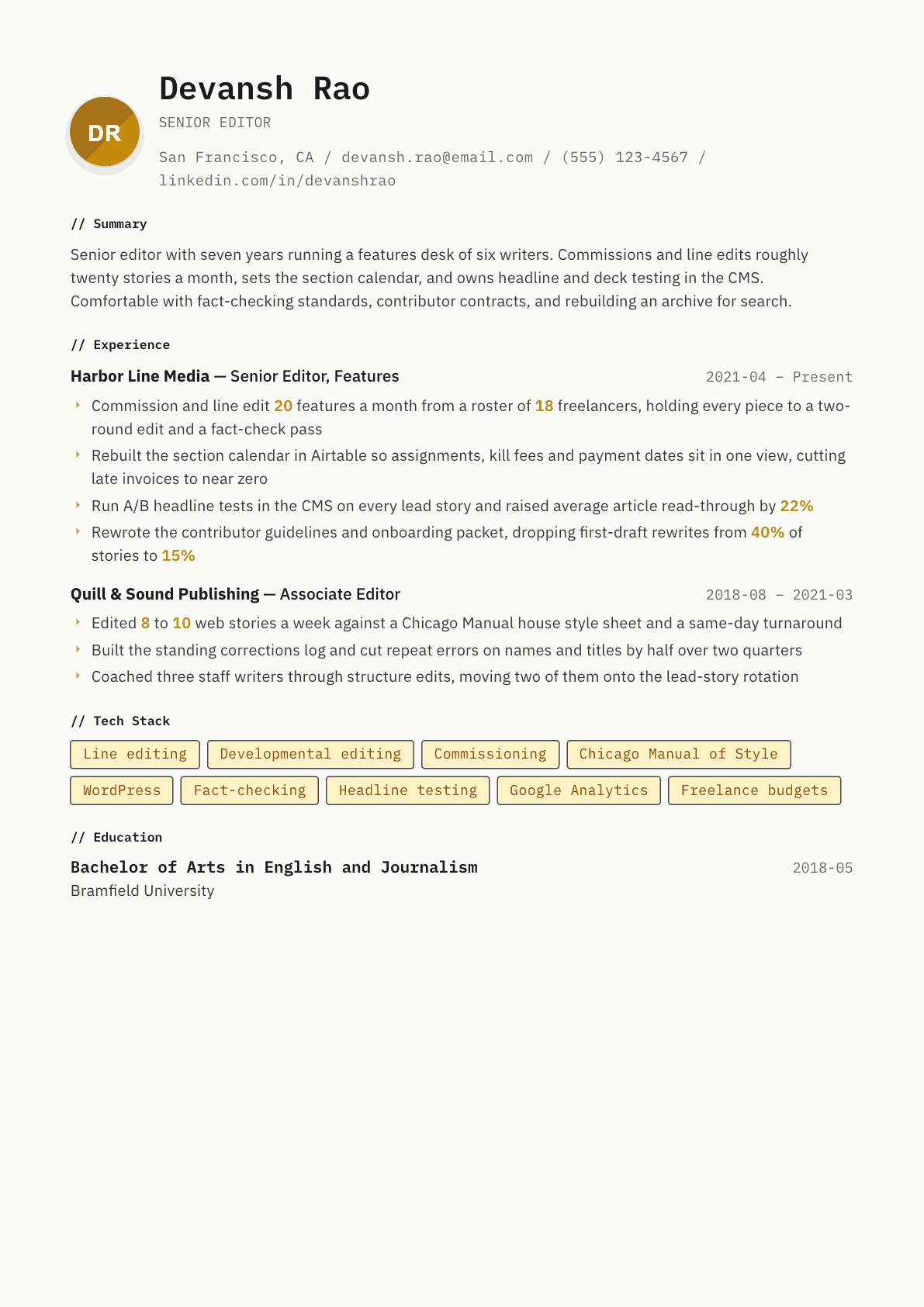
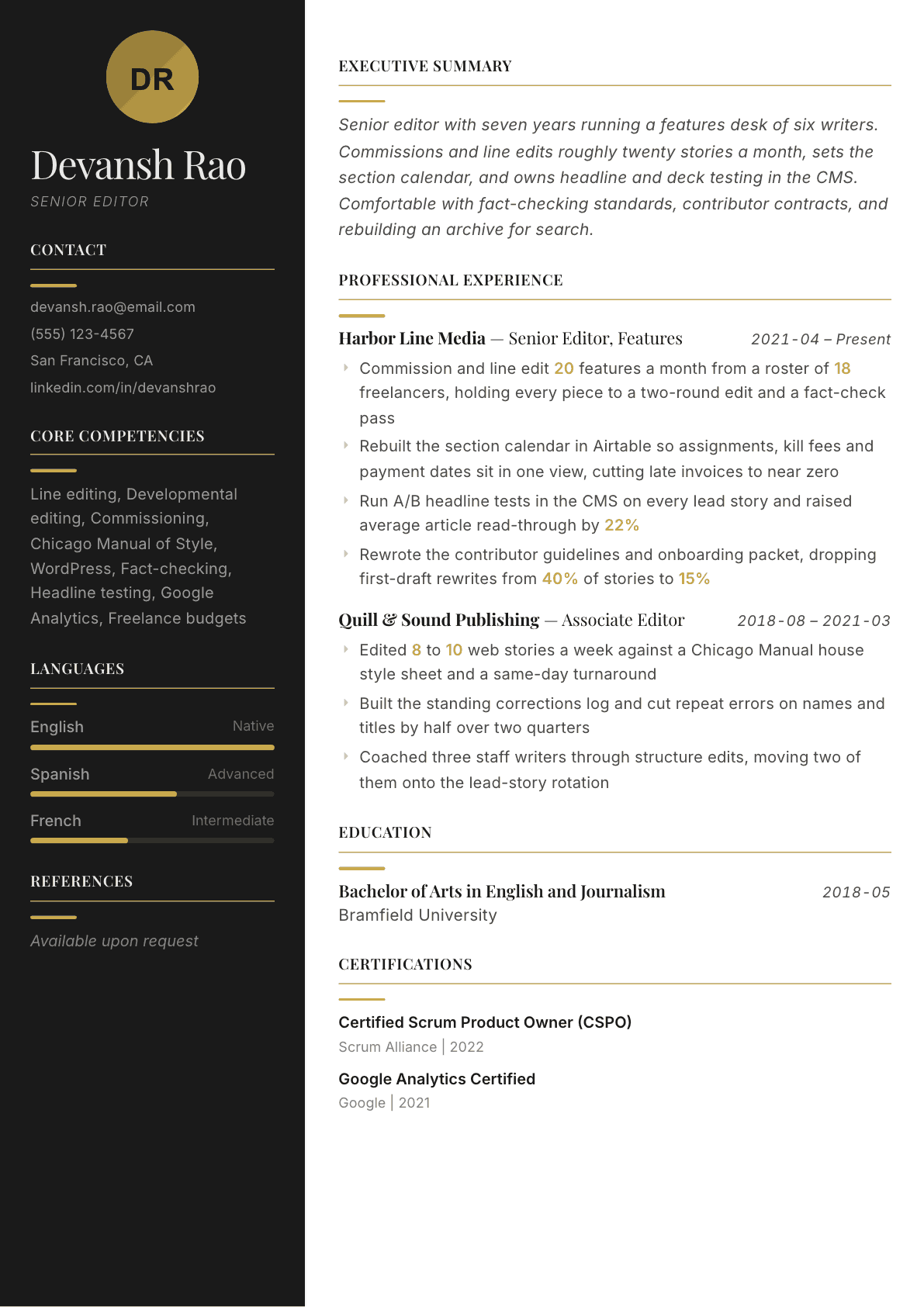
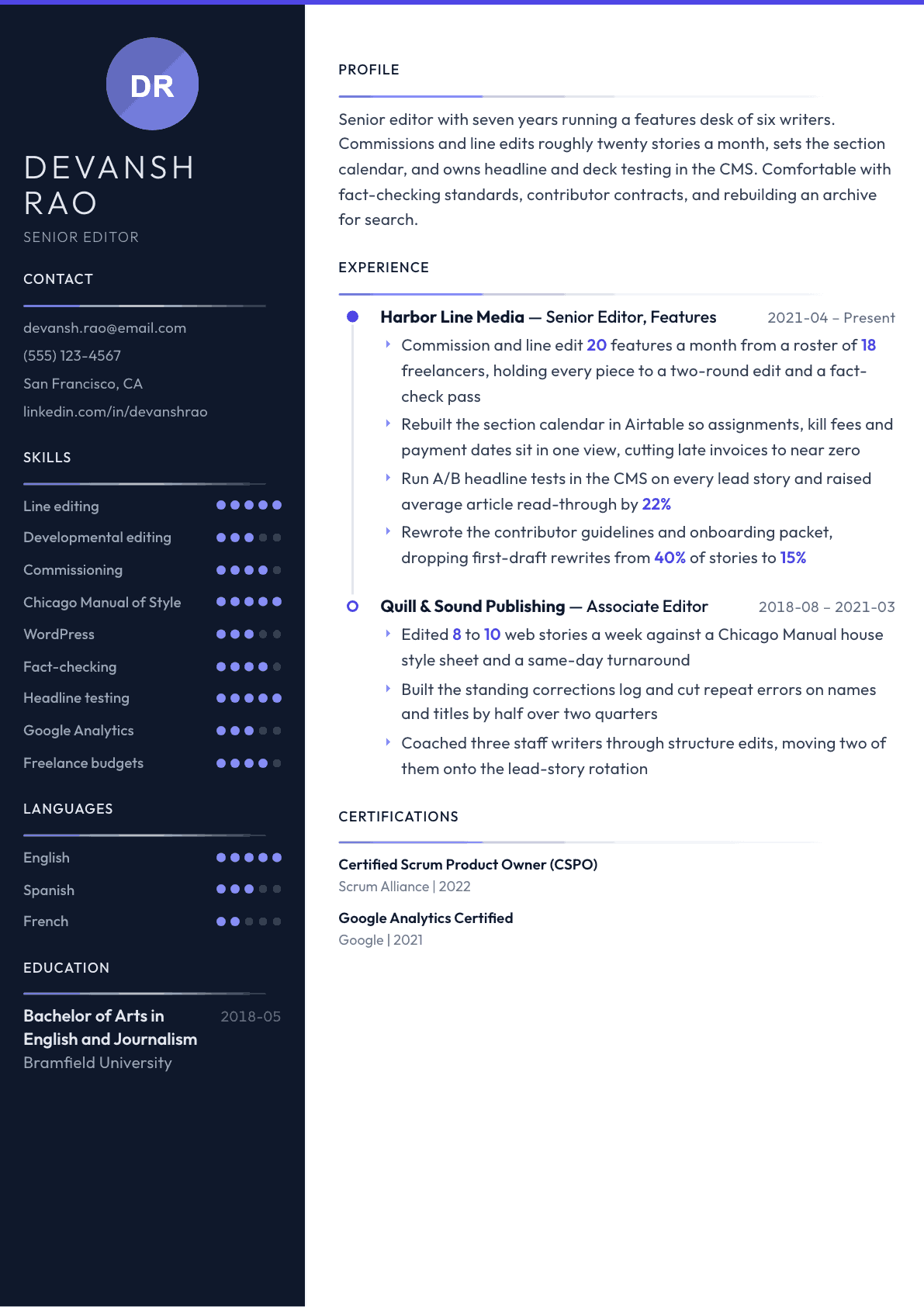
The same editor content laid out in three CVBooster templates, so you can see what the finished document looks like before you write a word.
Example Editor summary
Editor with seven years across features and digital desks, commissioning and editing about twenty stories a month from a freelance roster of eighteen. Enforces a Chicago-based house style, runs a two-round edit plus fact-check on every piece, and tests headlines in the CMS. Raised section read-through by 22% while keeping the desk on schedule through two redesigns.
Skills to list on a Editor resume
- Line editing
- Developmental editing
- Copy editing
- Commissioning
- Chicago Manual of Style
- AP style
- Fact-checking
- Headline writing
- SEO for editorial
- WordPress
- Editorial calendars
- Freelance management
- Google Analytics
- Story structure
- Rights and permissions
What actually gets this resume read
- Put your beat, your section and the number of stories you edit each month in the first two lines.
- Name the style guide you enforce, whether that is Chicago, AP, or a house sheet you wrote yourself.
- Show the writer side of the job: how many contributors you commission and how you keep them on deadline.
- Include the content management system by name, because editing job postings screen on CMS familiarity.
- Give one audience number per role, such as read-through, newsletter growth, or search traffic to your section.
- Separate developmental editing from line editing in your bullets, since hiring editors treat them as different skills.
How to write a editor resume
Hiring an editor is a bet on judgment. Anyone can fix a comma. The question a masthead is asking is whether you can look at a rough draft and see the story that is buried inside it, then get the writer to produce it before the slot closes. That is why an editor resume that lists only tools and style guides reads as a copy desk application rather than a commissioning one.
The person reading your file is usually an executive editor or a head of content. They scan for three things in the first ten seconds: what you edited, how much of it there was, and who you edited it with. A section name, a monthly story count and a roster size answer all three. Everything else on the page is supporting evidence.
This guide covers the section order editors expect, how to write about commissioning without sounding like an administrator, before and after bullets from real editing work, and the questions that come up when an editor sits down to write about a job that is mostly invisible in the finished piece.
Format: reverse chronological, one page under eight years
Editing is a credential-light field, so the structure of your file has to do the work that a license does elsewhere. Reverse chronological order, no functional format, and a clean single column. Many publishers still push resumes through parsers that scramble two-column layouts, and an editor whose dates arrive out of order looks careless in exactly the way this job cannot afford.
Under the header, add a one-line clips reference: three pieces you commissioned or edited, with the outlet and the year, written as plain text. The hiring editor will look them up. Give them the strongest three rather than a portfolio of twenty.
- Header: name, city and state, phone, email, portfolio reference in plain text.
- Order: summary, experience, selected clips, skills and systems, education.
- Career changers from writing lead with editing bullets inside each writing job rather than hiding them.
Summary: the desk, the volume, the roster
Three lines. Name the desk or vertical you have run, the number of pieces you move a month, and the size of the writer group you commission from. An editor who says "twenty features a month across a roster of eighteen freelancers" has told the reader more than a paragraph about passion for storytelling ever will.
If your experience is inside a brand or an agency rather than a newsroom, say so plainly and translate the volume. Editing content marketing at scale is a real qualification, and hiding it behind vague words invites the reader to assume the worst.
Experience: separate the three kinds of editing you do
Editors get hired for developmental work, line work and commissioning, and hiring managers treat those as separate skills. Give each of them at least one bullet per job. A developmental bullet talks about restructuring an argument or reordering a narrative. A line bullet talks about voice, rhythm and cuts against a word count. A commissioning bullet talks about pitches, assignments, rates and deadlines.
Set the scene for each job in the line under the title: the publication type, the cadence, the audience and the section you owned. An editor at a weekly trade title and an editor at a daily consumer site do different jobs, and the reader cannot tell them apart from a company name alone.
Include one bullet per role that names an audience outcome. Read-through, time on page, newsletter click rate or search traffic to your section are all fair. Editors are increasingly measured on these, and a candidate who has never looked at them reads as pre-digital.
- One developmental editing bullet: what was broken in the draft and how you fixed it with the writer.
- One line editing bullet: word count discipline, voice preservation, turnaround.
- One commissioning bullet: pitches reviewed, assignments placed, rates and kill fees managed.
- One systems bullet: the CMS, the calendar tool, the workflow you built or inherited.
Skills and systems: name the stack, not the adjectives
This section exists so the parser can match you and so the reader can see where you have worked. List the style guide you enforce, the content management system you publish in, the project tool that holds the calendar, and the analytics dashboard you check. WordPress, Arc, Chorus, Airtable, Asana and Google Analytics are all recognized instantly. Adjectives such as detail oriented are not, and they cost you a line.
Put fact-checking and standards here as well. An editor who can describe a verification process, a sourcing rule and a corrections policy is describing the part of the job that keeps a publisher out of trouble.
Keywords editing postings actually use
Editorial job descriptions repeat a small vocabulary: commissioning, line editing, developmental editing, editorial calendar, style guide, fact-checking, headline optimization, contributor management, audience growth. Mirror the exact words from the posting once in the summary and once inside a bullet where you can prove them. A keyword that appears only in a list is a claim; a keyword attached to a number is evidence.
Editorial resume sample: from assistant to section editor
An editorial resume is any resume for a job on the editorial side of a publisher, brand or agency: editorial assistant, copy editor, section editor, content editor. The structure is the one above at every level; what changes is which kind of editing leads. An assistant leads with accuracy and turnaround, a section editor with commissioning and the calendar.
The sample below is for an editorial assistant applying for a first content editor post. The person and employers are invented; keep the order and replace every figure with one you can defend in the interview.
- Header and summary: Talia Brennan, Editorial Assistant. Two years on the news and features desk of a regional weekly, copy editing and fact-checking about thirty pieces a week to house style and uploading them to the CMS. Ready to own a section calendar.
- Editorial Assistant, Marlow Valley Courier, two years. Copy edited and fact-checked news and features before each Thursday press deadline, cutting to fit on the page plan.
- Ran the weekly events listings and the reader letters page alone, from commissioning to upload.
- Wrote headlines and standfirsts for the website and tested two versions on the top stories each week with the digital editor.
- Earlier: Student Editor, Eastgate University newspaper, one year, a team of nine volunteer writers.
Editor resume summary examples
Moving up from staff writer
Staff writer moving into editing, with two years of filing three stories a week and eighteen months of editing the weekly newsletter and the intern desk. Comfortable with AP style, WordPress and headline testing. Looking for an assistant editor seat on a consumer features desk.
Five years on a desk
Editor with five years on a features desk, commissioning and line editing about eighteen pieces a month from a roster of fifteen freelancers. Owns the section calendar, the fact-check pass and headline testing. Lifted section read-through 22% over two quarters while holding a two-round edit standard.
Section head
Section head with nine years across trade and consumer titles, running a four-person desk and a freelance budget. Sets coverage strategy each quarter, edits every lead story, and rebuilt the pitch-to-publish workflow so on-time publication reached 94%. Hired and coached six editors, four now running desks of their own.
Work experience bullets: before and after
Before: Edited articles for the website.
After: Line edited 20 web features a month against a house style sheet, holding each piece to a two-round edit and a separate fact-check pass before publish.
Volume, standard and process turn an undefined task into a description of how you actually work.
Before: Worked with freelance writers.
After: Commissioned from a roster of 18 freelancers, negotiated rates and kill fees, and moved 9 of them onto repeat assignments after their first accepted piece.
Commissioning is a business relationship, and naming rates and repeat rates shows you managed it rather than emailed about it.
Before: Improved traffic to the section.
After: Ran A/B headline and deck tests on every lead story and raised average read-through on section features by 22% over two quarters.
The method is named, the metric is named, and the timeframe makes the claim checkable.
Before: Helped writers improve their drafts.
After: Rewrote the contributor guidelines and ran a structure clinic for staff writers, cutting first-draft rewrites from 40% of stories to 15% in a year.
It shows a systemic fix rather than one-off kindness, which is what a hiring editor is buying.
Before: Responsible for the editorial calendar.
After: Rebuilt the section calendar in Airtable so assignment, edit stage, kill fee and payment date sat in one view, ending late freelance invoices across the desk.
Naming the tool and the fields shows the reader a system they could adopt, not a duty you inherited.
Hard skills
- Developmental editing
- Line editing
- Commissioning and assigning
- Fact-checking and sourcing standards
- Chicago Manual of Style
- AP style
- Headline and deck writing
- Editorial calendar management
- WordPress and other CMS platforms
- Search optimization for editorial
- Google Analytics
- Freelance budget and rate cards
Soft skills
- Writer coaching
- Editorial judgment
- Negotiating with contributors
- Deadline discipline
- Giving hard feedback well
- Cross-desk collaboration
Mistakes that cost editor candidates the interview
- Describing editing in the abstract instead of naming the desk, the cadence and the number of pieces you move.
- Listing only line editing when the job is a commissioning role, which reads as an application for a different seat.
- Leaving out the content management system, so the reader cannot tell whether you can publish without hand-holding.
- Filling the skills section with adjectives such as meticulous, which no editor believes without a bullet behind it.
- Submitting a two-column design with icons that a publisher parser reorders, so your dates arrive scrambled.
- Sending a file with a typo or an inconsistent date format, which ends the application before the experience is read.
- Attaching a portfolio of twenty clips instead of the three that match the desk you are applying to.
Editor resume questions
How do I show editing work when my name is not on the finished piece?
Name the section, the cadence and the volume rather than individual bylines, then list three pieces you edited with the outlet and year. Hiring editors know the work is invisible and accept a short clips line with the writer credited.
Should an editor resume include writing samples?
Include a short clips reference of three pieces, mixing one you wrote and two you edited if you still write. A hiring editor wants proof you can hold a sentence, but the editing evidence carries more weight for the seat.
How do I move from writing into an editing role?
Pull every editing task out of your writing jobs and give them their own bullets: newsletter editing, intern supervision, copy passes on colleagues, style sheet work. Then write a summary that states the move plainly rather than leaving the reader to infer it.
What should an editorial resume include?
A summary naming the desk, the volume and the writers you work with; experience with one developmental, one line and one commissioning bullet per job; a three-piece clips line; and a skills section naming the style guide and CMS. Add at least one audience figure per recent role, such as read-through or newsletter clicks.
How long should an editor resume be?
One page below eight years of experience and two pages after that, once you have staff management, budget ownership and multiple titles behind you. A third page is only ever justified by a long list of books or documented projects.