Training Manager Resume Examples: the lines they read
Build a Training Manager Resume That Proves Business Impact
By Mustafa Tarabya, founder of CVBooster · Published · Updated
Training manager resume examples covering team leadership, budget ownership, learning strategy keywords and a full writing guide by section.
Sample resumes for a training manager
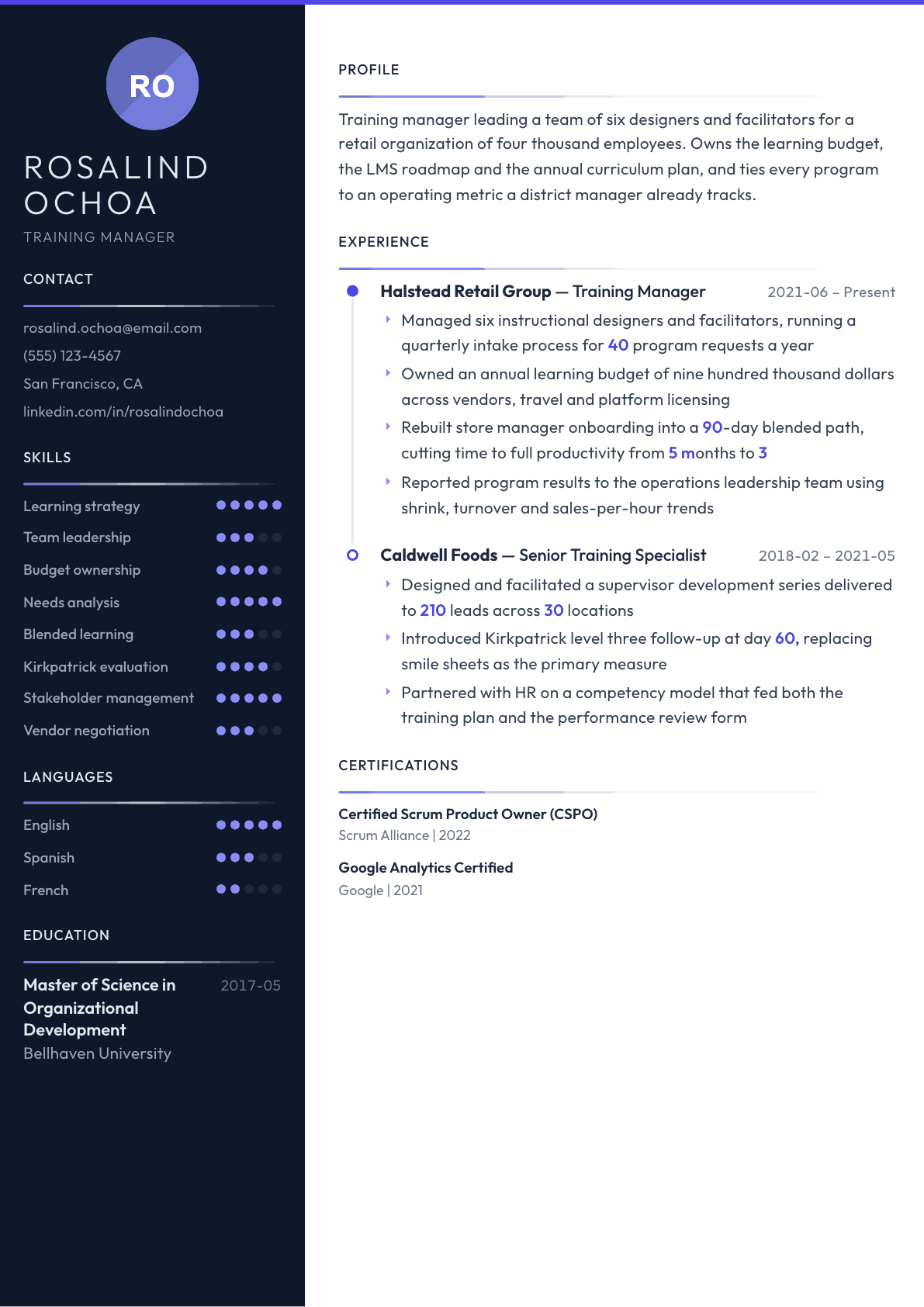
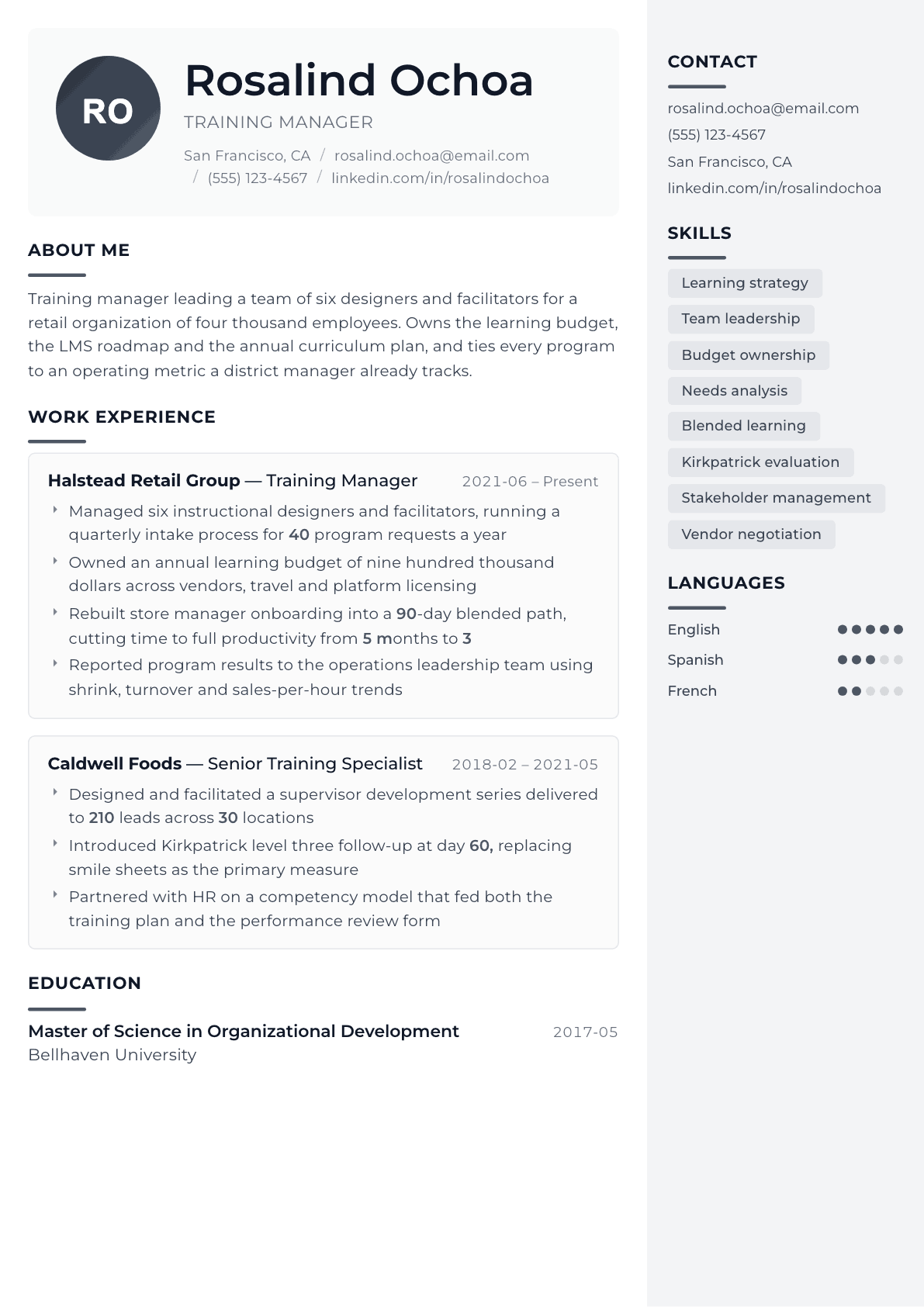
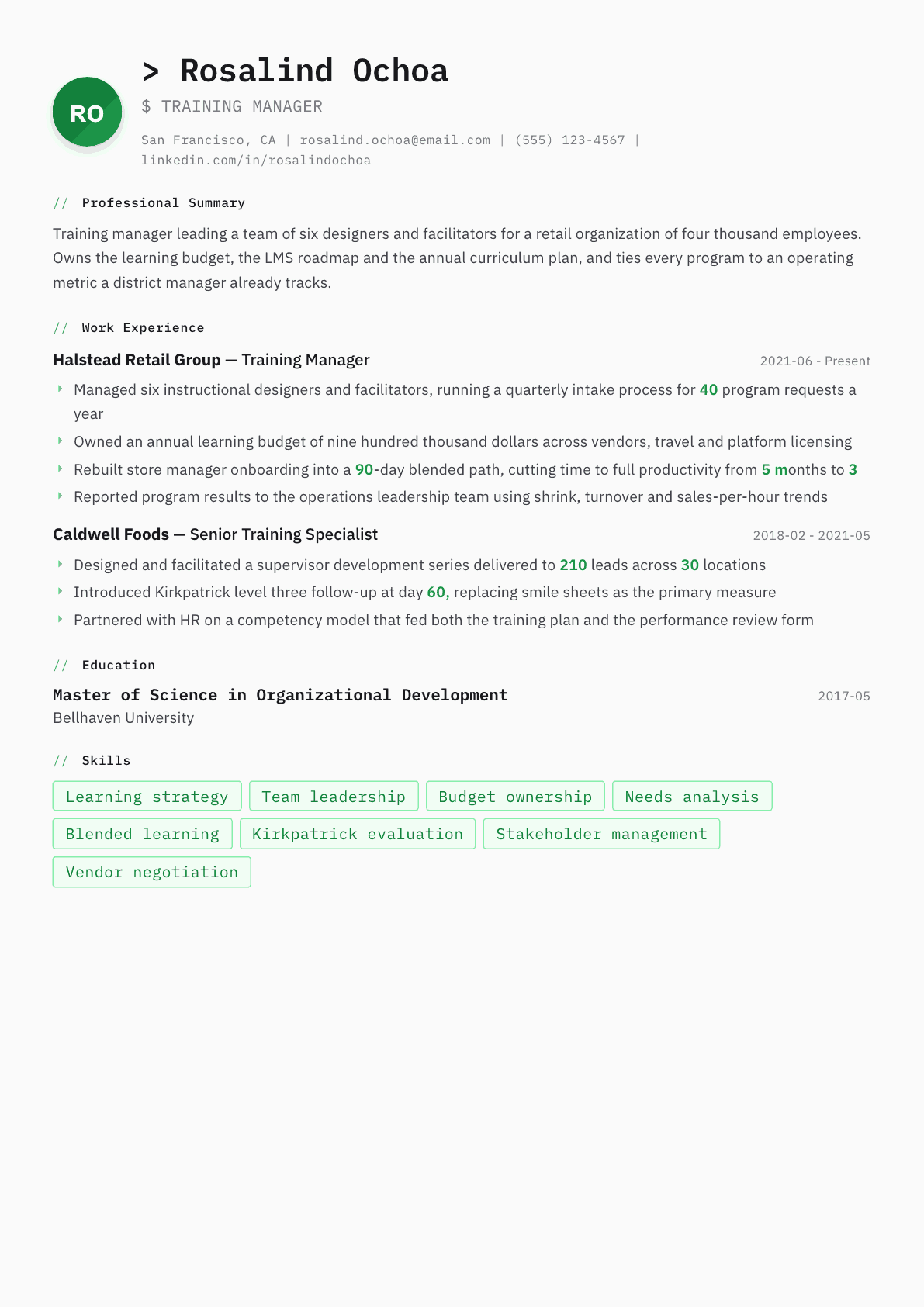
The same training manager content laid out in three CVBooster templates, so you can see what the finished document looks like before you write a word.
Example Training Manager summary
Training manager leading a team of six across design and facilitation for a four thousand person retail organization. Owns the learning budget, vendor relationships and the annual curriculum plan, and prioritizes requests through a quarterly intake process. Rebuilt store manager onboarding into a blended ninety day path and reports results using shrink, turnover and sales per hour rather than satisfaction scores alone.
Skills to list on a Training Manager resume
- Learning strategy
- Team leadership
- Training needs analysis
- Budget management
- Vendor negotiation
- Blended learning design
- Kirkpatrick evaluation
- Competency modeling
- LMS ownership
- Leadership development
- Stakeholder management
- Program prioritization
- Onboarding strategy
- Learning analytics
- Performance consulting
What actually gets this resume read
- Lead with span of control: how many designers, facilitators or coordinators report to you and across how many sites.
- State budget ownership in words rather than a raw figure, and pair it with what you negotiated or consolidated.
- Tie at least two programs to an operating metric the business already tracks, such as turnover, safety or sales per hour.
- Show the evaluation model you use, because a manager who stops at satisfaction surveys reads as a facilitator.
- Describe how you intake and prioritize requests, since training managers are judged on saying no well.
- Name the platforms you own end to end, including the LMS, authoring tools and any content library subscriptions.
How to write a training manager resume
By the time you are applying for a training manager role, nobody is checking whether you can facilitate. They assume it. What a chief human resources officer or operations vice president wants to see is whether you can run a function: a team, a budget, a platform, a prioritization process, and a story that connects learning spend to something the business already measures.
The resumes that stall are the ones that read like a very good specialist. Long lists of courses designed and delivered signal an individual contributor who was promoted by tenure. The resumes that advance show span of control, ownership of money, a method for saying no to requests, and at least two programs tied to an operating number.
This guide covers what to lead with, how to present budget and vendor ownership without pasting figures onto a resume, which evaluation language carries weight with executives, and the questions people ask when stepping up from specialist to manager or across industries.
Lead with the function you own
The first three lines should establish scope: population served, sites or regions, team size and reporting line, and the platforms and budget you control. An executive skimming the top of the page is calibrating whether your job is bigger or smaller than the one being filled, and everything after that is read through that lens.
Be explicit about the reporting line. A training manager who reports to the head of human resources and one who reports to a plant director run different jobs, and naming yours tells a reader which stakeholders you are used to negotiating with.
- Population served and how it splits between corporate, frontline and field.
- Team composition: designers, facilitators, coordinators, contractors.
- Systems owned end to end, including the learning platform and authoring stack.
Budget and vendors: ownership, not a number
State that you own an annual learning budget and describe what sits inside it: platform licensing, content library subscriptions, external facilitators, travel and materials. Write any amount in words rather than digits so it reads as context, not as a headline. What impresses a reader is the decision you made with the money, such as consolidating three content libraries into one or bringing an outsourced program in house.
Vendor negotiation belongs here too. Renewal terms improved, a request for proposals you ran, a contract you exited and what replaced it. These are the parts of the job a specialist has never touched, and they are the clearest evidence of readiness.
Prioritization: show how you say no
Every training function receives more requests than it can build. Managers are judged on how they triage. Describe your intake: a quarterly request process, a scoring rubric against business priorities, a performance consulting conversation that regularly ends with something other than a course.
That last point matters. A manager who occasionally concludes that the problem is a broken process or an unclear expectation rather than a knowledge gap is more valuable than one who builds whatever is asked. Put one example of that on the page.
Evaluation and business linkage
Name the evaluation model you actually run. Satisfaction sheets alone read as an order-taking function. Manager follow-up at a fixed interval, on-the-job observation, or a comparison against an operating metric shows a function that measures transfer rather than attendance.
Then link programs to numbers the business already tracks: turnover in the first ninety days, safety incident rates, time to full productivity, first-call resolution, sales per labor hour, audit findings. You do not need to claim sole causation. Saying that a program was one of three interventions during a period when a metric moved is credible and honest, and executives respect the distinction.
- Say which measures came from your team and which came from the operating system of record.
- Give the population and the period for any comparison you report.
- Include at least one program you retired because it was not earning its place.
People leadership and talent
Show that you build a team rather than staffing one. Hiring, development plans, moving a coordinator into a design role, running quality standards for facilitation, and setting design review practices are the concrete signals. Retention on a small team is worth a line because learning talent moves quickly.
If you manage contractors and agencies alongside employees, say so. Blended teams are now normal and managing them well is a distinct skill from managing direct reports only.
Training Manager resume summary examples
Stepping up from specialist
Senior training specialist ready for management, leading a two-person design pod and the leadership curriculum for a 1,200-employee manufacturer. Owns vendor selection for the supervisor series, runs a quarterly intake process with operations, and reports program results against turnover and safety measures.
Four years managing
Training manager leading six designers and facilitators for a 4,000-employee retail organization. Owns the learning budget, platform roadmap and annual curriculum plan, prioritizes through quarterly intake with operations leaders, and rebuilt store manager onboarding into a ninety day blended path.
Head of learning
Learning leader managing a team of eleven across design, facilitation and platform administration for three business units. Consolidated two learning platforms into one, renegotiated the content library portfolio, and reports quarterly to the executive committee using turnover, ramp time and audit outcomes.
Work experience bullets: before and after
Before: Managed the training team.
After: Managed six instructional designers and facilitators across two regions, running quarterly development conversations and a design review practice that every course passes before release.
Team size plus the practices you installed distinguish a leader from a person with direct reports.
Before: Responsible for the training budget.
After: Owned the annual learning budget across platform licensing, content libraries, external facilitators and travel, consolidating three overlapping subscriptions into one during renewal.
What you decided with the money matters more to an executive than the size of the line item.
Before: Improved new manager onboarding.
After: Rebuilt store manager onboarding into a ninety day blended path with weekly district manager check-ins, reducing time to full productivity from five months to three.
A named design change tied to a ramp metric is the kind of claim an operations leader can test.
Before: Handled requests from the business.
After: Introduced a quarterly intake with a scoring rubric for roughly 40 annual requests, redirecting several to process fixes rather than building courses that would not have solved the problem.
Demonstrating disciplined refusal is a management signal that no volume of delivered courses conveys.
Before: Measured training effectiveness.
After: Replaced end-of-session satisfaction sheets with day sixty manager observations as the primary measure, reporting transfer results to the operations leadership team each quarter.
Naming what you removed and what replaced it shows a deliberate shift from attendance to behavior.
Hard skills
- Learning strategy and roadmap
- Training needs analysis
- Budget ownership and forecasting
- Vendor selection and negotiation
- Learning platform ownership
- Blended learning design standards
- Kirkpatrick evaluation
- Competency modeling
- Leadership development programs
- Onboarding strategy
- Learning analytics and reporting
- Performance consulting
- Team hiring and development
Soft skills
- Negotiating priorities with operations
- Declining requests without damaging trust
- Executive communication
- Coaching designers and facilitators
- Managing through ambiguity in reorganizations
- Holding quality standards under deadline pressure
Certifications worth listing
- Certified Professional in Talent Development (CPTD) (Association for Talent Development)
- SHRM Senior Certified Professional (SHRM-SCP) (Society for Human Resource Management)
- Senior Professional in Human Resources (SPHR) (HR Certification Institute)
- Project Management Professional (PMP) (Project Management Institute)
Mistakes that cost training manager candidates the interview
- Reading like a senior specialist: pages of courses built, no span of control, no budget, no prioritization method.
- Reporting only satisfaction scores, which tells an executive the function measures attendance rather than transfer.
- Omitting vendor and platform ownership, the two pieces of scope that most clearly separate manager from specialist.
- Overclaiming causation for a business metric that several initiatives touched during the same period.
- Skipping the people leadership evidence, so a reader cannot tell whether your team stayed or churned.
- Keeping the resume industry-specific in language when applying across sectors, which hides transferable scope.
Training Manager resume questions
How do I move from training specialist to training manager?
Take on the scope that defines the manager job before you have the title: vendor selection, budget lines, a request intake process, and supervision of a coordinator or contractor. Then rewrite the resume around those, not around the courses you personally built.
Should I put the training budget figure on my resume?
Write it in words as context rather than as a headline number, and follow it with a decision you made: a consolidation, a renegotiation, a program brought in house. Reviewers care far more about judgment with money than about the size of the line.
What metrics do executives expect from a training manager?
Ones already on their dashboard: early turnover, time to full productivity, safety incidents, quality or audit findings, and productivity per labor hour. Attendance and completion belong in the operational report, not in the summary of your resume.
How long should a training manager resume be?
Two pages. One page forces you to cut the budget, vendor and team evidence that qualifies you, and three pages suggests you have not decided which of your programs is relevant to this particular employer and industry.
Does industry experience matter for a training manager role?
Less than scope does, with two exceptions. Heavily regulated industries such as healthcare, aviation and financial services expect familiarity with their compliance regime, and frontline retail or manufacturing employers want proof you have trained hourly shift-based populations.