Apprentice Electrician Resume Examples: read this first
Electrician Apprentice Resume: Electrical Apprentice Resume Sample
By Mustafa Tarabya, founder of CVBooster · Published · Updated
An electrical apprentice resume sample and examples, a resume for an electrical apprenticeship application, hour tracking, safety cards and keywords.
Sample resumes for a apprentice electrician
The same apprentice electrician content laid out in three CVBooster templates, so you can see what the finished document looks like before you write a word.
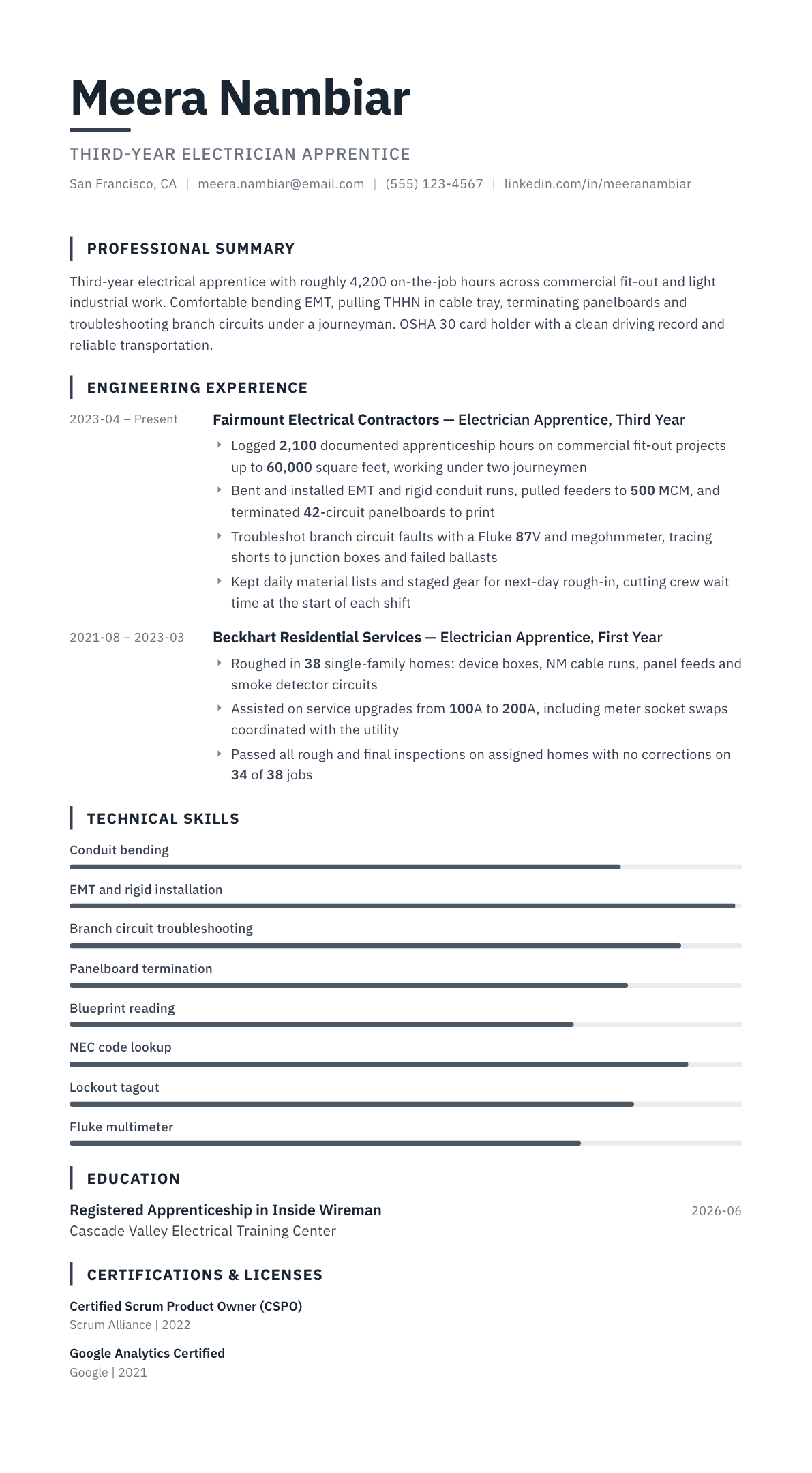
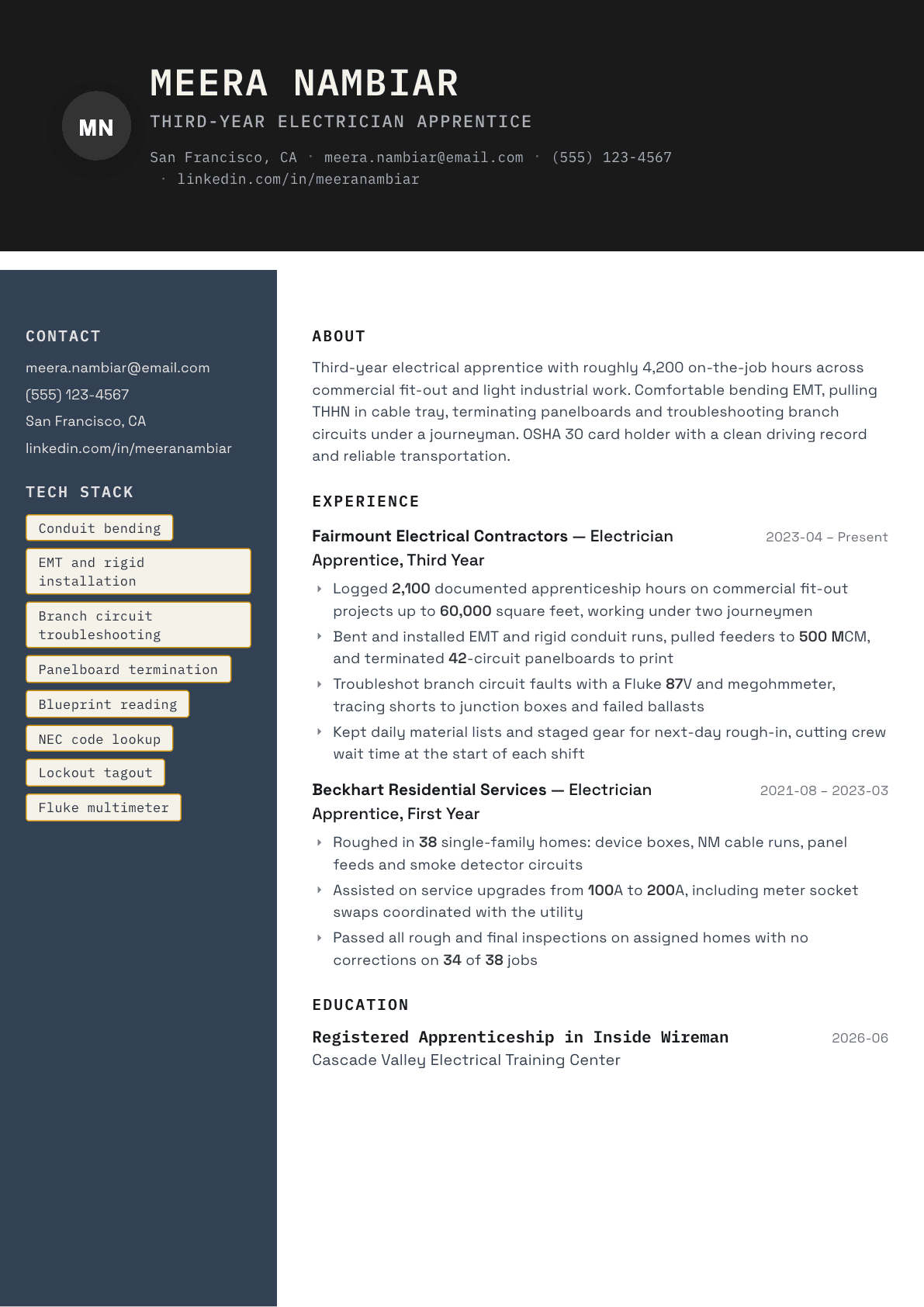
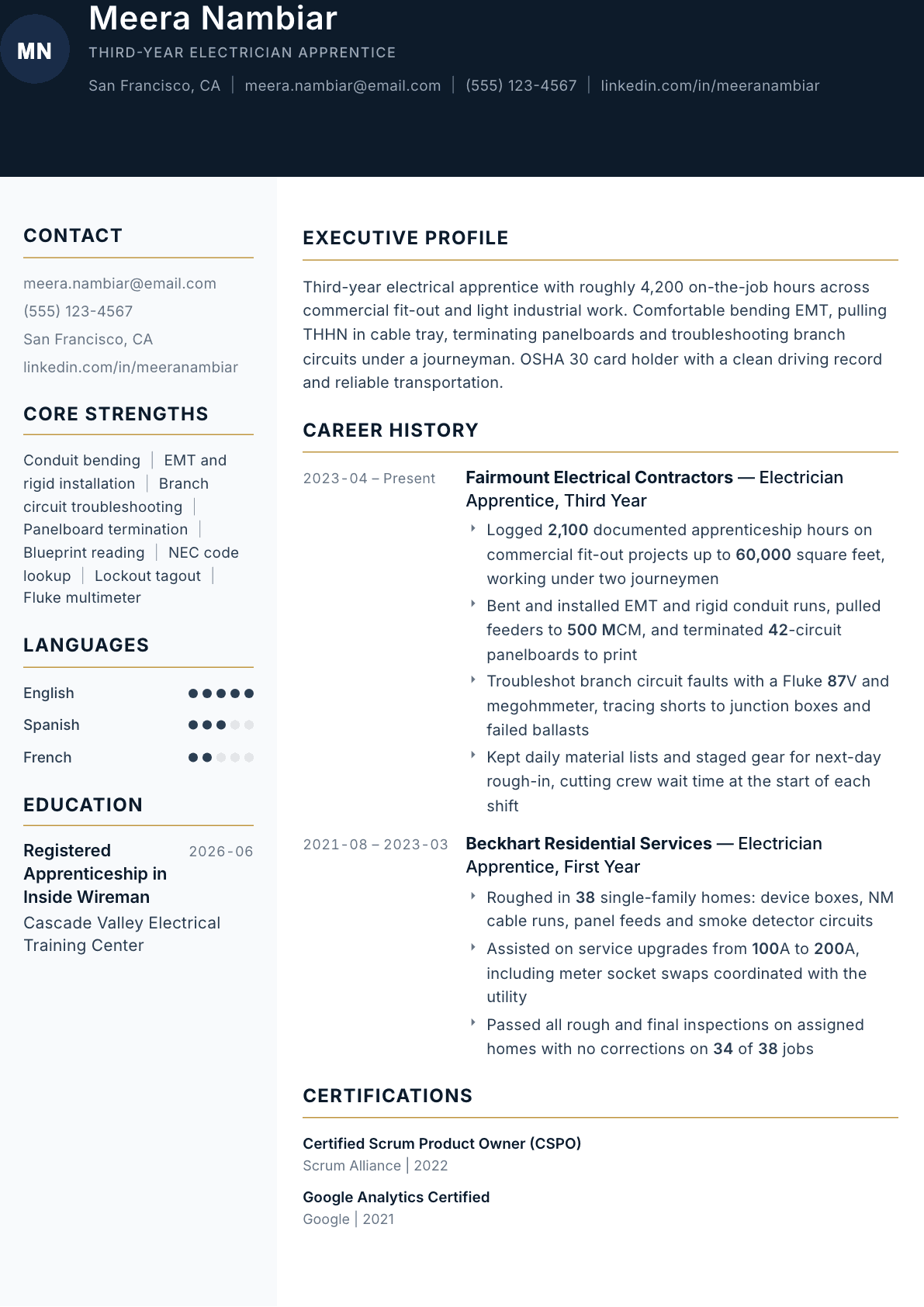
Example Apprentice Electrician summary
Registered electrical apprentice in the third year of a four-year inside wireman program with about 4,200 field hours. Strong on commercial rough-in: EMT bending, cable tray, feeder pulls and panel terminations, plus branch circuit troubleshooting with a digital multimeter. OSHA 30 and CPR current. Looking for a contractor who runs steady commercial work and will sign off on the remaining hours.
Skills to list on a Apprentice Electrician resume
- Conduit bending
- EMT installation
- Rigid conduit
- Wire pulling
- Panelboard termination
- Branch circuit troubleshooting
- Blueprint and print reading
- National Electrical Code
- Lockout tagout
- Grounding and bonding
- Device trim-out
- Cable tray
- Hand and power tools
- Material staging
What actually gets this resume read
- State your apprenticeship year and total documented on-the-job hours in the top third of the resume.
- Name the program you are registered with, the state, and the classroom hours you complete each term.
- List safety cards separately: OSHA 10 or 30, first aid and CPR, and any confined space or lift training.
- Split your experience by sector so a reader can see commercial, residential and industrial hours at a glance.
- Describe tools you use unsupervised, such as benders, knockout sets, meters and cable pullers, by name and size.
- Add your driver license class and whether you own hand tools, because contractors ask both before the interview.
How to write a apprentice electrician resume
An electrician apprentice resume is screened by a shop foreman or a project manager who has one question in mind: how much of the work can this person do without a journeyman standing next to them. Everything else on the page is secondary to that. Your apprenticeship year, your logged on-the-job hours and the tasks you already perform unsupervised answer it faster than any paragraph about work ethic.
The second reader is whoever handles compliance. Registered apprenticeship programs require documented hours and related classroom instruction, and a contractor taking you on needs to know which program holds your record, what year you are in and how many hours remain. Put that on the page rather than making them ask on the phone.
This guide covers the section order that works for apprentices, how to write hours and tasks so they mean something, three example summaries from first year to nearly topped out, before and after bullets, and the questions apprentices ask when the resume is due tomorrow. If a contractor or training provider asks for an apprentice electrician CV instead, send this same page: CV is the usual word in the UK and with some international employers, and the content they screen for is the same year, hours and tasks.
Format: one page, hours near the top, no decoration
One page is the right length for every apprentice. Use a plain single-column layout, reverse chronological, with a header that carries your name, city and state, phone, email, driver license class and the fact that you have your own hand tools and transportation. Those last two get asked in the first minute of every phone screen, so answer them before they are asked.
Under the header, put a short block that states the program you are registered with, your current apprenticeship year, your total documented on-the-job hours and your related classroom hours to date. That block is the whole reason a shop reads further.
- Header: name, city and state, phone, email, driver license class, own tools and transportation.
- Apprenticeship block: program name, year, on-the-job hours, classroom hours.
- Then experience, safety cards, education, skills.
Experience: sector, supervision and what you touch alone
Give each job the contractor name, your title with the apprenticeship year, and the sector: residential, commercial fit-out, ground-up commercial, light industrial or service. A shop that runs mostly commercial rough-in wants to see conduit and cable tray hours, not service calls, and the sector word is how they find it.
Then write bullets around what you actually do. Bending EMT, pulling wire, terminating devices, landing circuits in a panel, setting boxes to layout, digging and backfilling. For each one, add a size, a count or a condition: the conduit sizes you bend, the wire size you have pulled, the number of homes you roughed in, the panel size you have terminated.
Be honest about supervision, and be specific. A line that says you install and terminate branch circuits under a journeyman is worth more than a vague claim, because a foreman can price the work off it. Nobody expects an apprentice to have run a job.
Safety cards and licenses: a short, dated block
Give safety training its own short section rather than burying it in skills. Ten or thirty hour construction outreach training, first aid and CPR, aerial and scissor lift, confined space entry, arc flash awareness and any trenching training all belong here with the issuing body. Sites with owner safety requirements will not badge you in without them.
If your state requires apprentices to be individually registered or carry a trainee card, put the card type and number line here as well. Contractors who work in more than one jurisdiction check that before scheduling you.
Skills and keywords: name tools and code sections, not adjectives
The skills list is where the applicant tracking system finds its match, so use the words the posting uses. Conduit bending, EMT, rigid, PVC, MC cable, cable tray, panelboards, device trim, grounding and bonding, lockout tagout, troubleshooting. Add the meters and testers you use by name so a reader knows you have held one.
Skip anything that describes a personality. A foreman decides whether you are hardworking after a week on the job, not from a bullet point. Space on an apprentice resume is better spent on a task you can perform.
Electrical postings repeat a small vocabulary: apprentice, inside wireman, rough-in, trim-out, conduit, EMT, feeders, branch circuits, panel, code, blueprint, OSHA card. Mirror the exact terms once in your skills block and once inside a bullet where the work is described. A term that appears only in a keyword list and never in the experience reads as padding to the human who follows the software.
Resume for an electrical apprenticeship application
A resume for an electrician apprenticeship, written before you are accepted, is a different document from an apprentice electrician resume written two years in. You have no trade hours yet, so the page has to show the things a program or contractor screens for at the door: math, mechanical aptitude, reliability, a driver license and the ability to work on your feet in all weather.
Union programs usually take applications through a local Joint Apprenticeship and Training Committee, and non-union programs through contractor associations or direct with a contractor. Both read the same evidence. Lead with relevant coursework, any construction or warehouse work, and anything you have wired, built or repaired, then list the jobs outside the trade with one line each on attendance and physical work.
- Education: high school or GED, with algebra and any shop, physics or construction classes named.
- Hands-on work: construction labor, warehouse, landscaping, auto repair, or helping a family member with a renovation.
- Safety: OSHA 10 card if you have it, plus first aid and CPR.
- Practical facts: valid driver license, reliable transport, basic hand tools you own.
Electrical apprentice resume sample, start to finish
Once you are in a program, the page changes from potential to proof. The electrical apprentice resume example below is for a second year apprentice on commercial work. The name, program and contractor are invented, so keep the order and replace every detail with your own: header, program line with hours, a short summary, then experience written as tasks you perform alone and tasks you perform with a journeyman.
Summary: Daniel Reyes, Electrical Apprentice. Second year registered apprentice with a commercial contractor, working on tenant fit outs and small retail builds. Bends and installs EMT, pulls and terminates branch circuits, and lays out device rough-in from drawings, checked by the journeyman before inspection.
- Program line: Registered electrical apprenticeship, year two of four, sponsored by a local joint training committee, with on-the-job and classroom hours logged and current.
- Current role, Electrical Apprentice, commercial contractor: installs EMT runs with offsets and saddles, pulls wire and terminates devices on tenant fit outs.
- Lays out rough-in for receptacles and lighting from the drawings and marks changes on the field set for the foreman.
- Assists the journeyman on panel terminations, feeder pulls and lighting control wiring, and keeps the material list for each floor.
- Safety and licenses: OSHA 10, first aid and CPR, state apprentice registration card, valid driver license.
- Previous job, Warehouse Associate, two years: forklift trained, no missed shifts, moved to the receiving desk after the first year.
Apprentice Electrician resume summary examples
First year
First-year electrical apprentice with 900 hours on residential rough-in, registered with a state-approved program and current on related classroom instruction. Sets boxes to layout, runs NM cable, and assists on panel feeds and service upgrades. OSHA 10 card, own hand tools, and a clean driving record.
Third year
Third-year apprentice with 4,200 documented hours across commercial fit-out and light industrial work. Bends EMT and rigid to 2 inch, pulls feeders, terminates 42-circuit panelboards, and troubleshoots branch circuits with a digital multimeter. Holds OSHA 30 and lift certification, and is on track to test in 14 months.
Fifth year, close to testing
Fifth-year inside wireman apprentice with 7,600 hours and the classroom portion complete, sitting for the journeyman exam this year. Runs rough-in areas independently, lays out branch circuits from prints, terminates lighting control panels, and mentors two first-year apprentices on bending and layout.
Work experience bullets: before and after
Before: Helped electricians with wiring on job sites.
After: Assisted two journeymen on commercial fit-out, bending and installing 3/4 and 1 inch EMT and pulling THHN branch circuits to 120 device boxes per floor.
The sizes, the material and the device count turn a helper line into a measurable skill a foreman can price.
Before: Worked on residential houses doing rough-in.
After: Roughed in 38 single-family homes: device boxes to layout, NM cable home runs, panel feeds, and smoke and carbon monoxide detector circuits.
Naming the house count and the specific rough-in tasks shows the reader exactly what stage of the work you own.
Before: Used tools and equipment safely.
After: Operated benders, knockout sets, cable pullers and a scissor lift under a valid lift certification, with no recordable incidents across two years.
A safety claim only lands when it names the equipment and the certification behind it.
Before: Did some troubleshooting when circuits did not work.
After: Traced dead branch circuits with a Fluke multimeter and a tone generator, isolating faults to loose neutrals, failed ballasts and damaged home runs in occupied buildings.
The instruments and the fault types prove real diagnostic exposure instead of guesswork.
Before: Kept the job site organized.
After: Staged material and pre-cut conduit for next-day rough-in, which let the crew start bending at the first bell instead of running a morning supply trip.
Tying the housekeeping to crew productivity gives it a reason to occupy a line on the page.
Hard skills
- Conduit bending, EMT and rigid
- PVC and MC cable installation
- Wire and feeder pulling
- Device box layout and rough-in
- Panelboard termination
- Branch circuit troubleshooting
- Grounding and bonding
- Blueprint and riser reading
- National Electrical Code lookup
- Lockout tagout
- Digital multimeter and megohmmeter
- Trenching and backfill
Soft skills
- Taking direction on the first pass
- Attention to layout detail
- Reliability and attendance
- Asking before guessing
- Crew communication
Certifications worth listing
- OSHA 10-Hour Construction (OSHA Outreach Training Program)
- OSHA 30-Hour Construction (OSHA Outreach Training Program)
- Adult First Aid, CPR and AED (American Red Cross)
- Electrical Level One (NCCER)
Mistakes that cost apprentice electrician candidates the interview
- Leaving off the apprenticeship year and hour count, which is the first thing a shop needs and the reason to call.
- Writing helper duties in the passive voice so nothing on the page names a task you can perform alone.
- Padding the page to two sides with school projects and unrelated jobs instead of one tight page of field work.
- Skipping the safety cards, which stops a badge from being issued on any site with owner safety requirements.
- Claiming journeyman-level work, since a foreman will discover the truth on the first rough-in and remember it.
- Omitting transportation and tool ownership, both of which are asked in every phone screen for this job.
Apprentice Electrician resume questions
What if I have no electrical experience at all yet?
Lead with anything physical, dependable and tool-based: warehouse, landscaping, auto shop, military service. Then add a short line about the program you have applied to, your aptitude test result if you have one, and your availability for early start times.
How do I list my apprenticeship hours on a resume?
Put a single block under the header with the program name, your current year, total on-the-job hours and related classroom hours. Round to the nearest hundred. If your program tracks hours by category, break them into residential, commercial and industrial.
Should an apprentice electrician CV or resume be one page?
Yes, whichever name the posting uses. A shop foreman scans it between calls and needs the year, the hours and the sector in the first few seconds. A second page for an apprentice usually means unrelated jobs that dilute the electrical work.
What should a resume for an electrical apprenticeship application include?
Your education with algebra and any shop or construction classes, hands-on work such as construction labor, warehouse or repair jobs, an OSHA 10 card if you have one, a valid driver license and reliable transport. Jobs outside the trade stay, one line each, written to show attendance, physical work and following instructions.
How should I describe work I did under supervision?
State the task and the supervision in the same line, such as terminating branch circuits under a journeyman on energized panel work. That reads as honest and competent. Vague wording designed to sound independent gets exposed in the interview.
Related resume examples
- Electrician Resume example
- Construction Worker Resume example
- Journeyman Electrician Resume example
- Electrical Technician Resume example
- Plumber Apprentice Resume example
- Carpenter Resume example