Plumber Apprentice Resume Examples: the lines they read
Write a Plumber Apprentice Resume That Gets You on a Truck
By Mustafa Tarabya, founder of CVBooster · Published · Updated
Plumber apprentice resume examples with apprenticeship hours, pipe and joining methods, code exposure and the words plumbing shops search for.
Sample resumes for a plumber apprentice
The same plumber apprentice content laid out in three CVBooster templates, so you can see what the finished document looks like before you write a word.
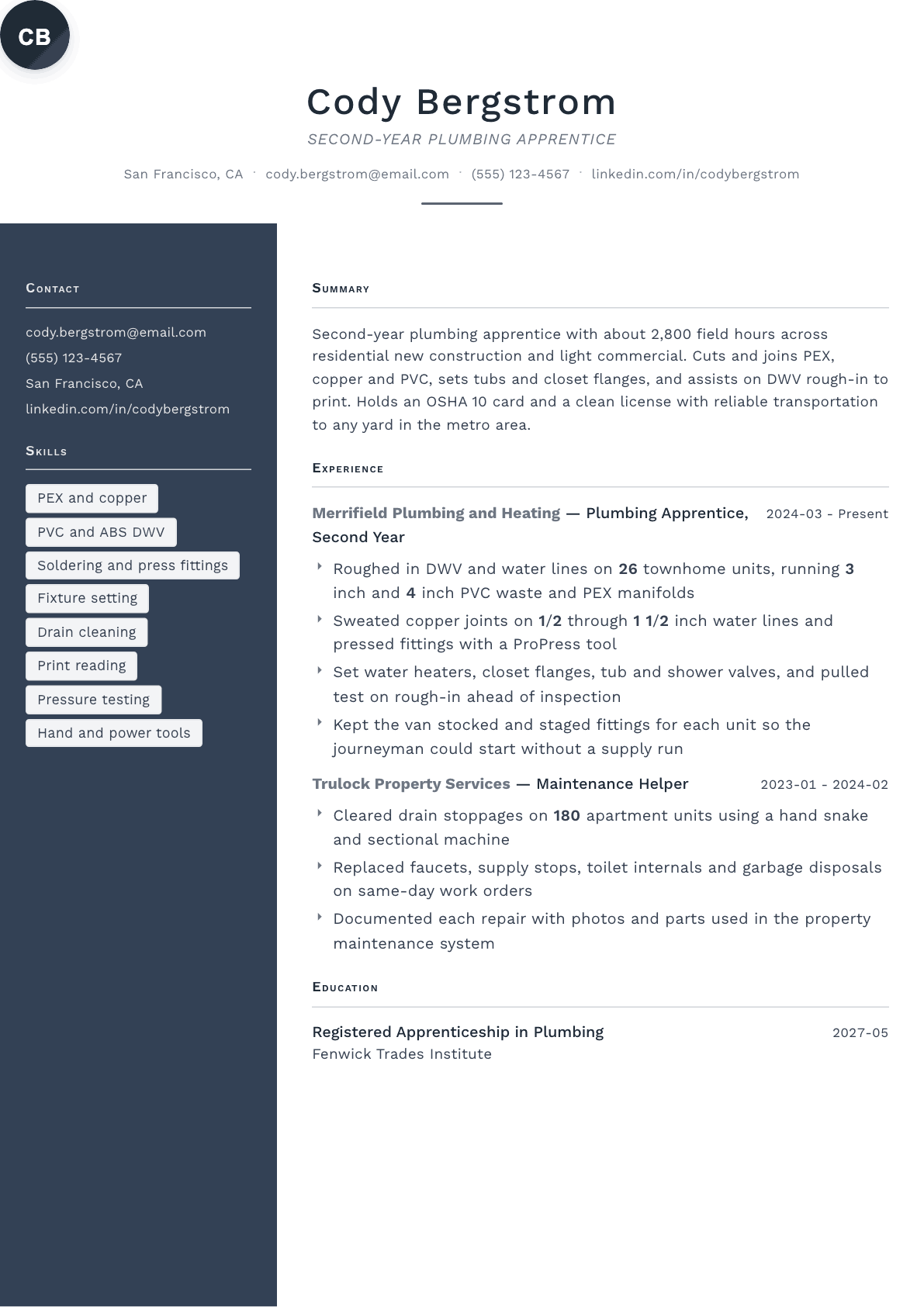
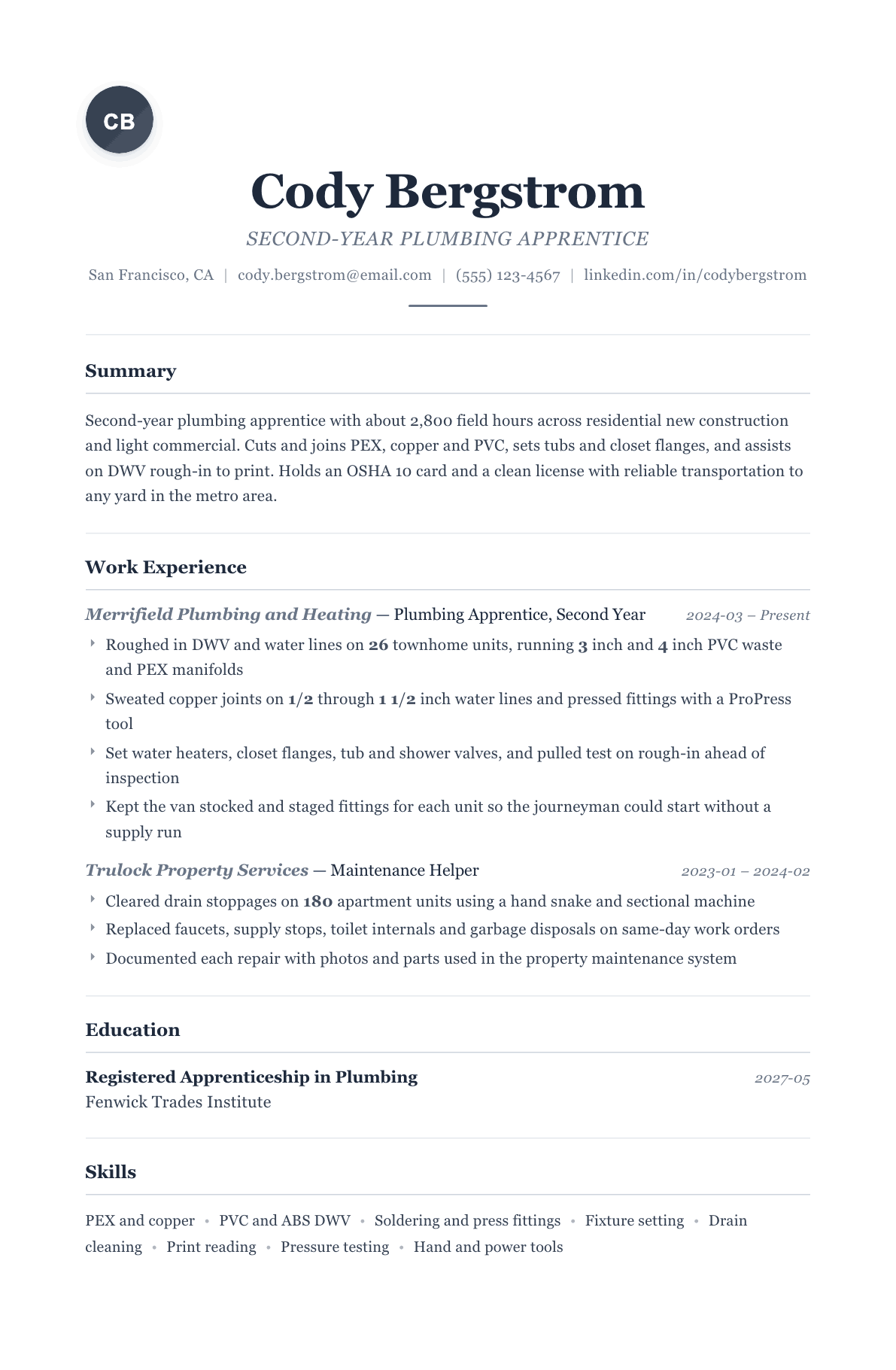
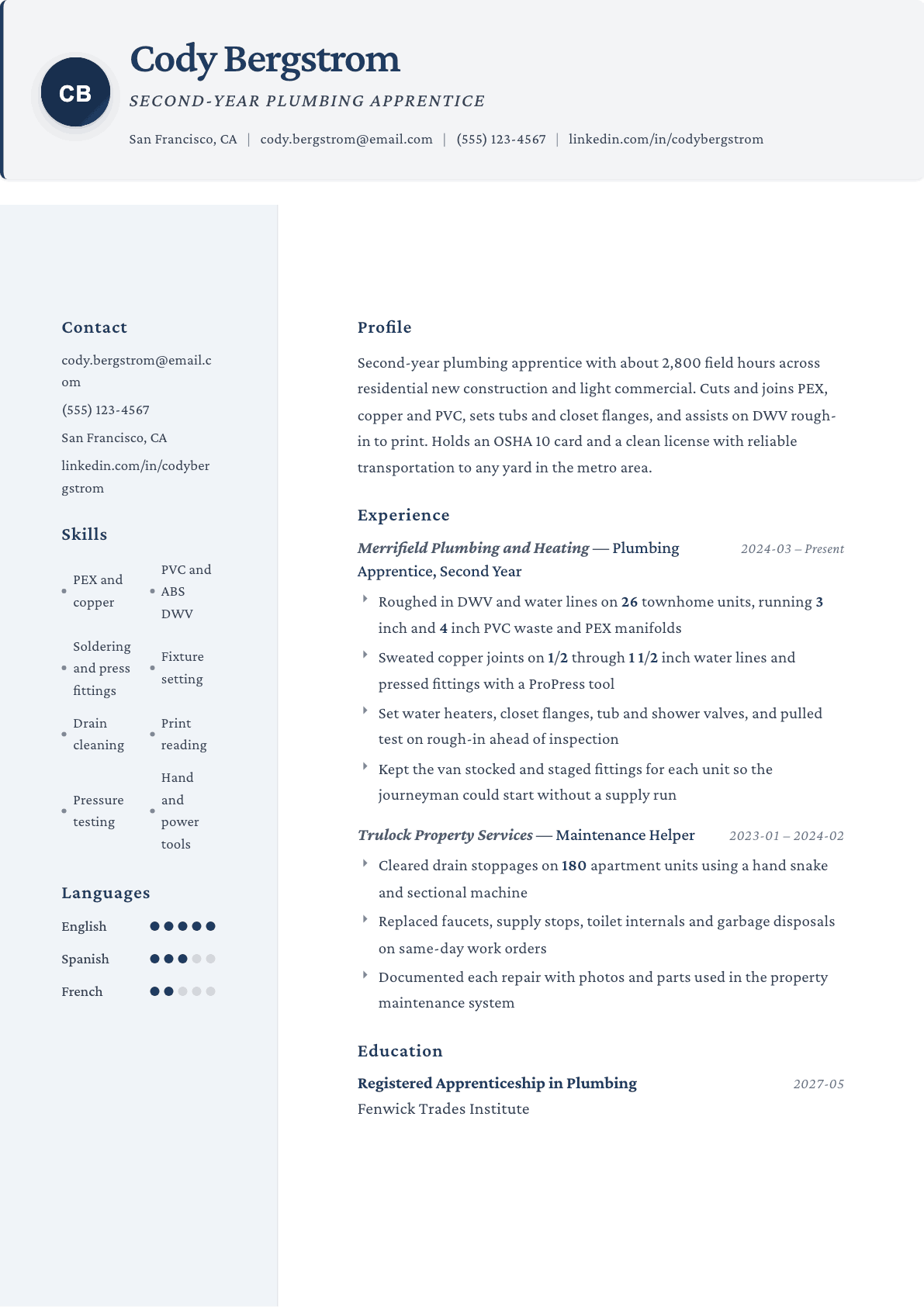
Example Plumber Apprentice summary
Second-year plumbing apprentice in a registered program with roughly 2,800 documented hours on townhome and light commercial jobs. Runs PEX manifolds, sweats and presses copper, solvent welds PVC waste, and sets fixtures and water heaters without supervision. Comfortable pulling test on a rough-in and walking it with the inspector. Looking for a shop that mixes new construction with service so the remaining hours cover both.
Skills to list on a Plumber Apprentice resume
- PEX crimp and expansion
- Copper soldering
- Press fittings
- PVC and ABS solvent weld
- DWV rough-in
- Water line rough-in
- Fixture and trim setting
- Water heater installation
- Drain cleaning
- Pressure and air testing
- Print reading
- Plumbing code basics
- Trenching and safety
- Hand and power tools
What actually gets this resume read
- Open with your apprenticeship year, registered program and documented hours, because shops track those hours themselves.
- List every joining method you can do alone: solder, press, solvent weld, crimp, cam and groove, no-hub bands.
- Break out residential, multifamily and commercial hours so a service manager knows what truck to put you on.
- Mention the tools you own and can bring, from torch and press jaws to a sectional drain machine.
- Include inspection experience: how many rough-ins you have pressure tested and walked with an inspector.
- Put the driver license, any DOT medical card and your comfort with on-call rotation near the contact details.
How to write a plumber apprentice resume
A plumber apprentice resume is usually read by a service manager or a shop owner deciding which truck to put you on tomorrow. What they need is quick: your apprenticeship year, your logged hours, the joining methods you can perform without help, and whether you have a clean driving record. Those four facts decide the call, and they should be visible without scrolling.
The second thing a shop weighs is which lane you have hours in. New construction rough-in, service and repair, and remodel are different jobs with different rhythms, and an apprentice who has 2,000 hours of townhome rough-in is a different hire from one who has 2,000 hours of drain cleaning. Split your experience by lane so the reader can place you.
What follows is the layout that works for plumbing apprentices, how to describe pipe work so it carries weight, three summaries from first year to nearly licensed, before and after bullets, and the questions apprentices ask when they need a resume by the weekend.
Format: one page, hours and lane at the top
Keep it to a single page in a plain single-column layout. The header carries name, city and state, phone, email, driver license class, and whether you have your own hand tools and a reliable vehicle. Service shops ask about the vehicle and the tools in the first two minutes of a phone call, so put the answer where they will find it.
Directly under the header, add a short apprenticeship block: the registered program, your year, your documented on-the-job hours and your classroom hours completed. If the program tracks hours by category, break them out into new construction, service and remodel.
- Header: contact details, driver license class, own tools, reliable transportation.
- Apprenticeship block: program, year, on-the-job hours, classroom hours.
- Then experience by lane, safety cards, education, skills.
Experience: pipe, sizes and the tasks you own alone
Give every job the shop name, your title with the apprenticeship year, and the type of work. Then write bullets around pipe and fixtures rather than duties. Which materials you cut and join, which sizes, which systems: domestic water, drain waste and vent, gas, hydronic heating, condensate. Sizes matter because a shop hears the difference between half inch water lines and 4 inch waste immediately.
Name the joining methods you can perform unsupervised. Solder, press, solvent weld, crimp and expansion PEX, no-hub couplings on cast iron, threaded black iron, compression. Each one is a separate skill and each one is a separate line in the shop mental checklist.
Add the parts of the process you handle from start to finish, such as setting fixtures, installing water heaters, pulling test on a rough-in and walking it with the inspector. Those show a foreman where they can leave you alone.
Safety cards, license and vehicle facts
Give a short block to safety and compliance items: construction outreach training, first aid and CPR, trenching and excavation, confined space entry, and any backflow or gas training you have started. Multifamily and commercial general contractors will not badge an apprentice onto a site without the outreach card.
If your state issues an apprentice registration card or a trainee permit, list the card type and status here. Also state whether you are willing to take on-call rotation, since service shops build their schedules around who will answer the phone at night.
Skills: tools, systems and code exposure
Write the skills as things you do, grouped by system. Water and DWV work, gas piping, fixtures and appliances, drain cleaning and diagnostics, testing. Then list the equipment you can run: torch and press tool with the jaw sizes, PEX expansion tool, sectional and drum drain machines, jetter, camera and locator, pipe threader.
Show code exposure without overclaiming. Knowing how to size a vent from a table, where cleanouts are required, and what needs a trap primer is realistic apprentice knowledge and worth saying. Claiming to know the whole code book is not, and a shop owner will test it in the interview.
Keywords plumbing shops search on
Plumbing postings repeat a compact vocabulary: apprentice, rough-in, trim, service, PEX, copper, press, cast iron, water heater, drain cleaning, backflow, gas line, code, OSHA card, on-call. Put each of them where the work is described rather than only in a list. A shop reader wants to see the term attached to a job, a size and a count.
Plumber Apprentice resume summary examples
First year
First-year plumbing apprentice with 1,100 documented hours on residential service and remodel. Cuts and solvent welds PVC, crimps PEX, replaces faucets, stops and toilet internals, and clears stoppages with a hand snake and sectional machine. OSHA 10 card, own hand tools, and a clean driving record.
Second year
Second-year apprentice with about 2,800 field hours across townhome new construction and light commercial. Runs 3 and 4 inch PVC waste, builds PEX manifolds, sweats and presses copper to 1 1/2 inch, sets water heaters and tub valves, and pulls test on rough-in before inspection.
Fourth year, testing soon
Fourth-year plumbing apprentice with 7,200 hours and the classroom portion finished, sitting for the journeyman exam this year. Rough-ins whole units from print without direction, installs gas piping and tankless water heaters, and runs a service truck on overflow days.
Work experience bullets: before and after
Before: Helped plumbers with installations on new houses.
After: Roughed in DWV and water lines on 26 townhome units, running 3 and 4 inch PVC waste and building PEX manifolds for each unit off a central wall.
Unit count, pipe sizes and the specific systems replace a helper line with work a foreman can price.
Before: Did soldering and other pipe joining.
After: Sweated copper joints from 1/2 through 1 1/2 inch on water lines and pressed the same sizes with a ProPress tool when the space would not take a torch.
Naming both methods, the size range and the reason for the choice shows judgment rather than a memorized task.
Before: Fixed drains and clogs at apartments.
After: Cleared stoppages across 180 apartment units with a hand snake and a sectional machine, cabling kitchen and lavatory branches and pulling toilets when the blockage was past the closet bend.
The volume, the equipment and the escalation step prove real drain experience instead of a repeated task.
Before: Set fixtures and water heaters.
After: Set closet flanges, tub and shower valves and water heaters, including expansion tanks and venting, then pressure tested each rough-in ahead of the inspector.
Adding the supporting components and the test step shows the whole job, not the easy middle of it.
Before: Kept the work van stocked.
After: Staged fittings and material for each unit the night before, which let the journeyman start the run at the first call instead of losing an hour to the supply house.
Attaching stocking to lost time gives a housekeeping habit an operational reason to be on the page.
Hard skills
- PEX crimp and expansion
- Copper soldering and press fittings
- PVC and ABS solvent weld
- Cast iron and no-hub couplings
- DWV rough-in
- Domestic water rough-in
- Fixture and trim setting
- Water heater installation
- Drain cleaning machines and cameras
- Pressure and air testing
- Print reading
- Trenching and backfill safety
Soft skills
- Working in occupied homes
- Taking direction cleanly
- Customer courtesy
- Reliability on early starts
- Careful documentation
Certifications worth listing
- OSHA 10-Hour Construction (OSHA Outreach Training Program)
- Plumbing Level One (NCCER)
- Adult First Aid, CPR and AED (American Red Cross)
Mistakes that cost plumber apprentice candidates the interview
- Leaving the apprenticeship year and hour total off the page, forcing the shop to call before it can even sort you.
- Describing plumbing in general instead of the joining methods and pipe sizes you personally handle.
- Mixing service, remodel and new construction into one blur so the reader cannot tell which truck you belong on.
- Omitting driver license status and tool ownership, which are asked on every first call in this trade.
- Listing school coursework above field hours, when the hours are the credential a shop is actually buying.
- Claiming code knowledge you cannot demonstrate, since a shop owner will ask you to size a vent in the interview.
Plumber Apprentice resume questions
How many hours do I need before a shop will hire me?
Shops hire at every stage, including first year with no hours, so list what you have honestly. What moves you up the pile is showing which tasks you already perform without a journeyman watching, whatever your hour count is.
Should I include drain cleaning and maintenance work?
Yes, especially for a service shop. Give the property count, the machines you ran and how far you escalated a blockage. Maintenance work also demonstrates that you can be alone in a customer home without a complaint.
What goes on a plumber apprentice resume with no trade experience?
Physical jobs with tools and dependable attendance: warehouse, landscaping, auto shop, farm work, military service. Add your registered program application status, your driver license class, and the hand tools you already own.
Do I list the plumbing code on my resume?
List the code family your jurisdiction adopted and the parts you use daily, such as fixture unit sizing, vent requirements and cleanout placement. Keep it to a single line, because an overreaching code claim gets tested immediately.
Is a cover letter worth writing for an apprentice position?
A short one helps when you are changing lanes, moving from service into new construction for instance, or when you have a gap. Three sentences naming the shop, the lane you want and your hour count is enough.
Related resume examples
- Plumber Resume example
- Construction Worker Resume example
- Journeyman Plumber Resume example
- Pipefitter Resume example
- Apprentice Electrician Resume example
- Carpenter Apprentice Resume example