Electrical Technician Resume Examples: read this first
Write an Electrical Technician Resume That Survives the Screen
By Mustafa Tarabya, founder of CVBooster · Published · Updated
Electrical technician resume example, keyword list and guide covering motor controls, PLC troubleshooting, NFPA 70E work and downtime numbers.
Sample resumes for a electrical technician
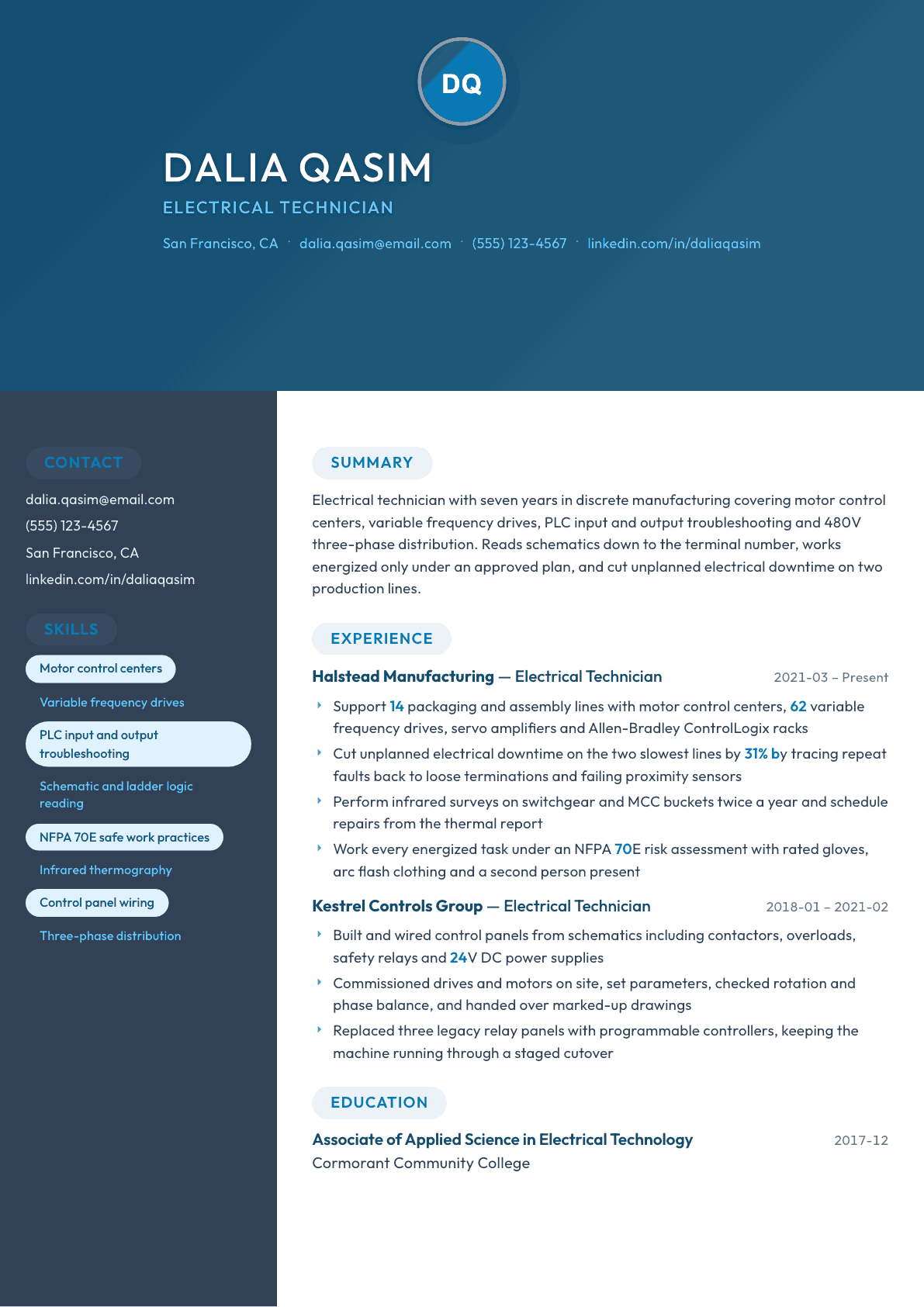
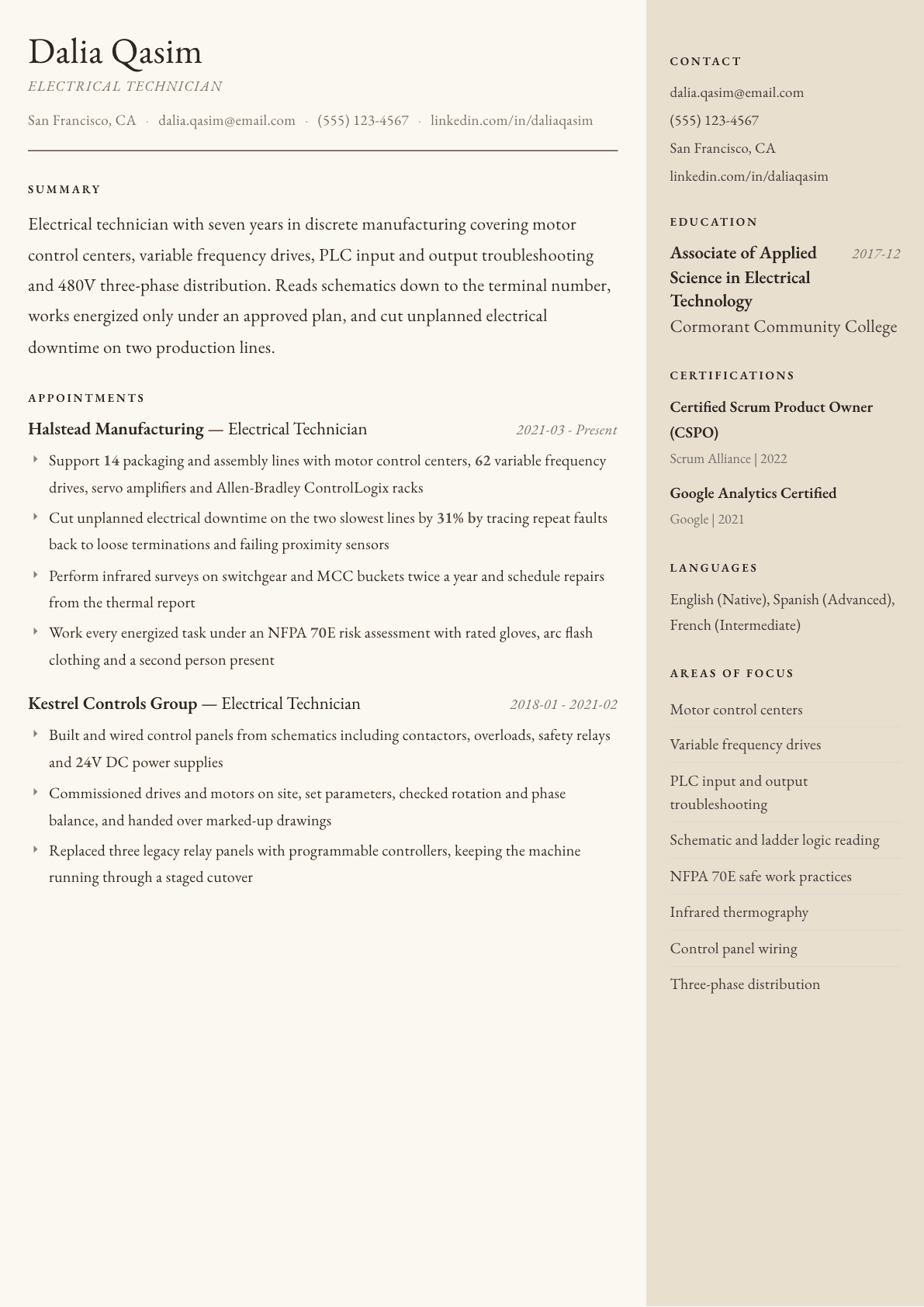
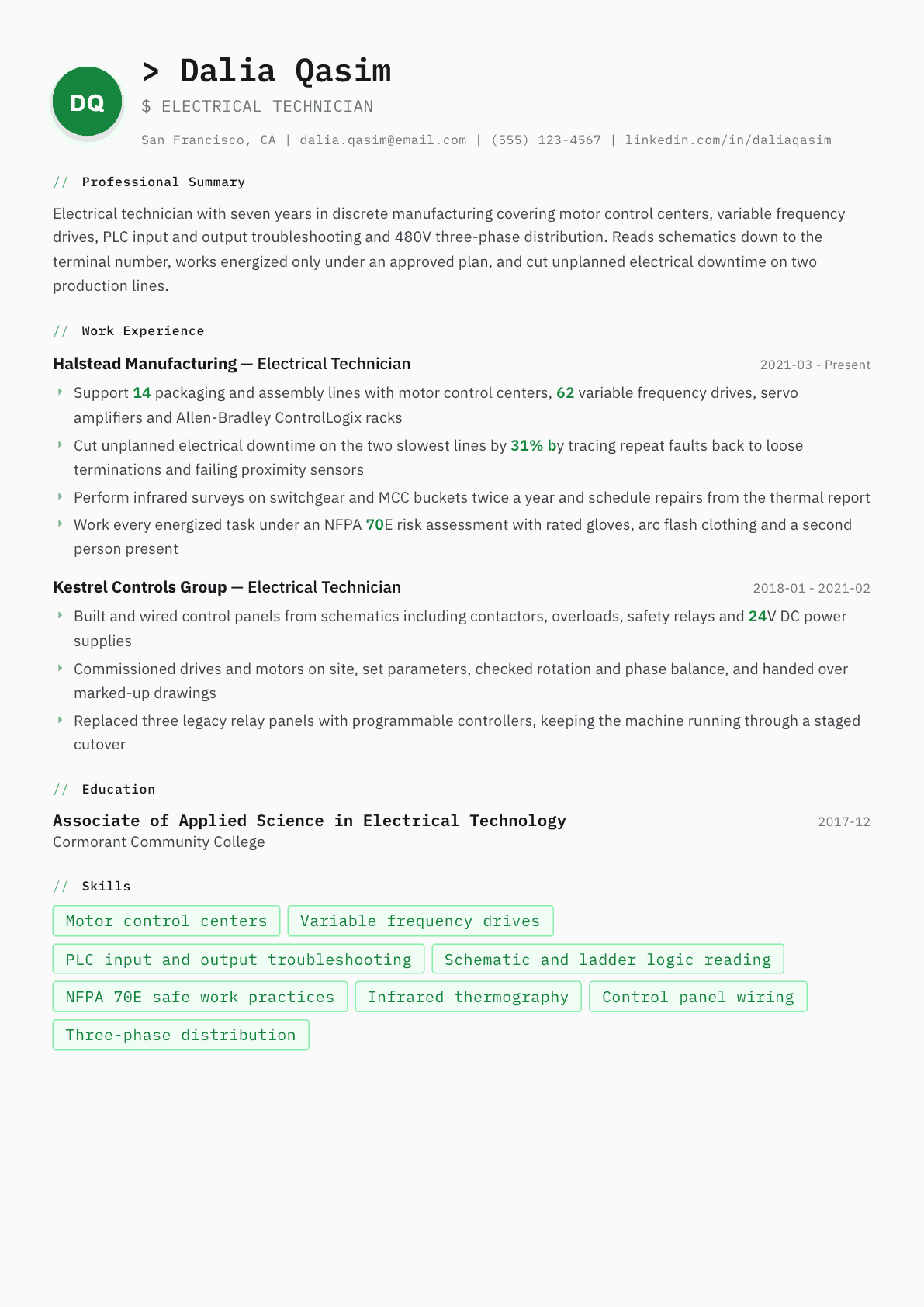
The same electrical technician content laid out in three CVBooster templates, so you can see what the finished document looks like before you write a word.
Example Electrical Technician summary
Electrical technician with seven years supporting packaging and assembly lines across motor control centers, variable frequency drives and ControlLogix racks. Troubleshoots from schematics to the terminal number, runs twice-yearly infrared surveys on switchgear, and treats every energized task as an NFPA 70E risk assessment. Cut unplanned electrical downtime on the two worst lines by tracing repeat faults to their real source.
Skills to list on a Electrical Technician resume
- Motor control centers
- Variable frequency drives
- Servo drives and amplifiers
- PLC input and output troubleshooting
- Ladder logic interpretation
- Electrical schematics and one-line diagrams
- Control panel build and wiring
- Three-phase power distribution
- Conduit bending and cable pulling
- Insulation resistance testing
- Infrared thermography
- NFPA 70E and arc flash practice
- Lockout tagout
- Safety relays and light curtains
- Grounding and bonding
- Preventive maintenance routes
What actually gets this resume read
- Name the voltage classes you have worked, because 24V control work and 480V distribution are different hires.
- List drive and controller brands by name, since a plant standardized on one will filter for it.
- Show that you troubleshoot from schematics rather than by swapping parts, and give one traced fault as proof.
- Put your NFPA 70E training and arc flash practice on the page, because safety records decide plant hiring.
- Quantify downtime you removed, in hours or in a share of line stoppages, not as improved reliability.
- Say whether you hold an apprenticeship, journeyman card or state license, and name the issuing board.
- Add the test equipment you own and use: clamp meter, megohmmeter, insulation tester, thermal camera, loop calibrator.
How to write a electrical technician resume
The person hiring an electrical technician is usually a maintenance supervisor with a downtime report open on the other monitor. He knows which lines stop most often and he knows roughly what each stopped hour costs the plant. When he reads your resume he is asking one question: can this person find the real fault in a machine he has never seen, from a drawing, without breaking anything or getting hurt.
The resumes that answer that question look different from the ones that do not. They name voltage classes, drive families, controller platforms and the test instruments used. They contain at least one story where a measurement led to a conclusion. And they show safety practice as a working habit rather than a training certificate collected once.
This guide covers the sections a maintenance supervisor reads in order, with summaries for an apprentice, a plant technician and a lead, before and after bullets built around real fault-finding, and answers to questions technicians ask when moving between panel shops, plants and field commissioning work.
Format: voltage, platforms and safety in the top third
Reverse chronological, one page under ten years. Skip the columns and graphics. Many plants run resumes through parsers that read a two-column layout in the wrong order, and a supervisor pulling the page up on a shop floor terminal wants the equipment list visible without scrolling.
Put a short technical profile under the header rather than an objective. Voltage classes worked, controller and drive brands, the instruments you own, and your safety training. Four lines of that beats a paragraph about being a motivated professional every time, because every line is checkable at interview.
- Header: name, city and state, phone, email, apprenticeship or license status, and whether you hold a journeyman card.
- Technical profile: voltage classes, drive and controller platforms, instruments, safety training, and any hazardous location experience.
- Each job opens with the plant type, the number of production lines or machines supported, and the shift pattern worked.
- Apprentices and graduates put the electrical program, lab hours and any panel build coursework above unrelated work history.
Summary: what you support, at what voltage, with what result
Three lines. The equipment population you support, the voltage range you work in, the platforms you troubleshoot, and one measurable result. A supervisor reads that and knows whether to keep going. He will not learn any of it from a summary about being detail oriented with strong problem solving abilities.
If you are moving from construction or residential work into a plant maintenance seat, name the transfer directly. Conduit, terminations, panel work and code knowledge all carry. Drives, sensors and controller logic usually do not. A technician who says which side of that line he stands on is easier to place than one who blurs it.
Experience: trace the fault, do not list the tasks
Open each job with scale before detail: the number of machines or lines, the drive count, the controller racks, and the distribution voltage. Then write three to five bullets and make at least two of them fault-finding stories rather than duty descriptions.
A strong fault bullet has three parts: the symptom, the measurement, the cause. An intermittent line stop measured back to a proximity sensor dropping out on vibration. A drive tripping on overcurrent traced to a phase imbalance from a loose lug in the motor control center bucket. A safety relay chattering because a light curtain alignment drifted. Those bullets tell a supervisor exactly how you think.
Then add the preventive side. Infrared surveys with repair actions taken from the report, torque checks on terminations, insulation resistance trending on motors, and the reliability outcome. Maintenance managers are hired on downtime, so they hire technicians who reduce it before it happens as well as after.
- Give drive, controller and switchgear counts so the workload is visible instead of implied.
- Name the instruments you use and what you use them for: clamp meter, insulation tester, oscilloscope, thermal camera, loop calibrator.
- Show at least one bullet where a repeat fault stopped repeating, with the root cause named.
- Include panel build or modification work by scope: enclosure size, component count, wiring standard followed, and the drawing you worked from or produced.
Safety practice belongs on the page, not just in a certificate list
Write NFPA 70E practice as behavior. An energized task performed under a written risk assessment with rated gloves, arc-rated clothing and a second person present is a sentence that tells a supervisor his insurance exposure is safe with you. A line that says safety conscious tells him nothing.
Lockout tagout deserves the same treatment. Name whether you write the procedures, verify absence of voltage with a proven tester, or manage group lockout during outages. Plants with a real safety culture screen hard on this, and technicians who write it well are rare enough to stand out immediately.
Skills and keywords an electrical maintenance posting filters on
The recurring vocabulary is small: motor control center, variable frequency drive, servo, PLC, ladder logic, schematic, one-line, contactor, overload, safety relay, light curtain, insulation resistance, megohmmeter, thermography, three-phase, grounding and bonding. Mirror the posting word for word inside your skills block and again in a bullet.
Draw a clear line between electrical work and controls programming. Many technicians can force an output, monitor a rung and change a timer preset without being programmers. Say exactly what you do inside the controller software, because a supervisor who hires a programmer and gets a troubleshooter, or the reverse, will notice in week one.
Electrical Technician resume summary examples
Apprentice or graduate
Electrical technology graduate with 2 years as a maintenance apprentice supporting conveyors, motor starters and 480V distribution. Reads schematics and ladder logic, wires control panels from drawings, and has completed arc flash and lockout tagout training. Seeking a plant electrical technician seat on a rotating shift.
Five years in a plant
Electrical technician with 5 years supporting 14 packaging lines including 62 variable frequency drives, servo amplifiers and ControlLogix racks. Troubleshoots from schematics to the terminal number, runs infrared surveys on switchgear, and cut unplanned electrical downtime on two lines by 31% by chasing repeat faults to root cause.
Lead maintenance technician
Lead electrical technician with 12 years across food and automotive plants covering motor control centers, medium voltage switchgear feeds, drives and safety systems. Writes energized work risk assessments, owns the thermography program, leads outage electrical scope, and mentors 4 technicians on schematic-first troubleshooting.
Work experience bullets: before and after
Before: Troubleshot electrical problems on production equipment.
After: Traced an intermittent line stop on a case packer to a proximity sensor dropping out under conveyor vibration, remounted the bracket and closed a fault that had stopped the line 3 times a week.
A symptom, a measured cause and the frequency that disappeared prove diagnostic ability instead of asserting it.
Before: Worked with variable frequency drives.
After: Commissioned and maintained 62 variable frequency drives, setting acceleration and current limit parameters, checking phase balance at the motor terminals and replacing drives during planned downtime windows.
The count and the specific parameter work show real drive ownership rather than proximity to drives.
Before: Performed preventive maintenance on electrical equipment.
After: Ran twice-yearly infrared surveys on switchgear and motor control center buckets, then scheduled repairs from the thermal report and eliminated 2 hot connections before they failed under load.
A named method with the follow-up action turns routine maintenance into demonstrated reliability work.
Before: Followed electrical safety procedures.
After: Performed every energized task under a written NFPA 70E risk assessment with rated gloves, arc-rated clothing and a second person present, and verified absence of voltage with a proven tester before any lockout was trusted.
Describing the behavior rather than the policy is what convinces a supervisor the practice is real.
Before: Built control panels.
After: Built and wired 30 control panels from schematics including contactors, overloads, safety relays and 24V DC supplies, then marked up the drawings with as-built changes before handover.
Volume, component detail and the as-built handover show craftsmanship and documentation discipline together.
Hard skills
- Motor control center maintenance
- Variable frequency drive setup and troubleshooting
- Servo drives and amplifiers
- PLC input and output troubleshooting
- Ladder logic interpretation and online monitoring
- Electrical schematics and one-line diagrams
- Control panel build and modification
- Three-phase power distribution
- Insulation resistance and continuity testing
- Infrared thermography surveys
- NFPA 70E energized work practice
- Lockout tagout and absence of voltage verification
- Safety relays, light curtains and interlocks
- Grounding, bonding and conduit installation
Soft skills
- Staying with a drawing when the pressure is to swap parts
- Explaining a fault to production without blaming an operator
- Writing handover notes a night shift technician can act on
- Refusing an unsafe energized task without stopping the plant
- Coaching apprentices through a trace instead of solving it for them
Certifications worth listing
- Certified Electrical Safety Compliance Professional (CESCP) (National Fire Protection Association)
- NCCER Electrical Craft Certification (NCCER)
- OSHA 30-Hour General Industry (OSHA Training Institute)
- Level I Thermographer (Infraspection Institute)
Mistakes that cost electrical technician candidates the interview
- Listing every voltage from 24V to medium voltage without saying which ones you have actually worked energized.
- Describing controller work so vaguely that a supervisor cannot tell whether you program, monitor or only replace modules.
- Filling the experience section with duty statements when a single traced fault would prove more than all of them.
- Treating arc flash training as a certificate line instead of describing how energized work is planned and performed.
- Leaving out drive, panel and machine counts, which are the numbers that let a supervisor gauge workload experience.
- Using a two-column layout that plant parsers read out of order, scrambling the dates and job titles.
Electrical Technician resume questions
Do I need a journeyman license to work as an electrical technician?
Many industrial maintenance seats do not require one, since plant work often falls under a maintenance exemption, but holding it widens your options and raises your rate. List your apprenticeship hours or license status clearly either way, because employers screen on it before asking.
How do I show PLC ability without claiming to be a programmer?
Describe exactly what you do in the software: go online, monitor rungs, check input and output status against field devices, adjust timer presets, and read fault words. Then say what you leave to controls engineering. That honesty is easier to hire than a vague claim about PLC experience.
How do I move from construction electrical work into plant maintenance?
Lead with what transfers: terminations, conduit, panel work, code knowledge and safe work practice. Then show any exposure to motors, starters, sensors or drives, even during commissioning. Finally state that you want the troubleshooting side, because supervisors want technicians who chose maintenance rather than fell into it.
Should I include the test instruments I own?
Yes, briefly, because it tells a supervisor how you work. A technician who carries an insulation tester, a clamp meter with inrush capture and a thermal camera is a different candidate from one who owns a basic multimeter, and the difference shows in the kind of faults each can find.
What should I write if most of my downtime numbers are not tracked?
Give the observable change instead. Say the fault stopped recurring, name how many stoppages a week it used to cause, or describe the outage window you removed work from. A supervisor recognizes those descriptions and trusts them more than a suspiciously precise number.
Related resume examples
- Electrician Resume example
- Maintenance Technician Resume example
- Industrial Maintenance Technician Resume example
- Instrument Technician Resume example
- Telecommunications Technician Resume example
- Elevator Technician Resume example