Employee Experience Manager Resume Examples: free score
Craft an Employee Experience Manager Resume That Shows Real Change
By Mustafa Tarabya, founder of CVBooster · Published · Updated
An employee experience manager resume example with survey, journey and onboarding results, ATS keywords, and a guide to every section.
Sample resumes for a employee experience manager
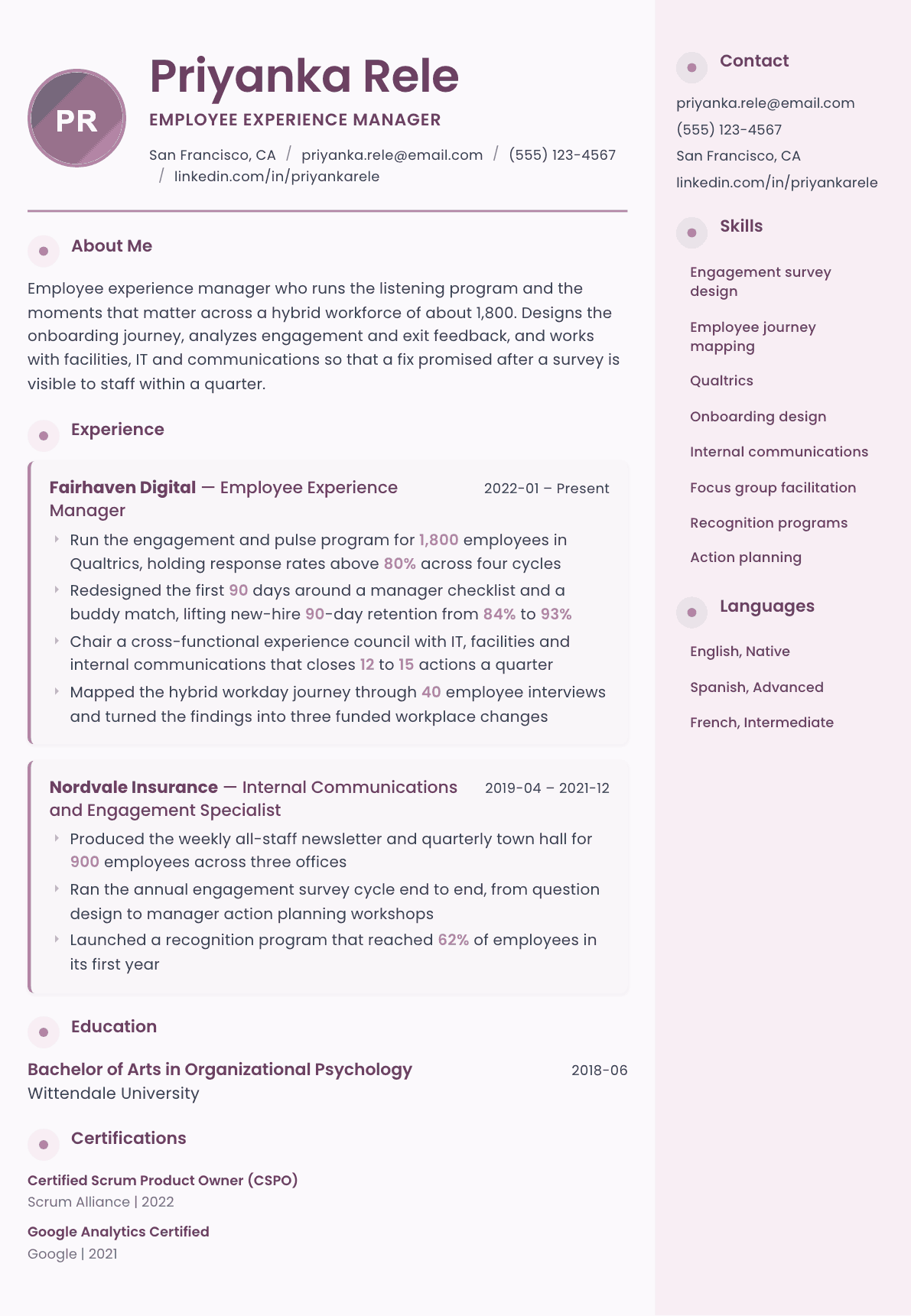
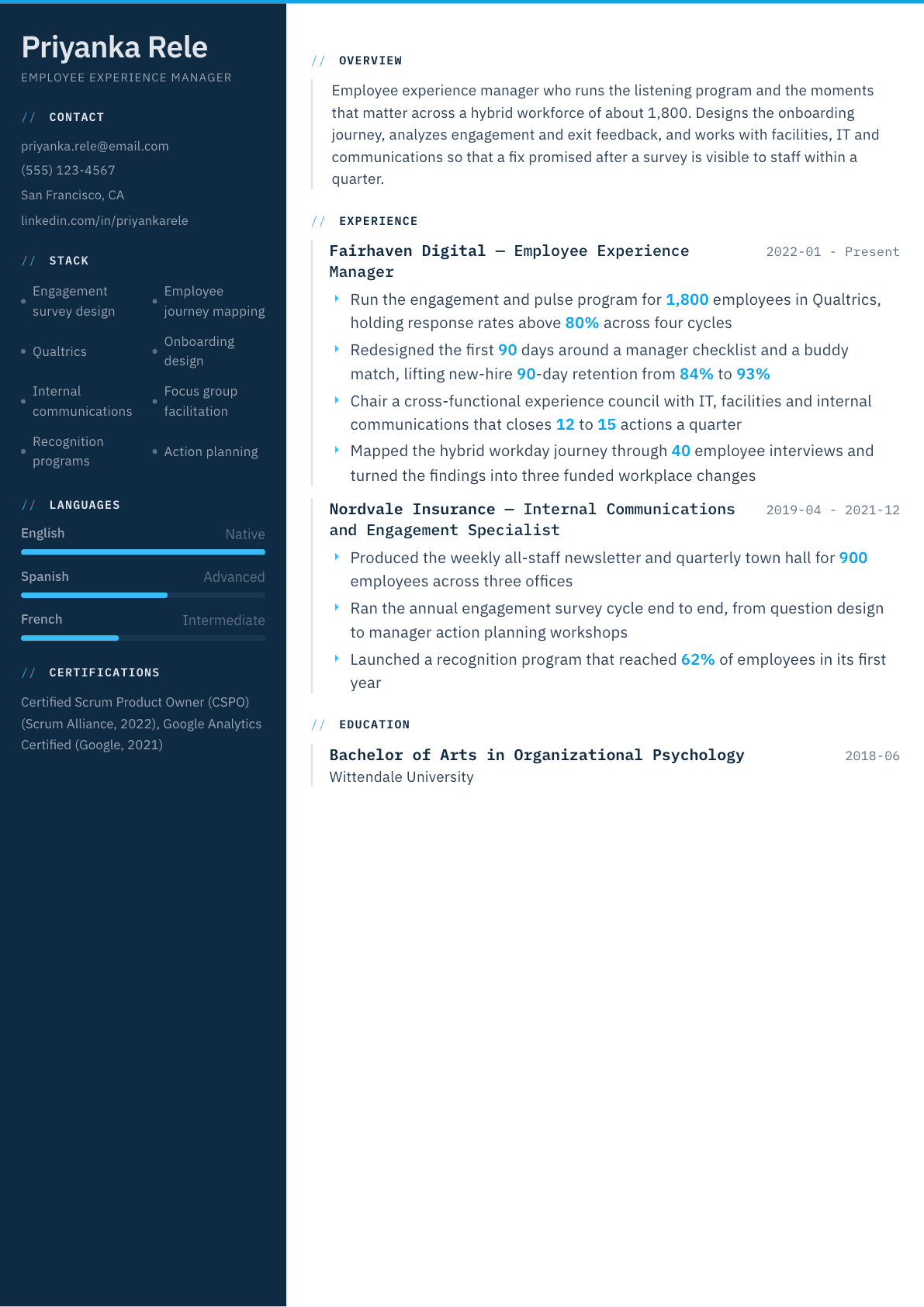
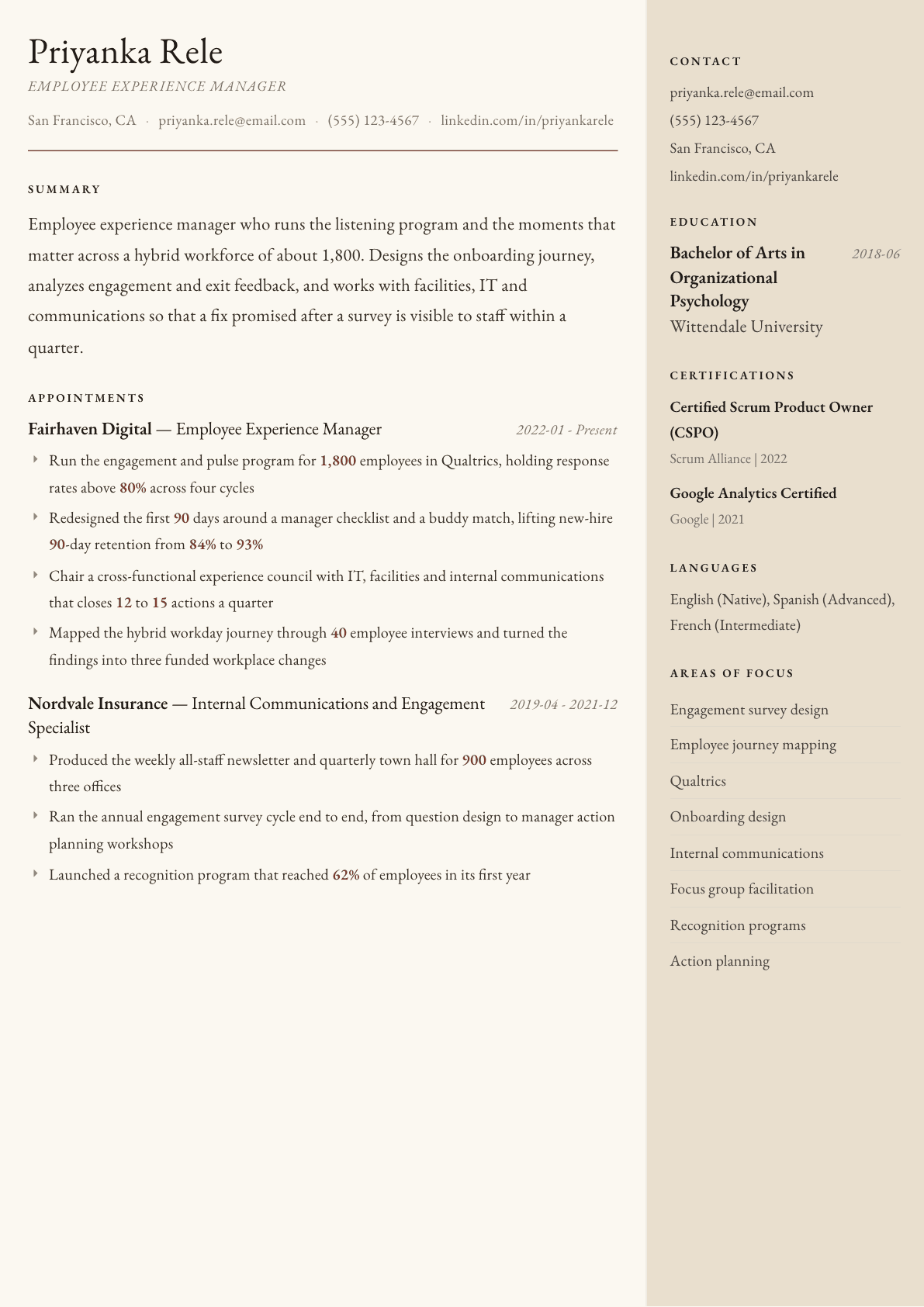
The same employee experience manager content laid out in three CVBooster templates, so you can see what the finished document looks like before you write a word.
Example Employee Experience Manager summary
Employee experience manager with six years running listening and journey work for hybrid workforces. Owns the engagement and pulse program for about 1,800 employees, keeps response rates above 80%, and rebuilt onboarding to raise 90-day new-hire retention from 84% to 93%. Works comfortably with IT, facilities and communications to turn survey findings into funded, visible change.
Skills to list on a Employee Experience Manager resume
- Employee engagement
- Survey design and analysis
- Qualtrics
- Culture Amp
- Employee journey mapping
- Onboarding program design
- Internal communications
- Focus groups and interviews
- Action planning facilitation
- Recognition programs
- Change management
- Stakeholder management
- Employer brand
- Program budgeting
What actually gets this resume read
- Anchor the role in a population: how many employees, how many sites, and whether the workforce is onsite, hybrid or deskless.
- Name the listening platform you run, since Qualtrics, Culture Amp and Glint each imply a different survey workflow.
- Pair every survey number with the change it produced, because leaders hire this role to close loops, not to report scores.
- Describe the journey stages you own by name: preboarding, first 90 days, internal moves, return from leave, exit.
- Show the cross-functional muscle: which teams you convened and what they funded or fixed.
- Keep recognition, workplace and communications work in separate bullets so a reader can see the breadth of the remit.
How to write a employee experience manager resume
Employee experience is the HR job most likely to be dismissed as fluff, which means the resume has to work harder than most. The person hiring has probably watched an engagement survey come back, get presented once, and then produce nothing. What they want is evidence that you closed the loop: a finding became an action, the action was funded, and employees could see it happened.
The second thing they look for is range. This role touches internal communications, onboarding, workplace and facilities, recognition, HR technology and sometimes brand. You do not need depth in all of them, but you need to show you can convene the people who own them and get something delivered without controlling their budgets.
This guide covers how to size the population you serve, how to write survey and journey work so it reads as change rather than reporting, which platforms to name, and how to answer the questions that come up when experience work is being justified to a skeptical executive team.
Format: one page under eight years, clean and text-first
Reverse-chronological, no columns, no icon rows. It is tempting to make an experience resume look designed, but HR parsers mishandle graphics and the reader is judging your thinking rather than your layout taste.
Under each employer, give a scope line: employee population, number of sites or countries, and the working model. Running experience for an office-based team of three hundred is a different craft from running it for a deskless workforce across twenty locations where most people have no company email.
- Header: name, city and state, phone, email, and a portfolio link only if it holds no confidential survey data.
- Section order: summary, experience, skills and platforms, education, certifications when relevant.
- Candidates from internal communications should lead with the listening and journey work, not the newsletter.
Summary: population, program, one loop you closed
Three or four lines covering the workforce you serve, the listening program you run, the journey stages you own, and one change that employees actually felt. That last clause is what distinguishes this profile from an engagement coordinator.
Do not open with culture language. Phrases about passion for people and building great places to work occupy the space where your scope should be, and every applicant for this job uses them.
Experience: listening, journeys, and the things that got fixed
Split each job into three families. Listening: the survey program, its cadence, the platform, response rates, and how manager action planning works after results land. Journeys: which moments you own by name, such as preboarding, the first ninety days, promotion, internal transfer, return from parental leave, and exit. Delivery: the specific changes that shipped out of that work, with the function that funded them.
Response rate is the honest proxy for whether employees believe the program. If yours held up over several cycles, say so and say what kept it there, because most survey programs decay after the first year when nothing visible follows.
Write at least one bullet that names a change employees noticed: a rebuilt onboarding week, a fixed equipment process, a policy that stopped generating complaints, a manager toolkit that replaced a broken practice. Abstract statements about improving culture cannot be verified and read as filler.
- Name the listening platform, since the workflow differs between the main survey vendors.
- Say how many actions your governance forum closes per quarter and who sits in it.
- Include qualitative method: interviews, focus groups, journey workshops, and roughly how many participants.
Skills and platforms: split the survey stack from the delivery stack
Group the tools honestly. Survey and analysis platforms sit in one group, internal communications and intranet tools in another, and the HRIS or case system in a third. A reader wants to know whether you can build a question set and read the results yourself, or whether you rely on an analyst.
Add facilitation explicitly. Running an action planning workshop with defensive managers, or a journey mapping session with operations and IT in the room, is a craft skill this role lives on and it does not appear anywhere else on the page unless you list it.
Keywords screeners use for this role
Postings repeat employee engagement, employee listening, pulse survey, action planning, employee journey mapping, moments that matter, onboarding experience, internal communications, recognition, retention and change management. Use the posting's own phrasing once in a bullet and once in the skills group.
Where the posting uses a specific framework or platform name, mirror it exactly. Filters here are usually simple keyword matches and a near synonym will not be picked up.
Employee Experience Manager resume summary examples
Coordinator level
Engagement coordinator with two years supporting the survey cycle, recognition program and internal communications for 600 employees at two sites. Ran manager action planning sessions after the last two surveys and rebuilt the first-week onboarding agenda with the HR business partner team.
Five years in
Employee experience manager running the listening program for 1,800 hybrid employees, holding response rates above 80% across four cycles. Redesigned the first ninety days around a manager checklist and buddy match, raising new-hire retention at ninety days from 84% to 93%. Chairs a cross-functional experience council.
Head of employee experience
Head of employee experience for a deskless and office workforce of 9K across three countries, owning listening, onboarding, recognition and the internal channel mix. Leads a team of five and a shared roadmap with IT, facilities and communications that funded eleven workplace changes in the past year.
Work experience bullets: before and after
Before: Ran the annual employee engagement survey.
After: Ran the annual engagement survey and two pulses for 1,800 employees in Qualtrics, holding response rates above 80% by publishing what changed after the previous cycle before fielding the next one.
The mechanism behind the response rate is the insight; running a survey on its own is a calendar entry.
Before: Improved the onboarding experience for new hires.
After: Rebuilt the first ninety days around a manager checklist, a buddy match and a week-one equipment guarantee, lifting ninety-day new-hire retention from 84% to 93% over four quarters.
Three named interventions and a retention outcome let a reader judge whether the redesign was real.
Before: Worked with other departments on employee issues.
After: Chaired a monthly experience council with IT, facilities and internal communications that closed 12 to 15 employee-raised issues a quarter against a published tracker.
Naming the forum, the members, the throughput and the tracker turns collaboration into governance.
Before: Gathered employee feedback through interviews.
After: Mapped the hybrid workday through 40 employee interviews across four job families, and converted the friction points into three funded changes to meeting norms, desk booking and equipment provision.
Sample size, segmentation and funded outcomes show research that led somewhere rather than a listening exercise.
Before: Managed the recognition program.
After: Relaunched peer recognition on a single platform with a manager nomination budget, reaching 62% of employees in the first year against 24% on the previous scheme.
A before and after reach figure gives the program a measurable result instead of an activity description.
Hard skills
- Engagement and pulse survey design
- Qualtrics
- Culture Amp
- Survey analysis and reporting
- Employee journey mapping
- Onboarding program design
- Internal communications planning
- Recognition program management
- Focus group and interview facilitation
- Action planning workshops
- Program budgeting
- Intranet and channel management
Soft skills
- Facilitating a room of defensive managers
- Influence without budget authority
- Writing plainly for a whole workforce
- Listening to critical feedback without defending
- Sequencing change so employees see progress
Certifications worth listing
- SHRM Senior Certified Professional (SHRM-SCP) (Society for Human Resource Management)
- Prosci Change Management Certification (Prosci)
- Certified Professional in Talent Development (CPTD) (Association for Talent Development)
Mistakes that cost employee experience manager candidates the interview
- Reporting survey scores with no evidence that anything changed afterward.
- Leaving out the workforce size and working model, which set the difficulty of the whole job.
- Writing culture statements that cannot be checked instead of naming delivered changes.
- Presenting the role as internal communications when the posting is asking for journey ownership.
- Omitting the listening platform, which several employers filter on directly.
- Claiming credit for changes that facilities or IT owned without saying you convened them.
- Filling the page with event planning when the employer wants program design.
Employee Experience Manager resume questions
How is employee experience different from employee engagement?
Engagement is a measure; experience is the set of moments that produce it. An experience manager owns onboarding, internal moves, workplace and communications as a designed journey, and uses engagement data as one input rather than as the deliverable itself.
What metrics belong on this resume?
Survey response rate, engagement or favorability movement on the specific items you worked on, new-hire retention at ninety days, internal mobility, recognition reach and action closure rates. Choose the two or three you genuinely influenced and skip the rest.
Can I get this role from an internal communications background?
Yes, and it is a common route. Reweight your resume so listening, onboarding and journey work sit above channel management, and add one example where you diagnosed a problem with research rather than solving it with a campaign.
Should I include the engagement scores from my employer?
Include movement on items you worked on, expressed as a change, and avoid publishing a full scorecard. Survey results are usually confidential, and a candidate who shares an employer's detailed engagement data raises a judgment concern in the interview.
How do I show impact when facilities or IT delivered the fix?
Describe your role precisely: you found the problem, quantified it, built the case, convened the owners and tracked closure. That is the job. Claiming you personally delivered a workplace change you did not own is easy for an interviewer to unpick.
Related resume examples
- Human Resources Resume example
- Organizational Development Consultant Resume example
- Employee Engagement Manager Resume example
- Wellness Coordinator Resume example
- Talent Development Manager Resume example
- People Operations Manager Resume example