Wellness Coordinator Resume Examples: what gets the call
Write a Wellness Coordinator Resume That Shows Participation and Value
By Mustafa Tarabya, founder of CVBooster · Published · Updated
A wellness coordinator resume example with participation numbers, vendor and biometric screening work, ATS keywords and a section-by-section guide.
Sample resumes for a wellness coordinator
The same wellness coordinator content laid out in three CVBooster templates, so you can see what the finished document looks like before you write a word.
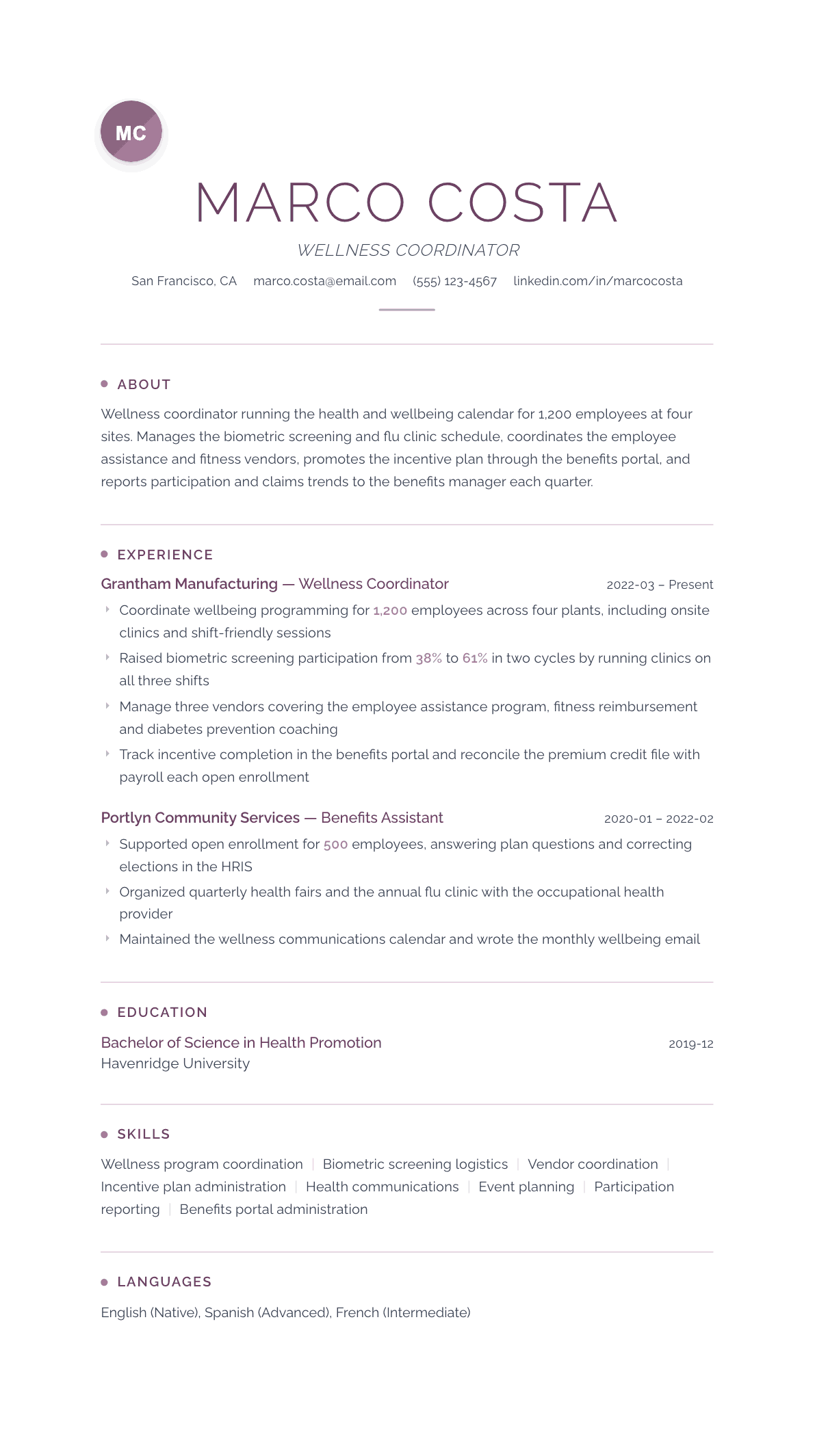
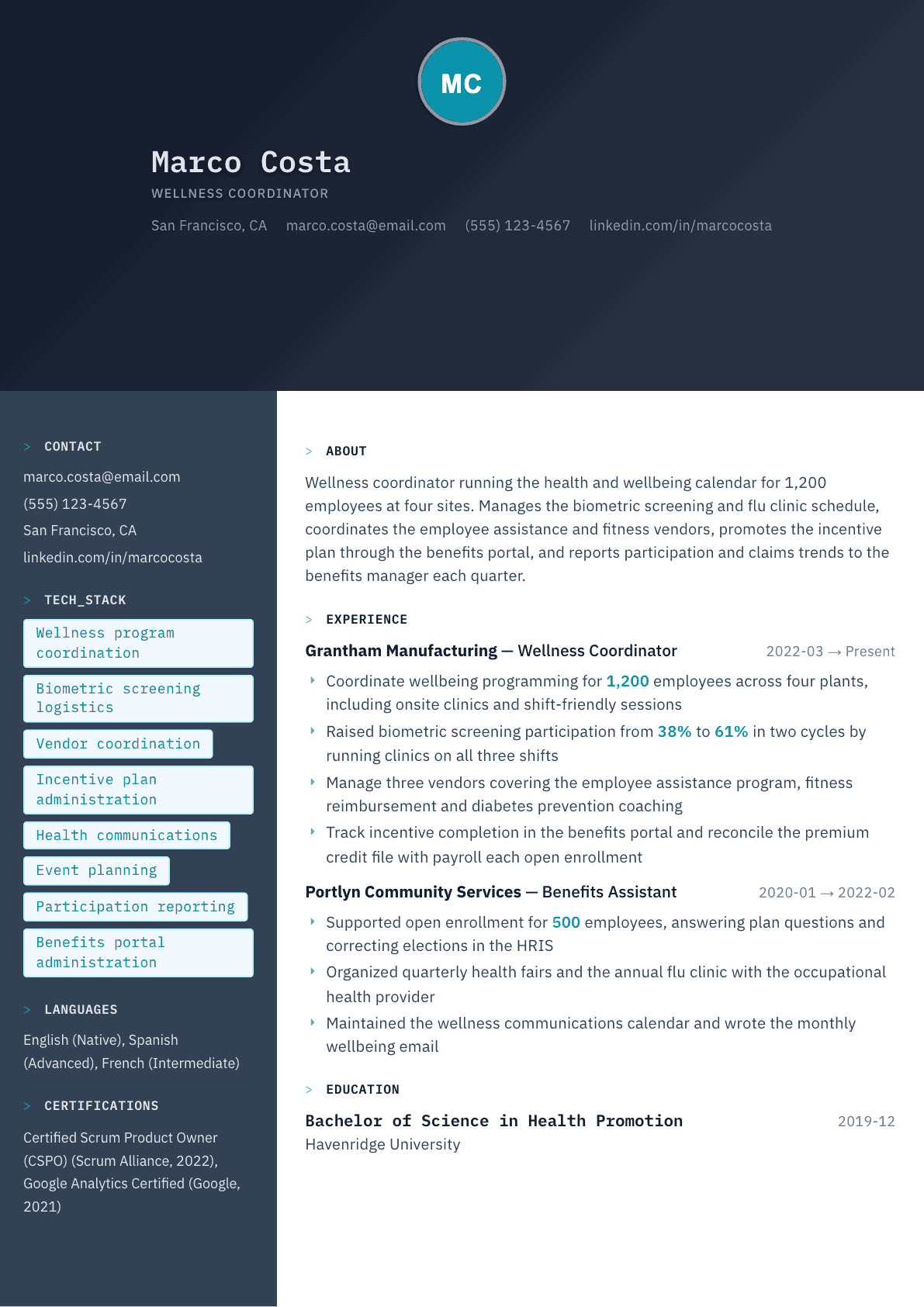
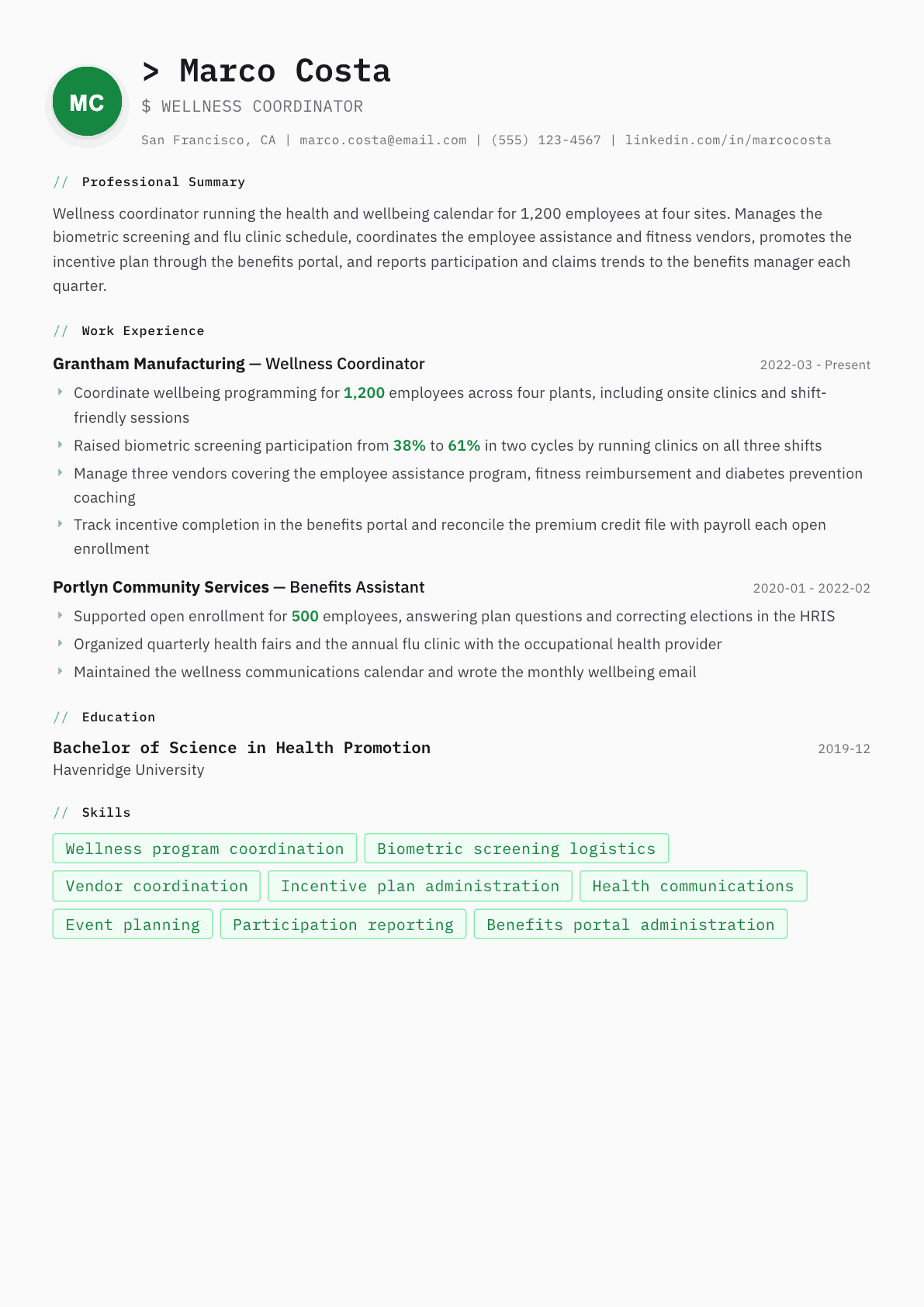
Example Wellness Coordinator summary
Wellness coordinator with four years running health and wellbeing programs for a multi-site workforce of about 1,200. Manages biometric screening and flu clinic logistics across three shifts, coordinates the employee assistance and fitness vendors, and lifted screening participation from 38% to 61%. Reports participation and incentive completion to the benefits team each quarter and keeps the premium credit file clean.
Skills to list on a Wellness Coordinator resume
- Wellness program coordination
- Employee wellbeing strategy
- Biometric screenings
- Health risk assessments
- Employee assistance programs
- Vendor management
- Incentive plan administration
- Benefits communications
- Event planning
- Participation reporting
- Budget tracking
- HIPAA awareness
- Occupational health coordination
- Health coaching support
What actually gets this resume read
- Give participation rates before and after your work, because that number is the first thing a benefits leader looks for.
- Name the vendors by category, such as employee assistance, fitness reimbursement or condition management, without naming the brand.
- Show that you can schedule around a real workforce: night shifts, plant floors, remote staff or multiple locations.
- Mention incentive administration and the payroll or premium credit handoff, since that is where accuracy matters most.
- List the health-related credential you hold with its issuing body, and leave it off entirely if you are still studying for it.
- Keep event planning bullets specific: how many clinics, how many attendees, and what you had to coordinate to run them.
How to write a wellness coordinator resume
A wellness coordinator resume is read by a benefits manager who has to defend the wellbeing budget to a finance partner every renewal. That reader is looking for one thing above all: proof that employees actually took part. A calendar of activities nobody attended is worse than no program, so participation numbers carry more weight here than any statement about promoting a culture of health.
The second thing the reader checks is operational reliability. Wellness work is logistics: booking clinic dates, matching vendor staffing to shift patterns, tracking incentive completion, and getting a premium credit file to payroll without an error that shows up in somebody's paycheck. Those details are what make the difference between a coordinator who runs the program and one who plans events.
This guide covers how to size your population, how to write participation and vendor bullets, which credentials are real and worth listing, and how to handle the health information boundary that this role sits on top of.
Format: one page, participation numbers visible early
Reverse-chronological, one page for most candidates. Keep the design plain, because these resumes are often screened inside an HR system that mangles multi-column layouts and decorative headers.
Put a scope line under each employer: employee population, number of sites, whether the workforce is shift-based, and whether spouses or dependents are included in the program. A wellness program covering employees at one office is not the same job as one running clinics on three shifts at four plants.
- Header: name, city and state, phone, email, and any health credential abbreviation you legitimately hold.
- Section order: summary, experience, skills, education, certifications.
- Candidates from a fitness or health promotion background should show the administrative side early, not just program delivery.
Summary: population, program components, participation, vendors
Three lines. State the workforce you serve and where it sits, the program components you run, the vendor relationships you manage, and one participation figure with a before and after.
Skip the mission statement opening. A summary that begins with a belief about workplace health uses up the space where the reader expects headcount, clinic volume and participation.
Experience: participation, logistics, vendors, incentives
Build every job from four bullet families. Participation: rates for screenings, assessments, challenges and coaching, with the before and after where you improved them. Logistics: clinic scheduling across shifts, room and staffing coordination, communications timing, and how you reached employees without a company email address.
Vendors: which categories you manage, how you handle a vendor whose staffing falls short on the day, and how you evaluate at renewal. Incentives: how completion is tracked, how it feeds a premium credit or a reward, and how the file gets to payroll or the benefits system accurately.
Do not write bullets about promoting health and wellbeing. They describe the job title rather than the work. Replace each one with the clinic you booked, the participation it produced and the constraint you worked around.
- Give clinic counts and attendance, not just the fact that a clinic happened.
- Say how you reached deskless or shift employees, since that constraint shapes the whole program.
- Name the budget you managed and what you tracked against it, if you had spending authority.
The health information boundary
Add one bullet showing you understand where your access stops. Coordinators see aggregate participation, not individual results, and screening data usually sits with the vendor rather than with HR. Saying that you worked from aggregate reporting and routed individual health questions to the vendor or the plan tells the reader you can be trusted near this data.
This is also the place to mention any confidentiality training or privacy practice you follow. It is a short line and it separates you from applicants who treat wellness as pure event work.
Skills and keywords a benefits team screens for
Wellness postings recur on a compact vocabulary: wellbeing program, biometric screening, health risk assessment, employee assistance program, incentive design, participation reporting, vendor management, open enrollment support, health fair, and condition management coaching. Mirror the exact words the posting uses.
List the benefits or wellbeing platform you administer alongside the HRIS. Employers filter on the portal name because it determines how much setup training you will need.
Wellness Coordinator resume summary examples
First coordinator role
Health promotion graduate with two years supporting benefits and wellbeing for 500 employees. Organized quarterly health fairs and the annual flu clinic with the occupational health provider, maintained the wellbeing communications calendar, and answered plan questions during open enrollment.
Four years in
Wellness coordinator running the wellbeing calendar for 1,200 employees at four plants, including onsite clinics scheduled across all three shifts. Raised biometric screening participation from 38% to 61% in two cycles and manages three vendors covering assistance, fitness reimbursement and diabetes prevention coaching.
Wellbeing program lead
Wellbeing program lead for a workforce of 6,000 across eleven sites, owning strategy, vendor selection and an annual budget. Redesigned the incentive plan around outcomes rather than attendance, ran two vendor renewals, and reports participation and claims trends to the benefits committee each quarter.
Work experience bullets: before and after
Before: Organized wellness activities for employees.
After: Coordinated a quarterly wellbeing calendar for 1,200 employees across four plants, including onsite clinics, walking challenges and shift-friendly sessions run before and after each changeover.
The population, the site count and the shift constraint show the logistics behind what otherwise sounds like party planning.
Before: Increased participation in the screening program.
After: Raised biometric screening participation from 38% to 61% over two cycles by scheduling clinics on all three shifts and sending reminders through supervisors rather than email alone.
The before and after plus the two tactics prove the improvement came from a decision rather than chance.
Before: Worked with wellness vendors.
After: Managed three wellbeing vendors covering the employee assistance program, fitness reimbursement and diabetes prevention coaching, running quarterly performance reviews against contracted service levels.
Naming the vendor categories and the review cadence turns a relationship into a managed contract.
Before: Tracked incentive completion for the wellness plan.
After: Tracked incentive completion for 900 enrolled employees in the benefits portal and reconciled the premium credit file with payroll at each open enrollment, with no correction requests in the last two cycles.
The volume, the handoff and the error record make an administrative task into evidence of accuracy.
Before: Promoted the employee assistance program.
After: Rebuilt employee assistance program awareness through manager briefings and break-room signage at sites without email access, lifting reported utilization from a low base across two locations.
The channel choice explains how a deskless population was reached, which is the real difficulty in the task.
Hard skills
- Wellbeing program coordination
- Biometric screening logistics
- Health risk assessment administration
- Employee assistance program coordination
- Incentive plan tracking
- Benefits portal administration
- Vendor management and renewals
- Participation and utilization reporting
- Event and clinic planning
- Health communications
- Budget tracking
- Open enrollment support
Soft skills
- Approachability with employees discussing health
- Discretion with sensitive information
- Scheduling around operational constraints
- Persuading supervisors to release staff for clinics
- Clear written communication for a mixed workforce
Certifications worth listing
- Certified Health Education Specialist (CHES) (National Commission for Health Education Credentialing)
- Certified Worksite Wellness Specialist (National Wellness Institute)
- SHRM Certified Professional (SHRM-CP) (Society for Human Resource Management)
- Certified Employee Benefit Specialist (CEBS) (International Foundation of Employee Benefit Plans)
Mistakes that cost wellness coordinator candidates the interview
- Listing activities with no participation numbers attached to any of them.
- Omitting the workforce size and site count, which decide how hard the logistics were.
- Ignoring the payroll and incentive handoff, where the costly errors in this job actually occur.
- Writing as an event planner when the employer is hiring a program administrator.
- Claiming clinical authority or health advice that a coordinator role does not carry.
- Leaving out how deskless or shift workers were reached, which is the central problem in most programs.
- Naming a credential you are studying for as though you already hold it.
Wellness Coordinator resume questions
What participation numbers should I include?
Use the ones you can defend: screening or assessment completion, challenge enrollment, coaching uptake and incentive completion. Give a before and after where you improved something, and state the population the rate is calculated on so the figure means something.
Do I need a health credential for this role?
Many postings prefer one but few require it. A health education or worksite wellbeing credential helps when your degree is not health related. Only list a certification you currently hold, with the full issuing body written out.
How do I show wellness work if my title was benefits assistant?
Keep the title and lead the bullets with the wellbeing content. Put clinic coordination, health fairs, communications and incentive tracking first, then the general benefits duties. Recruiters search on the work, not only on the job title.
Should I mention health data privacy on my resume?
One line is enough and it helps. Say that you worked from aggregate participation reporting and routed individual health questions to the vendor or plan administrator. That signals you understand where a coordinator's access properly stops.
How do I handle a program that failed to gain traction?
Do not put a flat result on the resume, but be ready to discuss it. In the interview, describe what you tested, what the barrier turned out to be, and what you would change. Employers with stalled programs value a candidate who has diagnosed one.
Related resume examples
- Benefits Administrator Resume example
- Human Resources Resume example
- Benefits Specialist Resume example
- Employee Experience Manager Resume example
- HR Specialist Resume example
- Campus Recruiter Resume example