Engineering Student Resume Examples: what gets the call
Engineering Student Resume Built for Internship and Co-op Screening
By Mustafa Tarabya, founder of CVBooster · Published · Updated
A complete resume of an engineering student: sample entry, coursework, CAD and lab tools, design team projects and an FE exam line, plus a writing guide.
Sample resumes for a engineering student
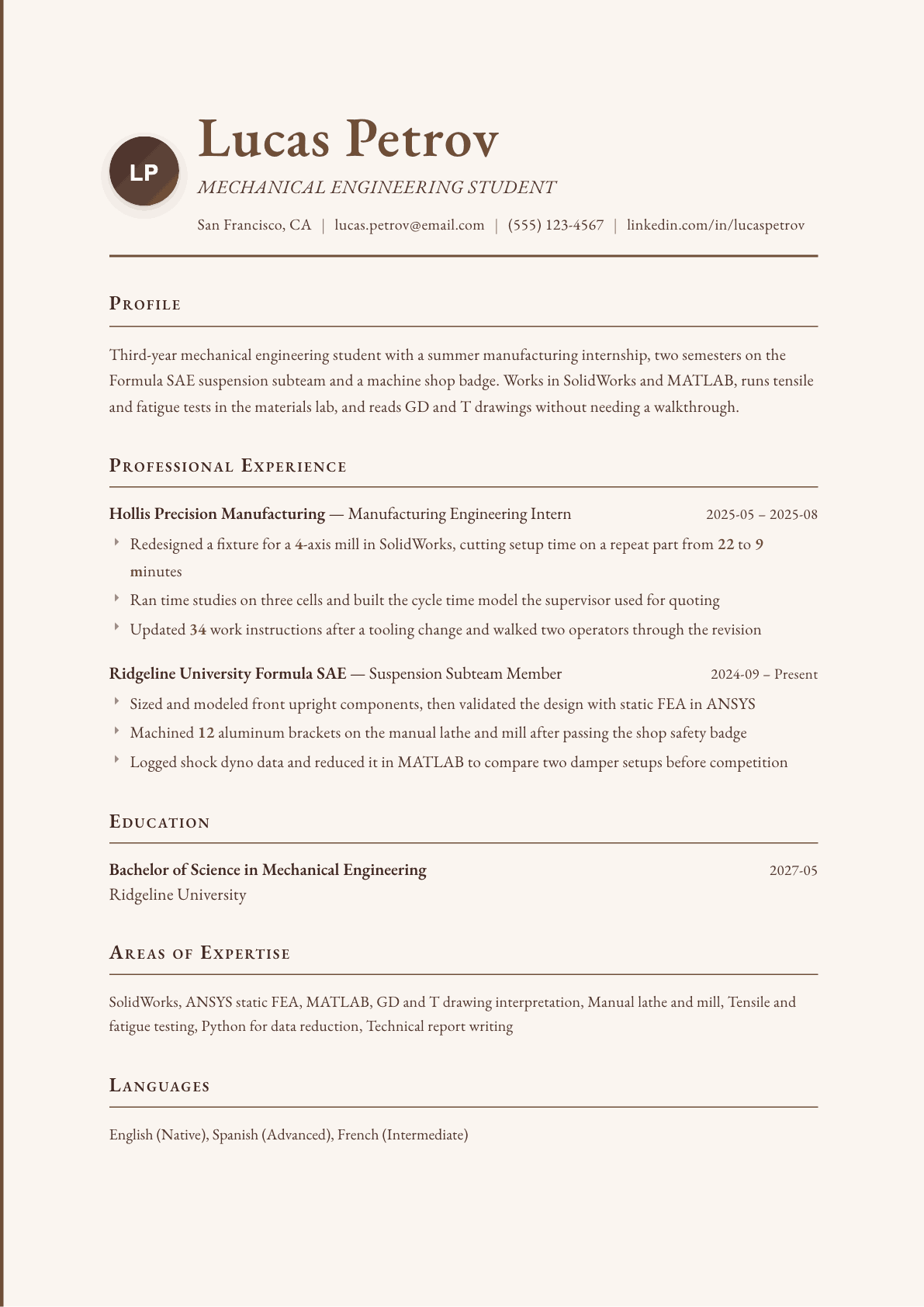
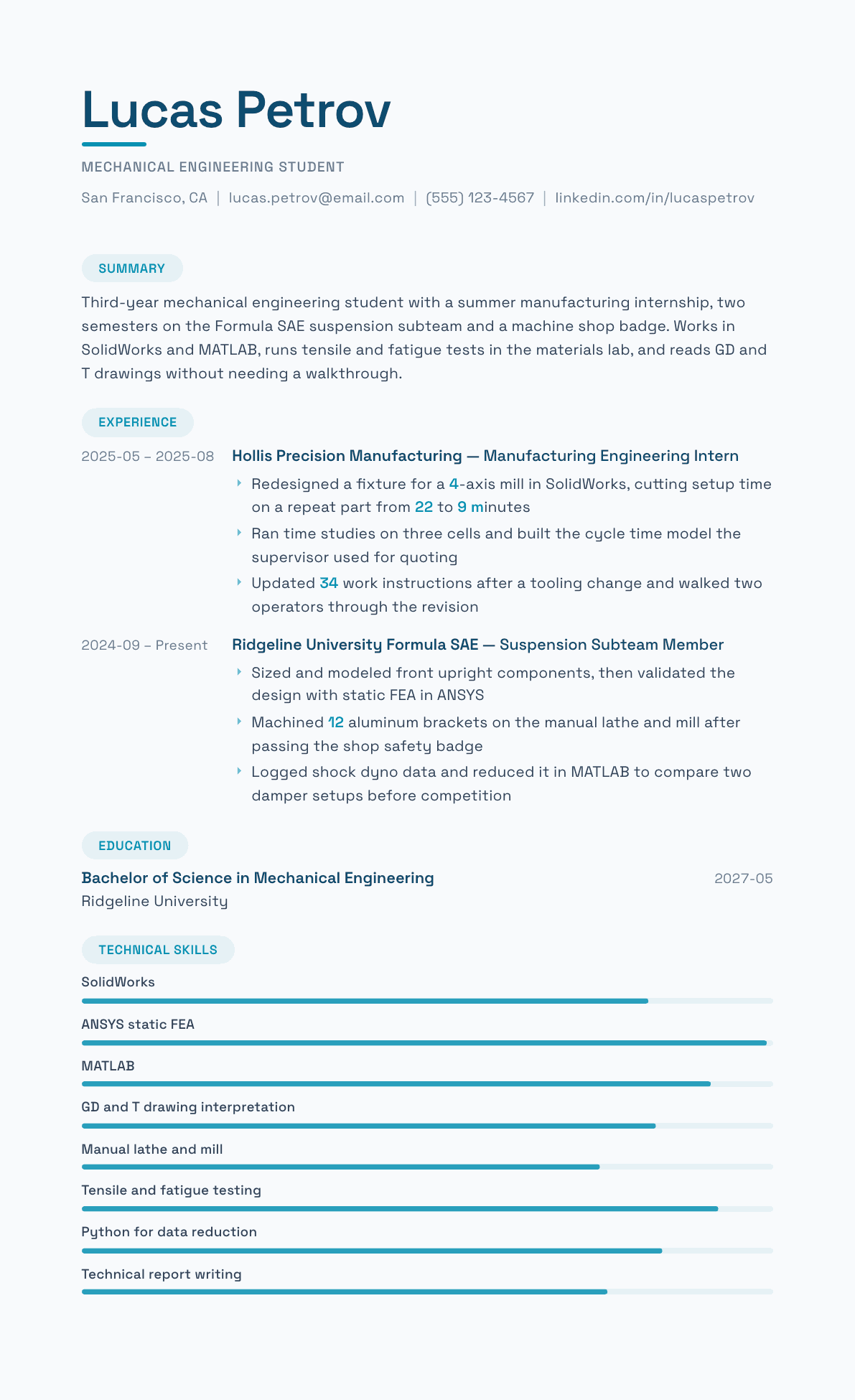
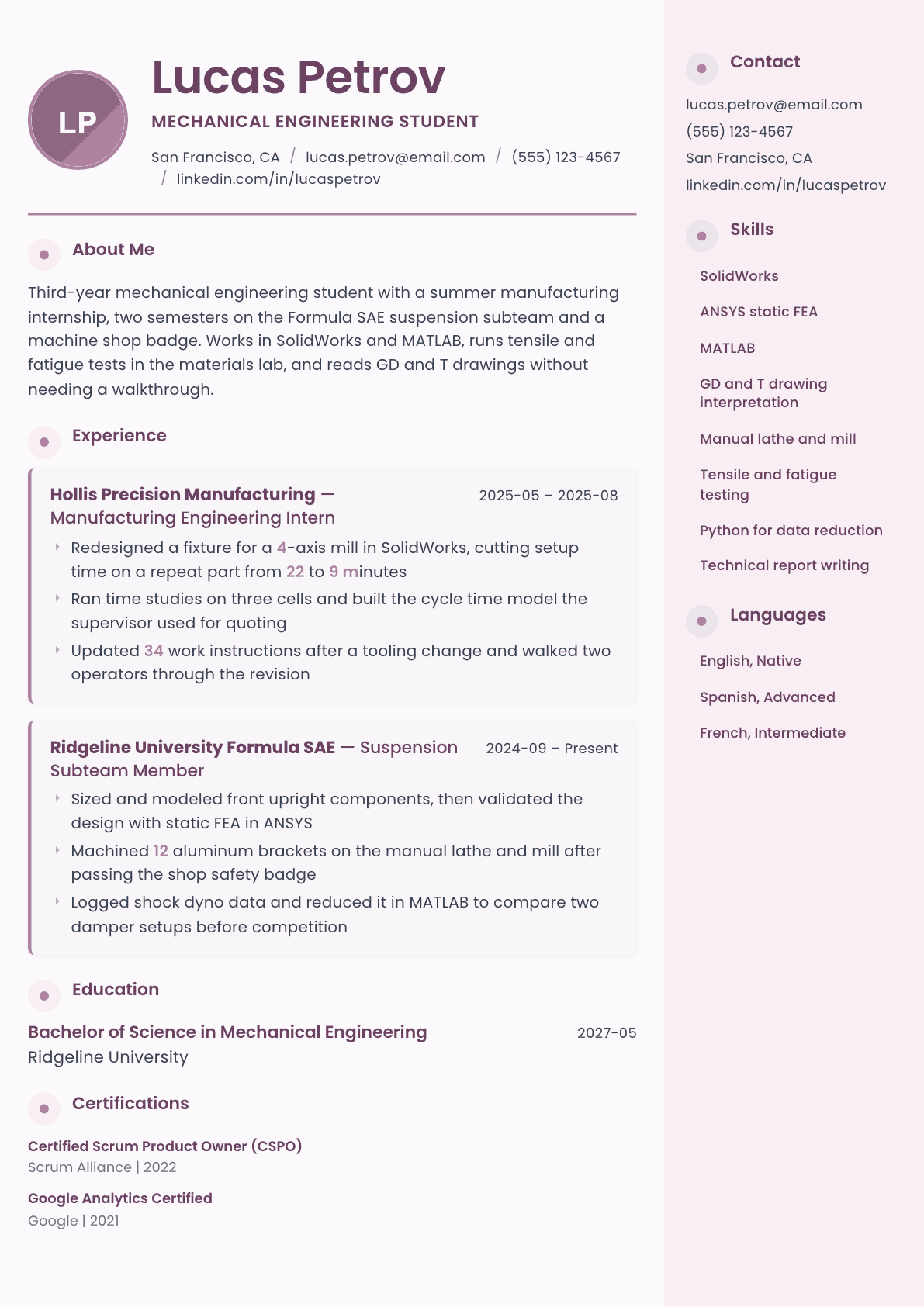
The same engineering student content laid out in three CVBooster templates, so you can see what the finished document looks like before you write a word.
Example Engineering Student summary
Third-year mechanical engineering student with a manufacturing internship, a Formula SAE suspension role and a machine shop badge. Models in SolidWorks, validates with static FEA, and reduces test data in MATLAB and Python. Redesigned a production fixture that cut setup time by more than half and rewrote the work instructions behind it. Seeking a summer engineering internship in design or manufacturing.
Skills to list on a Engineering Student resume
- SolidWorks part and assembly modeling
- CAD drawing and GD and T
- Finite element analysis
- MATLAB and Simulink
- Python for data analysis
- Materials and fatigue testing
- Manual machining and shop safety
- Design of experiments
- Statics and dynamics fundamentals
- Thermodynamics and fluid mechanics
- Technical documentation
- Bill of materials management
- Design team collaboration
- Lab notebook discipline
What actually gets this resume read
- Put expected graduation month and degree discipline in the education block at the top of the page.
- List relevant coursework by course title, not by number, since a recruiter outside your school reads titles.
- Give every project a deliverable: a part that was machined, a rig that ran, a report that was defended.
- Name the CAD, simulation and analysis tools separately, because postings filter on the exact package.
- Include shop badges, lab access and safety training, which tell a manager how soon you can work unsupervised.
- Say where you are with the Fundamentals of Engineering exam if your discipline hires against it.
- Keep the design team entry technical, listing the subsystem you owned rather than the club as a whole.
How to write a engineering student resume
An engineering student resume is read twice, and by two people with different jobs. A campus recruiter scans it in a stack for degree discipline, expected graduation and work authorization. An engineering manager then reads the same page looking for one thing: evidence that you have built, tested or analyzed something outside a homework set. Almost every rejected student resume passes the first read and fails the second.
The fix is not more adjectives about problem solving. It is a projects section written with the same precision a design review demands: what the part or system had to do, what you modeled it in, what the analysis or test said, and what happened when it was built. A manager can tell in two bullets whether you have held a caliper, run a mesh convergence check, or watched a design fail on the stand.
This guide covers the layout engineering internship screening expects, how to write coursework, labs, design teams and internships so they survive the second read, three summaries across a first-year, a third-year and a senior with a co-op behind them, and the questions engineering students ask when the page will not land interviews.
Resume of an engineering student: a complete sample
This resume of an engineering student is for a third-year mechanical student applying to a summer internship. The engineering manager reading it wants to know the discipline and graduation month, the tools you can drive, one project you owned and one place you have worked, so the page leads with those four in that order.
Header: name, city, phone, email and a portfolio link if you have one. Education: BS in Mechanical Engineering, the university, expected graduation month and grade point average while it helps. Technical skills: SolidWorks, ANSYS Mechanical, MATLAB, Python, manual mill and lathe, 3D printing. Then projects, then the internship, then other work in one line each.
The project entry for this sample, Baja SAE drivetrain subteam, reads as the bullets below. The internship entry under it follows the same pattern: the task, the tool, the number, the result.
- Designed the gearbox output shaft in SolidWorks and sized it with hand calculations checked against a static FEA study in ANSYS.
- Machined two shaft prototypes on the manual lathe and measured runout before assembly.
- Ran a dynamometer test plan with the powertrain lead and logged torque data in MATLAB.
- Wrote the design report and drawing package handed to next season's subteam.
Format: education block up top, projects before part-time work
One page through your final year, no exceptions. Education goes at the top with degree discipline, institution and expected graduation month, because those three decide whether the posting even applies to you. Include your grade point average while it helps you, since many engineering programs still screen against a floor.
Then technical skills, then projects and design teams, then internships and co-ops if they are separate from projects, then other employment. A cashier job stays on the page in one line: it shows work history and reliability, and a manager who worked through school reads it kindly. It just does not go above the fixture you redesigned.
- Education: degree title, discipline, institution, expected graduation month, and grade point average when it is a strength.
- Relevant coursework by title, not course number, since a recruiter outside your school cannot decode numbering.
- Technical skills split into CAD, analysis, programming, lab and manufacturing rather than one alphabet soup line.
- Projects with the subsystem you owned, the tools used, and the physical or analytical result.
Coursework and labs: only the ones that touched hardware or data
List coursework selectively and toward the posting. An internship in test engineering wants to see instrumentation, measurement and statistics. A design internship wants machine design, materials and CAD. Ten course titles chosen for a specific posting is stronger than a full transcript dumped in a paragraph.
Labs are where most students undersell themselves. Saying you completed a materials lab means nothing. Saying you ran tensile tests to failure on aluminum coupons, reduced the stress and strain curves, and wrote up the modulus against the published value tells a manager you have used a load frame and know what a bad data set looks like.
Projects and design teams: own a subsystem, not a club
The weakest line on any engineering student resume is the name of a design team with no subsystem after it. Write what you owned: the front upright, the battery box thermal path, the payload deployment mechanism, the bridge connection detail. Then the tool chain, then the verification, then the outcome at competition or on the test stand.
Include the failures, described as engineering rather than as apology. A bracket that cracked in test, the root cause you found, and the redesign that survived is the single most convincing thing a student can put on a page, because it is the actual work of engineering and it cannot be faked by someone who only did the modeling.
Senior design and capstone deserve their own entry with the sponsor named where allowed, the requirement you were given, and the deliverable at the end. If the project is under a confidentiality agreement, describe the class of problem without the sponsor detail rather than dropping the entry.
- One line per project naming the subsystem, the tools and the verification method.
- Quantities that a manager recognizes: tolerances, loads, cycle times, mass targets, part counts.
- Fabrication reality: what you machined, printed, wired, welded or assembled with your own hands.
- Team context: how many on the subteam, and what you handed to the next subteam.
Tools, badges and the credentials that shorten your onboarding
Separate the software you can drive from the software you have seen. A manager reads SolidWorks, ANSYS, MATLAB, Python, LabVIEW, Altium and Revit as claims she may test in the interview, so list the ones where you could open a file and get somewhere. Say what you did in each: parametric assemblies, static structural studies, data reduction, instrument control.
Shop badges, lab access, safety training and any tool qualification belong on the page because they shorten the time before you are useful. A student cleared on the manual mill, trained on the machine shop safety course and comfortable with a laser cutter can be given hardware tasks in week one instead of week six.
If your discipline hires against professional licensure, say where you are with the Fundamentals of Engineering exam: registered, sat, or passed. Civil and structural employers in particular treat that line as a signal about your intent to stay in the field.
Keywords, resume screens and tailoring per posting
Engineering internship postings are unusually literal. They name the package, the standard and the method: SolidWorks, GD and T, finite element analysis, design of experiments, root cause analysis, tolerance stack-up, PLC, ASME or IPC standards. Use the exact spelling from the posting in your skills block, and back each one inside a bullet where the work is visible.
Tailoring here takes ten minutes and works. Reorder the projects so the closest one sits first, swap three coursework titles, and change nothing else. A student who sends the same page to a manufacturing internship and a controls internship is competing against candidates who did the reorder.
Engineering Student resume summary examples
First-year student
First-year mechanical engineering student with a completed statics and CAD sequence, building the chassis jig for the campus rocketry team and running the shop safety badge process this term. Comfortable in SolidWorks and MATLAB, seeking a summer internship where a first-year can work on hardware.
Third-year with an internship
Third-year mechanical engineering student with a manufacturing internship and two years on the Formula SAE suspension subteam. Redesigned a mill fixture that cut setup time from 22 to 9 minutes, validates parts with static FEA, and reduces shock dyno data in MATLAB. Machine shop badged.
Final year with a co-op
Final-year mechanical engineering student with an eight month co-op in test engineering and a sponsored capstone on a thermal management enclosure. Built the instrumented test rig, ran a design of experiments across three airflow configurations, and presented results to the sponsor engineering team. Fundamentals of Engineering exam registered.
Work experience bullets: before and after
Before: Member of the Formula SAE team.
After: Owned front upright design on the Formula SAE suspension subteam, sizing the components in SolidWorks and validating the geometry with static FEA before release to manufacturing.
A named subsystem with a tool chain and a verification step replaces membership with responsibility.
Before: Used CAD software for class projects.
After: Modeled a 34-part assembly in SolidWorks with a full drawing package including GD and T callouts, and revised the tolerance stack after a fit problem appeared at first assembly.
Part count, drawing output and a real fit problem show CAD used for manufacture rather than for a screenshot.
Before: Did a summer internship in manufacturing.
After: Redesigned a workholding fixture for a 4-axis mill during a summer internship, cutting setup time on a repeat part from 22 to 9 minutes and updating 34 work instructions after the tooling change.
The before and after time with the documentation follow-through proves the change reached the floor.
Before: Performed tests in the materials lab.
After: Ran tensile tests to failure on 18 aluminum coupons, reduced the stress and strain curves in Python, and reported an elastic modulus within 4% of the published value for the alloy.
Sample count, analysis path and agreement with a reference value show you can judge whether data is trustworthy.
Before: Helped fix a part that broke.
After: Diagnosed a fatigue crack in a suspension bracket after 3 test days, traced it to a sharp internal corner, and released a filleted redesign that survived the full competition without a crack.
A failure with a root cause and a verified fix is the closest a student gets to real design engineering.
Hard skills
- SolidWorks part and assembly modeling
- Engineering drawings and GD and T
- Finite element analysis
- MATLAB and Simulink
- Python for data reduction
- Materials and fatigue testing
- Instrumentation and data acquisition
- Manual machining and shop safety
- Design of experiments
- Tolerance stack-up analysis
- Bill of materials and revision control
- Technical report and drawing package writing
Soft skills
- Explaining a design decision to someone who will build it
- Taking a design review comment without defending the first idea
- Working to a competition deadline that will not move
- Handing a subsystem over with notes the next person can use
- Asking for a measurement before arguing about a cause
Certifications worth listing
- Certified SOLIDWORKS Associate (CSWA) (Dassault Systemes)
- Fundamentals of Engineering (FE) Exam (NCEES)
- OSHA 10-Hour General Industry (OSHA Training Institute Education Centers)
Mistakes that cost engineering student candidates the interview
- Listing a design team without the subsystem you owned, which reads as attendance rather than engineering work.
- Writing coursework by course number, so a recruiter outside your department cannot tell what you studied.
- Filling the skills line with every package you have ever opened, then failing the interview question about one of them.
- Describing a lab as completed instead of naming the specimen count, the instrument and what the data showed.
- Hiding fabrication work, when a student who has machined a part is exactly who a hardware team wants.
- Sending an identical page to a design internship and a test internship instead of reordering the projects.
- Leaving expected graduation month off, which stalls the application at the first recruiter filter.
Engineering Student resume questions
Should an engineering student put grade point average on a resume?
Include it while it is at or above the level your target employers screen on, and drop it quietly once your project work is stronger evidence. Never list a major grade point average alone without labeling it as such, because a recruiter will read it as the cumulative figure.
What goes on the page if I have never had an engineering internship?
Class projects, labs, a design team subsystem, and anything you have built outside school. Write them with the same specifics an internship entry would carry: the requirement, the tool, the verification, the result. Managers hire second-year students on project evidence every season.
How do I write a project that is covered by a confidentiality agreement?
Describe the class of problem, the analysis method and your role without naming the sponsor, the part or any specific number. A capstone written as a thermal enclosure study with a design of experiments across airflow configurations is legible and still discreet.
What does a good resume of an engineering student look like?
One page with education and expected graduation at the top, a technical skills block split by type, then projects written with the subsystem you owned, the tool, the test and the result, then internships and other work. The sample at the top of this guide shows a complete entry.
Does the Fundamentals of Engineering exam belong on a student resume?
Yes for civil, structural, environmental and other disciplines where licensure is the career path, stated as registered, scheduled or passed. In software-adjacent or product engineering roles it is neutral, so use the line for a project or a lab technique instead.