Computer Science Student Resume Examples: free ATS score
Write a Computer Science Student Resume With No Job History
By Mustafa Tarabya, founder of CVBooster · Published · Updated
A computer science student resume example built from coursework and projects, with the section order recruiters expect and a full writing guide.
Sample resumes for a computer science student
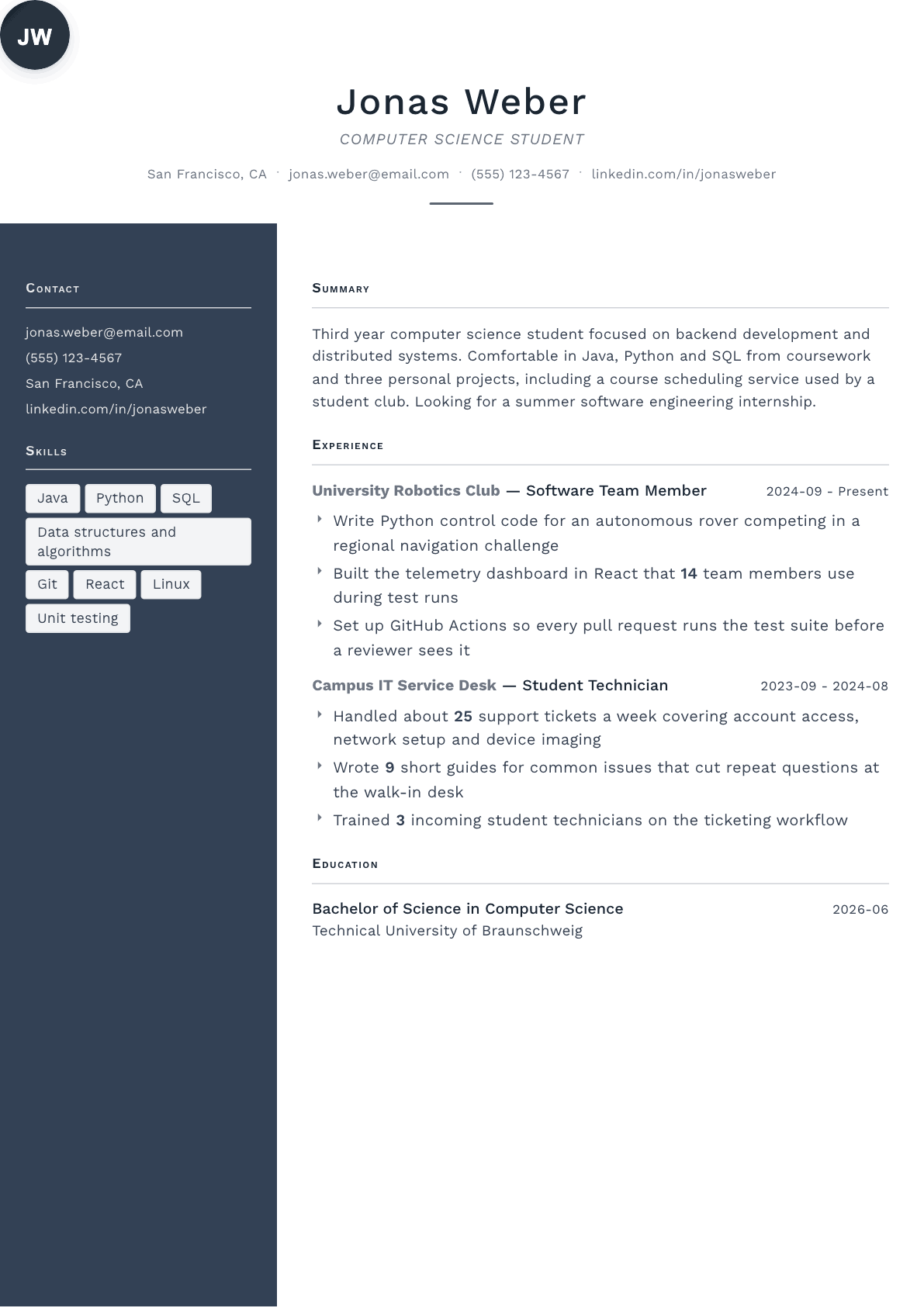
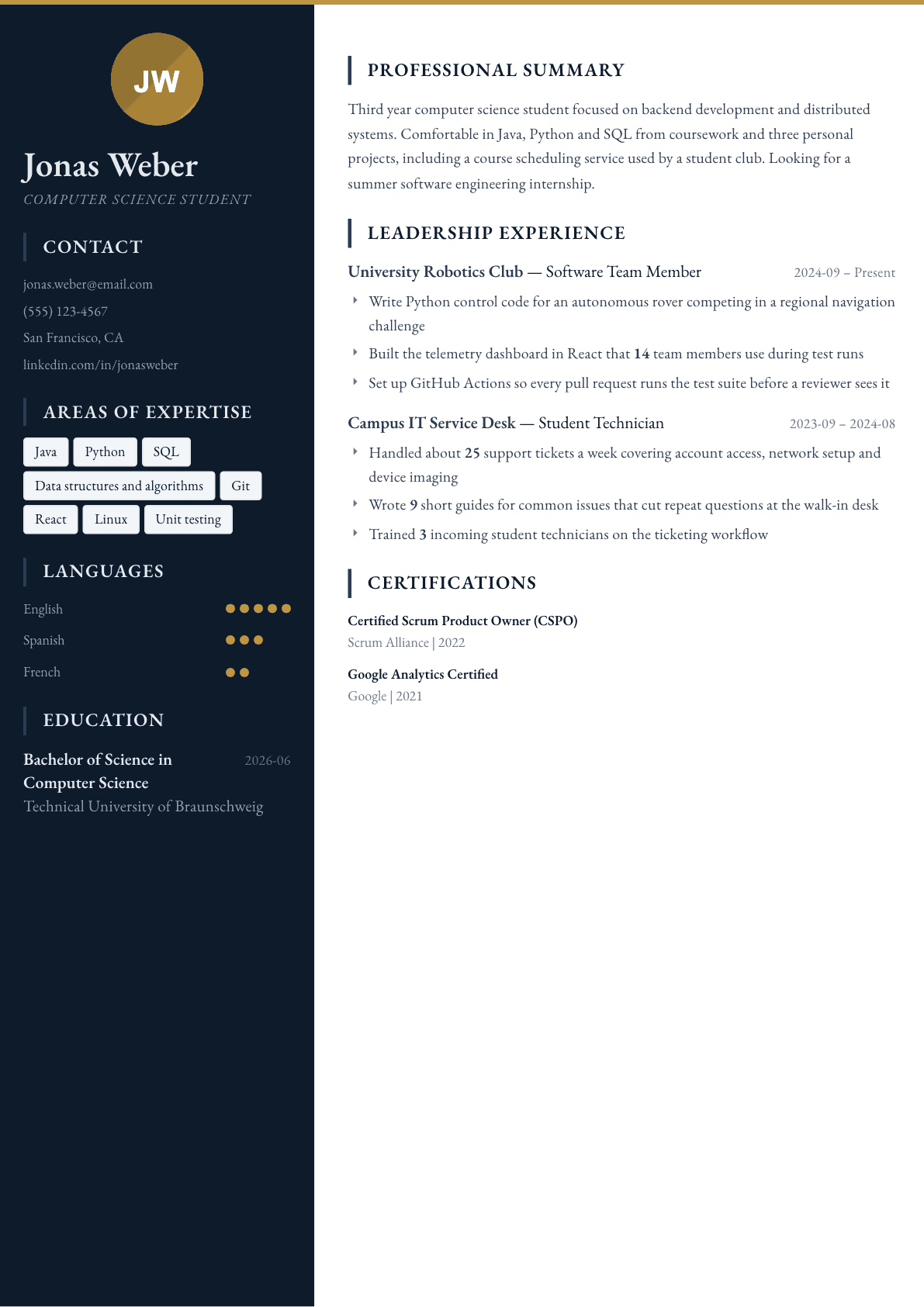
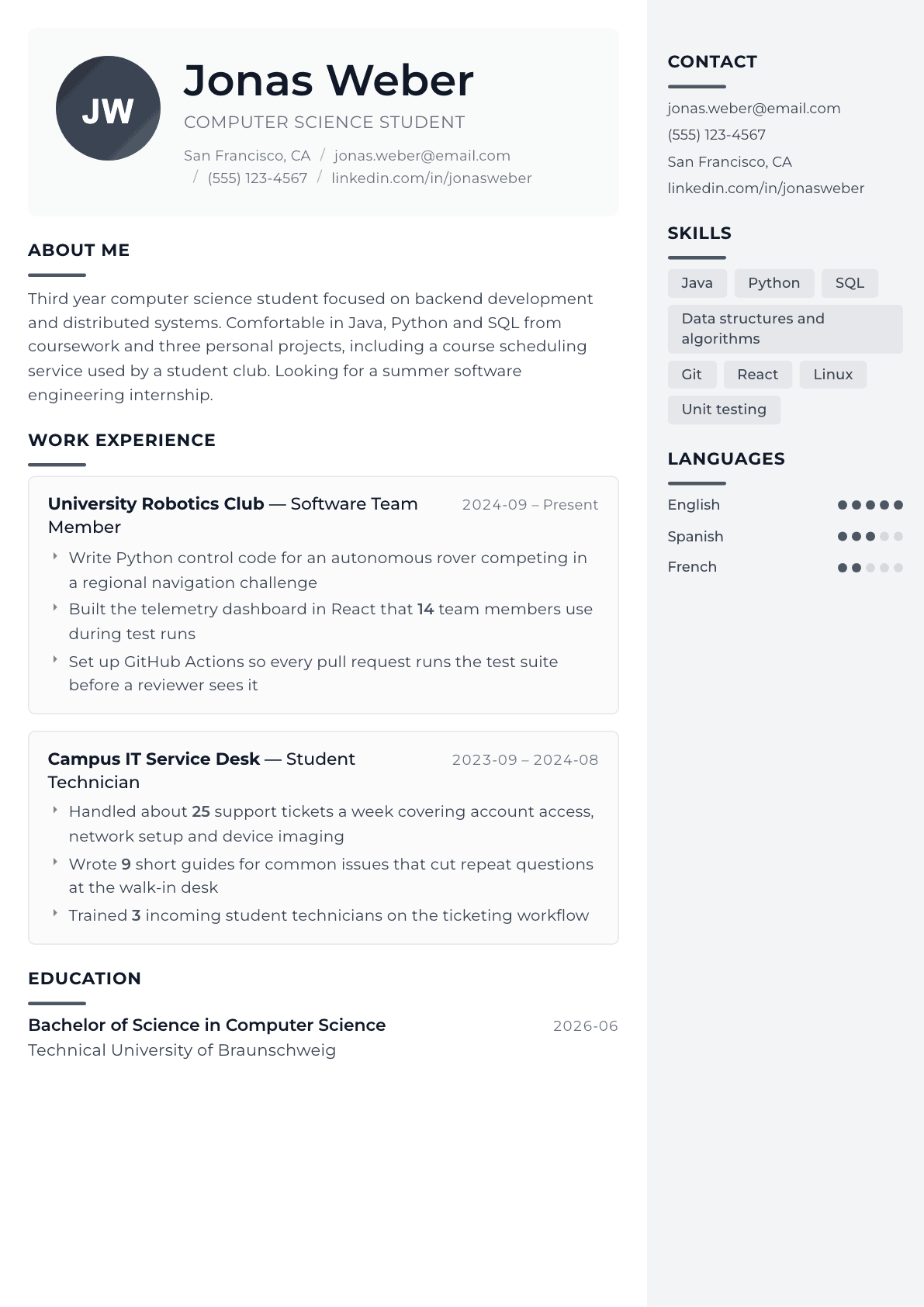
The same computer science student content laid out in three CVBooster templates, so you can see what the finished document looks like before you write a word.
Example Computer Science Student summary
Third year computer science student with coursework in operating systems, databases and distributed computing, and three projects built outside class. Writes Java, Python and SQL daily, maintains a course scheduling service used by a student club, and handles the continuous integration setup for a robotics team. Seeking a summer software engineering internship where backend work is the focus.
Skills to list on a Computer Science Student resume
- Java
- Python
- C++
- JavaScript
- SQL
- Data structures and algorithms
- Git and GitHub
- Linux
- React
- REST APIs
- Unit testing
- Object-oriented programming
- Databases
- Operating systems
- Agile teamwork
What actually gets this resume read
- Put education at the top with your expected graduation date, since that is the first thing an internship recruiter checks.
- Give projects the same treatment as jobs: what you built, the stack, who used it, and what it does now.
- List relevant coursework only when it maps to the posting, naming courses like operating systems or databases.
- Include non-technical jobs briefly if they show reliability, but keep the space weighted toward code you have written.
- Add your GitHub link and make sure the pinned repositories have a readme, because reviewers do click through.
- Name the languages you would be comfortable interviewing in rather than every language you have ever touched.
How to write a computer science student resume
A computer science student resume has an obvious problem and a less obvious one. The obvious problem is that you have little or no professional work history. The less obvious problem is that thousands of other students have the same coursework, the same three languages, and a project section describing a to-do application, a weather dashboard and a portfolio site. Recruiters at internship season read these in batches, and the ones that get calls are the ones where something on the page could only have been written by that particular student.
The good news is that internship and new graduate hiring genuinely does not require job history. It requires evidence that you can write code that works, that you can finish something, and that you can explain it. A project with real users, a contribution to an open source repository, a competition team, a research assistantship or a teaching assistant position all satisfy that far better than a longer skills list does.
This guide covers the section order for a student resume, how to write projects so they carry weight, how to handle coursework and grade point average, and the questions students ask when applying for their first technical role.
Format: one page, education first, projects doing the heavy lifting
One page, no exceptions, single column, plain and readable. Education goes at the top with your school, degree, expected graduation month and year, because internship recruiters filter on graduation timing before anything else. Then projects or experience, whichever is stronger, then skills, then anything else.
Do not add a photograph, a skills rating chart, or a colored sidebar. Technical recruiting runs through tracking systems and quick human scans, and both handle a plain document better. Save the visual design energy for a personal site you can link to.
- Header: name, city, phone, email, GitHub, LinkedIn, and a personal site if it exists.
- Order: education, projects or experience, technical skills, activities, awards.
- Include expected graduation date, and include the grade point average only if it is strong.
Projects: write them like jobs, with users and consequences
Give each project a title, the stack in a short parenthetical, and two or three bullets. The bullets should answer what it does, how you built it, and what happened once it existed. That last question is the one that turns a class assignment into something worth interviewing about, and it is the one almost every student resume leaves unanswered.
Real usage beats sophistication. A scheduling tool that a student club actually uses every week is more persuasive than an ambitious machine learning project nobody ran twice. Say how many people use it, how long it has been running, and what you had to fix once other people touched it, because maintenance is where engineering judgment shows.
Include the parts of software work that are not writing features. Tests, continuous integration, a readme someone else could follow, a deployment that stays up, an issue you triaged from a user report. Interviewers notice these because they are the habits of someone who has worked on a team, and students who show them stand out immediately.
Three strong projects beat six thin ones. Cut the tutorial follow-alongs. If a project is on your resume, be able to explain every design decision in it, because that is exactly what the technical screen will test.
- Per project: what it does, the stack, your specific contribution, and its usage or outcome.
- Say whether you worked alone or on a team, and what part was yours.
- Link the repository and make sure the readme is written for a stranger.
- Prefer projects with real users, real data, or a real deadline.
Experience: technical first, but non-technical work still counts
Anything technical goes first: a research assistantship, a campus information technology job, a teaching assistant role, a competition team, or an internship of any length. Describe them with the same specificity as a full job, naming the languages, the systems and the volume of work.
Non-technical jobs belong on the page too, briefly. Retail, hospitality, tutoring and campus employment demonstrate reliability and customer contact, which internship managers value more than students expect. Keep them to one or two lines each so the balance of the page stays technical.
Coursework, grades and skills: relevant only, honest always
List relevant coursework only when the courses map to the posting, and name the subjects rather than the course codes: operating systems, databases, computer networks, algorithms, distributed systems, machine learning. A course code means nothing outside your department. Drop the list once you have two internships behind you.
Include the grade point average when it is strong and leave it off otherwise; no recruiter will assume the best, but nobody rejects a strong project section over a missing number either. For skills, group into languages, frameworks and tools, and only list what you could use in a live coding exercise. Listing a language you touched once in a single lab is the fastest way to lose an interview you were passing.
Keywords internship postings scan for
Student technical postings repeat: data structures, algorithms, object-oriented programming, Java, Python, C plus plus, JavaScript, SQL, Git, Linux, REST APIs, unit testing, debugging, agile, and the phrase currently pursuing a bachelor of science in computer science. Use the true ones in real sentences. Also mirror the graduation timing language the posting uses, because internship pipelines are filtered by class year before a human ever reads the file.
Computer Science Student resume summary examples
First year student
First year computer science student with coursework in programming fundamentals and discrete mathematics. Built a command line grade tracker in Python and contributed documentation fixes to two open source repositories. Working the campus help desk and looking for a first technical internship or research assistantship.
Third year, seeking an internship
Third year computer science student focused on backend development, with coursework in operating systems, databases and distributed computing. Maintains a course scheduling service used weekly by a student club, writes the continuous integration setup for a robotics team, and codes primarily in Java, Python and SQL.
Final year with internship experience
Final year computer science student with two software internships, the most recent building internal reporting services in Go against a PostgreSQL warehouse. Led the campus hackathon team to a regional placement and teaches the introductory data structures laboratory. Seeking a new graduate software engineering position in backend or infrastructure.
Work experience bullets: before and after
Before: Built a web application for a class project.
After: Built a course scheduling service in Java and PostgreSQL that a forty member student club uses each term to assign meeting rooms and avoid conflicts.
Real users and a real problem move the project from a graded exercise to something a hiring engineer can discuss.
Before: Used GitHub for version control.
After: Set up GitHub Actions so every pull request runs the test suite and a linter before review, which stopped broken code reaching the team branch.
It shows a team engineering habit rather than the baseline fact of using version control.
Before: Worked at the campus IT help desk.
After: Handled about twenty-five support tickets a week at the campus service desk, covering account access, network setup and device imaging, and wrote nine walkthrough guides for repeat issues.
Ticket volume and the documentation output turn a student job into measurable technical work.
Before: Member of the robotics club.
After: Write the Python control code for an autonomous rover on the university robotics team and built the React telemetry dashboard that fourteen members use during test runs.
Naming the specific contribution separates you from every other student who listed club membership.
Before: Familiar with data structures and algorithms.
After: Completed coursework in algorithms and data structures and now teach the weekly laboratory section, walking thirty students through recursion, trees and complexity analysis.
Teaching the material is a far stronger claim of mastery than declaring familiarity with it.
Hard skills
- Java
- Python
- C plus plus
- JavaScript
- SQL and relational databases
- Data structures and algorithms
- Git and GitHub
- Linux command line
- REST APIs
- Unit testing
- Object-oriented programming
- Continuous integration basics
Soft skills
- Explaining technical decisions
- Working on a small team
- Meeting deadlines alongside coursework
- Asking for code review
- Self-directed learning
Certifications worth listing
- AWS Certified Cloud Practitioner (Amazon Web Services)
- Oracle Certified Associate, Java SE Programmer (Oracle)
- Google IT Automation with Python Certificate (Google)
- Microsoft Certified: Azure Fundamentals (Microsoft)
Mistakes that cost computer science student candidates the interview
- Filling the page with tutorial projects that thousands of other applicants also built from the same course.
- Leaving out the expected graduation date, which is the first field internship recruiters filter on.
- Listing every language ever seen in a laboratory, then failing a screen on one of them.
- Writing project bullets that describe features but never say who used the thing or what it changed.
- Stretching to two pages with coursework and club memberships when one focused page reads far stronger.
- Linking a GitHub profile whose repositories have no readme, no commits in a year, and no explanation.
Computer Science Student resume questions
What goes on a computer science student resume with no work experience?
Education first, then projects written like jobs, then any campus or technical role, then skills. Projects carry the page. Two or three built with real users and clear technical decisions will get more interviews than a longer list of coursework ever will.
Should I include my grade point average?
Include it when it is strong, and leave it off otherwise. Some large employers do screen on it for internships, but a missing figure rarely triggers rejection on its own, whereas a weak one printed at the top can. Let projects and internships carry the argument instead.
How many projects should a student resume have?
Three, occasionally four. Each needs enough room for what it does, how you built it and what happened afterward. Six shallow entries look like a course catalog, and every project you list is fair territory for detailed questions in the interview.
Do I list coursework on a computer science resume?
List relevant courses by subject name while you are still early, and match them to the posting: operating systems and databases for backend roles, machine learning for data roles. Drop the section entirely once you have real internship experience filling the space.
Should I include non-technical jobs like retail?
Yes, briefly. They show reliability, punctuality and customer contact, and they explain how you spent your time. Keep each to one or two lines so the page stays weighted toward code, and skip them once technical experience fills the space.
Related resume examples
- Software Engineer Resume example
- Junior Software Engineer Resume example
- Software Engineering Intern Resume example
- IT Intern Resume example
- Web Developer Resume example
- Backend Developer Resume example