Engineering Technician Resume Examples: read this first
Write an Engineering Technician Resume That Shows Hands On Skill
By Mustafa Tarabya, founder of CVBooster · Published · Updated
Engineering technician resume example with test and prototype bullets, instrumentation keywords, and a guide to writing each section.
Sample resumes for a engineering technician
The same engineering technician content laid out in three CVBooster templates, so you can see what the finished document looks like before you write a word.
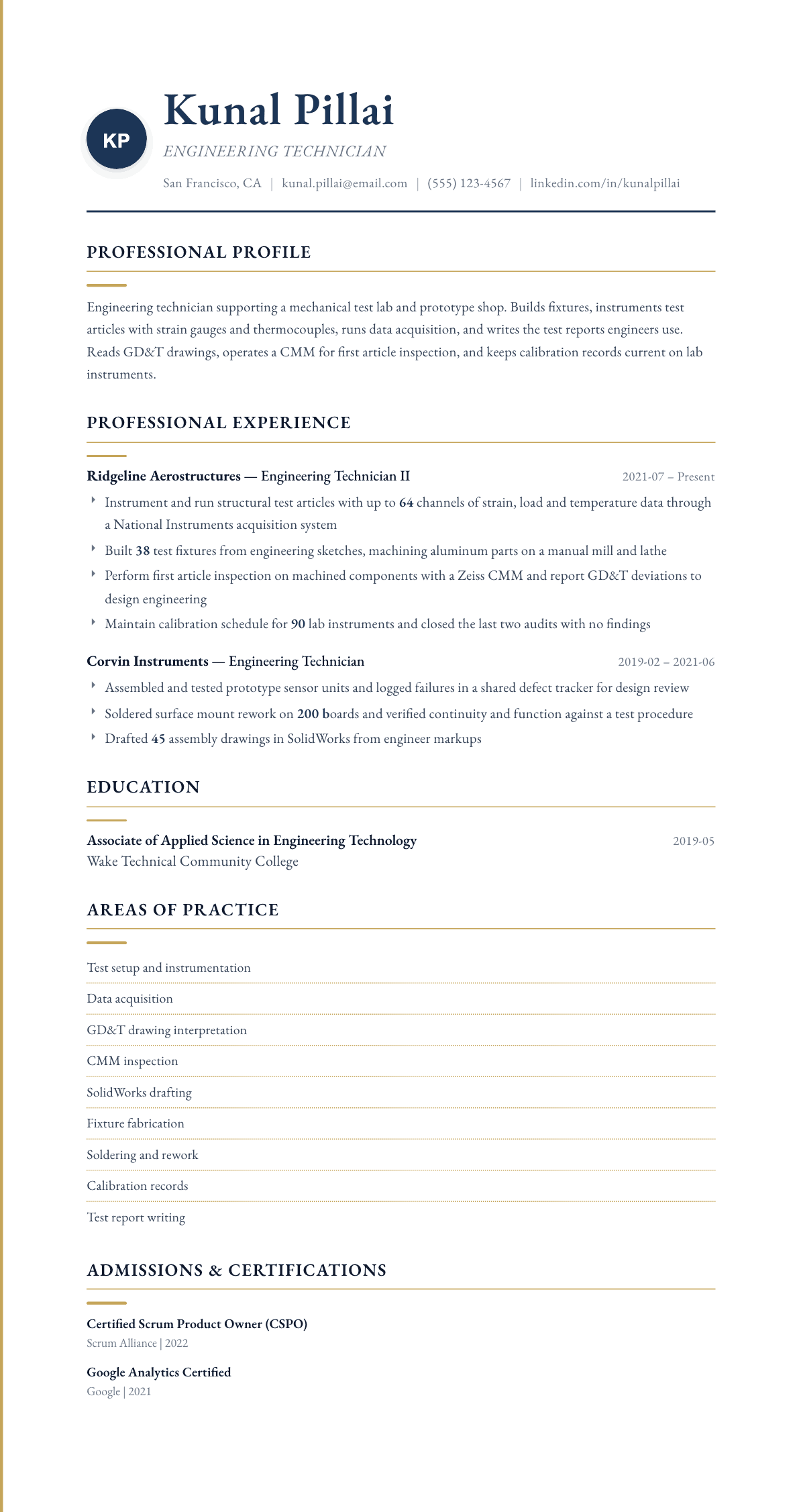
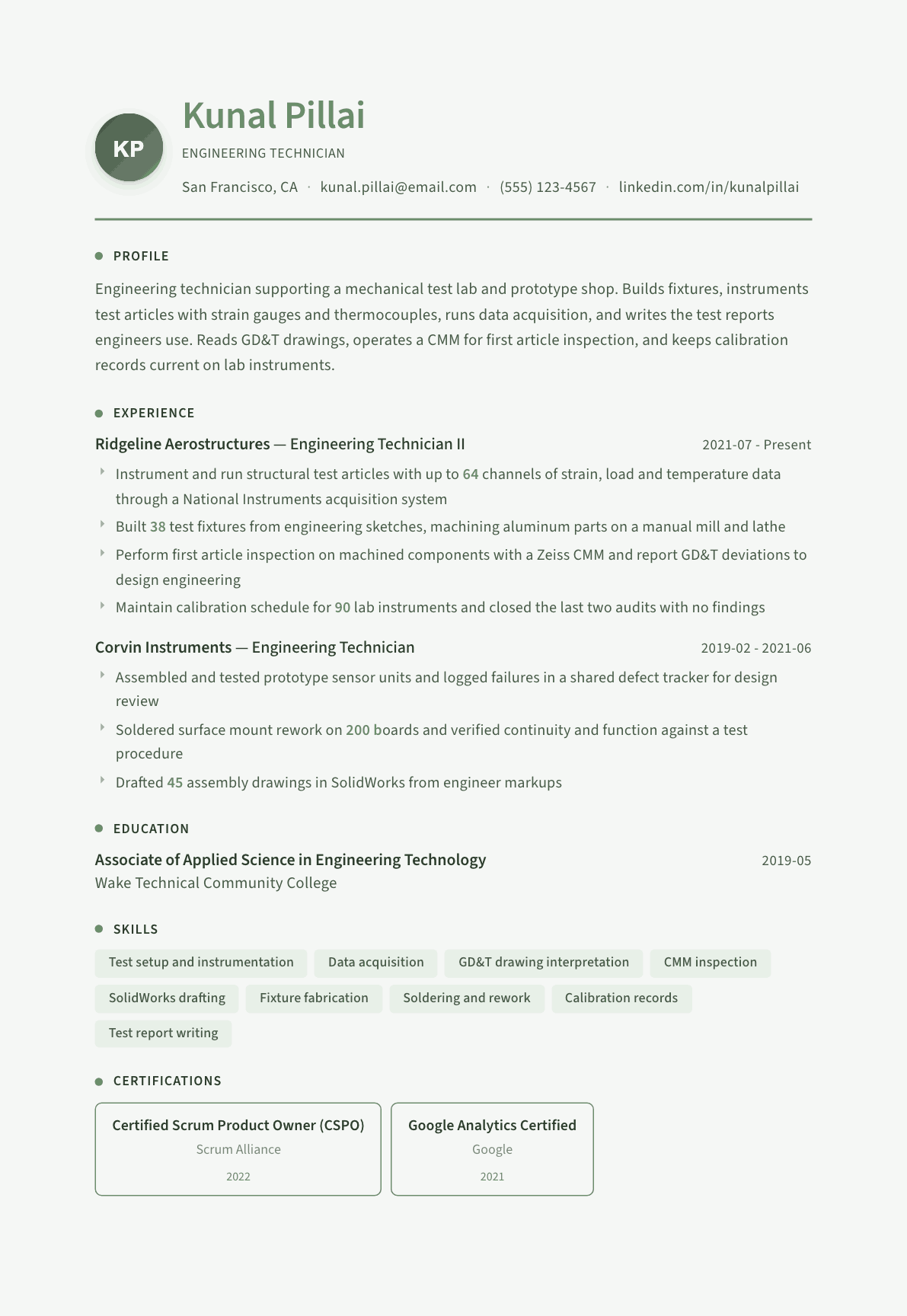
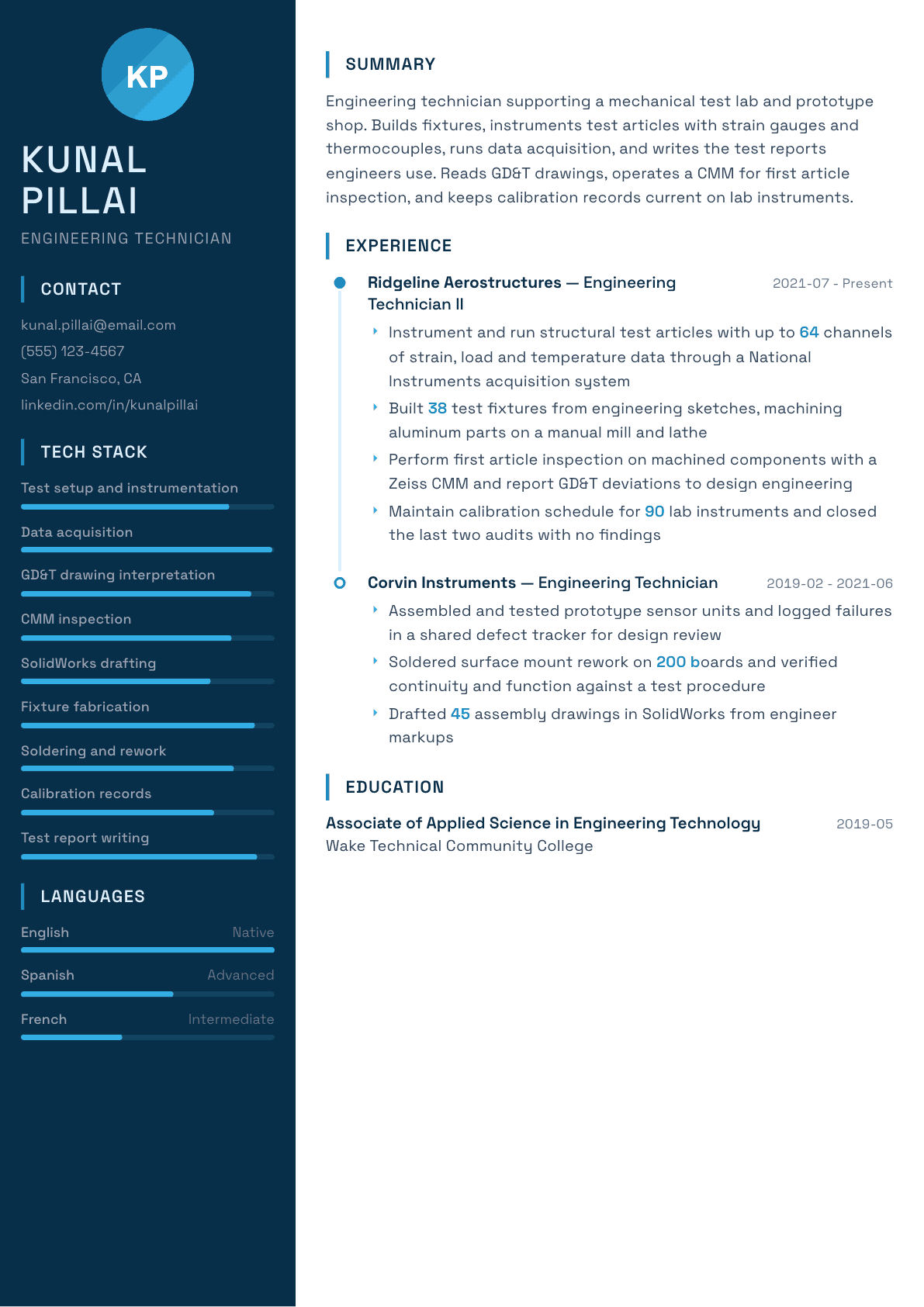
Example Engineering Technician summary
Engineering technician with five years in mechanical test labs and prototype shops. Instruments test articles with strain gauges and thermocouples, runs multi channel data acquisition, fabricates fixtures, and performs first article inspection on a CMM. Reads GD&T drawings, drafts assembly views in SolidWorks, and maintains calibration for ninety lab instruments with no audit findings. Seeking a senior engineering technician position.
Skills to list on a Engineering Technician resume
- Test instrumentation
- Data acquisition systems
- Strain gauge installation
- Mechanical testing
- GD&T interpretation
- Coordinate measuring machine
- Dimensional inspection
- SolidWorks
- AutoCAD
- Fixture design and fabrication
- Machine shop operations
- Soldering and rework
- Calibration management
- Test procedure execution
- Technical report writing
What actually gets this resume read
- Lead with the equipment you operate by name, because technician screening is a match against a tool list.
- Say what you build and measure: fixtures, instrumentation channels, inspection reports, prototype assemblies.
- Show drawing literacy directly by naming GD&T, tolerance stack ups and the CAD package you draft in.
- Include calibration and documentation duties, since audits make these a real requirement rather than a bonus.
- Put your associate degree, apprenticeship or military technical training near the top if experience is short.
- Quantify volume where you can: boards reworked, parts inspected, test channels run, drawings produced.
How to write a engineering technician resume
An engineering technician resume is a capability list with evidence attached. The hiring manager is usually a lab supervisor or an engineering lead who needs someone to build a fixture, instrument a test article, run the acquisition, inspect the parts and write up what happened. They screen by matching a tool list, then look for signs that the candidate has produced work an engineer trusted without supervision.
That is why vague phrasing hurts technicians more than most roles. Assisted engineers with testing could mean you carried cables or it could mean you designed the setup, wired sixty four channels and caught a bad load cell before the test ran. The resume has to remove that ambiguity in every bullet by naming the equipment, the method and the volume.
This guide covers how to lay out an engineering technician resume, what to put in the skills and experience sections, three summaries from a first job through a senior technician, before and after bullets from lab and shop work, and the questions technicians ask when they move industries or toward an engineering title.
Format: one page, equipment near the top
One page is right for most technicians, two only after a long career across several industries. Reverse chronological, one column, no graphics. Manufacturing and laboratory employers still parse resumes automatically and a sidebar full of skill icons often arrives as an empty block.
Put a technical skills section directly under the summary rather than at the bottom. For this role the tool list is the qualification, and a supervisor scanning for CMM, data acquisition or surface mount rework should hit it in the first third of the page.
- Header: name, city, phone, email, and any clearance or certification you hold.
- Order: summary, technical skills, experience, education and training, certifications.
- Add a short equipment list if you have operated machine tools or specialized test rigs.
Summary: environment, equipment, and what you produce
Name the environment first: mechanical test lab, prototype shop, electronics bench, quality inspection room, field service or production support. Then the equipment you run and the output you produce, which might be test data, inspection reports, fabricated fixtures or working prototypes.
Add drawing literacy explicitly. Reading geometric dimensioning and tolerancing, working from engineering sketches and drafting revisions in a CAD package are the abilities that let a technician work without an engineer standing over the bench, and they are worth stating in the summary.
Experience: name the equipment, the method and the volume
Every bullet should contain at least two of three things: the equipment, the technique and a number. Instrumented test articles with strain gauges and thermocouples across sixty four channels. Machined fixtures on a manual mill and lathe from engineer sketches. Inspected machined parts on a coordinate measuring machine and reported tolerance deviations. Reworked surface mount components and verified function against a test procedure.
Show the judgment part too. Technicians who catch problems are worth far more than technicians who follow steps, so include the bad sensor you found before a test, the fixture you redesigned because it flexed under load, or the drawing error you caught during a first article inspection.
Documentation belongs in the experience section, not hidden. Test reports, calibration records, inspection reports, redlined drawings and defect logs are real deliverables and audits depend on them. Say how many instruments you kept in calibration and how the last audit went.
Technical skills: group them the way a supervisor thinks
Use four groups. Test and measurement covers data acquisition hardware, strain gauges, thermocouples, load cells, oscilloscopes and multimeters. Inspection covers coordinate measuring machines, height gauges, micrometers, optical comparators and surface finish measurement. Fabrication covers mill, lathe, welding, soldering, wiring and assembly. Software covers the CAD package, the acquisition and analysis software and any spreadsheet or scripting you use for data reduction.
Be honest about level within each group. Operating a coordinate measuring machine with existing programs is different from writing the programs, and a supervisor will find out on the first day. Stating the level builds trust rather than costing you the interview.
Education, training and keywords
An associate degree in engineering technology, a completed apprenticeship or military technical training all belong near the top while your experience is short. Once you have four or five years the education block moves down and the equipment list carries the resume.
Keywords that recur in technician postings include test setup, data acquisition, instrumentation, first article inspection, dimensional inspection, GD and T interpretation, fixture fabrication, prototype build, calibration, test procedure execution, root cause support and technical documentation. Use the exact phrasing from the posting where it matches your actual work.
Engineering Technician resume summary examples
New technician
Engineering technology graduate with lab coursework in instrumentation and materials testing plus an internship building test fixtures and logging tensile data. Reads engineering drawings including tolerancing symbols, drafts in SolidWorks, and is looking for a technician role in a mechanical test lab.
Four years in
Engineering technician in an aerostructures test lab running strain, load and temperature instrumentation across multi channel acquisition systems. Fabricates fixtures on manual machine tools, performs first article inspection on a coordinate measuring machine, and writes the test reports design engineers work from.
Senior technician
Senior engineering technician with eleven years across test labs and prototype shops. Designs and builds test setups from a requirement, trains newer technicians on instrumentation and inspection practice, and owns the calibration program for a lab of roughly ninety instruments with a clean audit record.
Work experience bullets: before and after
Before: Assisted engineers with laboratory testing.
After: Instrumented and ran structural test articles with up to 64 channels of strain, load and temperature data through a National Instruments acquisition system.
Channel count and the acquisition platform show the complexity of the setups you can run without help.
Before: Built fixtures and parts for test setups.
After: Built 38 test fixtures from engineering sketches, machining aluminum components on a manual mill and lathe and correcting two designs that deflected under applied load.
Volume, the machines used and a design correction prove fabrication skill together with engineering judgment.
Before: Performed inspection of machined parts.
After: Performed first article inspection on a Zeiss coordinate measuring machine and reported tolerance and true position deviations back to design engineering with the measurement data attached.
Naming the machine, the inspection type and the reporting path shows the work reached a decision maker.
Before: Kept lab equipment calibrated.
After: Maintained the calibration schedule for 90 lab instruments, coordinating external calibration vendors and closing the last two quality audits with no findings.
Instrument count and audit outcome turn a housekeeping task into a documented compliance record.
Before: Did soldering and board repair work.
After: Performed surface mount rework on 200 boards to accepted soldering standards and verified continuity and functional performance against the released test procedure.
Board volume, the workmanship standard and the verification step tell a supervisor the work is repeatable and inspectable.
Hard skills
- Test setup and instrumentation
- Data acquisition hardware and software
- Strain gauge installation and wiring
- Load cell and thermocouple use
- Mechanical and environmental testing
- Coordinate measuring machine inspection
- Dimensional inspection and hand metrology
- GD and T drawing interpretation
- SolidWorks and AutoCAD drafting
- Fixture design and fabrication
- Manual mill and lathe operation
- Soldering and surface mount rework
- Calibration program management
- Test report and procedure writing
Soft skills
- Attention to setup detail
- Working from a verbal requirement
- Clear written handover
- Problem spotting before a test runs
- Training newer technicians
- Working alongside design engineers
Certifications worth listing
- Certified Engineering Technician (CET) (National Institute for Certification in Engineering Technologies)
- Certified Calibration Technician (CCT) (American Society for Quality)
- IPC J-STD-001 Soldered Electrical and Electronic Assemblies (IPC)
- Certified Quality Technician (CQT) (American Society for Quality)
- OSHA 10-Hour General Industry (OSHA Training Institute Education Centers)
Mistakes that cost engineering technician candidates the interview
- Writing assisted engineers without naming the equipment, which erases the only qualification the reader is checking.
- Listing every tool ever touched at the same level, so a supervisor cannot tell expertise from a single afternoon.
- Leaving out volumes, when parts inspected, boards reworked and channels instrumented are what scale the experience.
- Skipping documentation duties even though test reports and calibration records are audited deliverables.
- Hiding an apprenticeship or military technical training that would carry more weight than the job titles above it.
- Using an ornate two column template that parsers scramble, costing you the tool matches the resume was built on.
Engineering Technician resume questions
What is the difference between an engineering technician and an engineering technologist?
A technologist normally holds a four year applied degree and takes on more design and analysis. A technician works closer to the hardware with a two year degree or equivalent training. Match the title used in the posting rather than inventing one.
How do I move from an engineering technician role into an engineer role?
Collect bullets that show design and analysis rather than execution: fixtures you designed, test plans you drafted, data you reduced and interpreted. Then pursue the degree or credential the employer requires, and say on the resume that you are enrolled.
Should I list machine shop skills on a technician resume?
Yes when they are genuine. The ability to make a part instead of ordering one is a real advantage in a prototype or test environment, so name the machines, the materials and the tolerances you can hold rather than writing machining as a single word.
How important is drawing interpretation for this role?
It is close to essential. Say that you read geometric dimensioning and tolerancing, work from engineering sketches and can redline a drawing for revision. Many technician applications are rejected purely on doubt about drawing literacy.
Do engineering technicians need certifications?
Certifications are optional but they help you pass an initial screen, particularly soldering workmanship standards, calibration credentials and quality technician certificates. List the issuing body and any level, since employers verify them more often than degrees.
Related resume examples
- Mechanical Engineer Resume example
- Lab Technician Resume example
- CAD Technician Resume example
- Manufacturing Technician Resume example
- Mechanical Design Engineer Resume example
- Engineering Intern Resume example