Manufacturing Technician Resume Examples: free ATS score
Write a Manufacturing Technician Resume That Shows Uptime
By Mustafa Tarabya, founder of CVBooster · Published · Updated
Manufacturing technician resume example, keywords and guide covering equipment setup, troubleshooting, preventive maintenance, work instructions and yield.
Sample resumes for a manufacturing technician
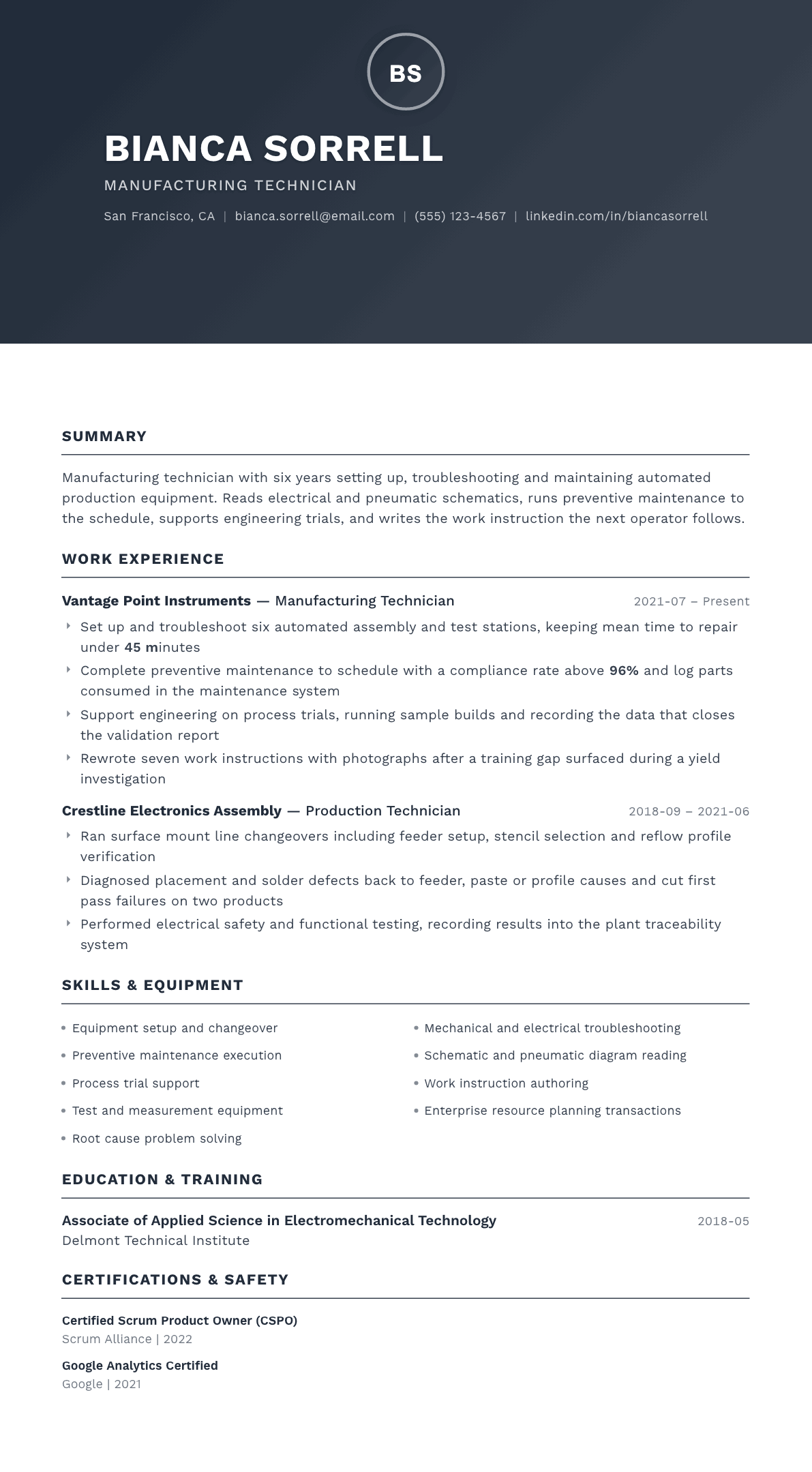
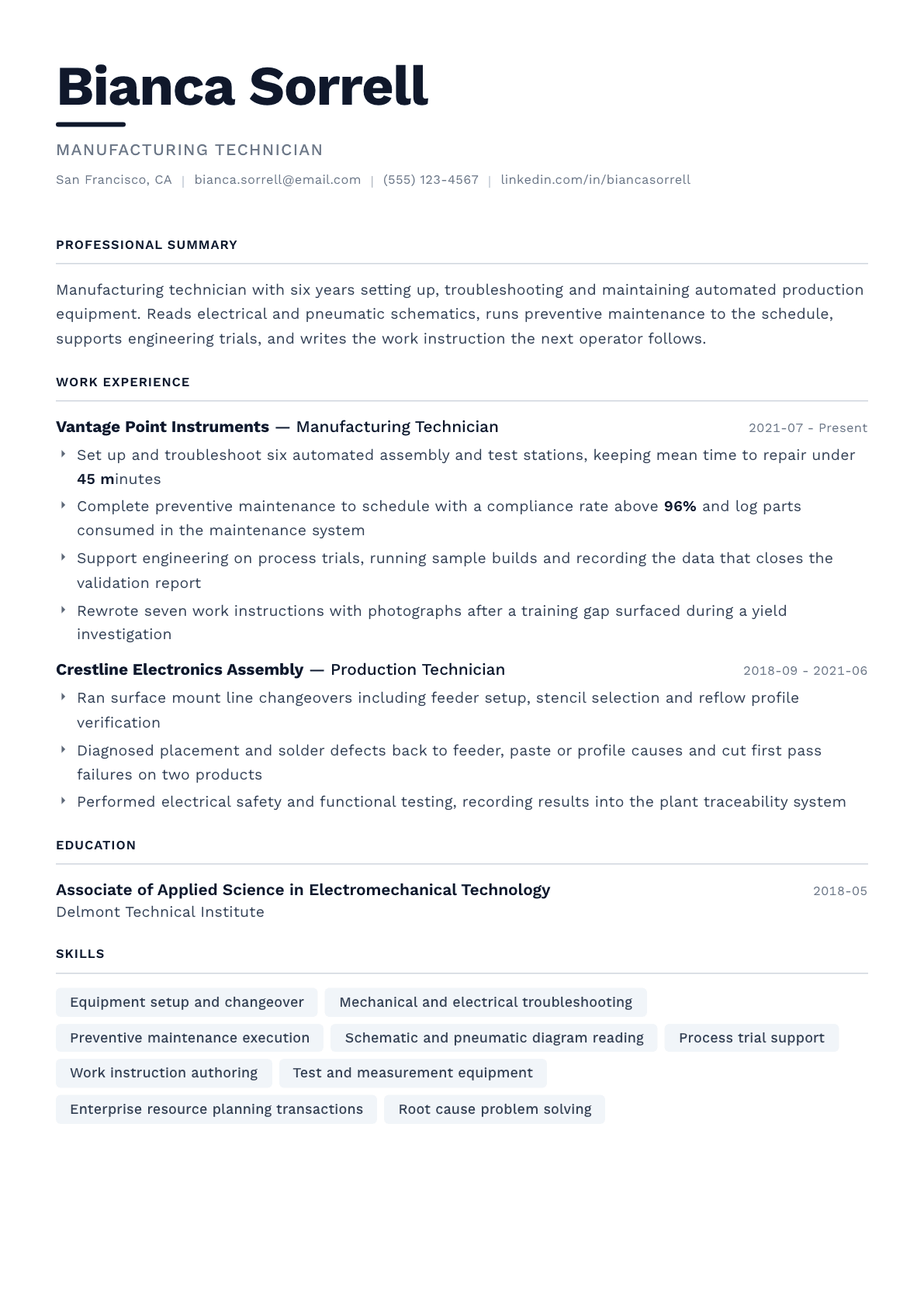
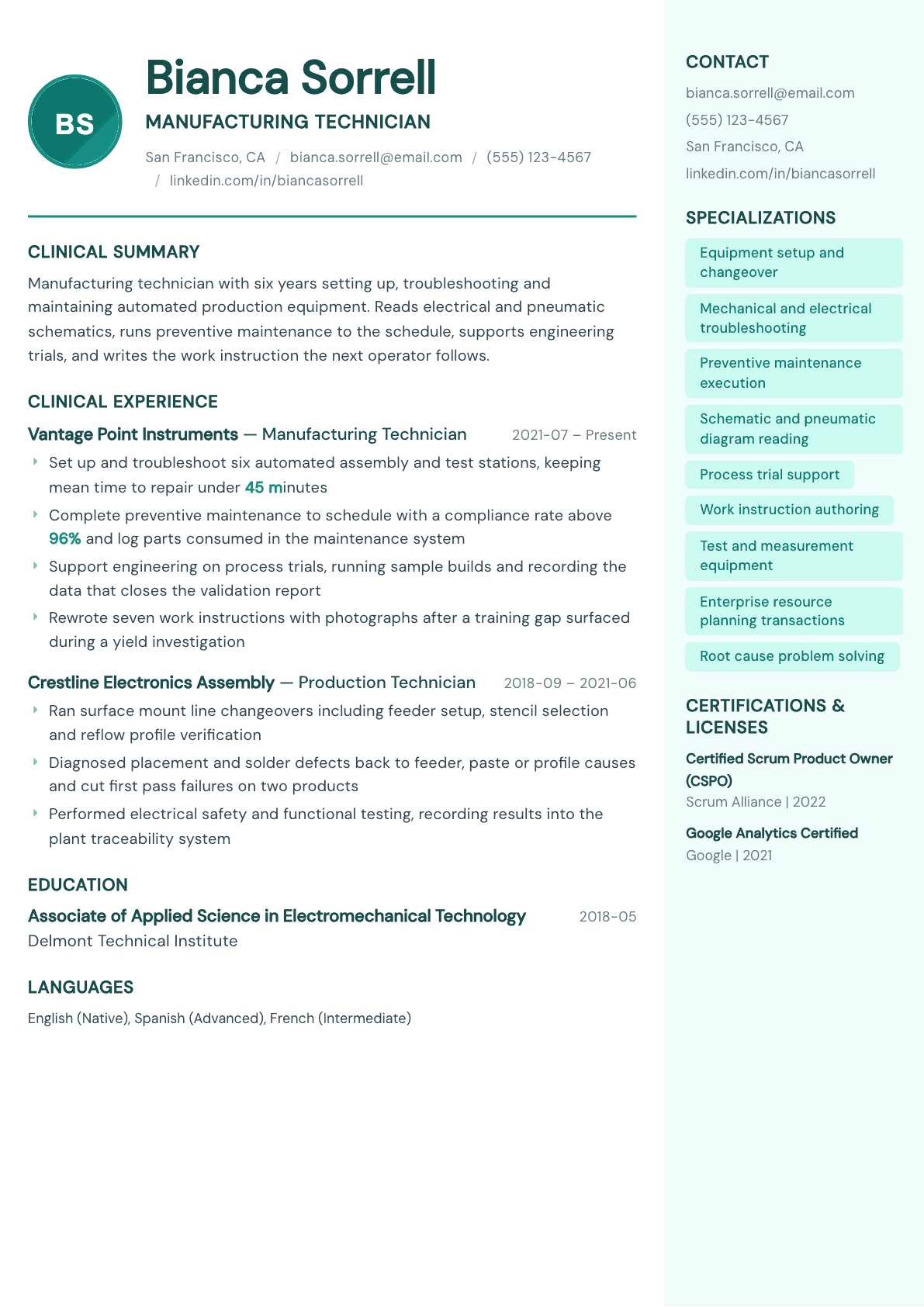
The same manufacturing technician content laid out in three CVBooster templates, so you can see what the finished document looks like before you write a word.
Example Manufacturing Technician summary
Manufacturing technician with six years setting up, troubleshooting and maintaining automated assembly and test equipment. Reads electrical, pneumatic and controller schematics, keeps mean time to repair low, and holds preventive maintenance compliance above the site target. Supports engineering trials by running sample builds and recording the data a validation report needs, then writes the work instruction the next operator follows. Diagnoses defects back to feeder, paste or profile causes.
Skills to list on a Manufacturing Technician resume
- Production equipment setup
- Line changeover and tooling swaps
- Mechanical troubleshooting
- Electrical and sensor troubleshooting
- Pneumatic and hydraulic systems
- Programmable logic controller basics
- Preventive maintenance scheduling
- Calibration and functional testing
- Schematic and drawing interpretation
- Process trial and validation support
- Work instruction authoring
- Operator training and handover
- Root cause and corrective action
- Enterprise resource planning transactions
- Yield and first pass tracking
What actually gets this resume read
- Say what equipment you own, because a manufacturing technician is hired for specific machines, not for effort.
- Give mean time to repair or downtime hours saved so a manager can see what your troubleshooting is worth.
- Show your preventive maintenance compliance, since a technician who skips it creates next quarter's failures.
- Name the schematics you read: electrical, pneumatic, hydraulic or programmable controller logic.
- Include work instruction writing and training, which separates a technician from a skilled operator.
- Describe an engineering trial you supported and the data you recorded that closed the report.
How to write a manufacturing technician resume
A manufacturing technician is the person a plant calls when a machine stops and the operator has already tried the obvious. The engineering manager hiring one is buying diagnosis time. She wants somebody who reads a schematic instead of swapping parts, who finishes preventive maintenance on schedule instead of deferring it, and who writes down what he found so the next failure takes ten minutes rather than two hours.
The resumes that miss describe the role as assisting with production and performing maintenance duties. That could be a janitor with a wrench. What a hiring manager wants to see is equipment named, faults diagnosed, downtime measured and process trials supported, because those four things are what a technician is actually paid for.
This guide covers the resume shape a manufacturing engineering group expects, how to write a summary that names your equipment, how to describe troubleshooting with evidence, before and after bullets, the credentials worth carrying, and the questions technicians ask when they move toward process engineering.
Format: equipment and systems block above the jobs
One page, reverse chronological, opening with an equipment and systems block. List what you own: assembly stations, test stands, packaging equipment, surface mount lines, conveyors, robots, vision systems, controllers and the utilities you work on. Then the disciplines: mechanical, electrical, pneumatic, hydraulic and controls.
Add a documentation line, because a technician who writes is worth more than one who only fixes. Work instructions authored, maintenance records kept, trial data recorded and training delivered are all evidence that your knowledge leaves your head and stays with the plant.
- Equipment block naming machine categories and, where you can, the makes you have worked on.
- Discipline line: mechanical, electrical, pneumatic, hydraulic, controls, instrumentation.
- A documentation line covering instructions written, records kept and operators trained.
- Each job labeled with the product, plant type and how many machines you personally covered.
Summary: equipment, response, maintenance, engineering support
Four facts in three lines: what equipment you cover, how fast you restore it, whether you hold preventive maintenance to schedule, and whether you support engineering on trials and validation. That last one is what makes a technician promotable and it is the one most candidates omit entirely.
Use restoration language a maintenance manager recognizes. Mean time to repair, first time fix, response time and unplanned downtime hours are all standard, and giving one honest figure against a plant target beats a paragraph about being a strong troubleshooter.
Experience: diagnose, restore, prevent, improve
Group your bullets into four. Diagnosis first: the fault, how you isolated it, and the tool you used. Reading a controller fault log, tracing a sensor circuit with a meter, checking air pressure at the cylinder, or scoping a signal are all specific and all more convincing than the word troubleshooting.
Restoration second: repair or replacement, the spare parts consumed, and the time taken. Prevention third: the preventive maintenance schedule, your compliance rate, the tasks you added after a repeat failure, and the spares you got stocked because a failure waited a week for a part.
Improvement fourth, and this is where a technician resume separates itself. Fixtures built, cycle time reduced, a station rebalanced, a fault made visible with a sensor or an indicator, a changeover shortened. Describe the change and what it produced, because engineering managers hire technicians who leave the line better than they found it.
Engineering support, trials and validation
Manufacturing technicians spend part of their week supporting engineering: building sample runs, setting parameters for a trial, collecting measurements, running installation and operational checks on new equipment, and writing the data into a report somebody else signs.
Say exactly what your part was. Ran the sample builds and recorded the data for the validation report is accurate and useful. Wrote the validation protocol usually is not, unless you did. Precision about your role in engineering work is what makes a hiring manager believe the rest of the page.
Documentation, training and the systems you transact in
Write down the documentation you produce: work instructions with photographs, maintenance procedures, spare parts lists, changeover sheets and one point lessons. Then the training you deliver, because operators learning correctly the first time removes more downtime than most repairs do.
Name the systems you use: the maintenance management system for work orders and history, the enterprise resource planning terminal for production and material transactions, and any data collection or monitoring platform. Technicians who keep the history complete are the reason a plant can see its own failure patterns at all.
Manufacturing Technician resume summary examples
New technician
Electromechanical technology graduate with 8 months supporting assembly equipment setup and preventive maintenance. Reads electrical and pneumatic schematics, uses a multimeter for sensor circuit checks, and records work orders in the maintenance system. Seeking a manufacturing technician role in electronics or device assembly.
Six years in
Manufacturing technician with 6 years covering six automated assembly and test stations, holding mean time to repair under 45 minutes and preventive maintenance compliance above 96%. Supports engineering trials with sample builds and recorded data, and rewrote 7 work instructions after a yield investigation.
Lead technician
Lead manufacturing technician with 12 years across electronics and medical device assembly, owning equipment installation, controller fault diagnosis and the preventive maintenance program for a full line. Trains technicians and operators, and cut unplanned downtime by rebuilding the spares list around actual failure history.
Work experience bullets: before and after
Before: Troubleshot equipment issues on the production floor.
After: Diagnosed faults on six automated assembly and test stations using controller fault logs, meter checks on sensor circuits and air pressure verification at the cylinder, holding mean time to repair under 45 minutes.
Naming the diagnostic method and a restoration time turns troubleshooting into evidence.
Before: Performed preventive maintenance as scheduled.
After: Held preventive maintenance compliance above 96% across 14 assets, logged parts consumed against each work order, and added two tasks after a repeat bearing failure on the indexer.
A compliance rate and a schedule change show maintenance treated as a system, not a chore.
Before: Assisted engineering with new processes.
After: Ran sample builds for three process trials, recorded dimensional and functional data at each condition, and delivered the dataset that closed the validation report.
Stating exactly what you contributed keeps the claim credible and still shows real value.
Before: Updated work instructions for operators.
After: Rewrote seven work instructions with photographs after a yield investigation traced first pass failures to an ambiguous torque step, then trained both shifts on the corrected sequence.
The cause, the fix and the training make a documentation task read as a yield improvement.
Before: Reduced downtime on the line.
After: Cut unplanned downtime on the surface mount line by rebuilding the spares list from 12 months of failure history, so three parts that used to sit on backorder were held on site.
The mechanism is specific and portable, which is what an engineering manager buys.
Hard skills
- Production equipment setup and changeover
- Mechanical troubleshooting and repair
- Electrical and sensor circuit diagnosis
- Pneumatic and hydraulic systems
- Programmable logic controller fault reading
- Robot and vision system tending
- Preventive maintenance execution
- Calibration and functional testing
- Schematic and assembly drawing interpretation
- Process trial and validation support
- Work instruction authoring
- Operator training and handover
- Root cause and corrective action
- Maintenance management system use
- Enterprise resource planning transactions
Soft skills
- Working a fault methodically while a line stands still
- Explaining a repair to an operator so it does not repeat
- Deciding when to call an engineer instead of pressing on
- Handing over an unfinished repair with a usable note
- Keeping preventive work moving when everything feels urgent
Certifications worth listing
- Certified Production Technician (CPT) (Manufacturing Skill Standards Council)
- OSHA 30-Hour General Industry (OSHA Outreach Training Program, U.S. Department of Labor)
Mistakes that cost manufacturing technician candidates the interview
- Writing performed maintenance duties without naming one machine, fault or diagnostic method.
- Leaving out restoration and compliance numbers, which are the measures a maintenance manager reports on.
- Overstating your role in engineering trials, which an interviewer will unpick in two questions.
- Skipping documentation and training, the parts of the job that stop failures repeating.
- Listing every tool you own instead of the systems and disciplines you can diagnose across.
- Reading as an operator resume because the page never shows a fault you found and fixed alone.
Manufacturing Technician resume questions
What separates a manufacturing technician from a maintenance technician?
Maintenance centers on asset reliability across a site, while manufacturing technician work sits with the production process: setup, changeover, trials, yield and the equipment on one line. Many plants overlap the two, so mirror the language of the posting you are answering.
How do I show troubleshooting skill without downtime data?
Describe individual faults from symptom to root cause to fix, and name the diagnostic step that found it. Two well told fault stories in bullet form carry more weight with an engineering manager than an unsupported claim about strong troubleshooting ability.
Do I need controller programming experience?
Reading fault logs and understanding input and output states is expected. Editing or writing controller logic is usually a controls engineer task, so state clearly which one you do, since overclaiming here is caught quickly in a technical interview.
How do I move from technician to process engineer?
Build the page around improvement rather than repair: trials you ran, parameters you tested, yield you moved, fixtures you designed and data you analyzed. Add any formal study in progress, since many engineering seats still expect a degree alongside the floor evidence.
Should I list every machine make and model?
List categories first and add makes where they are common enough to mean something to a reader. A long model list eats space and helps nobody, while naming the equipment types plus two or three recognizable makes gives the reader an accurate picture.
Related resume examples
- Production Technician Resume example
- Maintenance Technician Resume example
- Manufacturing Engineer Resume example
- Engineering Technician Resume example
- Manufacturing Associate Resume example
- Semiconductor Technician Resume example