Environment Artist Resume Examples: the lines they read
Write an Environment Artist Resume That Shows Real Level Craft
By Mustafa Tarabya, founder of CVBooster · Published · Updated
Environment artist resume guide with modular kit, lighting and engine keywords, plus a sample that shows how leads judge a level from a portfolio.
Sample resumes for a environment artist
The same environment artist content laid out in three CVBooster templates, so you can see what the finished document looks like before you write a word.
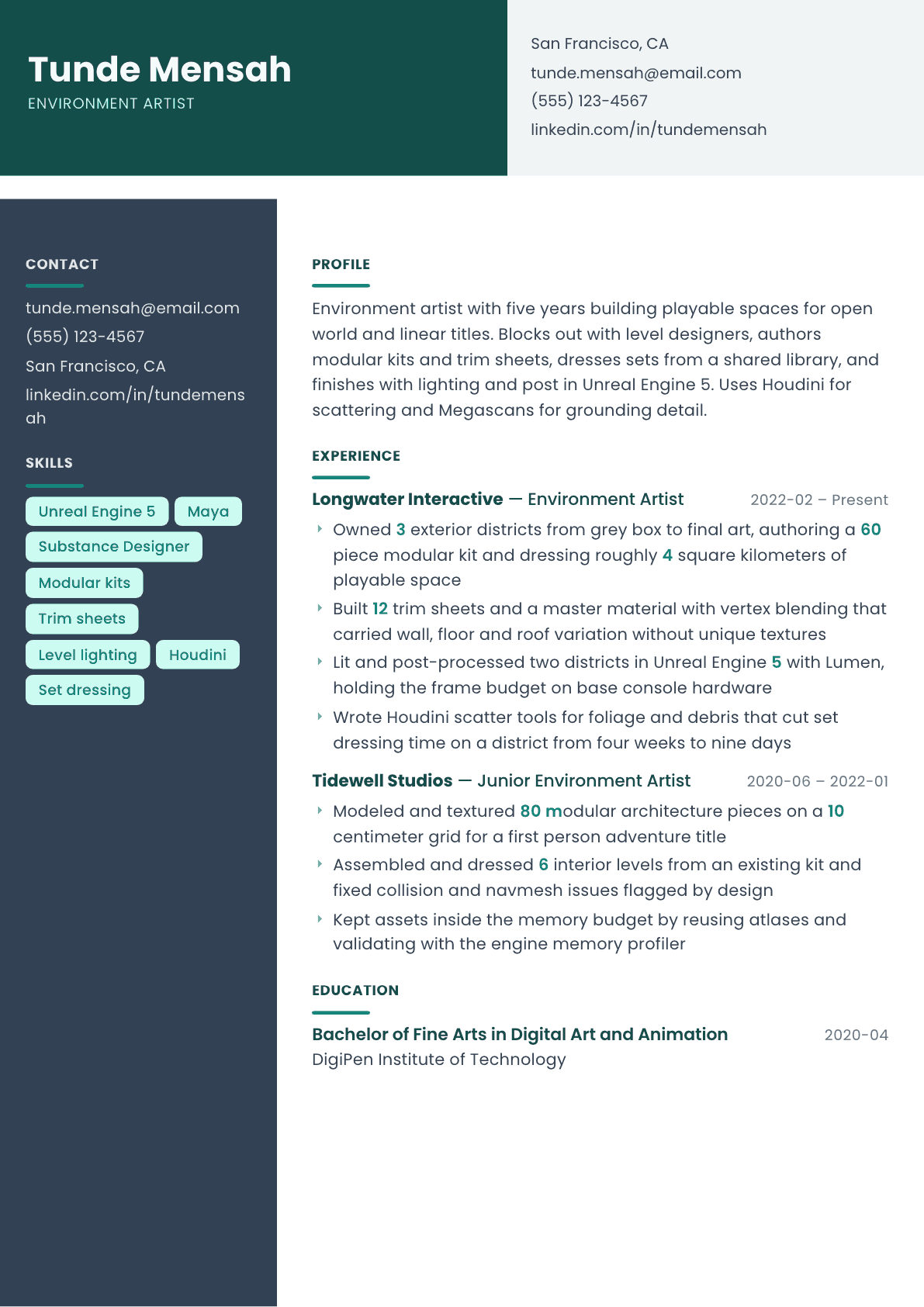
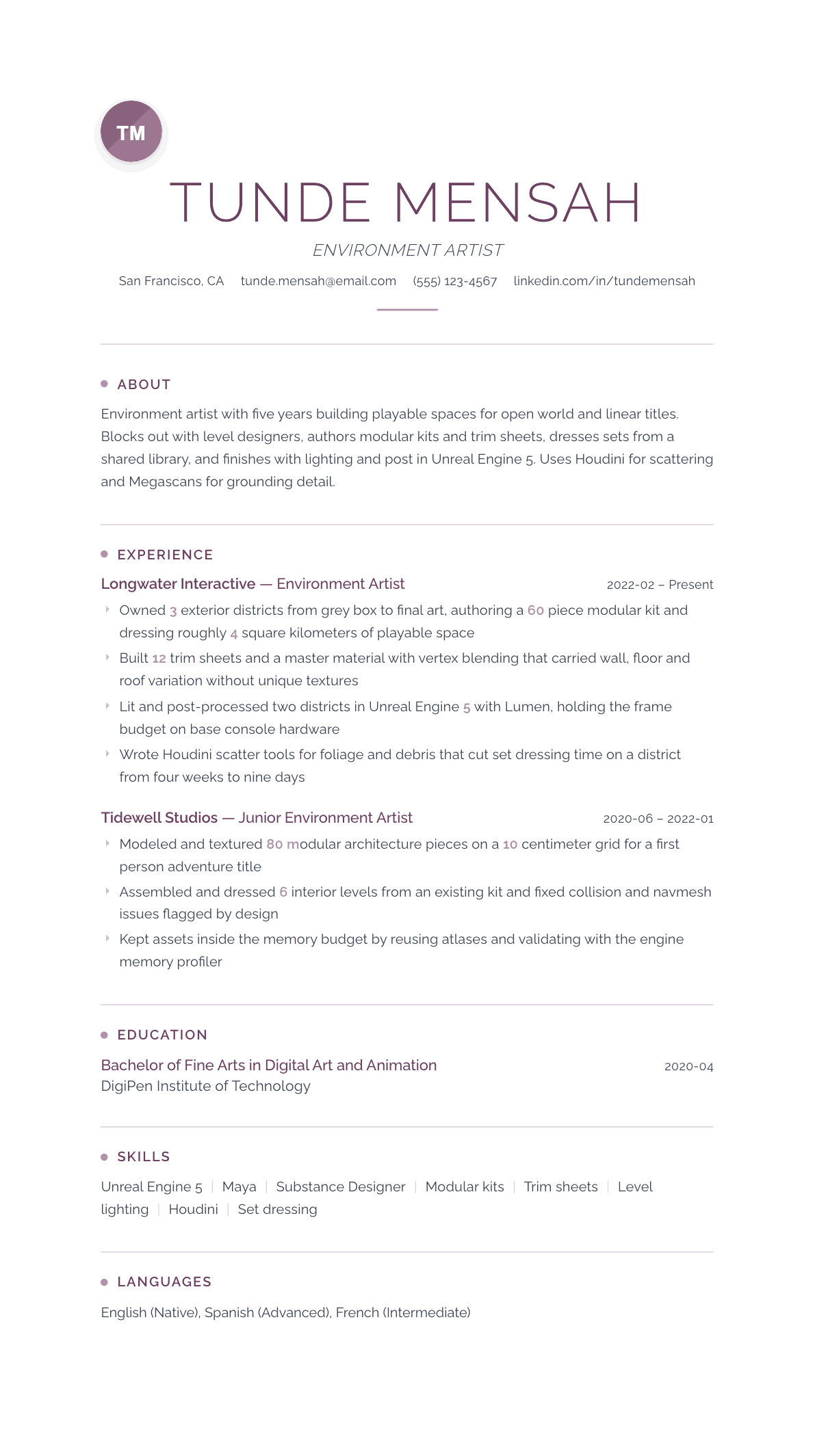
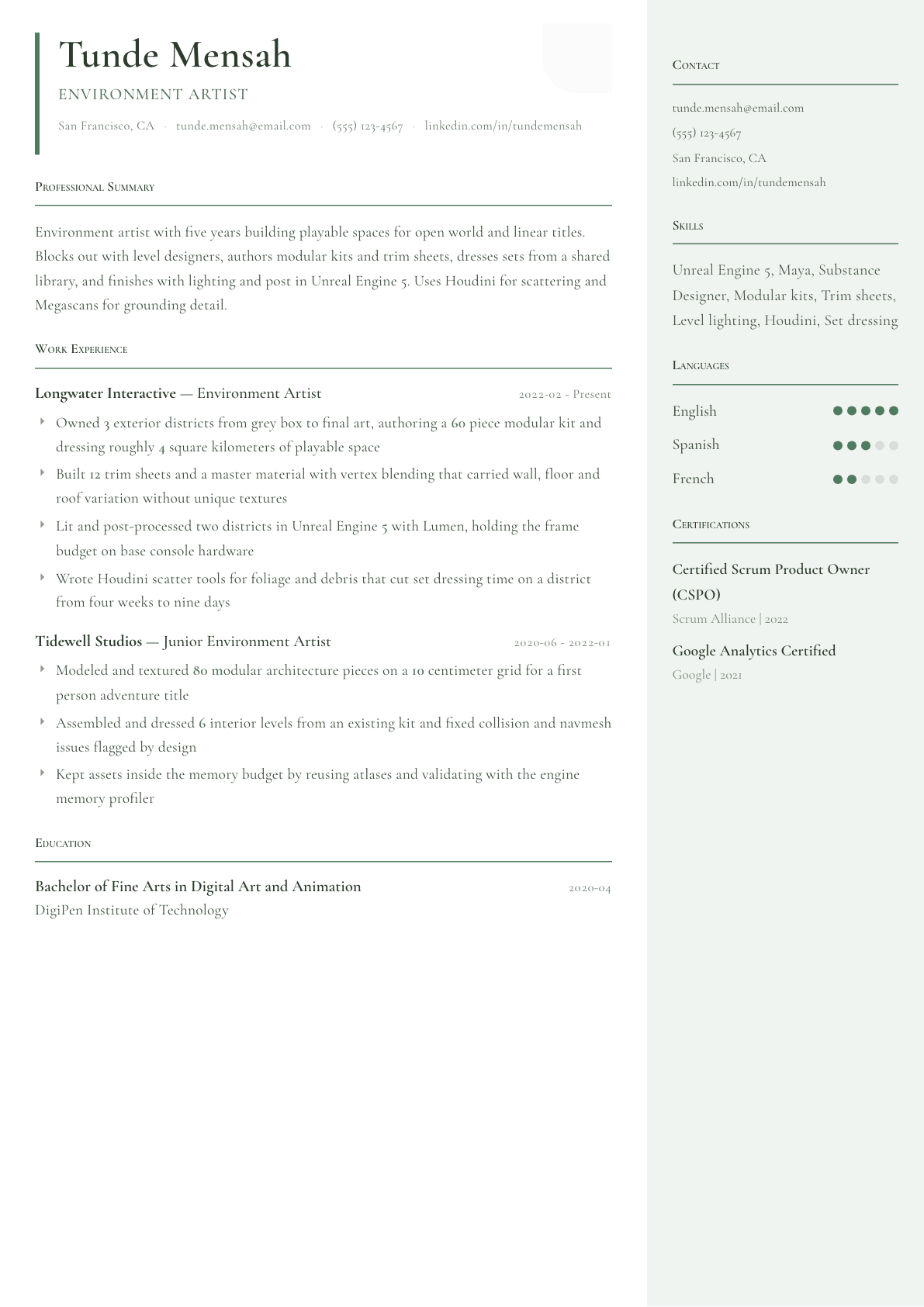
Example Environment Artist summary
Environment artist with five years taking playable spaces from grey box to final art on open world and linear titles. Authors modular kits and trim sheets, dresses sets, and lights levels in Unreal Engine 5 with Lumen while holding console frame budgets. Writes Houdini scatter tools for foliage and debris, and works closely with level design through every handoff.
Skills to list on a Environment Artist resume
- Unreal Engine
- Unity
- Maya
- Blender
- Substance Designer
- Substance Painter
- Houdini
- Modular kit building
- Trim sheets
- Level lighting
- Set dressing
- Megascans
- World building
- Optimization
- Material blending
What actually gets this resume read
- Show a full level, not loose props, because environment leads judge composition, readability and player flow.
- Name the engine and the lighting system you worked in, since Lumen, baked lightmaps and Unity HDRP differ in practice.
- Describe your modular approach with grid size, kit piece count, and how variation was created without new textures.
- Mention collaboration with level design, because grey box handoff is where most environment work actually starts.
- Include performance work such as memory budgets, draw call reduction, or LOD setup on target hardware.
- Add procedural tooling if you have it, since Houdini or Blueprint scatter tools separate you from a pure modeler.
How to write a environment artist resume
Environment art is judged on space, not on assets. A lead opening your portfolio is walking a level in their head, asking whether the composition guides the player, whether the silhouette reads at distance, whether the lighting sells the mood, and whether any of it could hold a frame budget on the target hardware. A folder of individual props answers none of that.
The resume is where you prove the parts of that job an image cannot show: the grid your kit was built on, how variation was created without new textures, the engine and lighting system you finished in, the profiling you did, and how you worked with level design from the gray box handoff onward.
This guide sets out the section order studios expect from an environment artist, three summaries across career stages, before and after bullets from real level work, and the questions artists ask when moving between engines, genres or from prop work into full environments.
Format: one page, portfolio link first, one full level visible
One page. Put the portfolio link on the first line of the header. What matters most is what the link opens onto: at least one complete environment presented as a walkthrough or a set of composed shots, with a breakdown showing the modular pieces, the trim sheets and the material setup behind it.
Keep the document plain and single column. Environment resumes get forwarded between the art lead, a technical artist and sometimes a level designer, and each of them is reading for something different in the same text.
- Header: name, portfolio link, city and time zone, email, and a note if any project is embargoed.
- Order: summary, software and pipeline, shipped titles, experience, education.
- Artists without a credit lead with a self-directed level built in a current engine and described with the same technical detail.
Summary: scale, engine, lighting, and tools
Two or three lines. Name the kind of space you build, whether that is open world exteriors, dense linear interiors, stylized worlds or realistic architecture. Then the engine and the lighting system you finish in, because a dynamic global illumination workflow and a baked lightmap workflow are different daily jobs.
Add procedural tooling if you have any. Scatter tools, material generators and asset instancing scripts separate an environment artist from a modeler who dresses sets by hand, and leads screen for it because it multiplies a small team.
Experience: districts and levels, not asset lists
Each role gets the studio, the project type and the platform. Then bullets scoped at the level of a space you owned: a district, an interior set, a biome, a hub. Give the area or the number of levels, the kit piece count, and how far you took it, from the gray box through set dressing to final lighting and post.
Modularity is the craft, so describe it precisely. The grid size the kit snaps to, the trim sheets you authored, the master material with vertex blending or layered surfaces, and how many unique textures the whole set actually needed. That paragraph is what convinces a lead you can build an environment that scales.
Then performance and collaboration. Memory budgets, draw call counts, instancing, LOD setup, occlusion, and the profiler you validated in. Add the handoff with level design, since gray box is where most environment work starts and where the worst arguments happen when nobody documents the intent.
- Give the grid size your modular kit was built on, in centimeters.
- Say whether you lit the level yourself or handed it to a lighting artist.
- Name the collision and navigation work you fixed, because designers remember who did.
Software and tooling: model, surface, engine, procedural
Group the stack in four bands. Modeling in Maya or Blender, surfacing in Substance Designer and Painter with scanned libraries such as Megascans, the engine you assemble and light in, and any procedural layer such as Houdini or in-engine blueprint tools. Presented that way, a lead can place you in their pipeline in seconds.
Be exact about the procedural claim. Writing that you authored a scatter tool for foliage and debris is checkable; saying you know Houdini is not. Environment teams lean on tool authors heavily, so a small verified tool is worth more than a large vague claim.
What an environment posting is scanning for
The vocabulary repeats across studios: modular kit, kit bashing, trim sheet, tileable material, vertex blending, decals, set dressing, world building, gray box, blockout, lighting pass, post process volume, LOD, occlusion culling, draw calls, memory budget. Use the terms you have earned once in your skills and again inside a bullet.
Genre words matter too. Open world work implies streaming, landscape layers and scatter density. Linear narrative work implies composition per beat, sightline control and heavy decal storytelling. Mirroring the right set signals you understand what the level actually has to do.
Environment Artist resume summary examples
Entry-level
Environment artist with one self-directed interior level built in Unreal Engine 5 from a 24 piece modular kit on a 10 centimeter grid, lit with dynamic global illumination and profiled on a mid tier graphics card. Comfortable in Maya, Substance Designer and Painter, and looking for a first studio role.
Five years in
Environment artist with five years taking playable spaces from blockout to final art on open world and linear titles. Authors modular kits and trim sheets, dresses sets, and lights in Unreal Engine 5 while holding console frame budgets. Writes Houdini scatter tools and works closely with level design at every handoff.
Senior environment artist
Senior environment artist with nine years and three shipped titles, owning biome direction across a large open world. Sets kit standards and material libraries, mentors two artists, and works with technical art on streaming, instancing and memory targets before any district reaches final art.
Work experience bullets: before and after
Before: Made environments for an open world game.
After: Owned three exterior districts from gray box to final art, authoring a 60 piece modular kit and dressing roughly four square kilometers of playable space.
District ownership, kit size and playable area describe scope in the terms a lead actually plans with.
Before: Created materials and textures for the level.
After: Built 12 trim sheets and a master material with vertex blending that carried wall, floor and roof variation across the district without unique textures per building.
It names the technique that produced variation, which is the whole craft of modular environment art.
Before: Did lighting for two levels.
After: Lit and post-processed two districts in Unreal Engine 5 with dynamic global illumination, holding the frame budget on base console hardware through reflection and shadow settings.
The lighting system, the hardware target and the budget make a lighting claim verifiable rather than decorative.
Before: Used Houdini to speed up set dressing.
After: Wrote Houdini scatter tools for foliage and debris that cut set dressing time on a district from four weeks to nine days and kept density consistent between artists.
The time saved and the consistency benefit show the tool served the team, not only your own shots.
Before: Built modular pieces for interiors.
After: Modeled and textured 80 modular architecture pieces on a 10 centimeter grid, then assembled six interior levels from the kit and fixed collision and navigation issues flagged by design.
The grid, the assembly work and the design fixes prove you finish spaces rather than hand over parts.
Hard skills
- Unreal Engine
- Unity
- Maya
- Blender
- Substance Designer
- Substance Painter
- Houdini
- Modular kit building
- Trim sheets and tileable materials
- Vertex blending and decals
- Level lighting and post process
- Set dressing and composition
- Megascans libraries
- Performance profiling
Soft skills
- Level design collaboration
- Composition judgment
- Scope estimation
- Receiving lead feedback
- Documentation of kit standards
- Mentoring junior artists
Certifications worth listing
- Unreal Authorized Instructor (Epic Games)
- Unity Certified Associate: Game Developer (Unity Technologies)
- Houdini Certified Trainer (SideFX)
Mistakes that cost environment artist candidates the interview
- Showing loose props instead of a complete space, which leaves composition, readability and player flow untested.
- Never naming the grid size or kit piece count, so a lead cannot judge whether your modular thinking is real.
- Presenting a level with no breakdown, which makes reviewers assume you assembled a purchased asset pack.
- Skipping performance work entirely, when memory and draw calls are half the daily conversation on a shipped title.
- Describing lighting without naming the system, since baked and dynamic workflows involve different skills.
- Leaving level design collaboration out, when the blockout handoff is where most environment work begins.
Environment Artist resume questions
What should an environment artist portfolio contain?
One or two complete spaces with a walkthrough, composed beauty shots, and a breakdown page showing the modular kit, trim sheets, material graphs and lighting setup. Individual props can support the level but should never lead the presentation.
Is it acceptable to use scanned or purchased assets in a portfolio level?
Yes if you say so clearly on the breakdown page. Studios use scanned libraries in production every day. What damages you is silence, because a reviewer who spots a recognizable asset assumes everything else is bought too.
How do I move from prop art into environment art?
Build one full space that uses your props inside a modular kit, light it, and profile it. The resume then leads with the level, and your prop history reads as the foundation rather than as the ceiling of what you do.
Do environment artists need Houdini?
It is not required, but procedural scatter and material tooling is common enough that it separates candidates on large worlds. If you have written even one working tool, describe what it produced and how much time it saved the team.
How do I describe work on a level that many artists touched?
Name your portion precisely: the kit you authored, the district you dressed, the lighting pass you owned. Environment work is always shared, and leads trust a specific smaller claim far more than an implied ownership of the whole map.