3D Artist Resume Examples: free ATS score and gap list
Create a 3D Artist Resume That Stands Out
By Mustafa Tarabya, founder of CVBooster · Published · Updated
Build a 3D artist resume showcasing your modeling, texturing, and rendering expertise with templates designed for creative professionals.
Sample resumes for a 3d artist
The same 3d artist content laid out in three CVBooster templates, so you can see what the finished document looks like before you write a word.
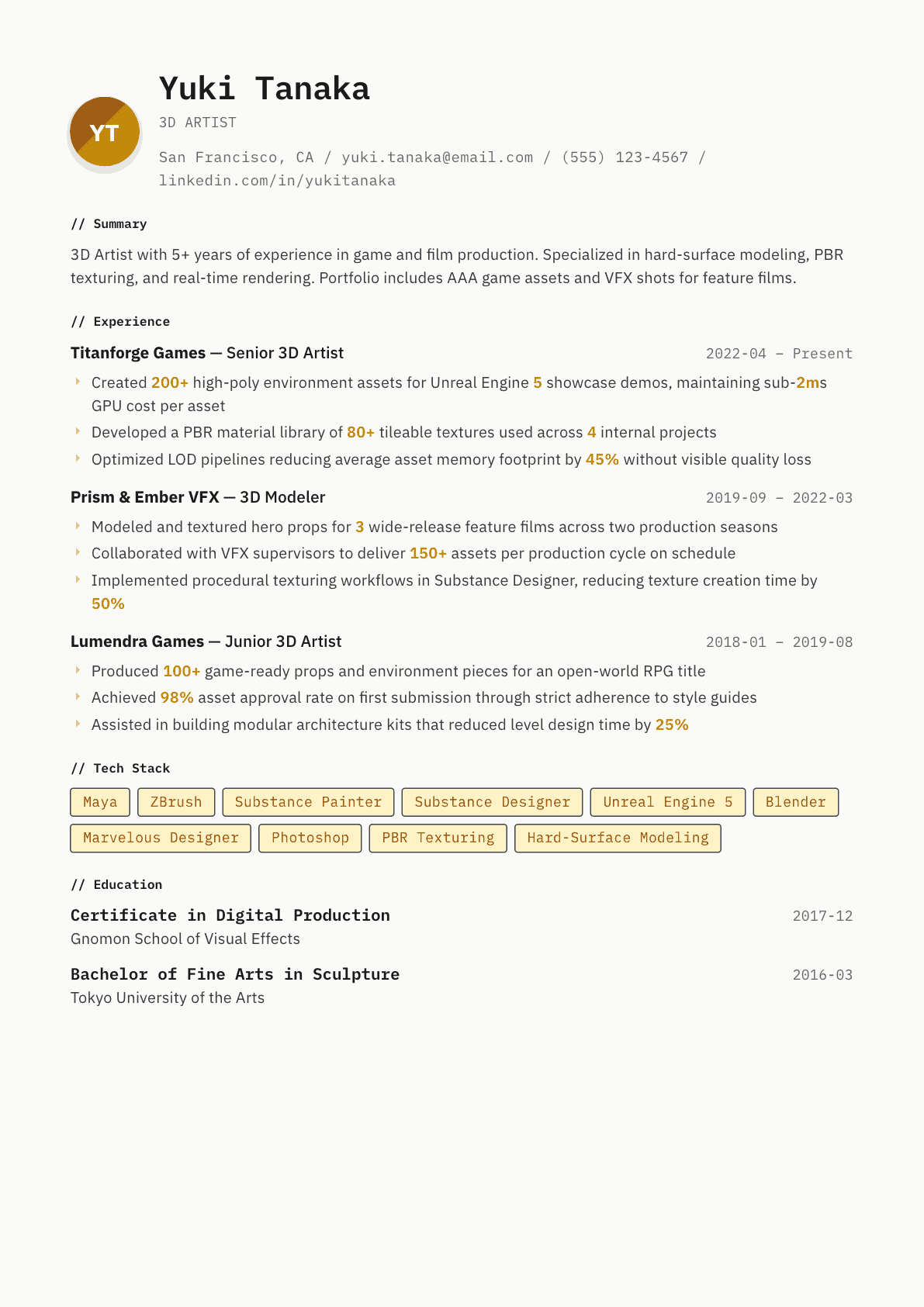
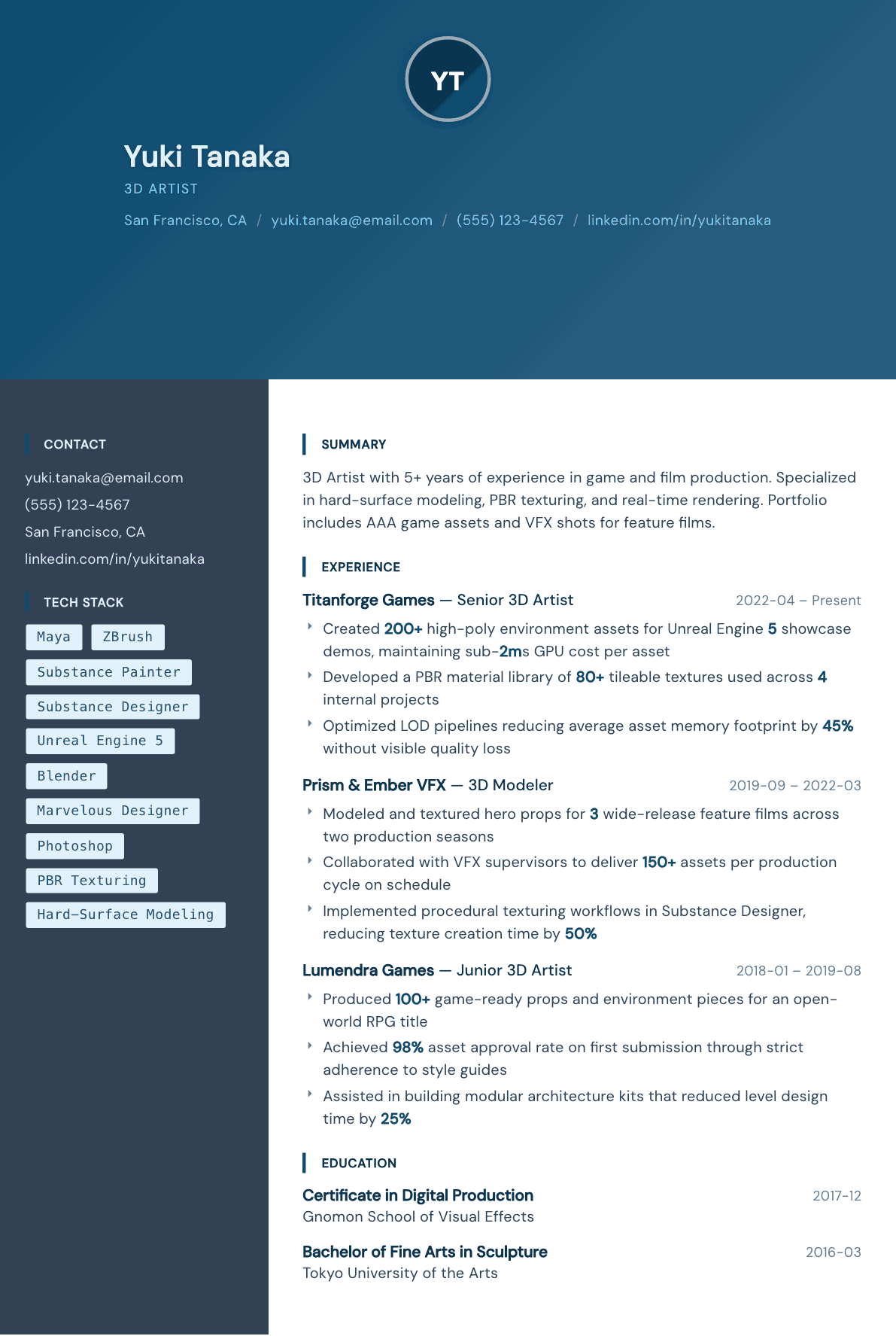
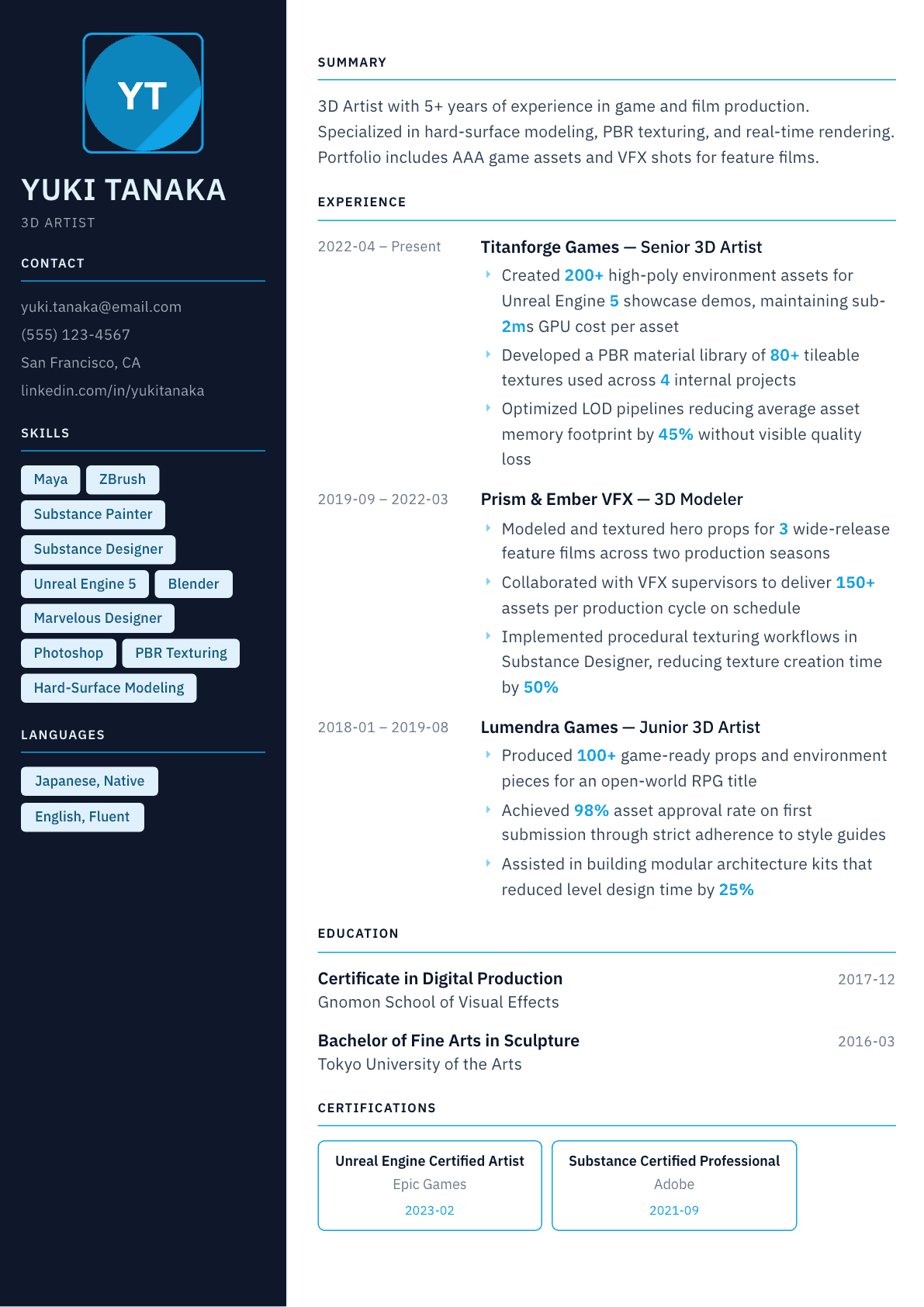
Example 3D Artist summary
3D Artist with 5 years across game and VFX production, working in Maya, ZBrush, and Substance. Built 500+ production assets for AAA titles and feature films, and cut average asset memory footprint 45% through LOD and retopology work. Strongest in hard-surface modeling and procedural texturing.
Skills to list on a 3D Artist resume
- Maya
- ZBrush
- Blender
- Substance Painter
- Substance Designer
- Unreal Engine
- Unity
- Houdini
- Marvelous Designer
- PBR Texturing
- Hard-Surface Modeling
- Organic Modeling
- UV Unwrapping
- Retopology
- Lighting & Rendering
What actually gets this resume read
- Link to your ArtStation or portfolio with rendered turntables and breakdowns for every major piece.
- Specify polygon counts, texture resolutions, and engine targets to demonstrate technical precision.
- Highlight the tools in your pipeline: Maya, ZBrush, Substance, Marvelous Designer, Unreal, etc.
- Mention optimization skills -- LODs, draw call budgets, memory footprints -- especially for game roles.
- Include any shipped titles, released films, or published projects by name for instant credibility.
- Show collaborative skills: working with art directors, animators, and technical artists.
How to write a 3d artist resume
For a 3D artist, the reel or portfolio decides the hire and the resume decides whether anyone opens the reel. That is the whole relationship between the two documents. A recruiter at a game studio or a visual effects house scans your page for the specialization, the engine or renderer, the pipeline position, and the shipped credits, then clicks the link if those line up with the open seat.
The word generalist is the most common self description on these resumes and the least useful one. Studios post for hard surface modelers, character artists, environment artists, look development artists, texture artists and lighting artists, and each one is judged on different work. Naming your specialization first, then your range, is what gets your link opened by the right lead.
This guide covers the layout art recruiters expect, how to present the portfolio and breakdowns, how to write technical constraints so a lead believes you can hit budget, three summaries from junior to senior, before and after bullets, and the questions 3D artists ask when they rewrite their resume.
Format: one page, portfolio link in the header
One page, always. The header carries your name, the specialization as a job title, your location and time zone or relocation status, and the portfolio link written out in full so it survives a printed or forwarded copy. If your work lives in more than one place, pick the single strongest link and put a second line only for a reel with a shot breakdown.
A 3D artist resume can be visually designed, but keep the text in a single readable column and avoid burying the software list inside a graphic, since studio applicant tracking systems still index text. Restrained typography and a small piece of your own work in the corner reads better to an art lead than a template full of skill rating circles, which artists consistently distrust.
- Header: name, specialization, city and time zone, email, portfolio link, and whether you need visa sponsorship for the region you are applying to.
- Sections in this order: summary, software and pipeline, experience with credits, education, and a short section for personal or contract work if it is stronger than your studio work.
- Name the target discipline in the file name of the resume, since recruiters sort a folder of attachments before opening them.
Software and pipeline: what you use and where you sit
Group software by what it does rather than listing it alphabetically. Modeling and sculpting, texturing and materials, layout and scene assembly, rendering and lighting, and pipeline scripting are the categories a lead reads. Within each, put the tools you would be trusted on unsupervised first, and drop anything you touched once, because an interview will find it.
Say where in the pipeline you sit. An artist who takes concept art to a final textured asset, one who retopologizes and unwraps scans, one who does look development against a lighting rig, and one who assembles and lights a shot are four different hands. Naming the handoff you receive and the handoff you deliver tells a lead exactly which seat you fill.
Real time and offline are still different worlds and the resume should say which one you live in. Engine work carries budgets and constraints, film and animation work carries subdivision, displacement and render time. Artists who have worked both should say so, because those candidates are genuinely scarce.
Experience: credits, asset counts, and the constraint you worked inside
Every studio job needs the project by name where the credit is public, the platform or format, your discipline on it, and what you personally delivered. Studios verify credits, so name only what you can point to in a shot or an asset. For unreleased or covered work, describe the genre and scale without breaking the agreement, and say the title is under wraps.
The strongest bullets carry the constraint. Triangle and texture memory budgets, level of detail chains, draw call and material count targets, subdivision levels, UV shell and texel density standards, render time per frame, and the review cycle you delivered against. A lead reads constraints as proof you can work inside a real production instead of a personal project where nothing is capped.
Add pipeline contribution if you have it. A tool you scripted, a naming and file structure convention you enforced, a procedural material library other artists used, or a scan cleanup workflow you documented. Studios promote artists who make the rest of the team faster.
Portfolio and reel: what the resume should say about it
The resume should tell the lead what they will find before they click. One line under each major project naming what in the portfolio is yours prevents the single worst outcome, which is a lead assuming a team piece is entirely your work and then discovering otherwise in the interview.
For reels, say the length and that a breakdown is included. Leads want to know what was modeled, what was textured, what was lit and what came from a library. Honest breakdowns are a selling point and dishonest ones end candidacies, because the community is small and the artists who made the other parts are often in the room.
Keywords studio recruiters actually search
Recruiters search by discipline and tool: hard surface, character art, environment art, look development, texturing, lighting, retopology, unwrapping, sculpting, physically based materials, procedural texturing, level of detail authoring, and the named applications and engines. Put the specialization words in the summary and in at least one experience bullet.
Do not build a wall of software logos or a tag list with no context. Studios read tools as capabilities attached to work, and a list without a project behind it is treated as familiarity rather than fluency.
3D Artist resume summary examples
Junior artist
Junior 3D artist focused on hard surface props and environment kits, with a portfolio of 12 game ready assets built from concept through physically based texturing in a real time engine. Comfortable with retopology, unwrapping and level of detail authoring to a set triangle budget.
Four to six years in
3D environment artist with 5 years across two shipped console titles, building modular kits, trim sheets and set dressing to memory and draw call budgets. Strong in sculpting, procedural texturing and engine assembly, and comfortable taking a block out from a level designer to final art.
Senior or lead
Senior 3D artist with 10 years in games and episodic visual effects, specializing in hard surface and look development. Set asset standards and review checklists for a team of 8, authored the studio material library, and mentored 4 juniors from first asset to independent delivery.
Work experience bullets: before and after
Before: Created 3D models for video games.
After: Built modular environment kits and trim sheets for an open world title, holding each hero prop under a set triangle budget with a three step level of detail chain and shared material slots.
The asset type, budget and level of detail work show a lead you can hit performance targets rather than only make things look good.
Before: Textured assets in Substance Painter.
After: Authored physically based texture sets in a procedural workflow, baking from high poly sculpts and building reusable smart materials that the rest of the environment team pulled from.
The word reusable turns personal output into team leverage, which is what earns a senior title.
Before: Worked with the art director on feedback.
After: Delivered assets through weekly art reviews, taking direction on silhouette and material breakup and turning around revisions within the same sprint without slipping the level lock date.
A named review cadence and a schedule outcome show a lead you are easy to run, which matters as much as raw skill.
Before: Optimized assets for better performance.
After: Cut memory footprint on a set of hero props by consolidating texture sets, packing masks into single maps and rebuilding the level of detail chain, with no visible loss at gameplay camera distance.
Three specific optimization techniques and a quality condition prove real technical judgment instead of a claim to be efficient.
Before: Helped junior artists on the team.
After: Wrote the asset checklist covering naming, pivot placement, texel density and export settings, and ran the first pass review on every junior submission for two production cycles.
A written standard and an ongoing review duty are evidence of leadership rather than casual help.
Hard skills
- Hard surface modeling
- Organic sculpting
- Retopology
- UV unwrapping and texel density
- Physically based texturing
- Procedural material authoring
- High to low poly baking
- Level of detail authoring
- Lighting and look development
- Real time engine asset assembly
- Trim sheets and modular kits
- Photogrammetry and scan cleanup
Soft skills
- Taking art direction without ego
- Estimating asset time honestly
- Written breakdowns of your own work
- Working to a lock date
- Peer review of other artists
Mistakes that cost 3d artist candidates the interview
- Calling yourself a generalist on the first line, which leaves the lead unsure which open seat to read you for.
- Sending a portfolio link with no breakdown, so team pieces read as either dishonest or unreadable.
- Listing twenty applications with no project behind any of them, which reads as familiarity rather than fluency.
- Leaving out budgets and constraints, the fastest way to look like a hobbyist to a production lead.
- Using skill rating bars, which artists and leads treat as decoration since nobody agrees what four out of five means.
- Naming a shipped title you only touched at the margins, in an industry small enough that the credit gets checked in conversation.
3D Artist resume questions
How long should a 3D artist resume be?
One page, no exceptions. The portfolio carries the evidence and the resume carries the context. If you have a long credit list, keep the last three studios in full and compress the rest into a single line of earlier credits with project names only.
Should I design my resume or keep it plain?
A restrained, well typeset page shows taste and is welcome. Keep one text column, avoid burying the tool list inside an image, and skip rating bars. The resume proves you can be clear, and the portfolio proves you can make things.
How do I list work covered by a nondisclosure agreement?
Describe the genre, platform and your discipline without naming the title, and note that it is unannounced. Recruiters see this constantly and it costs you nothing. Never post covered images in a public portfolio, since that ends candidacies faster than a thin reel.
What goes on a 3D artist resume with no studio experience?
Put the portfolio first and treat personal projects as production. Give each piece the constraint you set, the pipeline you followed and the tools used. Add contract or freelance work, game jams, mod work and any asset store or marketplace releases with download or sales evidence.
Do I need certifications as a 3D artist?
No. Hiring in this field runs on the portfolio, credits and a technical interview. Software certificates rarely change an outcome. Spend the time on one more finished, well presented piece with a breakdown instead, since that is what a lead is actually deciding on.