Motion Graphics Designer Resume Examples: free ATS score
Craft a Motion Graphics Designer Resume That Wows Recruiters
By Mustafa Tarabya, founder of CVBooster · Published · Updated
Build a motion graphics designer resume that highlights your animation skills, creative storytelling, and technical mastery with industry-tuned templates.
Sample resumes for a motion graphics designer
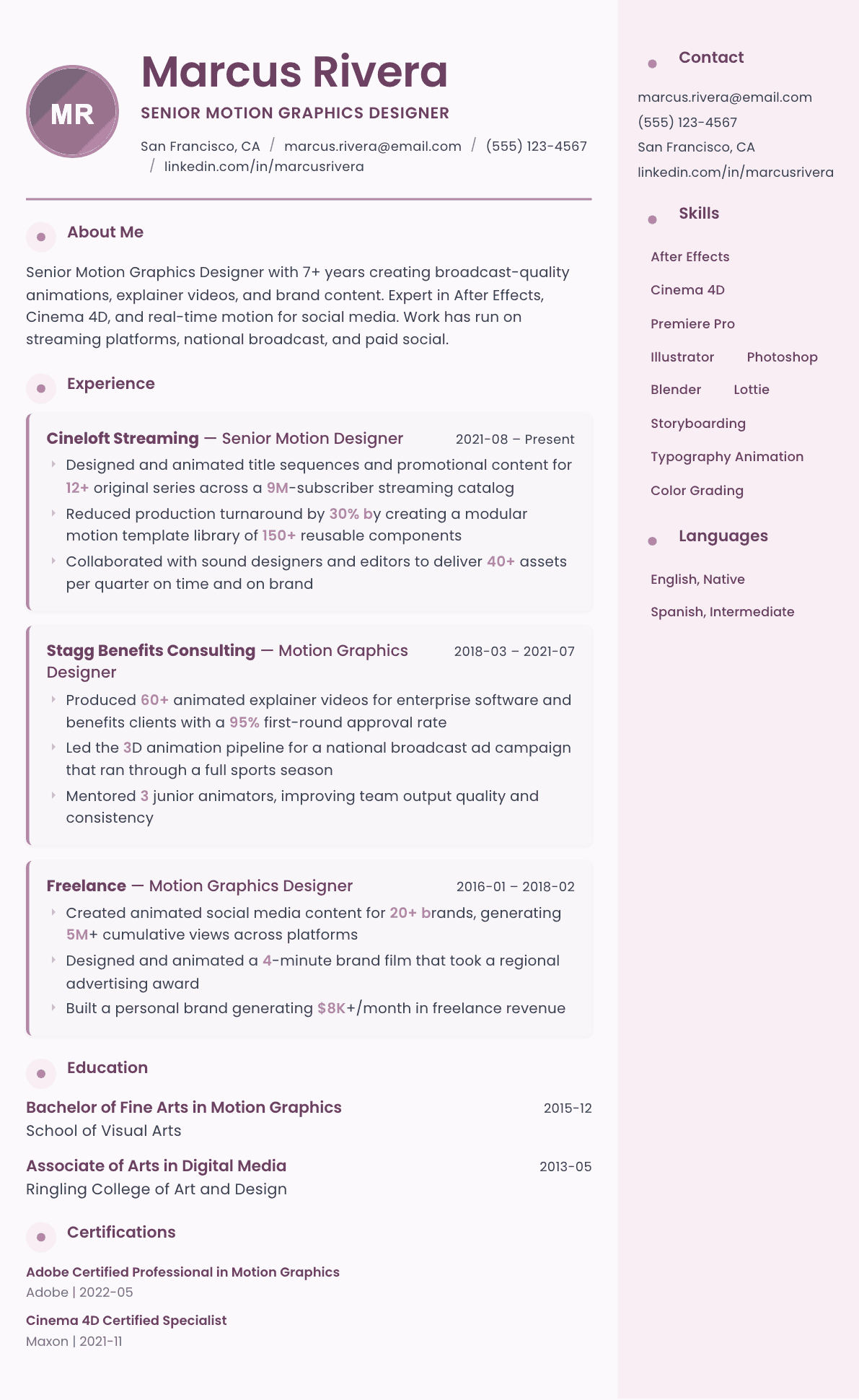
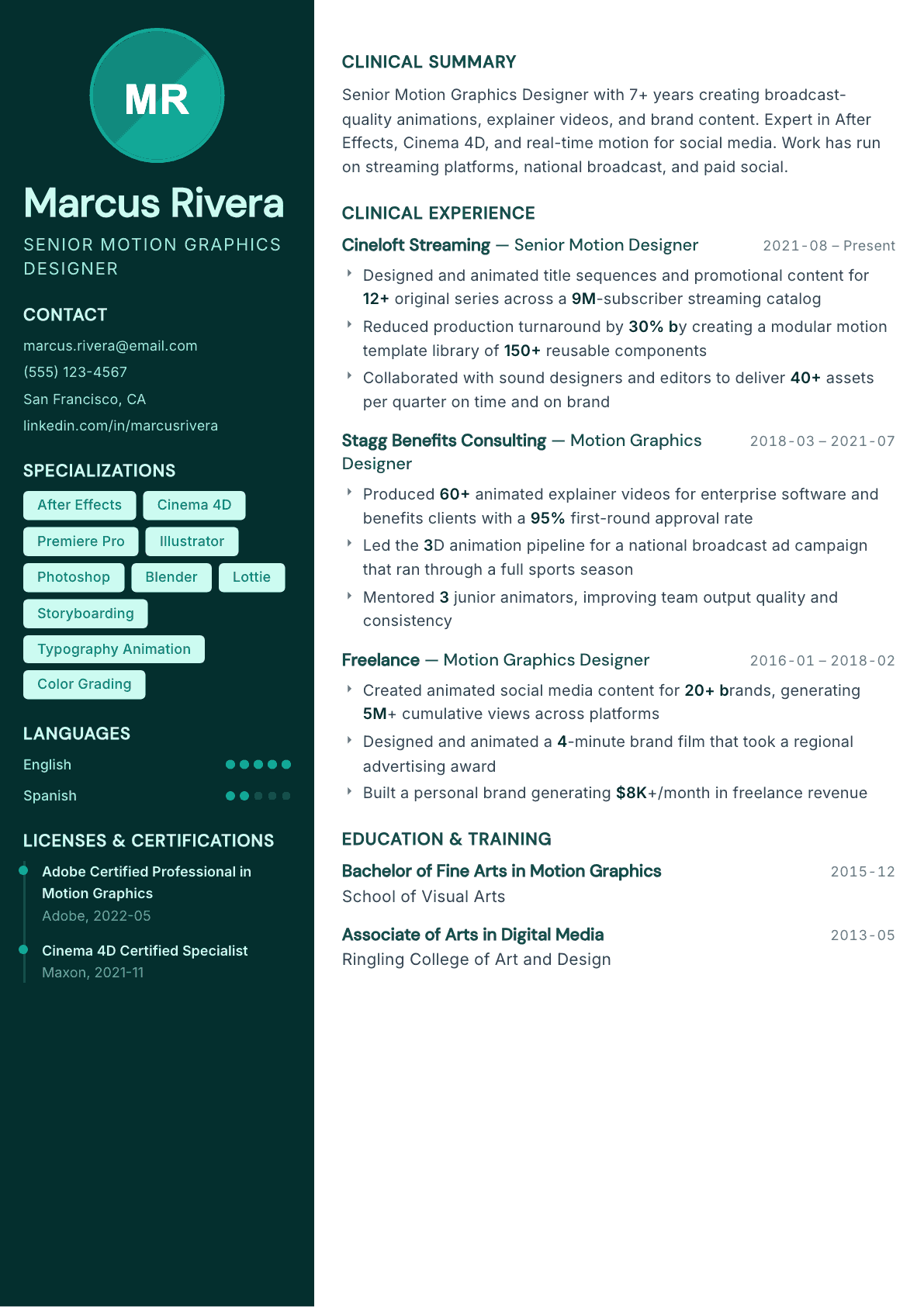
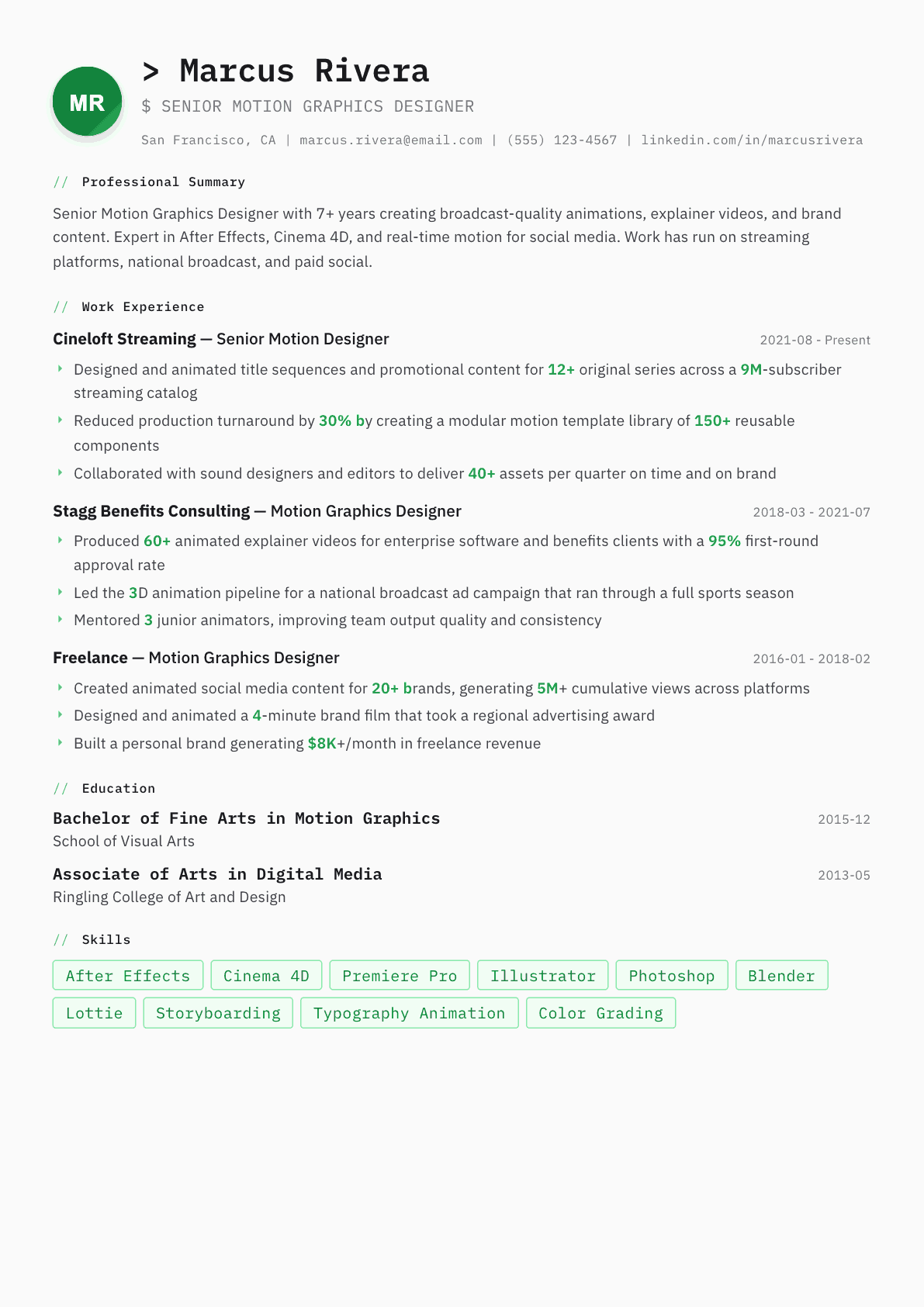
The same motion graphics designer content laid out in three CVBooster templates, so you can see what the finished document looks like before you write a word.
Example Motion Graphics Designer summary
Award-winning Motion Graphics Designer with 7 years of experience producing broadcast and digital animations for top-tier brands. Expert in After Effects, Cinema 4D, and real-time social content. Delivered 100+ projects with a 96% on-time rate and 5M+ cumulative views.
Skills to list on a Motion Graphics Designer resume
- After Effects
- Cinema 4D
- Blender
- Premiere Pro
- Illustrator
- Photoshop
- Houdini
- Lottie / Bodymovin
- Storyboarding
- Typography Animation
- Color Theory
- Video Compositing
- Character Animation
- 3D Rendering
What actually gets this resume read
- Always link to your demo reel or portfolio site -- hiring managers want to see your work in motion.
- Quantify output: number of projects delivered, view counts, turnaround improvements, or campaign reach.
- List both 2D and 3D tools you use (After Effects, Cinema 4D, Blender, Houdini) to show versatility.
- Highlight collaboration with directors, editors, and sound designers to show you work well in production teams.
- Mention any award-winning or high-profile campaigns to stand out immediately.
How to write a motion graphics designer resume
A motion graphics designer is hired off the reel, and the reel is judged in the first ten seconds. What the resume has to do is answer the questions the reel cannot: which parts of those shots you personally made, whether you can design as well as animate, whether you work in two dimensions or three, how fast you turn work around, and whether you can hold to somebody else brand system rather than only your own taste.
That last point separates the field. Studio work rewards craft and invention. In-house and agency work rewards a designer who can produce fifty campaign cutdowns to spec, build a template a marketing team can fill in without breaking it, and hand animation to a developer or a broadcast playout system in the right format. The strongest resumes make clear which environment the candidate belongs in.
This guide covers how to structure the document around a reel, how to describe motion work so a reader knows what you touched, three summaries at different levels, before and after bullets, and the questions motion designers ask about three-dimensional tools, reel breakdowns and moving between agency and in-house work.
Format: reel link first, then a short focused page
The reel link is the most important element on the page and belongs in the header next to the email. The reel itself should run about a minute, open with the strongest shot, carry no long title card, and be hosted somewhere that plays immediately without an account.
Under the reel link, add a line pointing to the reel breakdown. A breakdown document listing each shot with the client, the role you played and the tools used is standard in motion, and creative directors read it carefully because reels routinely include work the candidate only partly made.
- Header: name, discipline line such as "Motion Designer, 2D and Cel", city, email, reel link, breakdown link.
- Order: summary, experience, selected projects, tools, education, awards.
- Freelancers group clients under one heading with the date range rather than listing every job.
- Keep it to one page unless you have directed and staffed projects.
Summary: what you design, what you animate, and how fast
Say whether you design frames as well as animate them, since many motion designers can only do one and studios staff for both. Name the work type: broadcast package and brand identity in motion, explainer and product storytelling, social and campaign cutdowns, interface and product animation, title sequences, or event and environmental screens.
Add the dimensional split honestly. A designer working in After Effects with occasional Cinema 4D is not the same hire as one who lights, textures and renders in a full three-dimensional pipeline, and both get work as long as the resume is clear.
Experience: volume, turnaround and where the work played
For each role, give the team shape and the output. Whether you were the only motion designer supporting a marketing team, one of six in a studio, or a freelancer rotating through agencies changes how a reader interprets every project underneath. Add the throughput: pieces per month, campaign sizes, cutdown counts and typical turnaround.
Then describe your part in the pipeline: style frames and design boards, storyboarding and animatics, rigging and animation, three-dimensional modeling and lighting, compositing and cleanup, sound and music selection, and final delivery. Naming these stages tells a creative director which seat to put you in.
Say where the work played and to what specification. Broadcast graphics with a safe-title and playout specification, in-cinema delivery, social platform aspect ratios and duration limits, interface animation exported for engineering, or trade show screens at unusual pixel dimensions. Delivery discipline is a hiring criterion because a beautiful file in the wrong format is a missed air date.
Tools: two dimensional, three dimensional, and the handoff
Group the tools. After Effects with its expression and scripting layer sits at the center of most workflows, with Illustrator and Photoshop supplying artwork and Premiere Pro handling assembly. Cinema 4D, Blender and Houdini cover the three-dimensional side, and Redshift, Octane or a similar renderer belongs beside whichever one you use.
Then the handoff tools that get overlooked and get people hired: exporting Lottie for interface animation, building templates in Essential Graphics for editors and non-designers to fill, working with render farms and version control on long jobs, and delivering to a broadcast or platform specification. Add cel animation and rigging tools if you use them, since character work is a distinct discipline.
- Two dimensional: After Effects, expressions, shape layers, cel animation, rigging.
- Three dimensional: Cinema 4D, Blender, Houdini, lighting, texturing, physical simulation.
- Design: Illustrator, Photoshop, Figma, style frames and design boards.
- Delivery: Lottie export, Essential Graphics templates, codecs and broadcast specifications.
Reel breakdown: the document that decides the hire
Write the breakdown as a plain list, one line per shot: the project, the client or studio, the year, your specific role, and the tools. If you animated somebody else design, say so. If you built the style frames and someone else animated, say that too. Creative directors respect an honest breakdown far more than a vague one, and they always ask in the interview.
Keep the reel and the breakdown in sync, and update both together. A reel with shots that do not appear in the breakdown reads as padding, and a breakdown claiming more than the reel shows is the fastest way to lose a job at the second interview.
Motion Graphics Designer resume summary examples
Junior motion designer
Junior motion designer with a design degree and a year of agency internships, animating social and campaign work in After Effects from supplied brand artwork. Builds style frames in Illustrator, cuts in Premiere Pro, and has produced a set of vertical and square cutdowns for two consumer clients.
Five years in
Motion designer with five years in-house at a software company, designing and animating product explainers, launch films and interface motion. Works in After Effects with Cinema 4D for product renders, exports Lottie animation for the engineering team, and maintains the motion section of the brand guidelines.
Senior designer or motion lead
Senior motion designer with eleven years across studio and broadcast work, leading teams of three to five on brand identity packages and title sequences. Designs style frames, directs animation, manages three-dimensional rendering pipelines, and delivers to broadcast and platform specifications on fixed air dates.
Work experience bullets: before and after
Before: Created motion graphics for marketing campaigns.
After: Designed and animated a launch campaign of six hero films with 40 cutdowns across vertical, square and wide formats, delivering each to the duration and aspect requirements of four platforms.
Asset counts, formats and platform specification show the real production load behind campaign work.
Before: Made an explainer video for a product.
After: Built a 90-second product explainer end to end: script collaboration, storyboard, style frames, cel and shape-layer animation in After Effects, and a mixed sound pass with licensed music.
Walking the reader through the full pipeline proves you can own a piece rather than execute one stage.
Before: Used Cinema 4D for 3D elements.
After: Modeled, lit and rendered product hero shots in Cinema 4D with Redshift, then composited passes in After Effects to match the campaign color and lighting direction.
Naming the renderer, the passes and the compositing step distinguishes real three-dimensional work from a preset scene.
Before: Helped other teams create their own videos.
After: Built ten Essential Graphics templates for the content team, locking type, color and timing to the brand system so non-designers could produce on-brand social videos without a design request.
A template system that removes requests is a workload change a hiring manager can feel.
Before: Animated interface elements for the app.
After: Designed interface motion for onboarding and empty states, exported the animation as Lottie files, and worked with engineering to tune timing and file size on lower-end devices.
The export format and the performance conversation show real product motion work rather than a mockup.
Hard skills
- Adobe After Effects
- Expressions and scripting in After Effects
- Cinema 4D
- Blender
- Redshift or Octane rendering
- Style frames and design boards
- Storyboarding and animatics
- Cel animation and rigging
- Compositing and rotoscoping
- Typography in motion
- Lottie export for product animation
- Essential Graphics templates
- Adobe Illustrator and Photoshop
- Broadcast and platform delivery specifications
Soft skills
- Working inside a brand system
- Presenting style frames for approval
- Estimating animation time accurately
- Taking direction on timing and feel
- Collaborating with editors and sound
- Staying calm against an air date
Certifications worth listing
- Adobe Certified Professional, After Effects (Adobe)
- Maxon Certified Trainer, Cinema 4D (Maxon)
Mistakes that cost motion graphics designer candidates the interview
- Sending a reel with no breakdown, which leaves a creative director unable to tell what you personally made.
- Opening the reel with a long logo animation of your own name instead of the strongest shot.
- Claiming design and animation equally when you only do one, which becomes obvious in the first test brief.
- Leaving out delivery detail such as aspect ratios, codecs and platform specifications, the part that breaks air dates.
- Hosting the reel somewhere that requires an account or plays badly on a phone.
- Listing every three-dimensional package without saying which one you actually build and render in.
- Describing campaign work without the asset counts, so a manager cannot judge whether you can carry the volume.
Motion Graphics Designer resume questions
How long should a motion graphics reel be?
Around a minute. Open with your best shot, cut fast, and stop before it repeats itself. A short reel of strong work beats three minutes that includes filler, because the reviewer forms a judgment in the first few seconds and rarely revises it upward.
What should a motion designer reel breakdown include?
One line per shot with the project, the client or studio, your specific role and the tools used. Say plainly when you animated somebody else design or only built style frames. Honest breakdowns build trust and are always checked in interviews.
Do motion designers need 3D skills?
Not universally, but three-dimensional work widens the jobs available, especially in product and broadcast. Being genuinely capable in After Effects with basic Cinema 4D is a strong profile; claiming a full three-dimensional pipeline you cannot run is not.
How do I move from agency to in-house motion design?
Emphasize the parts in-house teams need: working inside brand guidelines, high asset volume, template building and delivery to platform specifications. In-house teams worry that agency designers want invention over consistency, so answer that concern directly.
Should a motion designer resume include the tools used per project?
Keep the resume clean and put tool detail in the reel breakdown, where a reader expects it. A single grouped tools section on the resume is enough, since per-project detail there crowds out the scale and outcome information.