Concept Artist Resume Examples: the lines they read
Write a Concept Artist Resume That Sells Your Visual Thinking
By Mustafa Tarabya, founder of CVBooster · Published · Updated
A concept artist resume guide covering portfolio placement, production keywords, a realistic sample, and what art directors look for in bullets.
Sample resumes for a concept artist
The same concept artist content laid out in three CVBooster templates, so you can see what the finished document looks like before you write a word.
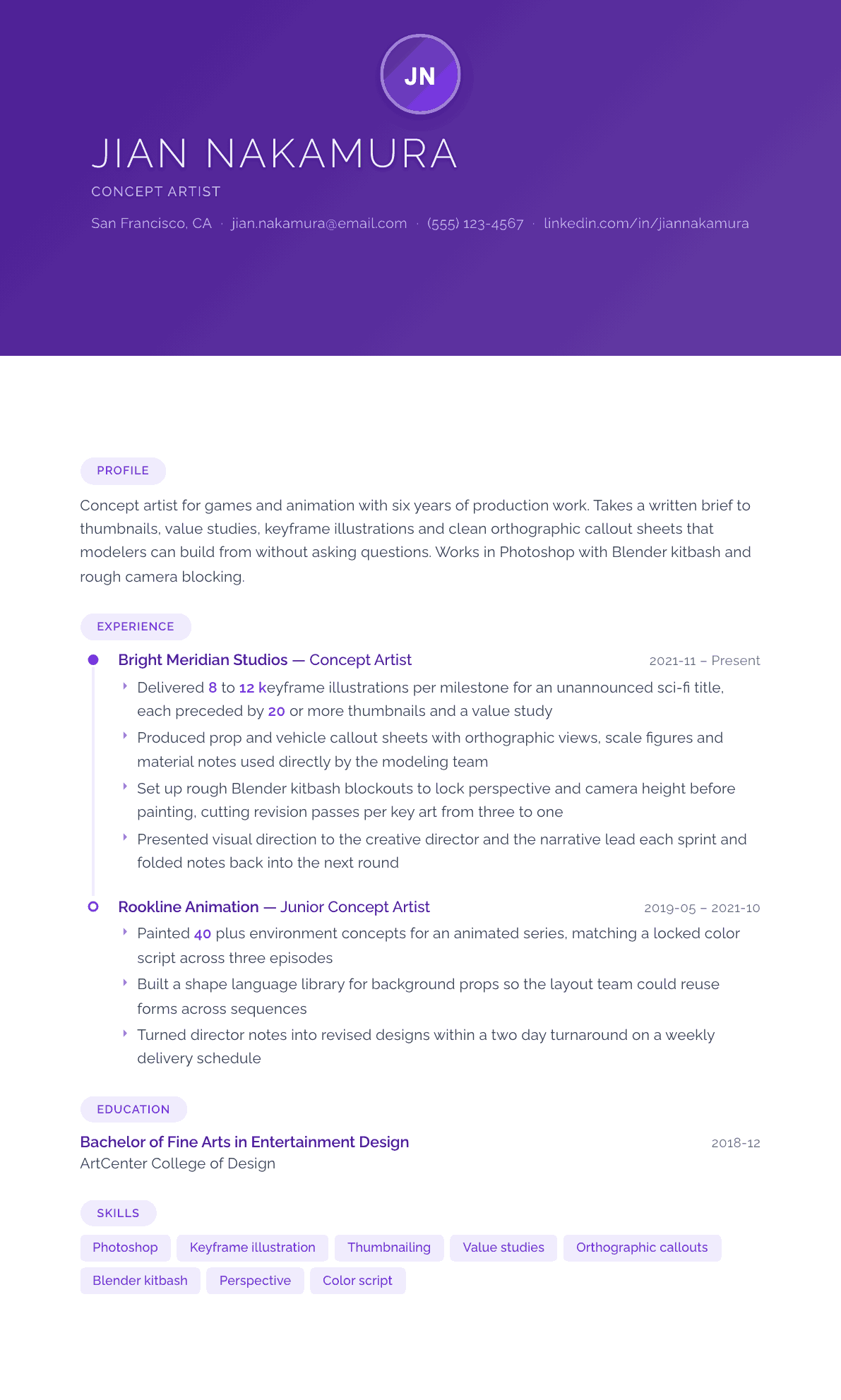
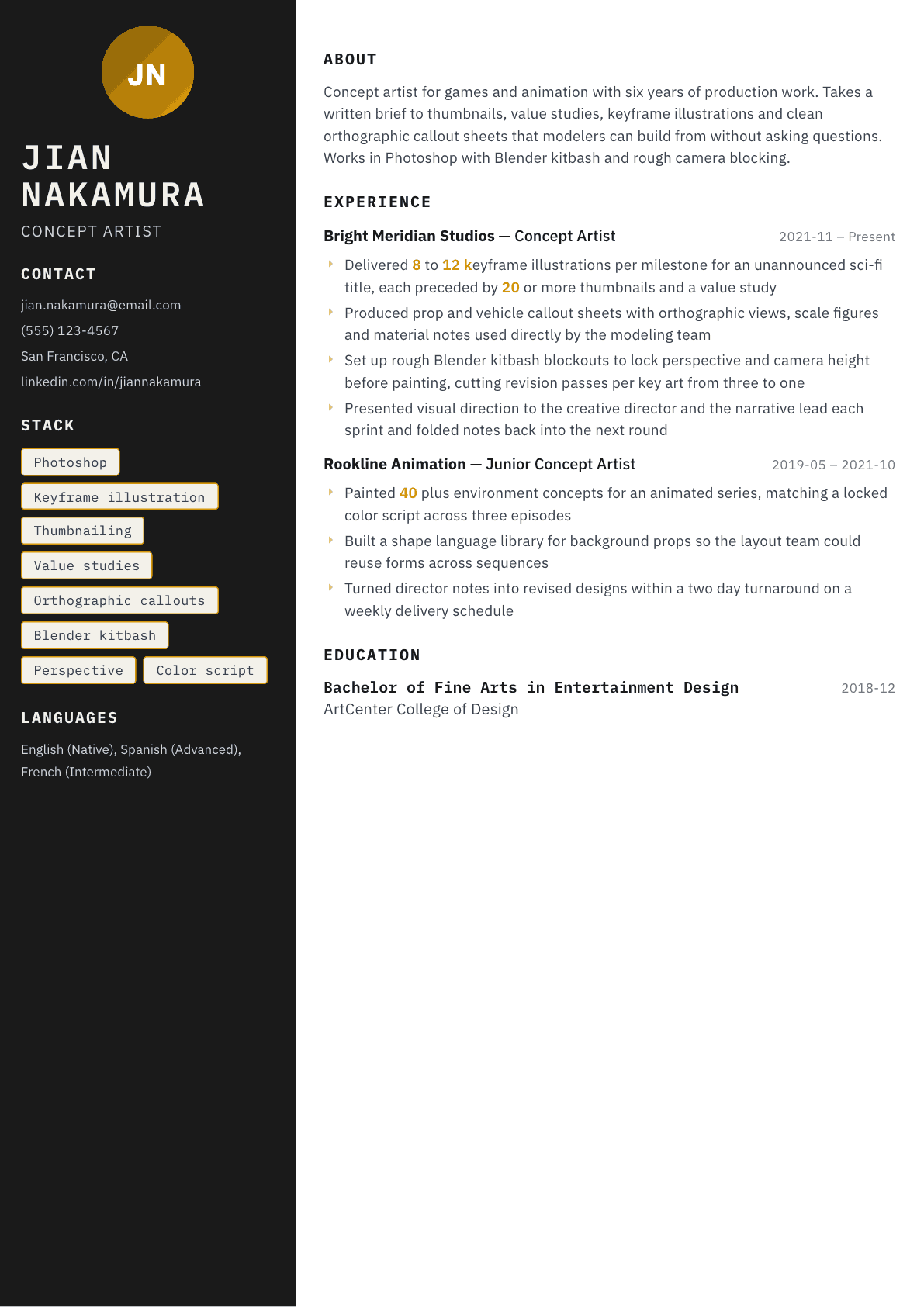
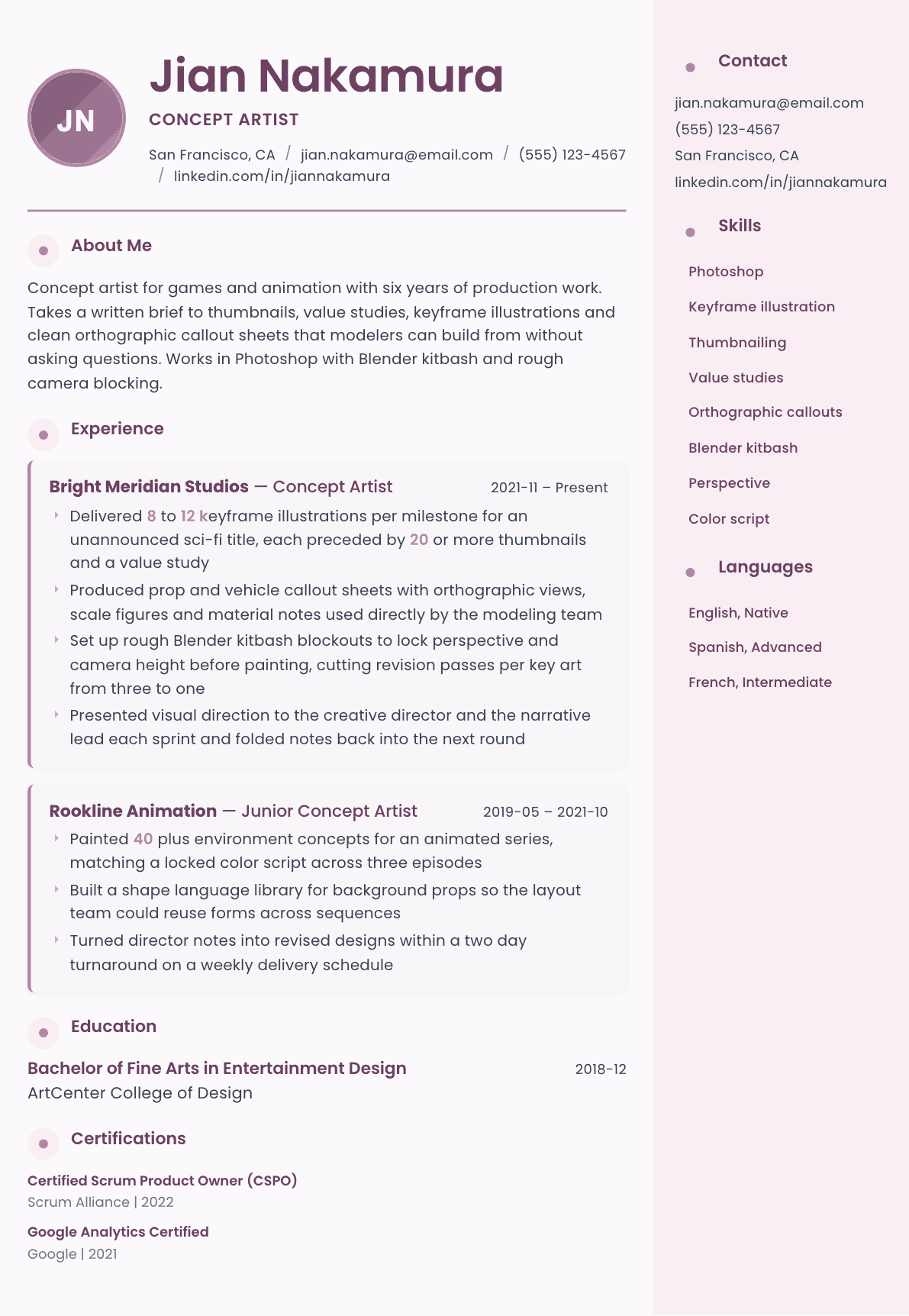
Example Concept Artist summary
Concept artist with six years in games and animation, moving from a written brief to thumbnails, value studies, keyframe illustrations and orthographic callout sheets that modelers build from directly. Strongest in environments and hard surface vehicles. Works in Photoshop with Blender blockouts for perspective, and delivers multiple usable directions on a weekly milestone schedule.
Skills to list on a Concept Artist resume
- Photoshop
- Digital painting
- Thumbnail exploration
- Value studies
- Perspective drawing
- Anatomy
- Color theory
- Keyframe illustration
- Orthographic callout sheets
- Blender
- Kitbashing
- Paintover
- Visual development
- Storytelling through design
What actually gets this resume read
- Lead the header with your portfolio link, because a concept hire is decided on images long before the resume is read.
- Describe the deliverables you produce by name: thumbnails, value studies, keyframes, callout sheets, and paintovers.
- Say which department consumes your work, whether that is modeling, environment art, previs, or the marketing team.
- Show turnaround speed, since production concept work is judged on how many usable options arrive per week.
- Separate personal illustration from production design in your bullets so the reader knows what was made under a brief.
- Mention the design domain you are strongest in: characters, creatures, environments, vehicles, props, or costume.
How to write a concept artist resume
Concept art hiring is decided on images, but the resume settles a question images cannot answer: can this person work under a brief, on a schedule, with notes coming back every week. Plenty of beautiful portfolios belong to illustrators who have never had a creative director rearrange a composition on a Thursday afternoon.
So a concept artist resume should read as a record of production deliverables. Thumbnails, value studies, keyframes, callout sheets, paintovers: these are the nouns an art director recognizes, and each one implies a different downstream department reading your work. A resume that says only that you painted concepts leaves the reader guessing which of those you can actually produce.
This guide walks through the layout entertainment studios expect, three summaries covering different career stages, before and after bullets from real production briefs, and the questions concept artists ask when they move between games, animation and film.
Format: one page with the portfolio link at the very top
One page, always. The portfolio link goes on the first line of the header, before the phone number, because an art director opens it before reading anything else and will decide there. If the site has a password or an embargo note, put that on the same line so nobody hits a wall.
Order the sections so production credibility comes early: summary, then experience, then software, then education. Keep the layout plain and single column. Recruiters at studios often forward the file as an attachment, and a design that depends on background color or a sidebar rarely survives the trip.
- Header: name, portfolio link, city and time zone, email, and a password note if the site is gated.
- Order: summary, production experience, personal or unannounced projects, software, education.
- Artists with no studio credit yet lead with client freelance and school production projects described in the same production language.
Summary: domain, medium, and the deliverables you produce
Two or three lines. Name the domain you are strongest in, whether that is environments, vehicles, creatures, characters, props or costume. Then the medium you serve: games, animated series, feature animation, live action, or theme park. Then the deliverables you generate from a written brief without hand holding.
Do not claim every domain. Directors hire for a specific gap on a specific show, and a claim of complete range reads as a portfolio the reader has to sort out themselves. Naming two strengths and one growing interest is more persuasive than naming six.
Experience: brief in, options out, on a schedule
Each role needs the studio, the project type, and who you reported to. Then bullets that describe throughput and process. Concept work is judged on how many usable directions arrive per week and on how cleanly you take notes, so give the milestone rhythm: keyframes per milestone, thumbnails preceding each key, revision passes to lock.
Include the department that consumes your work. Callout sheets that modelers build from, paintovers that environment art uses, color scripts that lighting follows, marketing key art that goes out to a publisher. That single detail tells a director whether your files are production ready or presentation only.
Show the front end of your process too. Thumbnail counts, value studies, perspective blockouts in a three dimensional package, reference gathering and research. Directors trust artists who explore broadly before rendering, because that is what prevents a beautiful first pass from being wrong.
- Give one bullet on turnaround: how fast a revised design comes back after notes.
- Separate production design made under a brief from personal illustration made for yourself.
- Name the review you attended: sprint reviews, art direction passes, or director notes sessions.
Software: painting stack and three dimensional support
List the painting tool first and the support tools after. Photoshop remains the default in production, and studios also read comfort with a three dimensional package as a strong signal because it means perspective, camera height and scale will be right before you paint. Blender kitbash blockouts, simple lighting passes and rough camera setups all count.
Do not overstate three dimensional skill. Saying you build rough blockouts and kitbash for perspective is honest and useful. Claiming full modeling capability invites a test you did not prepare for, and concept teams talk to modeling teams constantly.
What a concept posting is really scanning for
Postings recycle a narrow vocabulary: visual development, ideation, thumbnails, silhouette exploration, value study, keyframe, callout sheet, orthographic views, material callouts, paintover, style guide, art direction notes. Use those words once in the skills area and once inside a bullet where they describe something you actually delivered.
Then add the show vocabulary of your medium. Games want block-out support and asset feasibility. Animation wants color script, beat continuity and shape language. Live action wants previs support, set extension and practical buildability. Mirroring the right set tells a director you understand what the department needs from you.
Concept Artist resume summary examples
Entry-level
Entertainment design graduate with a portfolio of environment and vehicle concepts built from written briefs. Works in Photoshop with Blender blockouts for perspective, and delivers thumbnail sets, value studies and orthographic callouts. Six months of freelance prop design for an independent game team.
Six years in
Concept artist with six years in games and animation, moving from a written brief to thumbnails, value studies, keyframe illustrations and orthographic callout sheets modelers build from directly. Strongest in environments and hard surface vehicles, and delivers multiple usable directions on a weekly milestone schedule.
Lead concept artist
Lead concept artist with eleven years across two shipped games and a feature animated series. Sets visual direction with the art director, writes style guides, gives paintovers and reviews to a team of four, and presents design pitches to production and narrative leadership each milestone.
Work experience bullets: before and after
Before: Created concept art for a game project.
After: Delivered eight to twelve keyframe illustrations per milestone for an unannounced science fiction title, each preceded by twenty or more thumbnails and a value study.
Volume plus the exploration behind each key shows a repeatable process rather than a lucky image.
Before: Designed props and vehicles.
After: Produced prop and vehicle callout sheets with orthographic views, scale figures and material notes that the modeling team built from without a follow up meeting.
It names the deliverable and the department that consumed it, which is what makes concept work production ready.
Before: Used 3D to help with my paintings.
After: Set up rough Blender kitbash blockouts to lock perspective and camera height before painting, cutting revision passes per key art from three to one.
A process choice with a measured effect on revisions is exactly what a director is paying for.
Before: Took feedback from the director.
After: Presented visual direction to the creative director and narrative lead each sprint and folded notes into the next round within a two day turnaround.
Note handling and turnaround are the temperament traits studios screen for, so state them plainly.
Before: Painted backgrounds for an animated show.
After: Painted 40 environment concepts for an animated series, matching a locked color script across three episodes and building a shape language library the layout team reused.
Continuity work and a reusable asset show you served the show rather than only your own images.
Hard skills
- Photoshop
- Digital painting
- Thumbnail exploration
- Value studies
- Perspective construction
- Color theory and color script
- Keyframe illustration
- Orthographic callout sheets
- Blender kitbashing
- Paintover technique
- Visual development
- Reference and research gathering
Soft skills
- Note taking under direction
- Fast iteration
- Design pitching
- Collaboration with modelers
- Schedule discipline
- Curiosity and research habit
Mistakes that cost concept artist candidates the interview
- Mixing personal illustration and production design in one portfolio without labeling which was made under a brief.
- Showing only finished renders with no thumbnails or studies, which hides the exploration a director is hiring for.
- Claiming every design domain, which forces the reviewer to sort your strengths out for you.
- Leaving turnaround and milestone rhythm off the resume, so nobody can tell whether you can hold a weekly delivery.
- Naming the studio but not the department your work fed, which makes production readiness impossible to judge.
- Putting the portfolio link on the last line of the page, where an art director may never reach it.
Concept Artist resume questions
How many pieces should a concept art portfolio hold?
Enough to show range within your strongest domain and no more. Around fifteen to twenty strong pieces reads better than forty uneven ones, and at least two should include the thumbnails and studies behind the final image.
Do concept artists need three dimensional skills?
Not full modeling, but rough blockouts and kitbashing are now common in production because they lock perspective and scale before painting. Say honestly what level you work at, since concept and modeling teams sit close together.
What is the difference between a concept artist and an illustrator on a resume?
A concept artist designs to a brief for another department to build, so the deliverables are callouts, orthographics and paintovers. An illustrator delivers a finished image. Use the concept vocabulary if you want to be read as production capable.
How do I write bullets for unannounced projects?
Describe the genre, the deliverable types and the volume without naming characters, plot or unreleased visuals. Studios expect embargo language, and a bullet about callout sheets for an unannounced action title reads as normal practice.
Should I include an art test on my resume?
No, keep art tests off the document and out of a public portfolio unless the studio has given written permission. Instead mention comparable self-directed work built to the same brief structure so a director sees the same evidence.