Technical Artist Resume Examples: the lines they read
Write a Technical Artist Resume That Proves Art and Code
By Mustafa Tarabya, founder of CVBooster · Published · Updated
Technical artist resume examples showing tool scripting, shader work and performance budgets, plus the keywords game and film studios screen for.
Sample resumes for a technical artist
The same technical artist content laid out in three CVBooster templates, so you can see what the finished document looks like before you write a word.
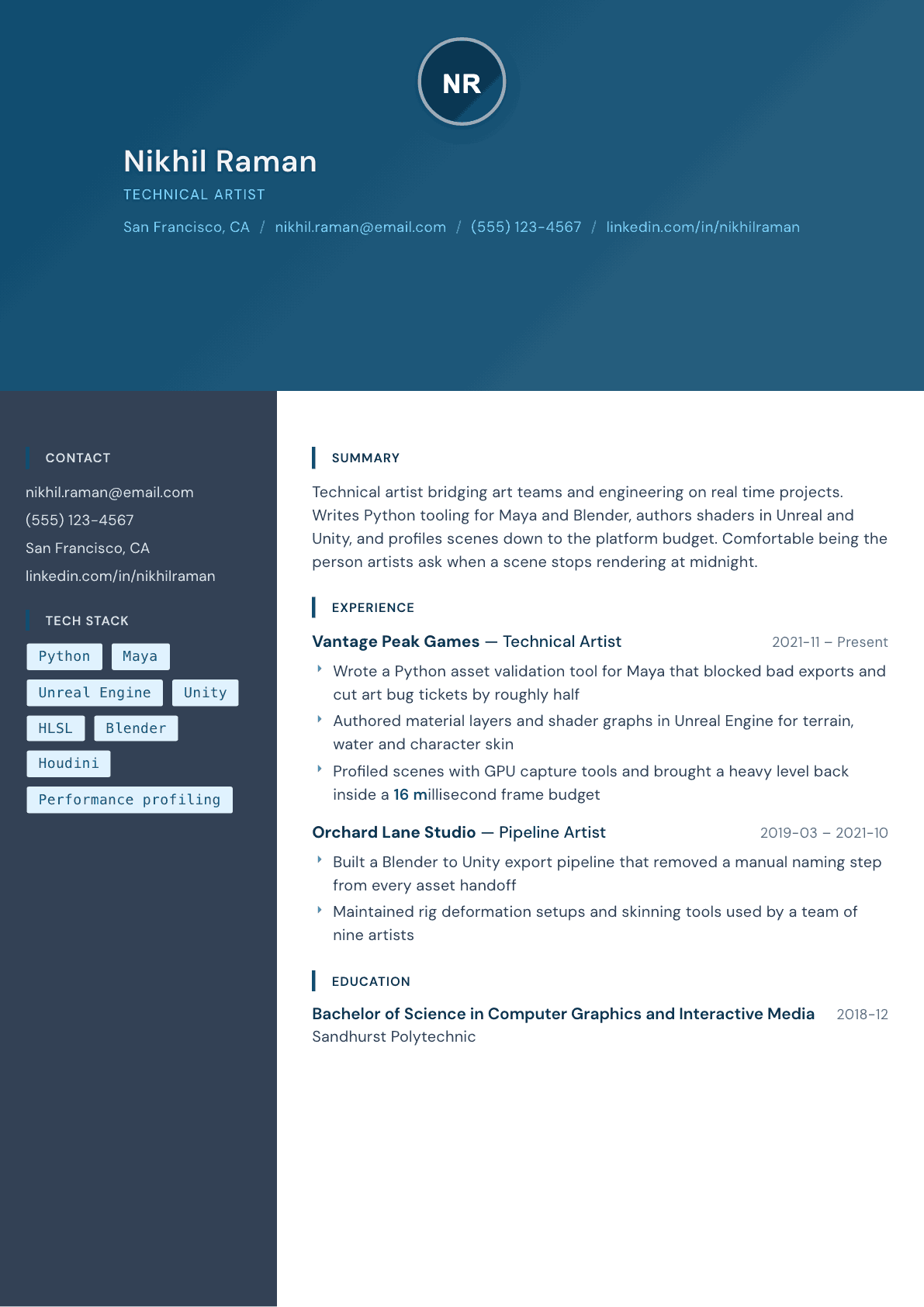
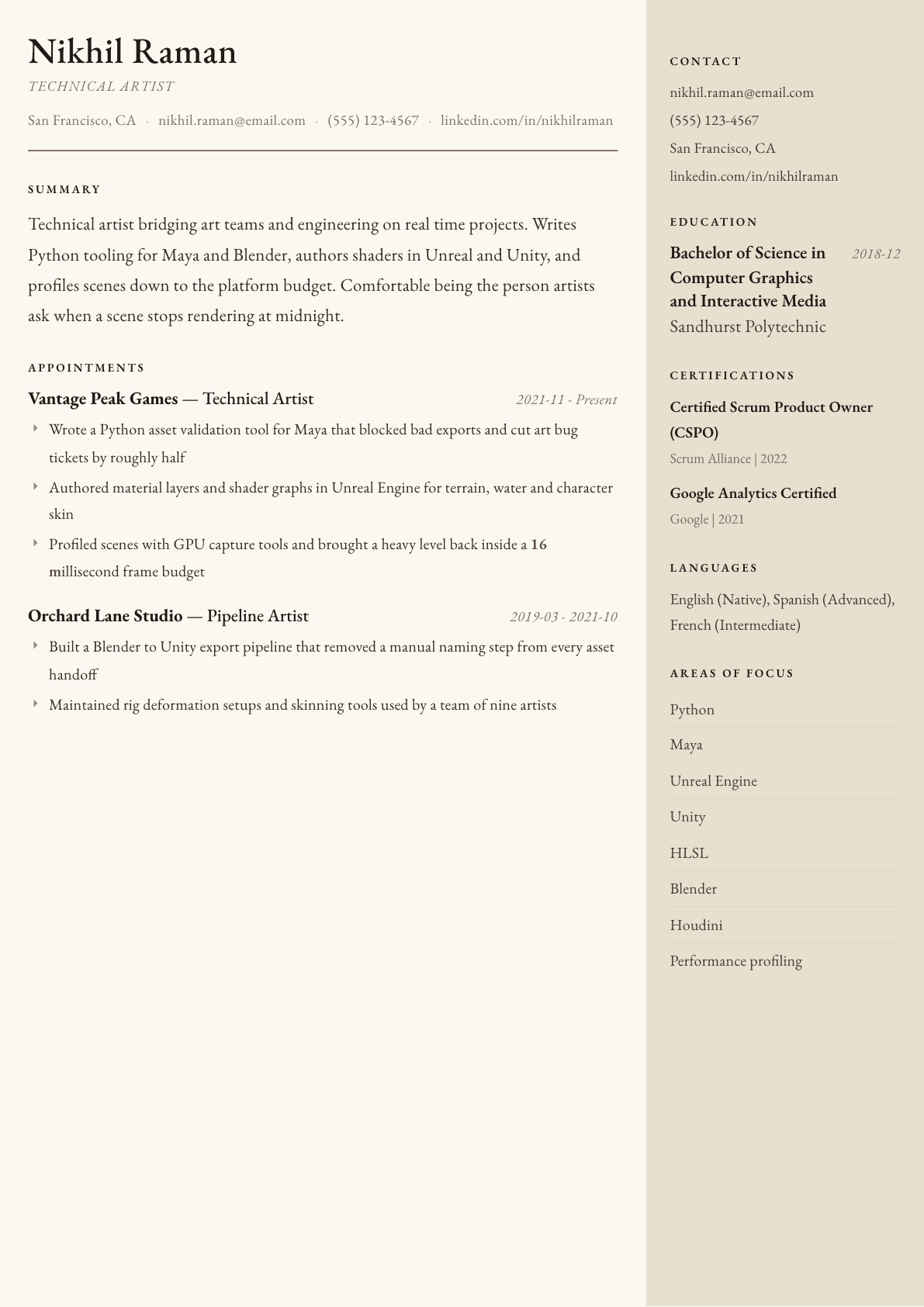
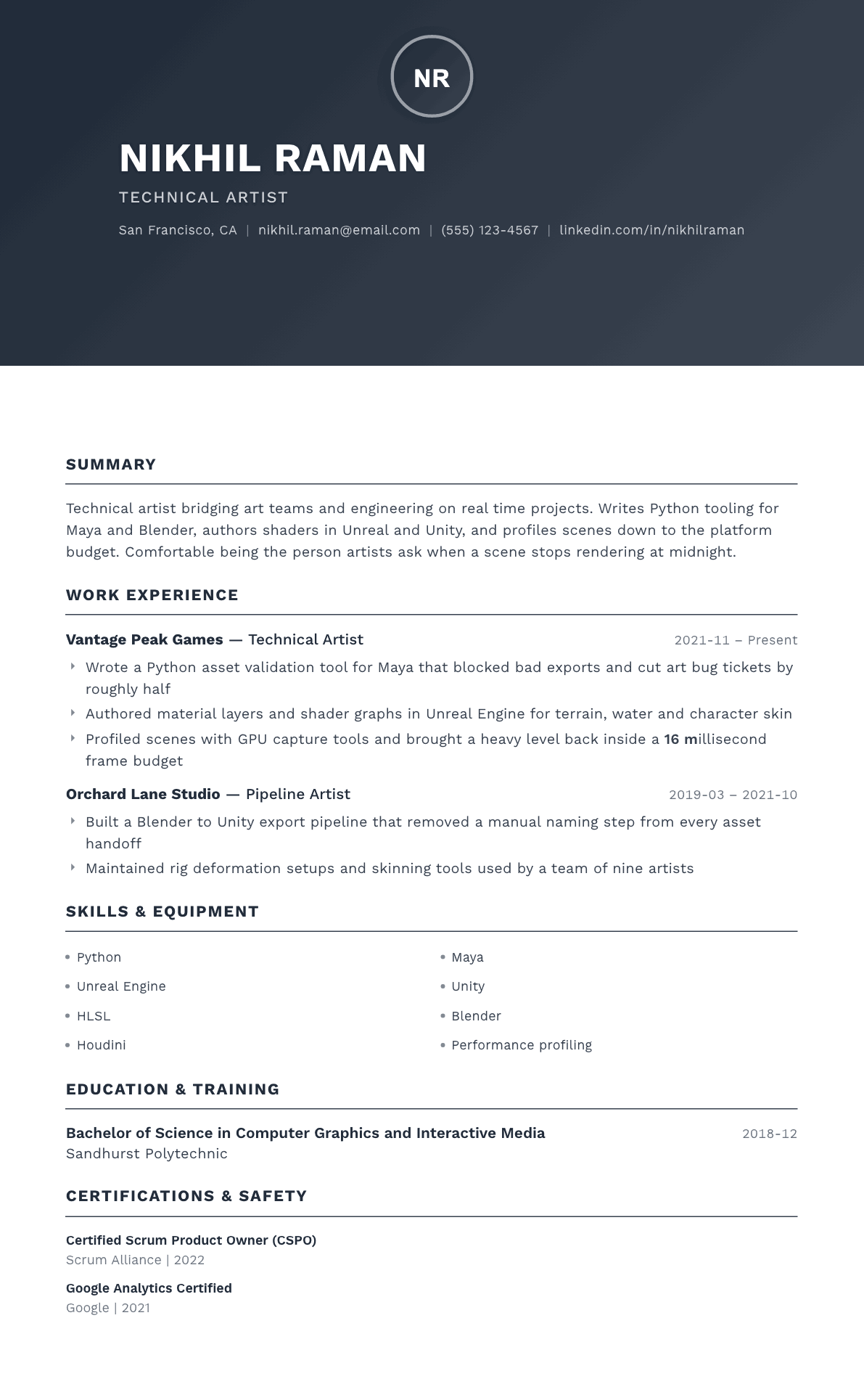
Example Technical Artist summary
Technical artist with seven years supporting real time art teams in games and virtual production. Writes Python tooling for Maya and Blender, authors shaders in Unreal and Unity, and rebuilds export pipelines so artists stop losing hours to naming rules. Regularly profiles scenes against platform frame budgets and translates the results into art direction the team can actually act on.
Skills to list on a Technical Artist resume
- Python
- Maya
- Blender
- Unreal Engine
- Unity
- HLSL
- Shader graphs
- Houdini
- Rigging
- Skinning and deformation
- Pipeline tooling
- Performance profiling
- Version control
- Procedural generation
What actually gets this resume read
- Split the resume into tools, shaders, rigging and performance so a lead can find the half of the job they need.
- Name the language and the host application together, such as Python inside Maya or C sharp inside Unity.
- Quantify tool impact by time saved per artist or by the class of bug the tool made impossible.
- Give a frame budget or memory target you worked to, because performance work is invisible without a number.
- List shader languages explicitly, whether HLSL, GLSL, shader graphs or Houdini VEX, since studios screen on them.
- Say which engine version and platform you targeted, since console and mobile constraints change the whole approach.
How to write a technical artist resume
The technical artist job is really four jobs sharing a title: tools and pipeline, shaders and lookdev, rigging and deformation, and performance. Almost no studio needs all four from one person, so the hiring lead opens your resume looking for the specific half they are short of. A document that blends everything into a paragraph of hybrid language makes that lead work, and busy leads stop working.
The second thing the lead checks is whether you write real code or paste snippets. Naming the language together with its host, Python inside Maya, C sharp inside Unity, HLSL in a shader graph, VEX in Houdini, is the fastest way to answer that without a code test. The third thing is whether you have ever hit a hard budget: a frame time, a memory ceiling, a draw call target.
This guide covers how to structure the four disciplines so a lead finds theirs in seconds, how to quantify tool work honestly, and which credentials and keywords actually appear in game and film postings.
Format: split by discipline, not by buzzword
One to two pages, reverse chronological, with a skills block broken into tools and scripting, shaders and materials, rigging and deformation, and performance. That single structural choice does most of the work of this resume, because it lets a lead scan to the section they are hiring for and read only that.
A technical artist portfolio is code and breakdowns rather than a reel, so link a repository or a documented tool page in the header alongside any visual work. Short videos of a tool in use are worth more than screenshots of the interface.
- Header: name, city, email, portfolio or breakdown page, code repository if public.
- Order: summary, experience, technical skills by discipline, engines and platforms, education.
- State the engine version family and target platform for each shipped title or production.
- Keep a short line naming the source control and build systems you worked inside.
Summary: which half of the job you are, and for whom
Say the domain first: real time games, virtual production, animation pipeline or visualization. Then name your center of gravity. A technical artist who mostly writes tooling and one who mostly authors shaders both call themselves technical artists, and the posting was written for one of them.
Finish with the relationship you have with the art team. Being the person artists ask when a scene stops rendering late at night is a genuine job description, and it tells a lead you handle support load rather than only greenfield work.
Experience: the tool, the users, the time it gave back
Tools are only valuable when someone uses them. Every tooling bullet should say what the tool does, how many artists used it, and what class of problem it removed. A validation tool that blocks a bad export is stronger than one that saves minutes, because preventing a category of bug is measurable and permanent.
Performance work is invisible without a number, so give the target you worked to: a frame budget in milliseconds, a texture memory ceiling, a draw call count on a specific platform. Say which capture tool you profiled with and what you actually changed, whether that was material complexity, overdraw, instancing or level of detail.
Rigging and deformation deserve their own bullets when you have done them, including the character count, the deformation approach and whether artists could use your setups without you in the room. Pipeline bullets should name the two applications you bridged and the manual step you deleted.
Shaders and code: name the language with its host
Write HLSL, GLSL, shader graph, Houdini VEX and OSL explicitly rather than saying you author materials. Studios screen on those strings because they map onto the renderer they use. Do the same for scripting: Python inside Maya or Blender, C sharp for Unity editor tooling, C plus plus for engine side work, PySide or Qt for the interface layer.
Mention the parts of a shader you have actually built. Terrain layer blending, water, skin and hair, and vertex animation each carry their own difficulty, and naming them stops a lead from assuming you have only wired up nodes in a graph.
Keywords that appear in real postings
The vocabulary is consistent across studios: pipeline tooling, asset validation, shader graph, material layering, procedural generation, rigging, skinning, deformation, level of detail, draw calls, profiling, source control, build automation, technical direction. Use the ones that are true and drop the rest, because a lead will open a code screen share and ask about anything on the page.
If the posting is for a game studio, mirror the platform language: console targets, mobile constraints, streaming budgets. If it is virtual production or animation, mirror the pipeline language: shot publishing, versioning, asset resolution, render farm submission.
Technical Artist resume summary examples
First technical art role
Junior technical artist from a computer graphics program, writing Python tools for Maya and authoring shader graphs in Unreal Engine. Built a small export validator for a student project team of nine, and profiled a level back inside a frame budget using engine capture tools. Comfortable supporting artists directly.
Four to six years in
Technical artist bridging art and engineering on real time projects. Writes Python tooling for Maya and Blender, authors terrain, water and skin shaders in Unreal, and profiles scenes against a 16 millisecond frame budget. Rebuilt an export pipeline that removed manual naming from every handoff between two applications.
Lead or technical director
Lead technical artist owning tooling, shaders and performance standards across a shipped console title. Sets the art budget targets with engineering, reviews shader complexity in code review, and maintains the Python framework three artists extend. Trains new technical artists and runs the weekly performance triage with the art directors.
Work experience bullets: before and after
Before: Wrote Python scripts for the art team.
After: Wrote a Python asset validation tool for Maya that blocked bad exports at save time, which cut art bug tickets on the board roughly in half over two milestones.
It names the host application, the moment of intervention and the class of bug the tool made impossible.
Before: Made shaders in Unreal.
After: Authored layered material systems in Unreal Engine for terrain, water and character skin, exposing a small set of artist facing parameters so lookdev did not require engineering time.
Naming the surfaces and the artist facing design shows shader judgment rather than node wiring.
Before: Optimized levels for performance.
After: Profiled heavy scenes with GPU capture tools, reduced overdraw and material instruction counts, and brought a dense level back inside a 16 millisecond frame budget on the target console.
A budget, a platform and the specific changes turn optimization from a claim into verifiable work.
Before: Built an export pipeline.
After: Built a Blender to Unity export pipeline that enforced naming and scale on publish, removing a manual rename step from every asset handoff for a team of nine artists.
The two applications, the rule enforced and the number of users show the tool had real reach.
Before: Helped with character rigs.
After: Maintained rig deformation setups and skinning tools used across the character team, including a corrective shape workflow artists could run without technical support.
It shows the rig work was maintained for other people, which is the difference between rigging and technical art.
Hard skills
- Python
- C sharp
- HLSL
- Shader graphs
- Maya
- Blender
- Houdini
- Unreal Engine
- Unity
- Rigging and skinning
- Pipeline tooling
- Performance profiling
- Procedural generation
- Source control and build automation
Soft skills
- Translating art needs into technical requirements
- Supporting artists under deadline
- Documentation habit
- Negotiating budgets with engineering
- Debugging patience
- Training and onboarding
Certifications worth listing
- Unity Certified Professional: Programmer (Unity Technologies)
- Unreal Engine Educator Training (Epic Games)
- Autodesk Certified Professional: Maya (Autodesk)
Mistakes that cost technical artist candidates the interview
- Writing a single blended skills paragraph, so a lead hiring for shaders cannot tell whether you have ever written one.
- Claiming optimization work with no budget, platform or capture tool attached, which reads as having watched someone else profile.
- Listing languages without their host application, when the whole job is code running inside another artist facing program.
- Showing screenshots of tool interfaces instead of a short video of an artist using the tool to finish a task.
- Omitting how many artists used a tool, which is the only honest measure of whether a tool mattered.
- Applying to a film pipeline role with a resume written entirely in game engine vocabulary, or the reverse.
Technical Artist resume questions
Should a technical artist resume include code samples?
Link them rather than paste them. A public repository or a documented tool page with a short usage video is enough. Keep the resume readable and let the reviewer choose to open the code once the summary has convinced them.
How technical should the language be?
Technical enough that a lead recognizes real experience, plain enough that a recruiter can match the posting. Naming tools, languages and budgets does both, while inventing hybrid job phrasing that no posting uses does neither.
Do I need a shipped title to get hired?
It helps but it is not the only door. Strong tools built for a student team, a game jam or a mod community count if you state the number of users and the problem solved. Studios hire on evidence of usefulness, not only on credits.
How do I show rigging experience without a rigging title?
Give it its own bullets under each job, naming the characters, the deformation approach and whether animators used your setups unaided. Rigging is often invisible on a resume because it hides inside the phrase supported the art team.
Is Houdini worth listing if I only use it occasionally?
Yes, if you can defend it in an interview. Say what you built, whether that was procedural props, destruction setups or VEX driven tools, and be clear about depth. Overclaiming Houdini is caught in the first technical conversation.