Character Artist Resume Examples: the lines they read
Build a Character Artist Resume That Passes the Art Test
By Mustafa Tarabya, founder of CVBooster · Published · Updated
Character artist resume advice with sculpting and grooming keywords, a production sample, and the pipeline details leads check before an art test.
Sample resumes for a character artist
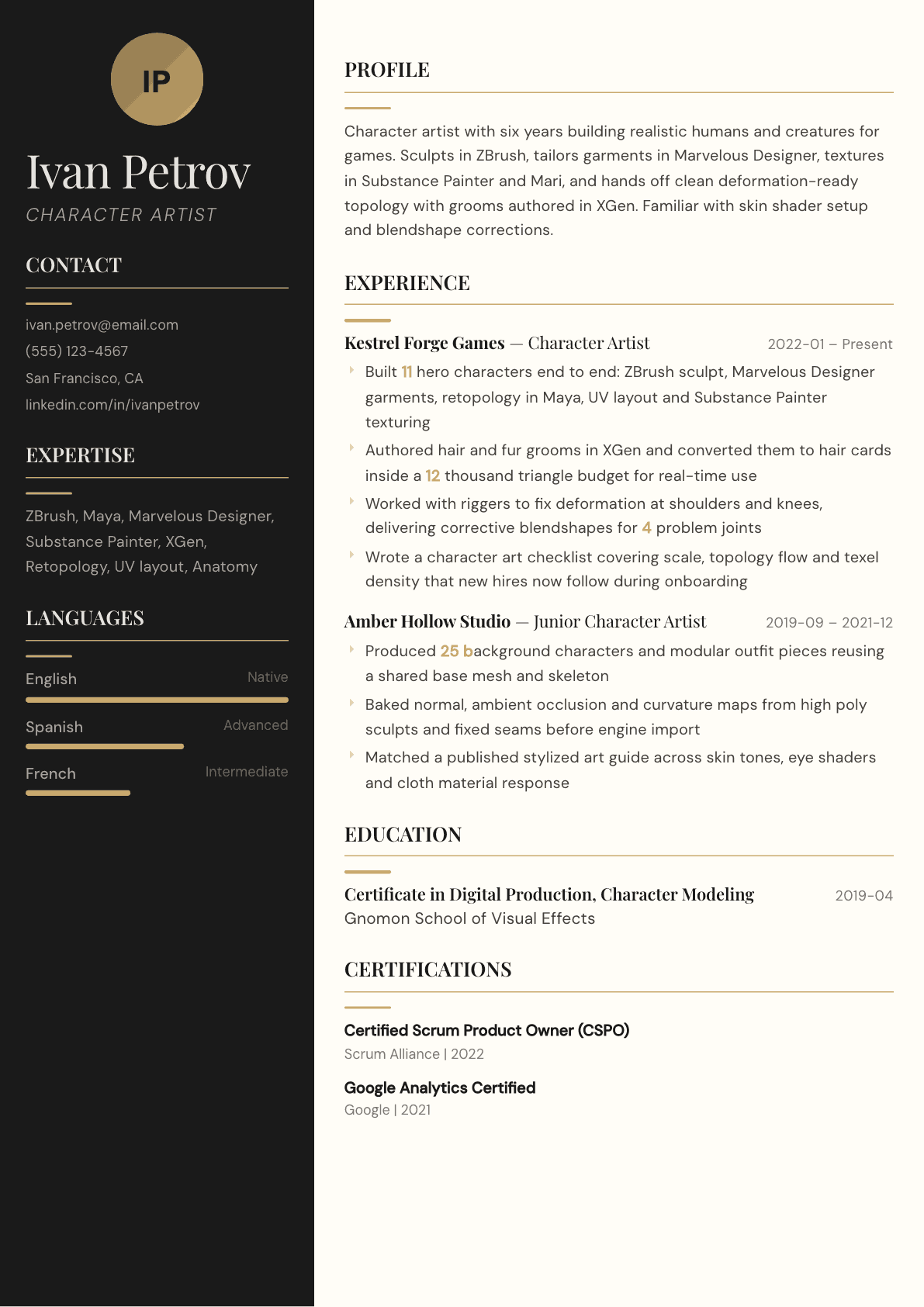
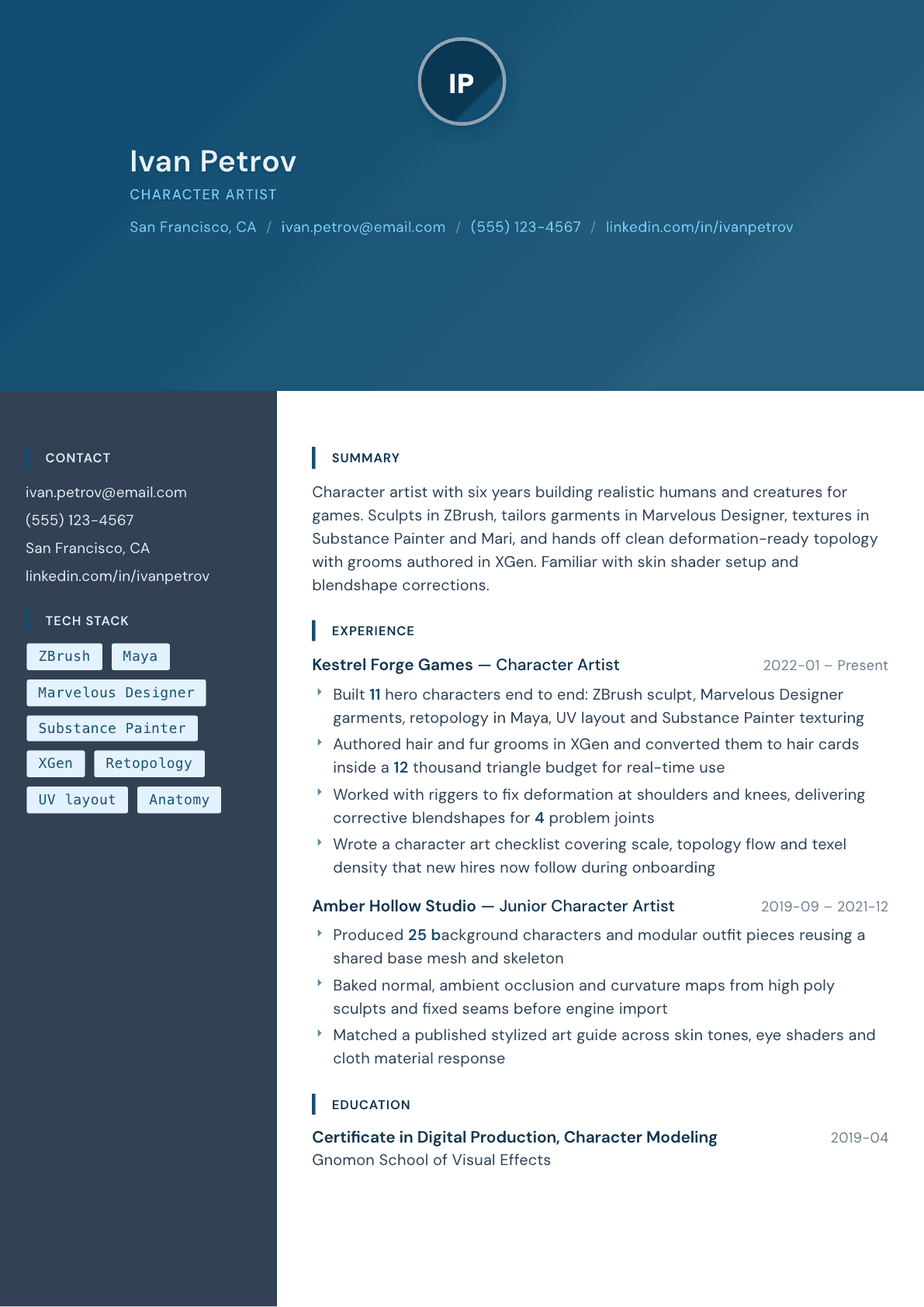
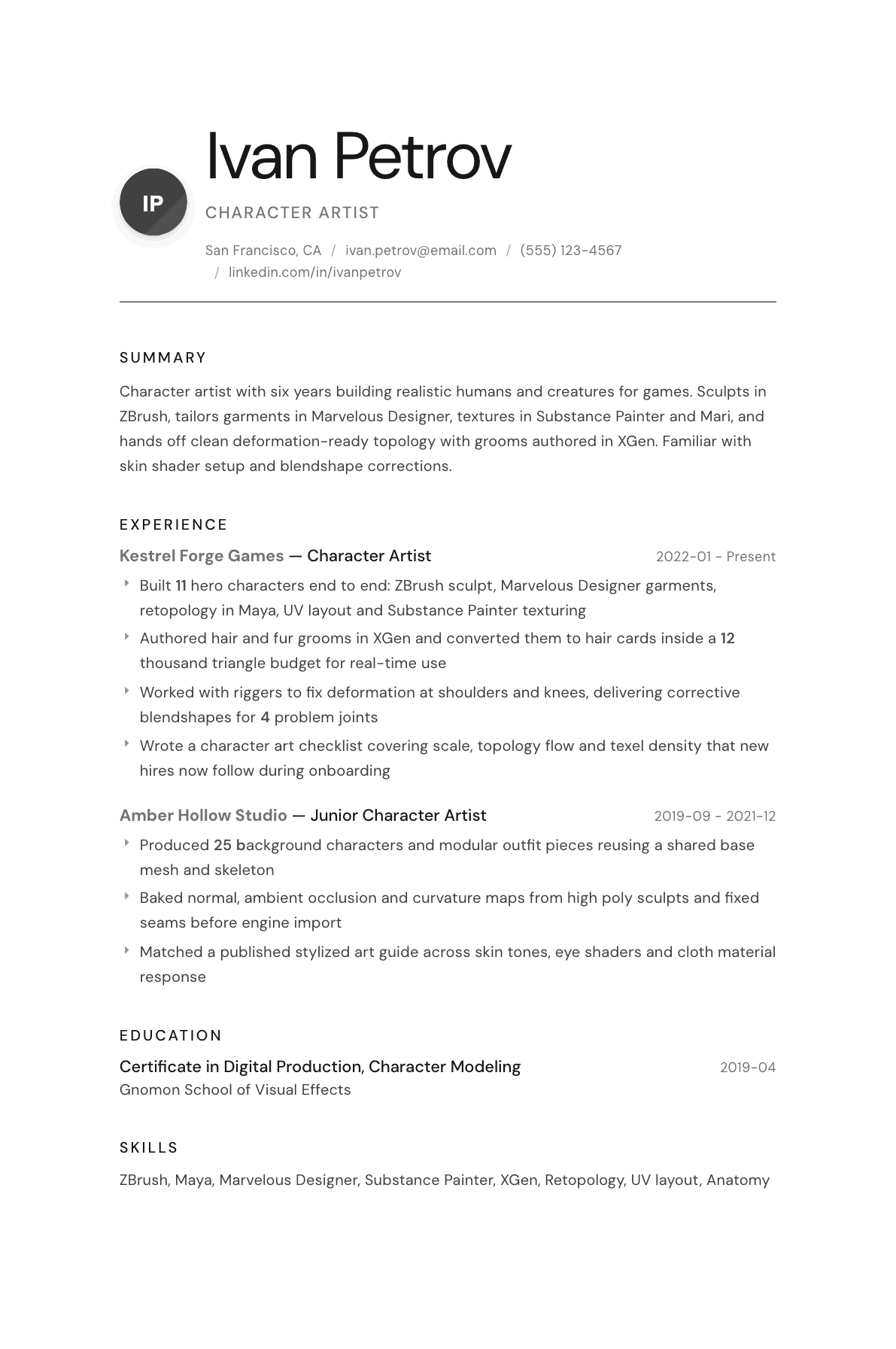
The same character artist content laid out in three CVBooster templates, so you can see what the finished document looks like before you write a word.
Example Character Artist summary
Character artist with six years delivering realistic humans and creatures for console and PC titles. Sculpts in ZBrush, tailors in Marvelous Designer, retopologizes in Maya and textures in Substance Painter and Mari. Delivers deformation-ready topology, hair card grooms authored from XGen, and corrective blendshapes worked out directly with the rigging team.
Skills to list on a Character Artist resume
- ZBrush
- Maya
- Blender
- Marvelous Designer
- Substance Painter
- Mari
- XGen
- Retopology
- UV layout
- Normal map baking
- Skin shading
- Blendshapes
- Anatomy
- Cloth simulation
- Unreal Engine
What actually gets this resume read
- Say whether you work realistic or stylized, because leads hire for one look and the art test reflects it.
- Name the full sculpt to engine path you own, from ZBrush through retopology, UVs, baking and texturing.
- Mention deformation work with riggers, since clean topology at joints is what separates a hire from a portfolio.
- Include grooming tools you know by name, whether that is XGen, Ornatrix, or hair card authoring for real time.
- Give polygon and texture budgets you have worked inside so the reader trusts you can hit production constraints.
- Show your anatomy foundation with life study or ecorche work if your production credits are still thin.
How to write a character artist resume
Character art is the most scrutinized discipline in a game art department, because a character is the asset players look at longest and the one that has to deform, animate, wear clothes and hold up in close camera. The lead reading your resume is deciding whether to spend a week of studio time on an art test, and that decision hangs on evidence you can finish a figure, not just sculpt one.
The first filter is style. Realistic and stylized character work are effectively two professions with shared software, and a lead filling a realistic role will pass over a stylized portfolio no matter how strong it is. Say which one you are in the first line and let the portfolio agree with it.
This guide covers the resume order character teams expect, three summaries across career stages, before and after bullets from real sculpt to engine work, and the questions character artists ask when preparing for an art test or moving between studios.
Format: one page, portfolio first, turntables assumed
One page with the portfolio link on the first header line. A character lead expects to see turntables, wireframes and texture breakdowns on the site, so the resume does not need to describe images. It needs to supply what images cannot: budgets, engines, team size, and who checked your topology.
Keep it plain and single column. Studios pass character resumes around between the lead, the technical artist and the rigger, often as an emailed attachment, and a plain document reads the same for all three.
- Header: name, portfolio link, city and time zone, email, and a password note if work is embargoed.
- Order: summary, software and pipeline, shipped titles, experience, education and training.
- Artists without a shipped credit lead with personal characters described with the same budgets and pipeline detail.
Summary: style, subject, and the path you own
Two or three lines. Name whether you work realistic or stylized, whether your subject strength is humans, creatures or both, the years, and the path you own end to end. Sculpting alone is a junior signal. Sculpt through retopology, UVs, baking, texturing, groom and engine setup is a full character artist.
Anatomy deserves a mention when your production credits are thin. Life drawing, ecorche study and skeletal work are what a lead uses to predict whether your next figure will be right, so name the practice rather than assuming the portfolio implies it.
Experience: characters completed, budgets held, deformation solved
Each role gets the studio, the project type and the platform. Then bullets that count finished characters, not sculpts. A hero character taken from block-out through ZBrush sculpt, Marvelous Designer garments, retopology in Maya, UV layout, baking, texturing in Substance Painter or Mari and engine import is one complete unit of work, and leads count those.
Give budgets. Triangle counts for hero and background tiers, texture set counts, texel density, and the hair card budget if you groom. Real time character work is a constant negotiation with the technical artist, and naming the numbers shows you have had that conversation before.
Then deformation. Topology that holds at shoulders, elbows, knees and the jaw is where character art either succeeds or generates weeks of rigging complaints. A bullet describing work with riggers, corrective blendshapes or a topology revision after a deformation review is worth more than three bullets about sculpting detail.
- Name your garment workflow: Marvelous Designer patterns, simulation settings, and how you retopologize the result.
- Say which grooming tool you use and whether you deliver strands or hair cards.
- Mention shader setup if you have it: skin response, eye shaders, cloth and fuzz.
Software and pipeline: stack it in production order
List tools in the order the work moves through them rather than alphabetically, because that alone tells a lead you think in pipeline. Sculpting, garment work, retopology, UV layout, baking, texturing, grooming, engine. Naming ZBrush, Marvelous Designer, Maya or Blender, Substance Painter, Mari, XGen or Ornatrix, and Unreal Engine in that sequence reads as a working artist.
Add source control and review habits. Perforce, naming conventions, a character checklist, scale reference against a standard rig: these small things are what a lead needs to believe your files will land in the project without cleanup.
Keywords a character art posting repeats
Character postings reuse a compact set of terms: high poly sculpt, retopology, edge flow, UDIM or UV layout, normal and ambient occlusion baking, PBR texturing, skin shading, subsurface, grooming, hair cards, blendshapes, cloth simulation, LOD tiers, and anatomy. Mirror the ones you truly do once in your skills and once inside a bullet.
Anatomy and likeness deserve their own mention when relevant. Likeness work for scanned actors, ecorche studies and creature anatomy from reference are all specific enough that a lead treats them as evidence rather than a claim.
Character Artist resume summary examples
First studio role
Junior character artist with a portfolio of three realistic humans and one creature taken from ZBrush sculpt through retopology, UVs, baking and Substance Painter texturing, presented in Unreal Engine 5. Trained in anatomy through life drawing and ecorche study, and comfortable with Marvelous Designer garments.
Six years in
Character artist with six years delivering realistic humans and creatures for console titles. Sculpts in ZBrush, tailors in Marvelous Designer, retopologizes in Maya and textures in Substance Painter and Mari. Delivers deformation-ready topology, hair card grooms authored from XGen, and correctives worked out with the rigging team.
Senior or lead
Senior character artist with a decade across four shipped titles, leading a team of three. Sets the character standard for topology, texel density and grooming, reviews outsource deliveries, and partners with rigging and technical art on deformation targets before a sculpt is ever approved.
Work experience bullets: before and after
Before: Sculpted characters in ZBrush for the game.
After: Built 11 hero characters end to end: ZBrush sculpt, Marvelous Designer garments, retopology in Maya, UV layout and Substance Painter texturing, all approved for engine import.
Counting finished characters and naming every stage proves you close the whole path, not only the sculpt.
Before: Made hair for the characters.
After: Authored hair and fur grooms in XGen and converted them to hair cards inside a 12 thousand triangle budget for real time use on hero characters.
The tool, the conversion step and the budget turn a general claim into a specific real time skill.
Before: Worked with the rigging team.
After: Partnered with riggers to fix deformation at shoulders and knees, revising edge flow and delivering corrective blendshapes for four problem joints.
Deformation ownership is the difference between a portfolio sculpt and a production character, so name the joints.
Before: Helped new artists get up to speed.
After: Wrote a character art checklist covering scale, topology flow and texel density that new hires now follow during their first month of onboarding.
A durable artifact used by other people is stronger evidence of seniority than a claim about mentoring.
Before: Made background characters using a base mesh.
After: Produced 25 background characters and modular outfit pieces from a shared base mesh and skeleton, baking normal, ambient occlusion and curvature maps and fixing seams before engine import.
Modular reuse and clean bakes are the daily reality of crowd work, and the numbers make the scope readable.
Hard skills
- ZBrush
- Maya
- Blender
- Marvelous Designer
- Substance Painter
- Mari
- XGen grooming
- Retopology and edge flow
- UV layout
- Normal map baking
- Skin and eye shading
- Corrective blendshapes
- Anatomy
- Unreal Engine
Soft skills
- Receiving art direction
- Rigging collaboration
- Self critique against reference
- Time estimation per character
- Patience with revision
- Written handoff notes
Certifications worth listing
- Unreal Authorized Instructor (Epic Games)
- Autodesk Certified Professional: Maya (Autodesk)
Mistakes that cost character artist candidates the interview
- Mixing realistic and stylized characters in one portfolio, which makes a lead unsure which art test to send.
- Showing sculpts only, with no wireframes, UV layouts or engine renders to prove the character was finished.
- Ignoring deformation entirely, which is the first thing a rigger asks about when your name comes up.
- Leaving out triangle and texture budgets, so nobody can tell whether your work has met a real time constraint.
- Listing grooming as a skill without saying whether you deliver strands, cards or both.
- Overloading the resume with software names while never describing a single character you completed.
Character Artist resume questions
How many characters should be in a character artist portfolio?
Three to five complete characters is enough if each one is finished to production standard with turntables, wireframes and texture breakdowns. A lead would rather see four figures with clean topology than a dozen unresolved sculpts.
Do I need Marvelous Designer for character art jobs?
For clothed realistic characters it has become the default, so most postings list it. You can sculpt garments instead, but say so plainly, because a studio with a clothing heavy roster will test pattern work during the art test.
How important is anatomy if my portfolio is stylized?
Very. Stylized proportion only reads correctly when the underlying structure is right, and leads check that in the ribcage, shoulder and hip. Mention life drawing or ecorche study on the resume even for a stylized target.
Should I list an art test on my character artist resume?
No. Art tests belong to the studio that set them and are usually covered by an agreement. Instead describe an equivalent self-directed character built to the same brief type, with the same budgets and pipeline stages named.
How do I move from film character work into games?
Rebuild one figure to real time constraints with a triangle budget, baked maps, hair cards and an engine presentation. Film sculpting reads as transferable, but a lead needs proof you can hold topology and memory limits.