Game Artist Resume Examples: free ATS score and gap list
Craft a Game Artist Resume That Gets Your Reel Opened
By Mustafa Tarabya, founder of CVBooster · Published · Updated
Build a game artist resume with engine and pipeline keywords, a sample from a shipped title, and advice on what art directors check first.
Sample resumes for a game artist
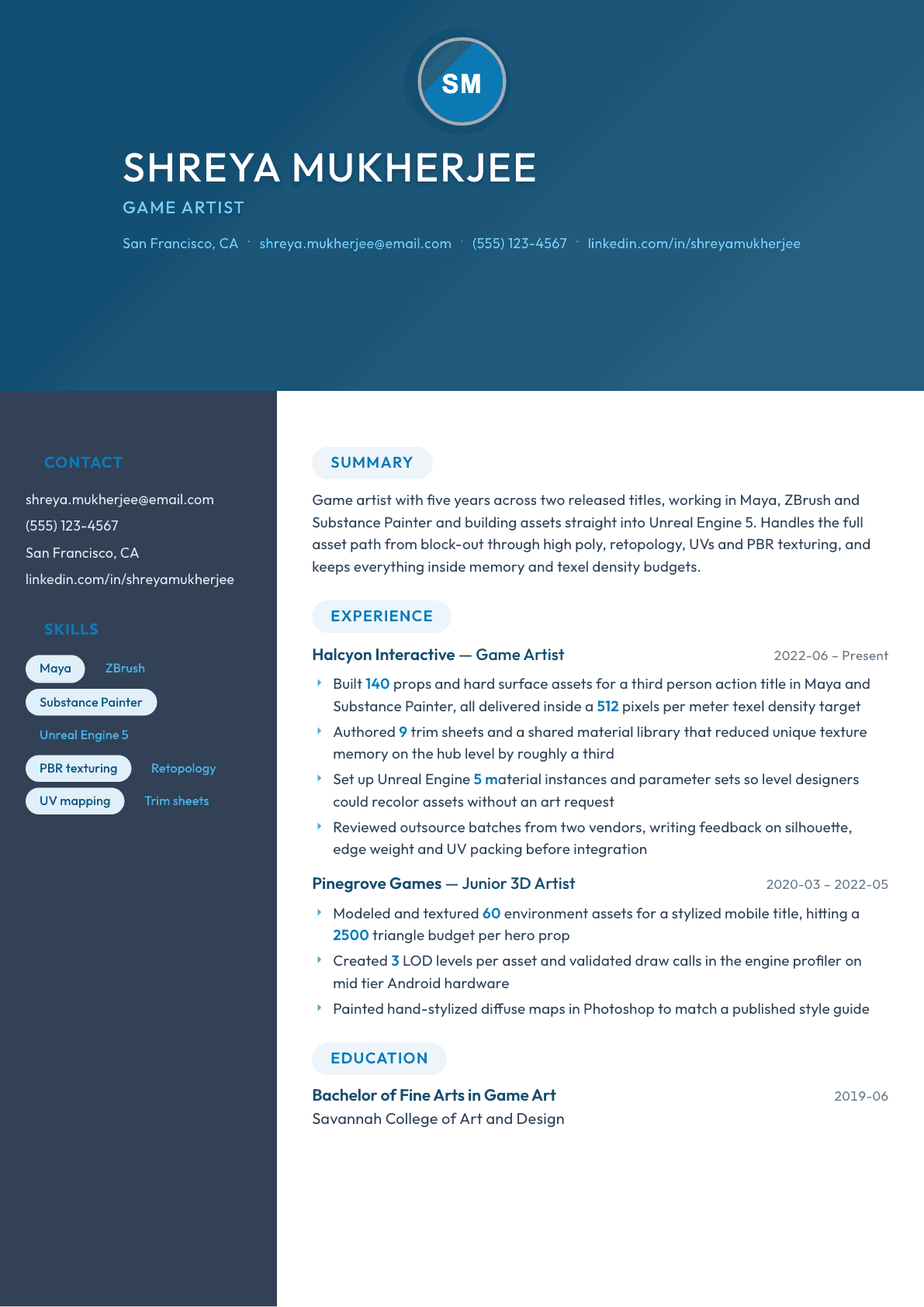
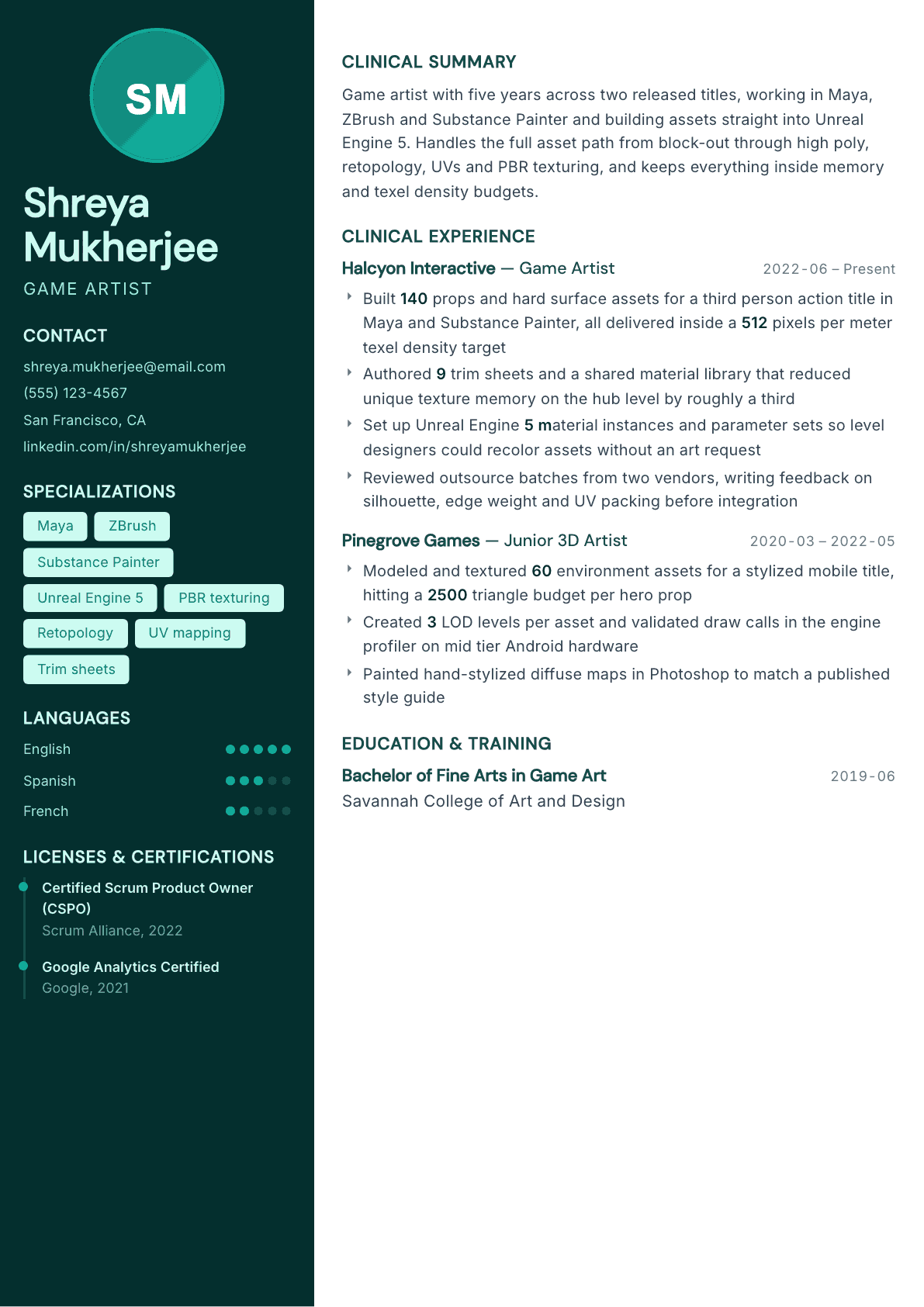
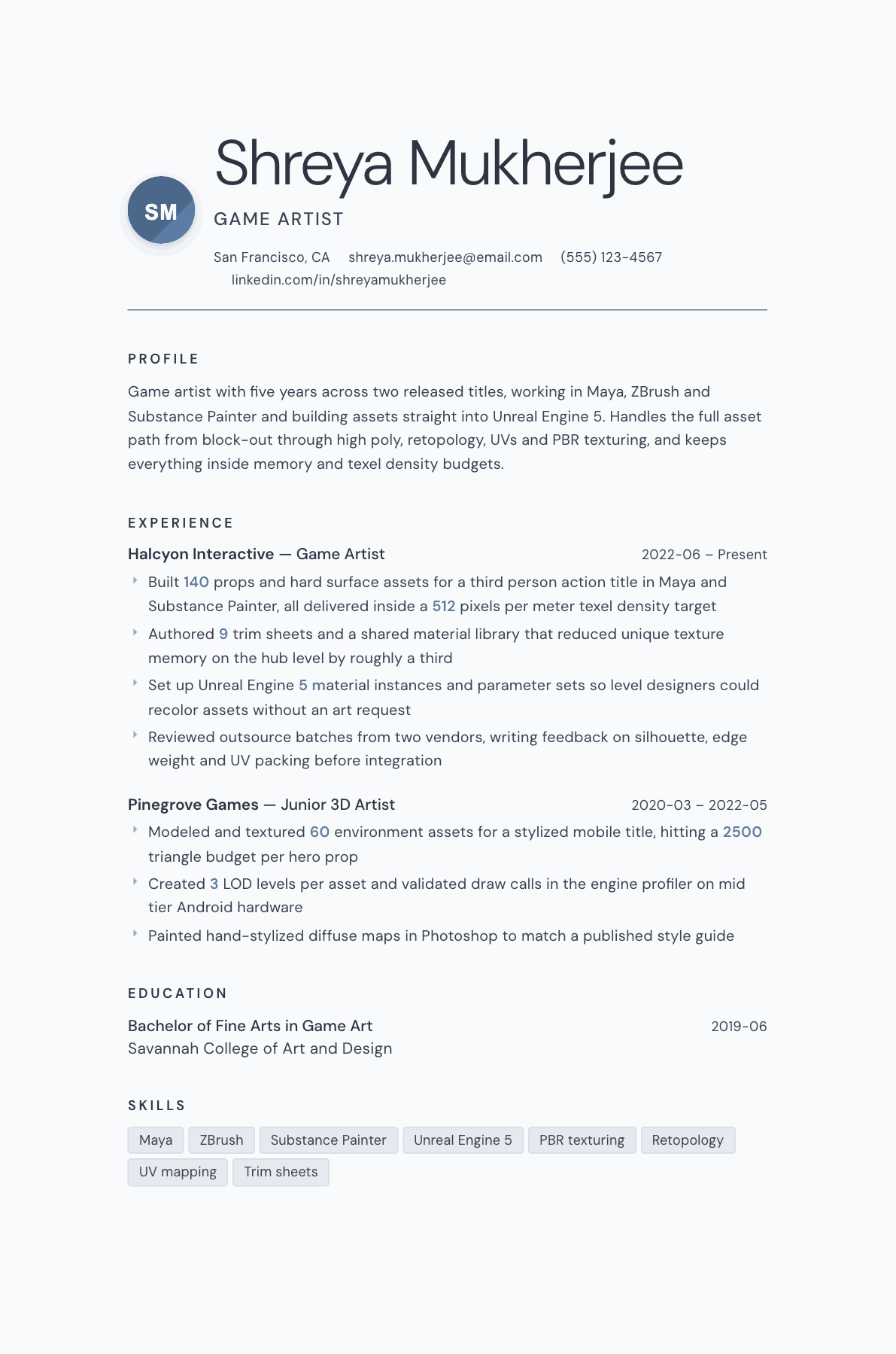
The same game artist content laid out in three CVBooster templates, so you can see what the finished document looks like before you write a word.
Example Game Artist summary
Game artist with five years and two released titles, covering the asset path from block-out through high poly, retopology, UVs and PBR texturing in Maya, ZBrush and Substance Painter. Integrates directly in Unreal Engine 5 with material instances and LODs, and works inside triangle, texel density and memory budgets set by the technical art team.
Skills to list on a Game Artist resume
- Maya
- Blender
- ZBrush
- Substance Painter
- Substance Designer
- Unreal Engine
- Unity
- PBR workflow
- Retopology
- UV mapping
- Baking normals
- Trim sheets
- LOD creation
- Hard surface modeling
- Photoshop
- Perforce
What actually gets this resume read
- Put the reel link in the header, above everything, because an art director opens it before reading a single line.
- Name the engine you shipped in and the version, since Unreal and Unity pipelines hire on different muscle memory.
- Say which part of the asset path you own: block-out, high poly, retopology, UVs, texturing, or engine integration.
- Quote budgets you worked inside, such as triangle counts, texel density, or texture memory per level.
- List released titles with platform and your specific contribution, not just the studio name and the dates.
- Keep the resume to one page and let the portfolio carry the images, since recruiters print or scan the document quickly.
How to write a game artist resume
A game artist is hired off the reel, not the resume, but the resume decides whether the reel gets clicked. An art director opening a stack of applications gives each one a few seconds to answer three questions: what engine did this person ship in, which part of the asset path do they own, and did anything they made actually reach players.
That is why a game art resume should read like a production record. Titles with platforms, the pipeline stage you were responsible for, the budgets you worked inside, and the software by name and version family. Adjectives about passion for games are assumed by everyone who applies and separate nobody.
This guide covers the layout studios expect, three summaries for different stages of a game art career, before and after bullets pulled from real asset work, and the questions artists ask when they move between studios, engines or genres.
Format: one page, reel link first, no decoration
One page. Recruiters at game studios triage large volumes of applications and print or scan quickly, so a second page usually goes unread. Put the reel or portfolio link on the first line of the header, ahead of the phone number, because that is the only element on the page an art director is guaranteed to use.
Keep the document plain. No screenshots pasted into the resume, no colored panels, no icons standing in for section names. The images belong on the portfolio site where they can be seen at full size, and a plain document survives the applicant tracking system most publishers run.
- Header: name, reel or portfolio link, city and time zone, email, and a site password if the work is under embargo.
- Order: summary, software and pipeline skills, shipped titles, experience, education.
- Artists with no released credit replace the titles section with personal projects and game jam entries described the same way.
Summary: engine, discipline, years, asset path
Two or three lines that answer the director question directly. Name the engine you produce assets for, the discipline within game art, the years, and the stages of the asset path you handle without supervision. A generalist claim helps nobody, so if you are strongest at hard surface props or stylized environments, say that.
If you are crossing from film, archviz or product visualization, name the gap honestly and then close it. Real time work is judged on constraint handling, so a summary that mentions triangle budgets, texel density and engine integration reassures a lead far more than a list of offline renderers.
Experience: assets, budgets, and what the engine received
Every role needs the studio, the project type, and the platform. Then three to five bullets that name what you built and the constraints you built it under. Volume matters in this field, so give the asset count. Constraint matters more, so give the triangle target, the texel density, or the texture memory budget alongside it.
Include the handoff. Assets that stop at a render are half a job, so mention material instances, LOD chains, collision, naming conventions, version control in Perforce or Git, and anything you set up that let designers work without an art request. Leads read that as pipeline sense, and pipeline sense is what promotes an artist.
One bullet per role should show that you improved a shared thing rather than only completing your own tickets: a trim sheet library, a master material, an outsourcing feedback loop, a documented naming standard.
- Give asset counts with the budget they were made inside, not counts alone.
- Name the engine version family, because Unreal and Unity workflows differ in daily practice.
- Say whether the work was in-house, outsourced with your review, or personal.
Shipped titles: a section of its own
Give each released title a line with the platform, the studio, your role and your specific contribution. Studio name and a date range is not a credit, because reviewers assume the largest possible team and discount accordingly. Writing that you built the props and trim materials for two districts is smaller and far more convincing.
Unannounced work can be listed as an unannounced title in the genre, with the contribution described in general terms. Personal and jam projects belong in the same format when you have no commercial credit yet, clearly marked so nobody thinks you are inflating.
Software and pipeline keywords studios screen for
Job postings for game art repeat a compact vocabulary: high poly, low poly, retopology, UV packing, baking normal and ambient occlusion maps, PBR texturing, trim sheets, tileable materials, LODs, texel density, draw calls, collision, blueprint or prefab setup, and source control. Use the exact terms once in the skills block and again where they carry weight inside a bullet.
List tools in stacks rather than one long line: modeling, sculpting, texturing, engine, and pipeline. A lead reading Maya and Blender together, ZBrush, Substance Painter and Designer, Unreal and Unity, Perforce, sees a complete artist. The same words scattered randomly read as a keyword dump.
Game Artist resume summary examples
First studio role
Game art graduate with a portfolio of hard surface props built to real time budgets and presented in Unreal Engine 5. Comfortable with the full path from block-out to baked and textured low poly in Maya, ZBrush and Substance Painter. Two shipped game jam titles and one modding credit.
Five years in
Game artist with five years and two released titles, covering block-out, high poly, retopology, UVs and PBR texturing in Maya, ZBrush and Substance Painter. Integrates directly in Unreal Engine 5 with material instances and LODs, and works inside triangle, texel density and memory budgets set by technical art.
Senior artist
Senior game artist with nine years across four shipped titles on console and PC. Owns asset standards and material libraries, reviews outsource batches from three vendors, and writes the documentation new artists follow. Known for holding memory budgets on hub levels without losing silhouette quality.
Work experience bullets: before and after
Before: Created 3D assets for a video game.
After: Built 140 props and hard surface assets for a third person action title in Maya and Substance Painter, all delivered inside a 512 pixels per meter texel density target.
The count, the tools and the density target tell a lead exactly what standard you have already worked to.
Before: Optimized textures to save memory.
After: Authored nine trim sheets and a shared material library that cut unique texture memory on the hub level by roughly a third while keeping surface variation intact.
It names the technique that produced the saving instead of claiming the saving on its own.
Before: Set up assets in the engine.
After: Set up Unreal Engine 5 material instances and exposed parameter sets so level designers could recolor and retile assets without opening an art request.
The outcome shows pipeline thinking, which is what separates a modeler from an artist a team relies on.
Before: Gave feedback to outsourcing partners.
After: Reviewed weekly outsource batches from two vendors, writing notes on silhouette, edge weight and UV packing, and approving assets against the studio checklist before integration.
Naming the review criteria proves you can hold a quality bar for other people, not only for yourself.
Before: Made low poly models for mobile.
After: Modeled and textured 60 environment assets for a stylized mobile title inside a 2500 triangle budget per hero prop, with three LOD levels validated in the engine profiler on mid tier Android hardware.
The budget, the LOD chain and the profiling hardware turn a generic claim into verifiable constraint work.
Hard skills
- Maya
- Blender
- ZBrush
- Substance Painter
- Substance Designer
- Unreal Engine
- Unity
- PBR workflow
- Retopology
- UV mapping and packing
- Normal and ambient occlusion baking
- Trim sheets and tileable materials
- LOD creation
- Perforce
Soft skills
- Taking art direction notes
- Peer critique
- Estimating asset time
- Cross-discipline communication
- Working to a milestone
- Documentation habits
Certifications worth listing
- Unreal Authorized Instructor (Epic Games)
- Unity Certified Associate: Game Developer (Unity Technologies)
- Autodesk Certified Professional: Maya (Autodesk)
Mistakes that cost game artist candidates the interview
- Burying the reel link at the bottom of the page, when it is the only element a hiring art director is certain to use.
- Listing a studio and a date range as a credit without naming what you personally built on the title.
- Claiming both stylized and realistic strength with a portfolio that only supports one, which costs you the art test.
- Leaving out budgets entirely, so a lead cannot tell whether your work has ever met a performance constraint.
- Pasting asset screenshots into the resume, which bloats the file and shows images at a size nobody can judge.
- Naming every package you have opened once, which dilutes the tools you are actually fast in.
Game Artist resume questions
What matters more for a game artist, the resume or the portfolio?
The portfolio decides the hire and the resume decides whether it gets opened. Keep the document to one page, lead with the reel link, and use the text to supply the production facts images cannot show: engines, budgets, credits and pipeline ownership.
How do I list an unannounced game on my resume?
List it as an unannounced title with the genre, platform and your role, and describe the work in general terms such as environment props or character clothing. Studios do this constantly and understand the constraint, so nobody reads it as evasion.
Do I need to know both Unreal and Unity?
No, but say which one you produce in. Studios hire for the engine on their project because the daily habits differ. If you have used both, put the one matching the posting first and describe integration work you did inside it.
Should I include game jam and personal projects?
Yes when you have few commercial credits, listed in the same format as shipped work but clearly labeled. A finished jam entry with a playable build shows scope control, which studios value as much as raw asset quality in junior candidates.
How do I move from film or visualization into game art?
Rebuild two or three portfolio pieces to real time constraints and describe them in the resume with triangle counts, texel density and engine setup. The modeling reads as transferable, but a lead needs evidence you can work inside a budget.