Wedding Planner Resume Examples: the lines they read
Build a Wedding Planner Resume Around Couples and Vendors
By Mustafa Tarabya, founder of CVBooster · Published · Updated
Wedding planner resume example with wedding counts, budget ranges and vendor detail, plus the keywords studios search for and a writing guide.
Sample resumes for a wedding planner
The same wedding planner content laid out in three CVBooster templates, so you can see what the finished document looks like before you write a word.
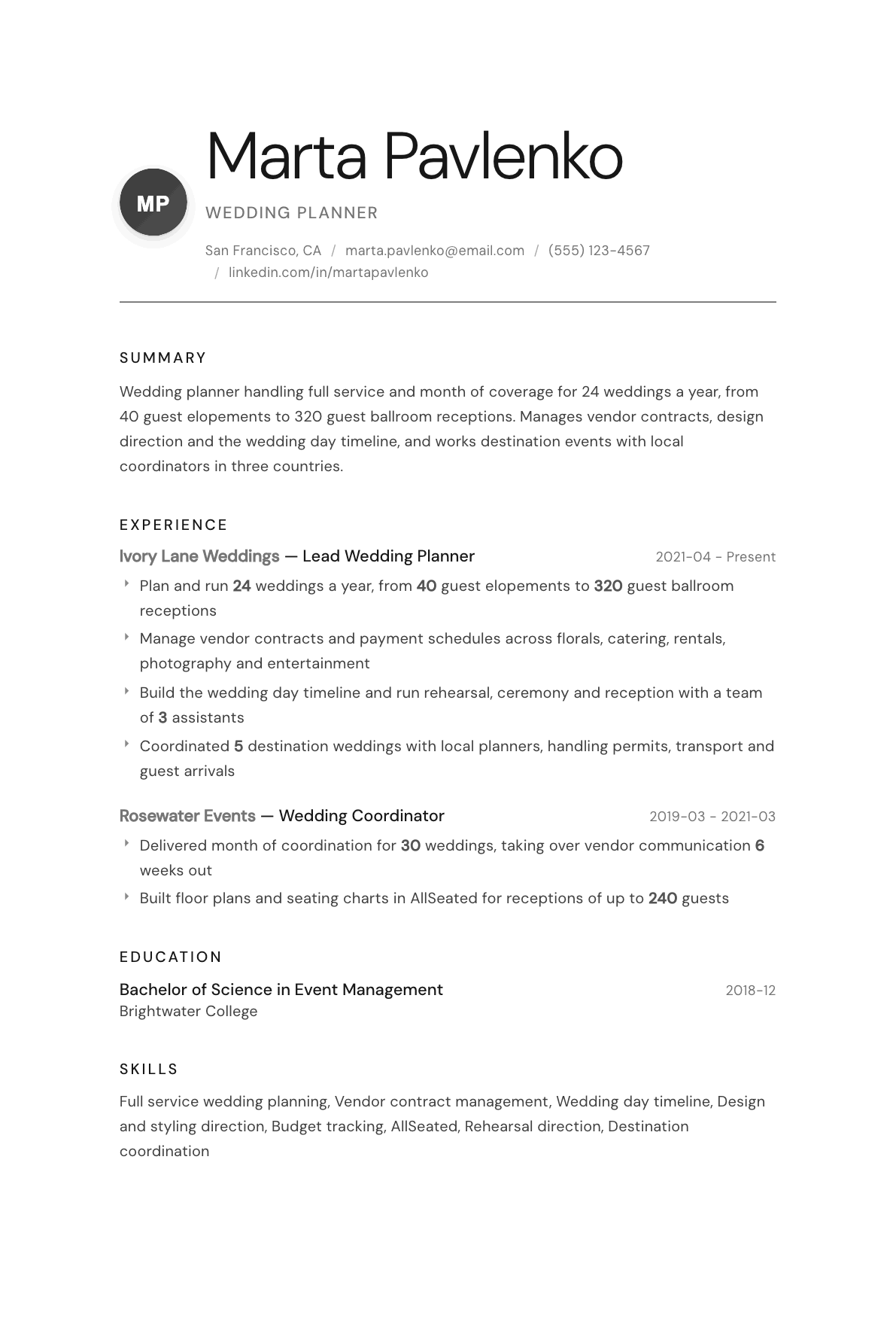
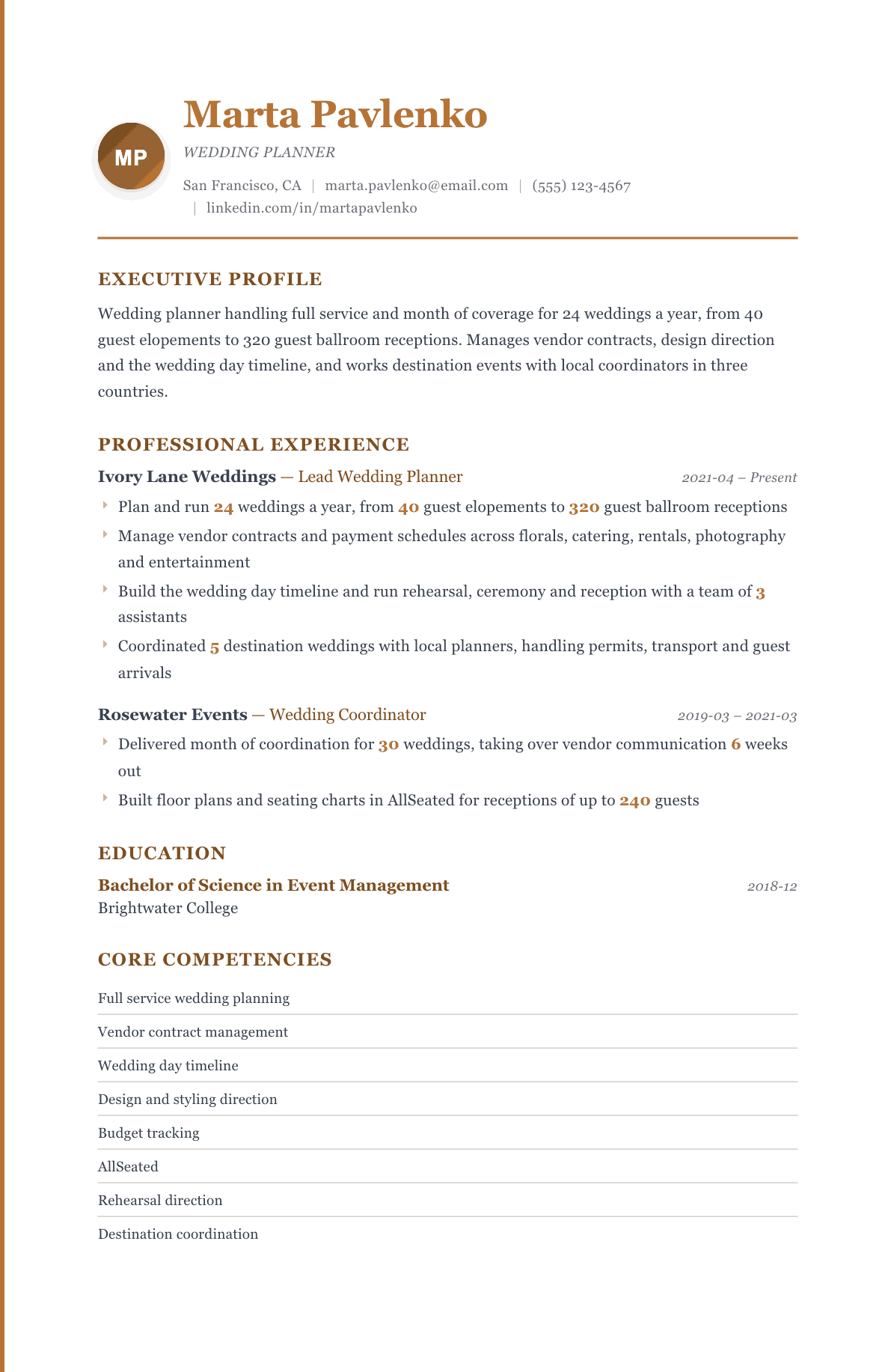
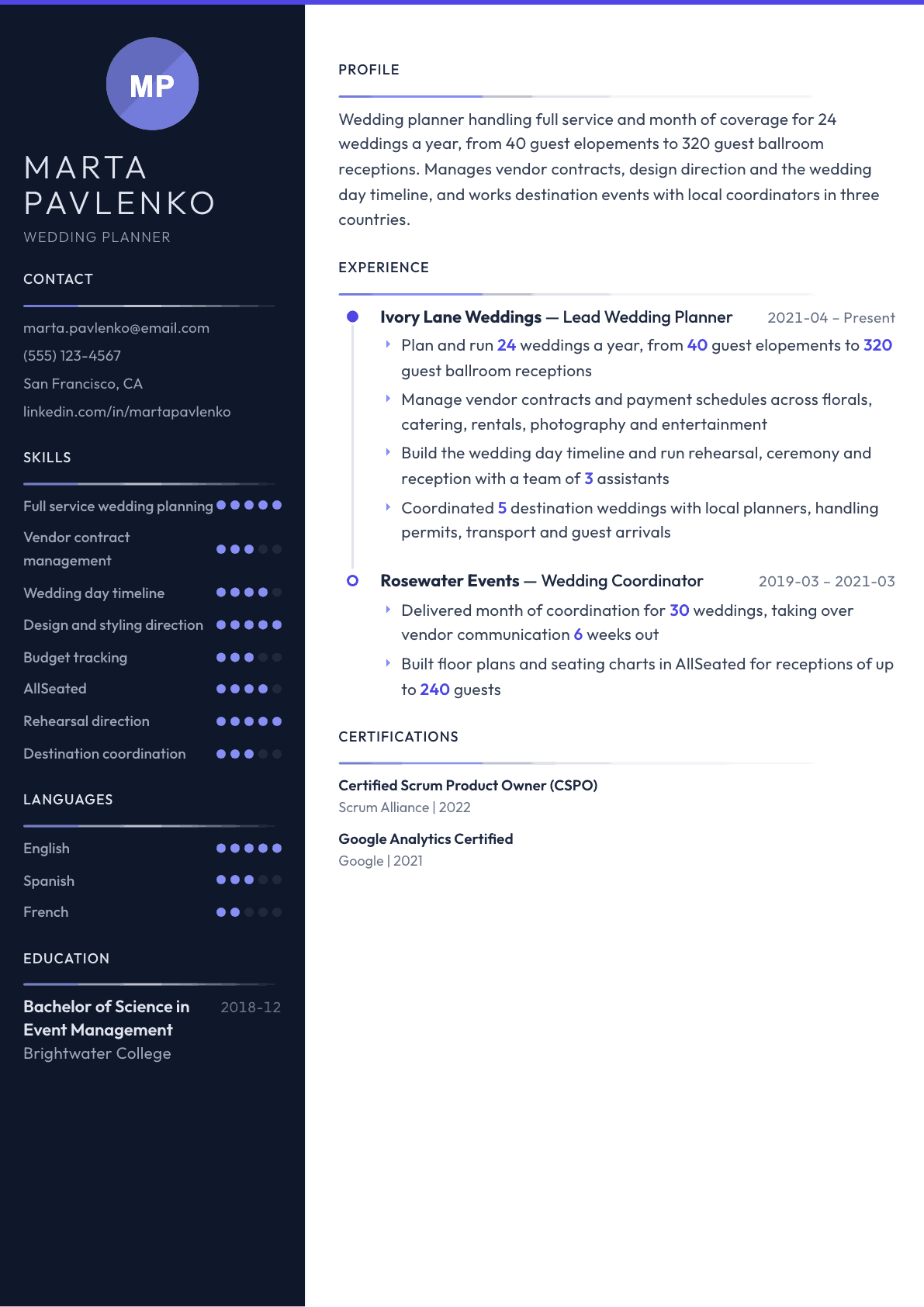
Example Wedding Planner summary
Wedding planner with six years covering full service and month of clients, running about two dozen weddings a year from small elopements to ballroom receptions of more than three hundred guests. Handles vendor contracts, design direction, timelines and destination logistics, and leads a small onsite team through rehearsal and reception. Looking to join a studio building a destination portfolio.
Skills to list on a Wedding Planner resume
- Full service wedding planning
- Month of coordination
- Vendor sourcing and contracts
- Budget tracking and payment schedules
- Wedding day timeline
- Floor plans and seating charts
- Design and styling direction
- Rehearsal direction
- Destination wedding logistics
- Guest travel and accommodation blocks
- Aisle Planner
- AllSeated
- Client communication cadence
- Cultural and religious ceremony formats
What actually gets this resume read
- Give weddings per year and guest count range, because studio owners hire against the calendar they need covered.
- Separate service tiers clearly: full service planning, partial planning and month of coordination are different jobs.
- Show budget stewardship without naming figures you cannot support, for example tracking, payment schedules and contracts.
- Name the tools you plan in, such as Aisle Planner, Honeybook or AllSeated, and what you build in each one.
- Include destination and multi day events with permits, transport and how you worked with local coordinators.
- Describe how you run the day itself: timeline building, rehearsal direction, and the assistants you led onsite.
How to write a wedding planner resume
A wedding planner resume is read by a studio owner who is protecting her calendar and her reputation at once. She wants to know how many weddings you can carry in a season, what size and style of celebration you have actually run, and whether couples came out of the experience calm.
The service tier matters more than any adjective. Full service planning, partial planning and month of coordination are three separate products with different workloads and different client expectations, and a resume that blurs them tells the reader nothing about what you can be assigned.
What follows is how to structure the resume, three summaries from an assistant through a lead planner with a destination portfolio, before and after bullets, and the questions planners ask when they move from freelance work into a studio or the other way.
Format: a calendar, not a duty list
Lead with the shape of your year. Weddings per season, guest count range, service tiers offered and the venues or regions you know. A studio owner is filling dates, so a resume that reads like a calendar answers her question before the bullets start.
Keep it to one page early and two once you have a destination or multi day portfolio. Plain layout, no photographs of your work on the resume itself. Put the portfolio behind a link in your contact line and let the page stay readable.
- Weddings per year, split by service tier.
- Guest count range, from small ceremonies to large ballroom receptions.
- Venue types worked: hotel ballroom, barn, estate, garden, place of worship, private residence.
- Cultural and religious ceremony formats you have run.
Service tiers: say exactly what you delivered
Full service planning is design, budget, vendor selection and management, and the day itself, usually across a year or more with a couple. Partial planning picks up an existing set of decisions. Month of coordination takes over vendor communication several weeks out and executes someone else plan.
Write each tier separately with the count attached. Doing thirty month of weddings and doing thirty full service weddings are not comparable workloads, and a studio hiring for a full service seat will pass on a resume that hides which one you did.
Vendors, budget and the paperwork behind a wedding
The unglamorous half is what makes a planner employable. Vendor sourcing and contracts, payment schedules and deposit deadlines, insurance and venue requirements, rental orders with counts, and the budget tracker a couple actually looks at. Say which of these you owned rather than assisted on.
Describe budget stewardship without publishing numbers. Tracking against category, flagging an overrun early, renegotiating a rental order, and explaining a trade off to a couple are all things a studio owner needs to know you can do without her in the room.
Design and the day itself
Design direction deserves its own lines if you do it: concept development, color and floral direction, tabletop and rental selection, stationery and signage, and working with a florist rather than around one. If you do not design, say so plainly, because plenty of studios pair a designer with a logistics planner.
Then the wedding day. Timeline building backward from the ceremony, the vendor arrival schedule, rehearsal direction, cueing the ceremony, family photograph wrangling, reception flow and the strike at the end. State how many assistants you led and how the day was split between you.
- Timeline built backward from the ceremony with vendor arrival windows attached.
- Rehearsal direction and processional cueing.
- Floor plan and seating chart tool used, with the largest reception you laid out.
- Assistant team size and the coverage split across ceremony and reception.
Destination, tools and the terms studios search for
Destination work is a premium line, so give it detail: countries or regions, how you worked with a local coordinator, permits and marriage requirements handled, guest travel and accommodation blocks, and multi day programs with a welcome party and a farewell brunch.
Name your tools. Aisle Planner, Honeybook or a comparable client system for proposals, contracts and payments, and a floor plan tool such as AllSeated for layouts. Studio postings repeat terms like full service, month of coordination, vendor management, timeline, seating chart, design direction and client communication, so mirror the ones you own.
Wedding Planner resume summary examples
Assistant planner
Wedding assistant with two seasons supporting a studio across roughly forty celebrations, covering ceremony setup, vendor arrivals and reception flow. Builds seating charts and timelines under a lead planner, has run three small weddings independently, and is ready for a coordinator seat carrying her own dates.
Lead coordinator
Wedding planner running twenty four celebrations a year across full service and month of clients, from forty guest ceremonies to three hundred guest ballroom receptions. Manages vendor contracts and payment schedules, builds the wedding day timeline, and leads a team of three assistants through rehearsal and reception.
Destination lead
Senior planner with a destination portfolio across three countries, delivering multi day programs with welcome events, ceremony and farewell brunch. Works with local coordinators on permits and marriage requirements, manages guest travel and accommodation blocks, and mentors two coordinators inside the studio.
Work experience bullets: before and after
Before: Planned weddings for clients.
After: Planned and ran twenty four weddings a year, from forty guest elopements to three hundred and twenty guest ballroom receptions, across full service and month of tiers.
Count, guest range and service tier together tell a studio owner exactly what you can be assigned.
Before: Worked with vendors.
After: Managed vendor contracts and payment schedules across florals, catering, rentals, photography and entertainment, tracking deposit deadlines for every couple.
The categories and the payment discipline show contract ownership rather than friendly coordination.
Before: Made the wedding day schedule.
After: Built each wedding day timeline backward from the ceremony with vendor arrival windows attached, then ran rehearsal, processional cues and reception flow.
Backward timeline building is the craft of the job, and naming it proves you were not handed the schedule.
Before: Did destination weddings too.
After: Coordinated five destination weddings with local planners, handling permits, marriage requirements, guest transport and staggered arrivals over three days.
The specifics of destination work are what justify the premium a studio charges for it.
Before: Kept couples calm and happy.
After: Held a fixed communication cadence with each couple, a scheduled call every month and a written recap after every vendor meeting.
A stated cadence turns a feeling into a repeatable practice a studio can rely on.
Hard skills
- Full service wedding planning
- Month of coordination
- Vendor sourcing and contract management
- Budget tracking and payment schedules
- Wedding day timeline construction
- Floor plans and seating charts
- Design and styling direction
- Rehearsal and ceremony direction
- Destination logistics and permits
- Guest travel and accommodation blocks
- Aisle Planner
- AllSeated
Soft skills
- Family diplomacy
- Expectation setting with couples
- Calm under a fixed deadline
- Vendor relationship building
- Written communication with couples
Certifications worth listing
- Accredited Bridal Consultant (Association of Bridal Consultants)
- Certified Wedding Planner (Certified Wedding Planner Society)
- Certified Meeting Professional (CMP) (Events Industry Council)
Mistakes that cost wedding planner candidates the interview
- Blurring full service planning and month of coordination into one number, which misrepresents the workload.
- Skipping guest count ranges, so a studio cannot tell whether you have handled a large reception.
- Listing pretty adjectives about aesthetics with no evidence of contract, budget or timeline ownership.
- Leaving out the assistants you led on the day, which makes the reader assume you worked alone on small events.
- Ignoring cultural and religious ceremony formats when a studio serves communities that expect that knowledge.
- Putting photographs and heavy graphics on the resume file instead of linking a portfolio and keeping the page readable.
Wedding Planner resume questions
How many weddings a year should a planner have on a resume?
Give the real number and split it by tier. Studio owners are matching you to a calendar, so twenty full service weddings and twenty month of weddings read very differently even though the count is identical.
Do I need a wedding planning certification to be hired?
Not usually. Studios hire on portfolio, references and how you talk through a difficult wedding day. A credential helps a career changer show formal training, but it never outweighs a season of celebrations you can describe in detail.
How do I write a resume when I have been freelance the whole time?
Treat your own business as the employer, give the years, the weddings per season and the service tiers, and name the venues and vendor partners you work with regularly. That reads as a real operation, because it is one.
Should I include the budgets of weddings I have planned?
Describe the scale in guest counts and service scope instead. Budget figures vary enormously by market and by what is included, so they invite misreading, while guest counts and vendor scope travel cleanly between regions.
What does a studio look for that most applicants leave out?
Evidence you can hold a difficult day together: a vendor arriving late, weather forcing an indoor move, or a family dispute during photographs. One honest example of a recovery is worth more than a page of design language.
Related resume examples
- Event Planner Resume example
- Banquet Manager Resume example
- Event Manager Resume example
- Catering Sales Manager Resume example
- Camp Director Resume example
- Concierge Resume example