Catering Manager Resume Examples: the lines they read
Build a Catering Manager Resume That Wins Clients
By Mustafa Tarabya, founder of CVBooster · Published · Updated
Create an impressive Catering Manager resume showcasing event coordination, client relationship management, menu planning, and revenue generation for hospitality businesses.
Sample resumes for a catering manager
The same catering manager content laid out in three CVBooster templates, so you can see what the finished document looks like before you write a word.
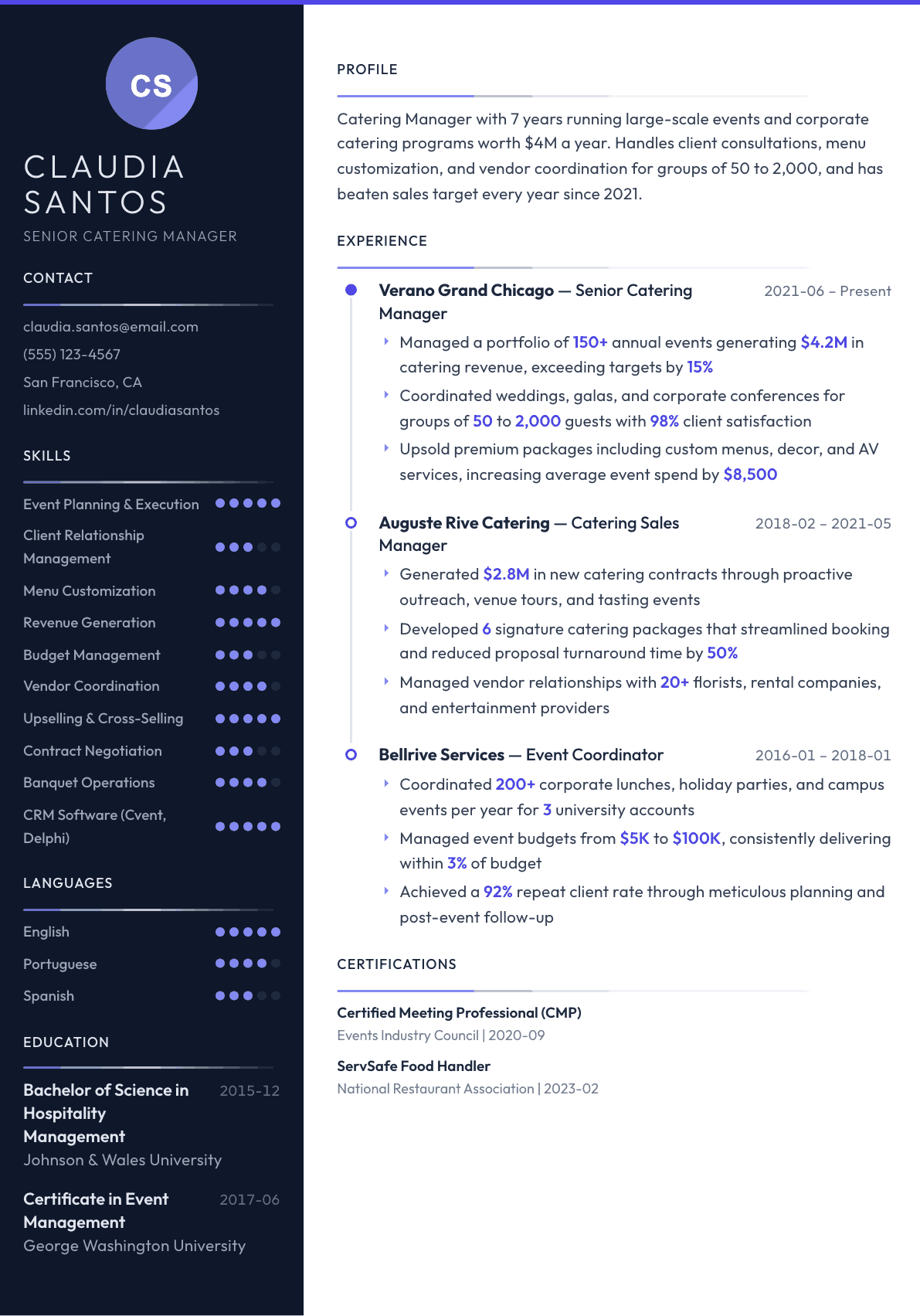
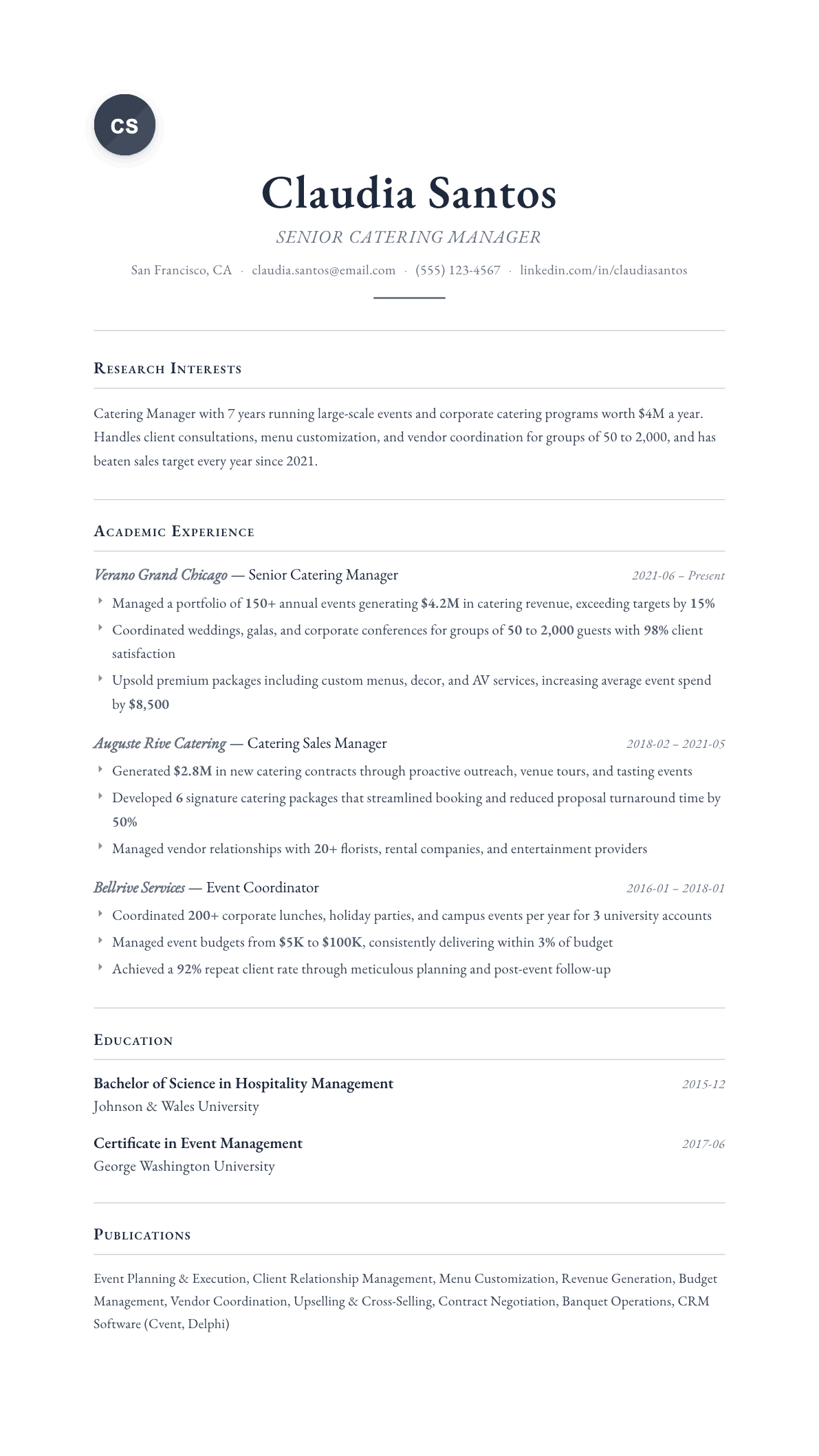
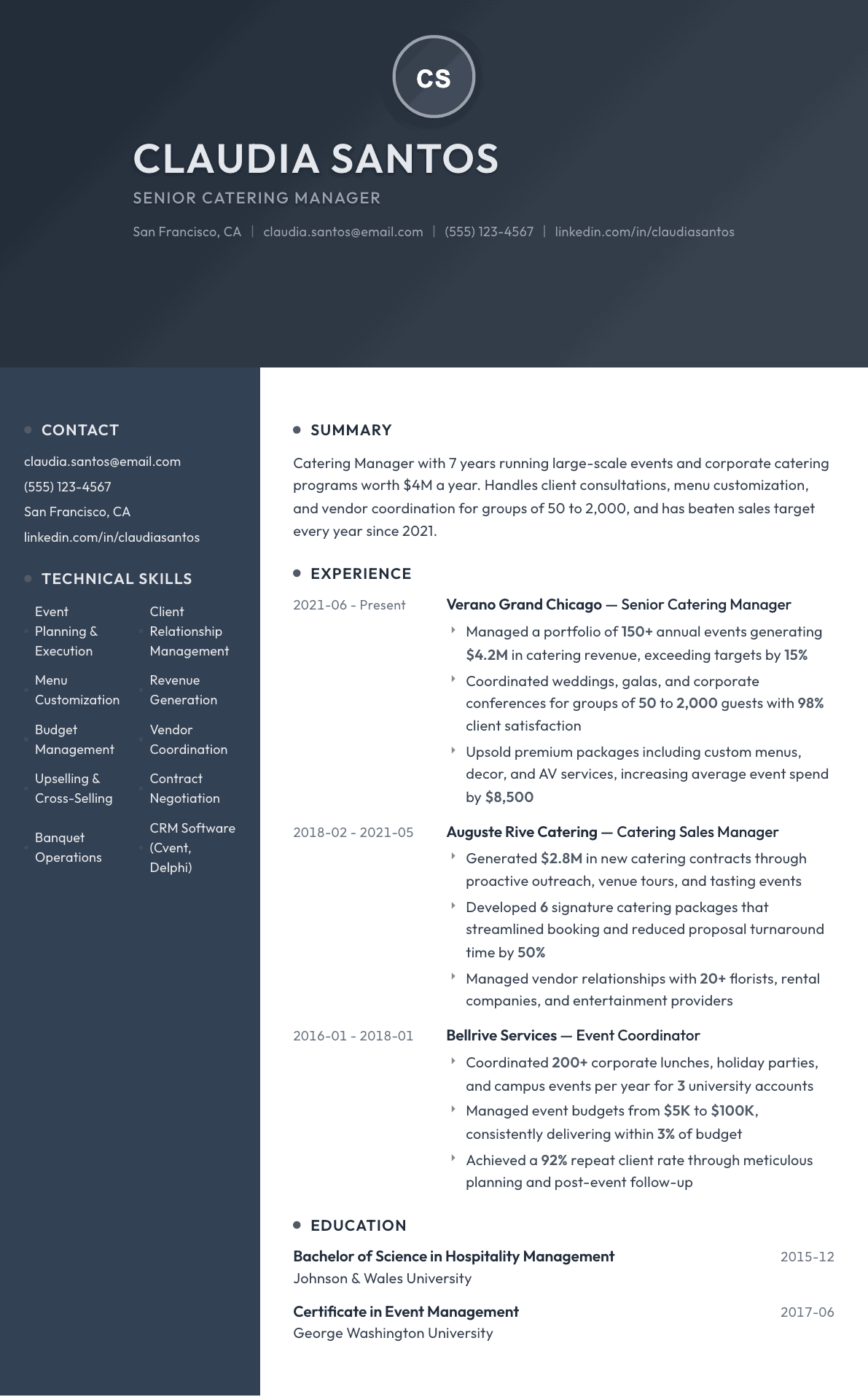
Example Catering Manager summary
Catering Manager delivering 150+ events a year and $4.2M in revenue, from 50-guest board dinners to 2,000-guest galas. Raised average event spend by $8,500 through package upsells and holds 98% client satisfaction. CMP certified.
Skills to list on a Catering Manager resume
- Event Planning & Execution
- Catering Sales
- Client Relationship Management
- Menu Development
- Budget Management
- Vendor Coordination
- Contract Negotiation
- Upselling
- Banquet Operations
- CRM (Cvent, Delphi)
- Food & Beverage Knowledge
- Team Leadership
- Site Inspections
- Post-Event Analysis
What actually gets this resume read
- Lead with revenue metrics: total catering revenue managed, sales targets exceeded, and average event value increases.
- Highlight event scale diversity: weddings, corporate conferences, galas, and casual events with guest count ranges.
- Showcase client retention rates and satisfaction scores as evidence of relationship management skills.
- Include CRM and event management software experience (Cvent, Delphi, Social Tables, Tripleseat).
- Demonstrate upselling achievements with specific dollar increases per event or contract.
How to write a catering manager resume
A catering manager resume is read by a director of catering, a general manager or a catering company owner who is looking at one line before anything else: how much business did you book, and did it come back. Catering is a sales job wearing an operations uniform. You are measured on revenue booked, average check per event, conversion from inquiry to contract, and repeat rate, and a resume that only describes coordinating events reads as an assistant's resume.
The second thing that reader checks is the segment. On-premise hotel and venue catering, off-premise drop-off and full service catering, corporate and campus contract catering, and social and wedding catering are four different businesses with different margins, different lead times and different competition. Say which one you come from in the first line or your experience is unreadable.
This guide covers each section in the order a catering director scans it, with example summaries for a catering coordinator, a working catering manager and a director of catering, before and after bullets that turn duties into commercial results, and the questions people ask when they cross between hotel catering and independent catering companies.
Format: two pages once you have a book of business
One page while you are a coordinator, two once you carry a quota. Reverse chronological. Under each job put the venue or company, the segment, the maximum guest count you handle, and the annual catering revenue the operation produced, because those four facts set the frame for every bullet beneath them.
Keep a short account section if you have named corporate or institutional accounts you managed. Catering hiring is partly about the relationships you can bring, and a list of account types, such as pharmaceutical sales meetings, law firm client dinners or university development events, tells a director whether your network matches their market.
- Header: name, city and state, phone, email, food safety and alcohol certification.
- Order: summary, experience, key accounts or event types, systems, certifications, education.
- Give each job a segment label so the reader is never guessing between hotel, off-premise and contract catering.
Summary: revenue, event volume, guest range and win rate
Four lines at most. Name the segment, the annual catering revenue you were responsible for, the number of events per year, the guest count range you have executed, and your conversion or repeat rate if you know it. Those five numbers are the entire commercial profile of a catering manager.
Add one differentiator that matches the market you are applying into. Kosher or halal service, dietary and allergen programs at scale, tented and off-grid events with generator and kitchen build, multi-day conference feeding, or high-touch social work each signal a different capability.
Experience: booking, proposal, tasting, execution, and the money after
Follow the sales cycle in your bullets, because it is what a director recognizes. Lead generation and outreach: venue tours, tastings, wedding shows, corporate prospecting, and inbound inquiry response time. Proposal and contract: menu customization, pricing and package design, deposits, cancellation terms, and the contract you actually wrote. Handoff: the banquet event order or event brief, the kitchen production sheet, the rentals order and the staffing plan.
Then the execution and the reconciliation. Vendor coordination with rentals, floral, entertainment and audio visual. On-site management and the size of the crew you directed. Final billing, guarantee versus actual counts, and the post-event follow up that produces the rebooking. Catering managers who never mention final billing look like they hand the account off before the hard part.
Quantify with the department metrics: revenue booked, average spend per event or per guest, upsell attachment on bar, dessert or premium menu, food cost against the quoted package, and repeat and referral rate. A single line saying you exceeded a booking target is worth more than a paragraph about attention to detail.
Menus, kitchen partnership and dietary handling
A catering manager who cannot talk to a chef gets overruled by one. Show the kitchen side: how you built packages with the chef, how you priced against food cost, how you handled production capacity limits on a heavy weekend, and how you managed guarantees so the kitchen was not producing meals no one paid for.
Dietary and allergen management deserves its own bullet. Tracking counts for vegetarian, vegan, gluten-free, nut allergy, kosher and halal meals, labeling on the buffet, and the separate service protocol for a severe allergy. Corporate and campus clients now select vendors on this capability, and it is a genuine differentiator on a resume.
- Name the systems: Tripleseat, Caterease, Delphi, Amadeus, Total Party Planner, HoneyBook.
- Say whether you priced the menus or received a price list.
- Include the rental and equipment side: china counts, linen, tenting, kitchen build for off-premise.
Certifications and the licensing reality
Food protection manager certification is expected of anyone with authority over a catering operation, and alcohol service certification is expected wherever you sell or oversee a bar package. Both are short to earn and both belong in a labeled section, not buried in a skills list.
For off-premise work, mention any operating knowledge that a health department cares about: commissary kitchen use, temporary event permits, transport temperature control and the health inspection results your operation held. Certified Professional Catering Executive and hotel industry catering credentials read well for candidates targeting director roles.
Catering Manager resume summary examples
Catering coordinator
Catering coordinator with 2 years supporting a hotel catering team, building banquet event orders for 200 events a year, managing rental orders and dietary counts, and running day-of coordination for groups up to 300. Food protection manager certified and trained on Tripleseat.
Catering manager
Catering manager booking 150 events a year in corporate and social segments, from 50-guest dinners to 2,000-guest galas, and carrying a revenue target exceeded by 15% for two consecutive years. Grew average event spend through premium bar and dessert attachment and held a 92% repeat rate on corporate accounts.
Director of catering
Director of catering for an off-premise company serving a metropolitan market, leading four managers and a coordinator team across 400 events a year. Rebuilt the package and pricing structure with the executive chef, opened three institutional accounts, and cut proposal turnaround by half.
Work experience bullets: before and after
Before: Managed catering events for clients.
After: Booked and executed 150 events a year across corporate, social and nonprofit segments, from 50-guest board dinners to 2,000-guest galas, carrying the account from first inquiry through final invoice.
Event count, segment mix and guest range establish the scale, and owning the account end to end shows it was your book.
Before: Increased catering sales.
After: Exceeded the annual catering revenue target by 15% by adding structured venue tours and quarterly tasting events, converting inquiries at a rate well above the prior year.
Naming the tactic that produced the growth turns a claim into a repeatable method a director can buy.
Before: Created catering menus and proposals.
After: Built six signature packages with the executive chef priced against a target food cost, which standardized quoting and cut proposal turnaround from four days to under two.
Working with the chef against a cost target and reporting the turnaround shows commercial and operational judgment together.
Before: Worked with vendors for events.
After: Coordinated 20 rental, floral, entertainment and audio visual vendors per season, holding one delivery timeline per event and reconciling rental counts against the invoice after every load-out.
The reconciliation detail proves you managed the cost tail of the event, not just the pretty part.
Before: Handled dietary requirements for guests.
After: Tracked vegetarian, vegan, gluten-free and severe allergy counts per event in the event brief, ran labeled separate service for allergy meals, and closed two years of institutional accounts with no allergen incident.
A named process and a clean record answer the compliance question that institutional clients ask first.
Hard skills
- Catering sales and prospecting
- Proposal and contract writing
- Menu package pricing to food cost
- Banquet event order preparation
- Guarantee and final count management
- Vendor and rental coordination
- Tripleseat and Caterease
- Delphi and Amadeus sales and catering
- Event budgeting and final billing
- Dietary and allergen management
- Off-premise logistics and transport temperature control
- Staffing plans and on-site crew management
Soft skills
- Client consultation
- Negotiation on scope and price
- Chef partnership
- Account retention
- Composure during load-in
- Written clarity in contracts
Certifications worth listing
- ServSafe Food Protection Manager (National Restaurant Association)
- ServSafe Alcohol (National Restaurant Association)
- TIPS Alcohol Certification (Health Communications, Inc.)
- Certified Professional Catering Executive (CPCE) (National Association for Catering and Events)
- Certified Meeting Professional (CMP) (Events Industry Council)
Mistakes that cost catering manager candidates the interview
- Writing a coordination resume with no revenue, no event count and no conversion number for a job that carries a quota.
- Failing to name the segment, so a hotel director cannot tell whether you have ever worked on premise.
- Stopping the story at execution and never mentioning guarantees, final billing or rebooking.
- Listing event software generically rather than naming the platform, which is a direct predictor of ramp-up speed.
- Ignoring the kitchen relationship, which makes you look like someone who sells menus the chef cannot produce.
- Leaving food protection manager and alcohol certification off a resume for a role that supervises both.
Catering Manager resume questions
What is the difference between a catering manager and an event planner resume?
A catering manager sells and delivers food and beverage for a venue or a catering company and carries a revenue number. An event planner produces the whole event for a client across many vendors. Write toward the revenue and menu side for catering roles.
How do I show catering revenue without sharing confidential numbers?
Use ranges and percentages against target rather than exact figures, for example exceeding an annual booking target by a stated margin or growing average event spend. Directors care that you carried a number and hit it, not the precise value of your former employer's book.
Can I move from hotel catering to an independent catering company?
Yes, but translate the operations. Off-premise work adds transport, temporary permits, commissary kitchens, generator power and full equipment build. Lead with any off-site, tented or remote event you have executed and be honest about what you would be learning.
Should I list the accounts I managed?
List account types rather than confidential client names unless the relationship is public. Pharmaceutical sales meetings, law firm client dinners, university development events and association conferences each tell a director whether your network matches their target market.
How important is the tasting on a catering resume?
Very, because tastings are where contracts close. Say how many you ran, whether you designed the tasting menu with the chef, and what your conversion looked like afterward. It is one of the few places a catering manager can prove selling ability on paper.
Related resume examples
- Event Planner Resume example
- Restaurant Manager Resume example
- Food & Beverage Director Resume example
- Event Manager Resume example
- Banquet Manager Resume example
- Event Coordinator Resume example