Executive Assistant Resume Examples: what gets the call
Build an Executive Assistant Resume That Impresses the C-Suite
By Mustafa Tarabya, founder of CVBooster · Published · Updated
Craft a professional executive assistant resume with CVBooster. Highlight C-level support experience, strategic planning, and top-tier organizational skills.
Sample resumes for a executive assistant
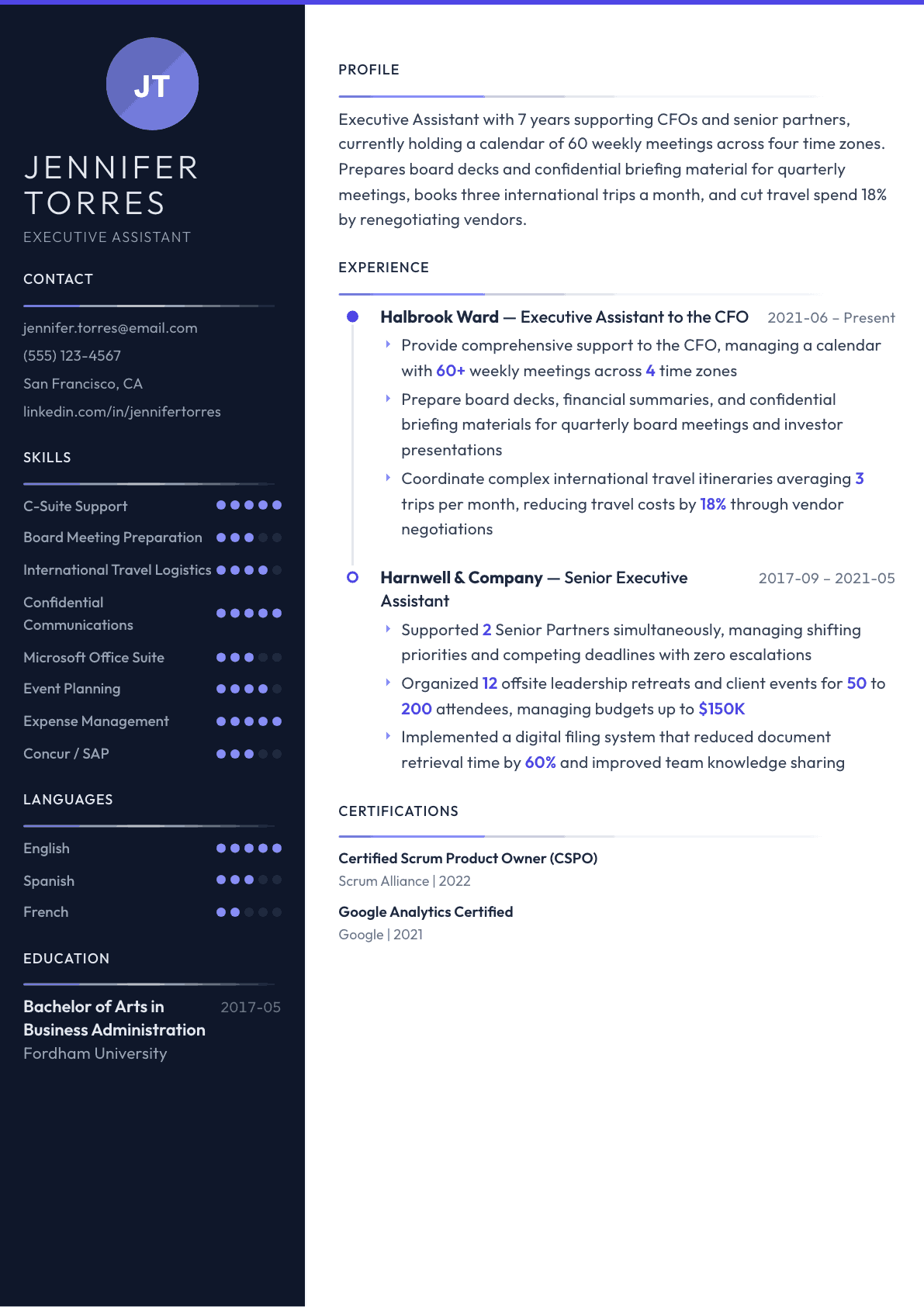
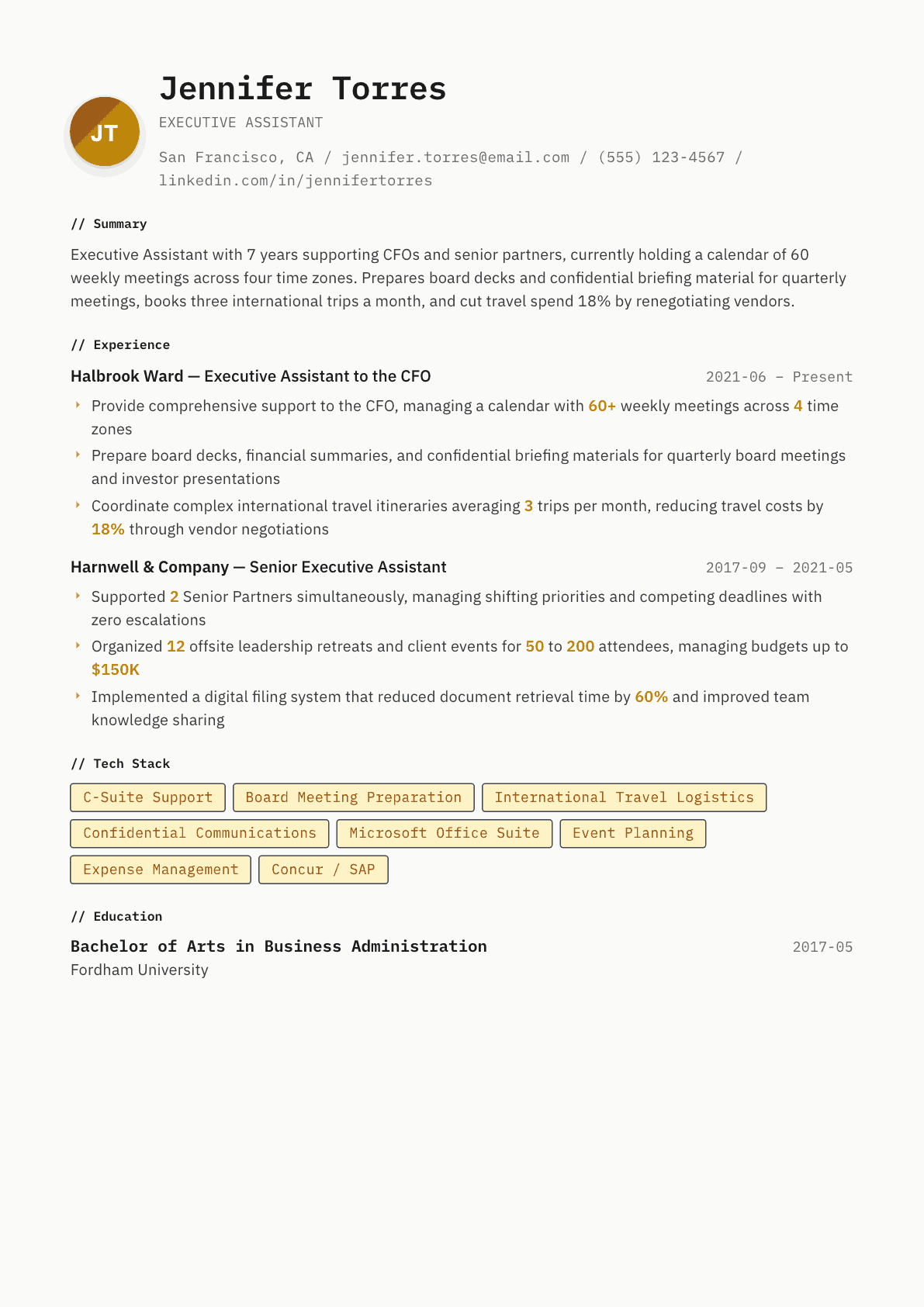
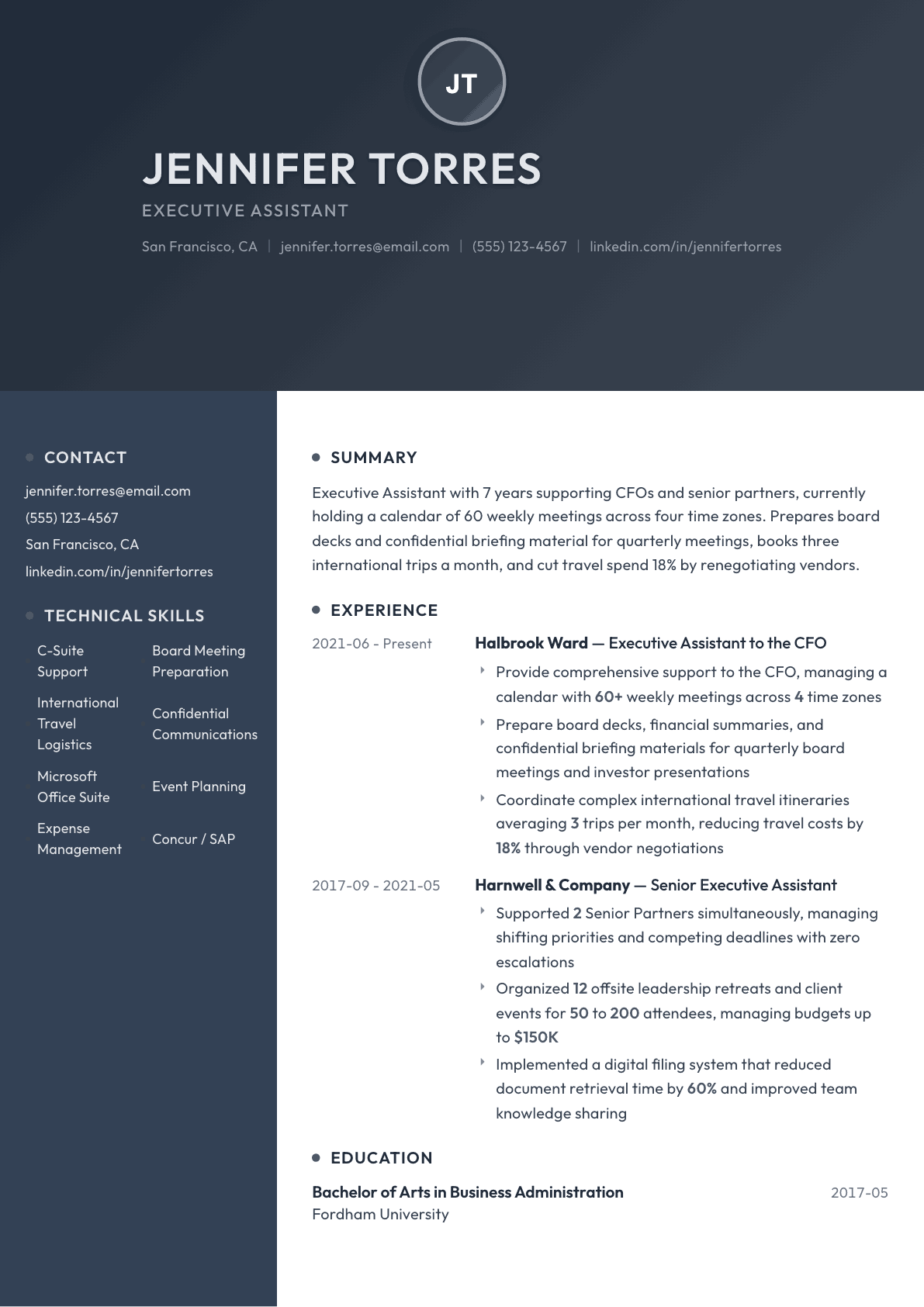
The same executive assistant content laid out in three CVBooster templates, so you can see what the finished document looks like before you write a word.
Example Executive Assistant summary
Executive assistant to a CFO, 7 years, owning a 60-meeting week across four time zones, quarterly board packs and investor presentation logistics. Ran 12 leadership offsites for up to 200 people on budgets to $150K and built the digital filing system that cut document retrieval time 60%.
Skills to list on a Executive Assistant resume
- C-Suite Support
- Board Meeting Preparation
- International Travel Logistics
- Calendar Management
- Confidential Communications
- Event Planning & Coordination
- Expense Management
- Concur / SAP
- Microsoft Office Suite
- Stakeholder Communication
- Project Coordination
- Vendor Management
What actually gets this resume read
- Emphasize the seniority of the executives you supported, whether CEO, CFO, or SVP, to signal the level of trust and discretion required.
- Quantify your calendar complexity: number of meetings managed per week, time zones coordinated, or scheduling conflicts resolved.
- Highlight event and travel management with specific metrics: attendee counts, budget sizes, or cost savings achieved.
- Showcase your ability to handle confidential and sensitive information with discretion.
- List specialized tools: Concur, SAP, Navan, Asana, Slack, or board portal software like Diligent or BoardEffect.
- Demonstrate proactive problem-solving by describing situations where you anticipated needs or averted potential issues.
How to write a executive assistant resume
An executive assistant resume is a trust document. The person reading it, often the executive herself or a chief of staff, is deciding whether to hand a stranger her calendar, her inbox, her travel, her board materials and a great deal of information she cannot discuss at home. That decision is made on seniority of prior principals, tenure, and evidence that you exercised judgment rather than took instruction.
Seniority of the principal is the fastest signal on the page. Supporting a chief executive of a listed company, a founder of a growing firm, a hospital chief medical officer or a partner group are all demanding jobs, but they are not interchangeable, and the reader is matching yours to hers. Name the title you supported, the size of the organization and how many principals you carried at once.
This guide covers how to structure an executive assistant resume, how to write about confidential work without breaching it, three summaries from first support role to executive assistant to a chief executive, before-and-after bullets, and the questions assistants ask when they are moving up a level or across an industry.
Format: two pages once you have supported at the top
One page early in a support career, two once you have carried senior principals for several years, because the reader needs to see tenure and continuity rather than a compressed list. Long stays are an asset in this field and should be visible at a glance, so keep dates clean and never hide a gap with a vague year range.
Under each role, name the principal by title, never by name, along with the size of the organization and the scope of your remit. "Executive assistant to the chief financial officer of a listed manufacturer, supporting a leadership team of 9" tells the reader more than any three achievement bullets that follow it.
- Header: name, city and state, phone, email, LinkedIn.
- Section order: profile, executive support scope, experience, technical skills, education and certifications.
- Say how many executives you supported simultaneously and at what level.
Profile: principal, remit, and the thing you protect
Three or four lines. Who you support and at what level, the remit beyond the calendar, and the quality that makes you the right hire for this particular executive. Some principals want an assistant who guards time ruthlessly, others want one who runs the office, briefs the leadership team and prepares the board pack. Read the posting for which and lead with that.
Avoid describing yourself as a gatekeeper without evidence. The persuasive version is a mechanism: a weekly calendar review with the principal, a triage rule for meeting requests, a briefing note delivered the evening before, or a standing block that never moves. Mechanisms show that you manage the executive rather than react to her.
Experience: calendar, travel, board, inbox, and the office
Calendar is the core of the job, so quantify it. Meetings per week, time zones spanned, the number of standing forums you owned, how conflicts were resolved, and whether you had authority to decline on the principal's behalf. That last point is a genuine seniority marker and most assistants leave it out.
Travel deserves the same precision. Trips per month, domestic and international, visa and immigration handling, itinerary structure, ground arrangements, and how you handled a disruption at short notice. A single bullet about rerouting an executive overnight after a cancellation is worth more than a general claim of travel expertise.
Board and governance work is what separates senior assistants. Preparing board packs, coordinating with directors and their offices, managing document distribution securely, taking or formatting minutes and tracking actions between meetings all belong on the page, described by process rather than by content.
Then the inbox and the office. Managing correspondence on behalf of a principal, drafting replies in her voice, running the leadership team meeting rhythm, and coordinating offsites, town halls and executive events are the parts that make you the operating system of the office rather than a scheduler.
Confidentiality: prove it by how you write
This section is the interview in miniature. Describe categories of work rather than content: board materials, compensation letters, restructuring plans, legal correspondence, investor communications and personnel matters can all be named without disclosing anything. Any detail that would identify a person, a deal or a decision does not belong on a resume, and including one is disqualifying to an experienced reader.
The same restraint applies to your principal. Naming a former chief executive personally, even admiringly, tells the next one exactly how she would be discussed. Use the title and the organization type, and let the discretion itself be the credential.
- Name categories, never contents.
- Refer to principals by title, not by name.
- Mention any confidentiality agreement or security clearance you held, without detailing what it covered.
Skills, tools and the keyword pass
Name the stack: Outlook and calendar delegation, Teams or Zoom including webinar setup, Concur or a comparable expense system, travel booking platforms, board portals such as Diligent or Boardvantage, document signature tools, and the presentation software you build decks in. Board portal experience in particular is a strong differentiator and is often listed as required.
For the keyword pass, mirror the posting once in the skills block and once inside a bullet: complex calendar management, international travel coordination, board meeting preparation, expense reporting, confidential correspondence, stakeholder liaison and event management. Then read the whole document once for tone, because an executive assistant resume with a careless error contradicts the only product being sold.
Executive Assistant resume summary examples
Moving up from administration
Administrative professional with three years supporting a department of 30, including calendar and travel for 2 directors. Runs the monthly leadership meeting rhythm, prepares agendas and minutes, and manages expenses in Concur. Seeking a first executive assistant role supporting a senior leader.
Six years in
Executive assistant with six years supporting vice presidents in professional services, currently managing a calendar of 50 weekly meetings across three time zones and 3 international trips a month. Prepares leadership team materials, coordinates quarterly offsites for 60 attendees, and handles confidential correspondence daily.
Assistant to the chief executive
Senior executive assistant with twelve years supporting chief executives and chief financial officers, currently sole assistant to the chief executive of a mid-sized firm. Owns board pack preparation for 4 meetings a year, director liaison, executive travel, and the leadership meeting calendar for a team of 11.
Work experience bullets: before and after
Before: Managed the executive calendar and scheduled meetings.
After: Managed a chief executive calendar of 55 weekly meetings across four time zones, holding two protected strategy blocks a week and declining or redirecting requests within an agreed triage rule.
Volume, time zones and delegated authority to decline show judgment rather than diary keeping.
Before: Booked flights and hotels for executives.
After: Coordinated 3 international trips a month including visa applications, connecting itineraries, ground transport and a printed briefing pack for each meeting on the schedule.
The frequency and the briefing pack demonstrate anticipation, which is what senior principals actually pay for.
Before: Prepared materials for board meetings.
After: Prepared and distributed board packs for 4 quarterly meetings through a secure board portal, coordinating contributions from 6 executives against a staged deadline and tracking actions between sittings.
The portal, the contributor coordination and the action tracking prove governance work rather than document assembly.
Before: Handled confidential information with discretion.
After: Handled compensation letters, legal correspondence and restructuring documents under a confidentiality agreement, controlling distribution lists and version access for each set of materials.
Naming the categories and the controls you applied evidences discretion without revealing anything sensitive.
Before: Organized company events and offsites.
After: Ran two annual leadership offsites for 60 attendees, managing venue contracts, agenda logistics, travel for 15 remote participants and the post-event action summary.
Attendee counts, contracts and the follow-up summary turn event planning into demonstrated project ownership.
Hard skills
- Complex calendar and diary management
- International travel and visa coordination
- Board pack preparation and portals
- Minutes and action tracking
- Expense management in Concur
- Inbox management and drafting in voice
- Leadership meeting cadence
- Executive event and offsite coordination
- Presentation and deck preparation
- Outlook delegation and Teams administration
- Vendor and contract coordination
- Confidential document control
Soft skills
- Absolute discretion
- Anticipation
- Calm during disruption
- Reading the room
- Saying no on behalf of a principal
- Building trust with directors
Certifications worth listing
- Certified Administrative Professional (CAP) (International Association of Administrative Professionals)
- Organizational Management specialty certificate (International Association of Administrative Professionals)
- Professional Administrative Certification of Excellence (PACE) (American Society of Administrative Professionals)
- Microsoft Office Specialist: Expert (Microsoft)
Mistakes that cost executive assistant candidates the interview
- Never naming the level of the principals supported, which is the first thing an executive checks.
- Listing the same generic administrative duties as an office assistant resume with no governance or travel depth.
- Naming a former executive personally, which signals to the next one how her own affairs would be discussed.
- Describing discretion as a personal quality while including a detail that should never have left the office.
- Leaving out board, committee or investor work when the posting is clearly built around it.
- Hiding tenure by compressing dates, when long service is one of the strongest assets in this field.
- Allowing a single typographical error onto a page whose entire argument is precision.
Executive Assistant resume questions
Should I name the executives I supported on my resume?
Use titles, not names. Executive assistant to the chief financial officer conveys the seniority you need, while naming the person invites a reader to wonder what else you would repeat outside the office.
How long should an executive assistant resume be?
One page for early support careers and two once you have several years with senior principals. Two pages let you show tenure, board work and travel scope, which are exactly the things a compressed page removes first.
What is the difference between an executive assistant and an administrative assistant resume?
Scope and judgment. An administrative assistant resume shows office support across a team, while an executive assistant resume shows a named principal, delegated authority, governance work and confidential material handled under formal restrictions.
How do I show I can support a chief executive when I have only supported directors?
Lead with the elements that scale upward: multi-time-zone scheduling, board or committee exposure, international travel, confidential material and any occasion you deputized for a more senior assistant. Then state the ambition plainly in the profile.
Do executive assistants need certifications?
They are not usually required, but a professional credential signals that you treat this as a career rather than a stopgap. Combined with software certification and long tenure, it strengthens an application competing against candidates with similar experience.
Related resume examples
- Administrative Assistant Resume example
- Office Manager Resume example
- Project Manager Resume example
- Senior Administrative Assistant Resume example
- Recruiting Coordinator Resume example
- Personal Assistant Resume example