Executive Secretary Resume Examples: what gets the call
An Executive Secretary Resume That Shows Board Level Support
By Mustafa Tarabya, founder of CVBooster · Published · Updated
Executive secretary resume example covering board papers, C-suite diaries and minutes, plus keywords and a step by step writing guide.
Sample resumes for a executive secretary
The same executive secretary content laid out in three CVBooster templates, so you can see what the finished document looks like before you write a word.
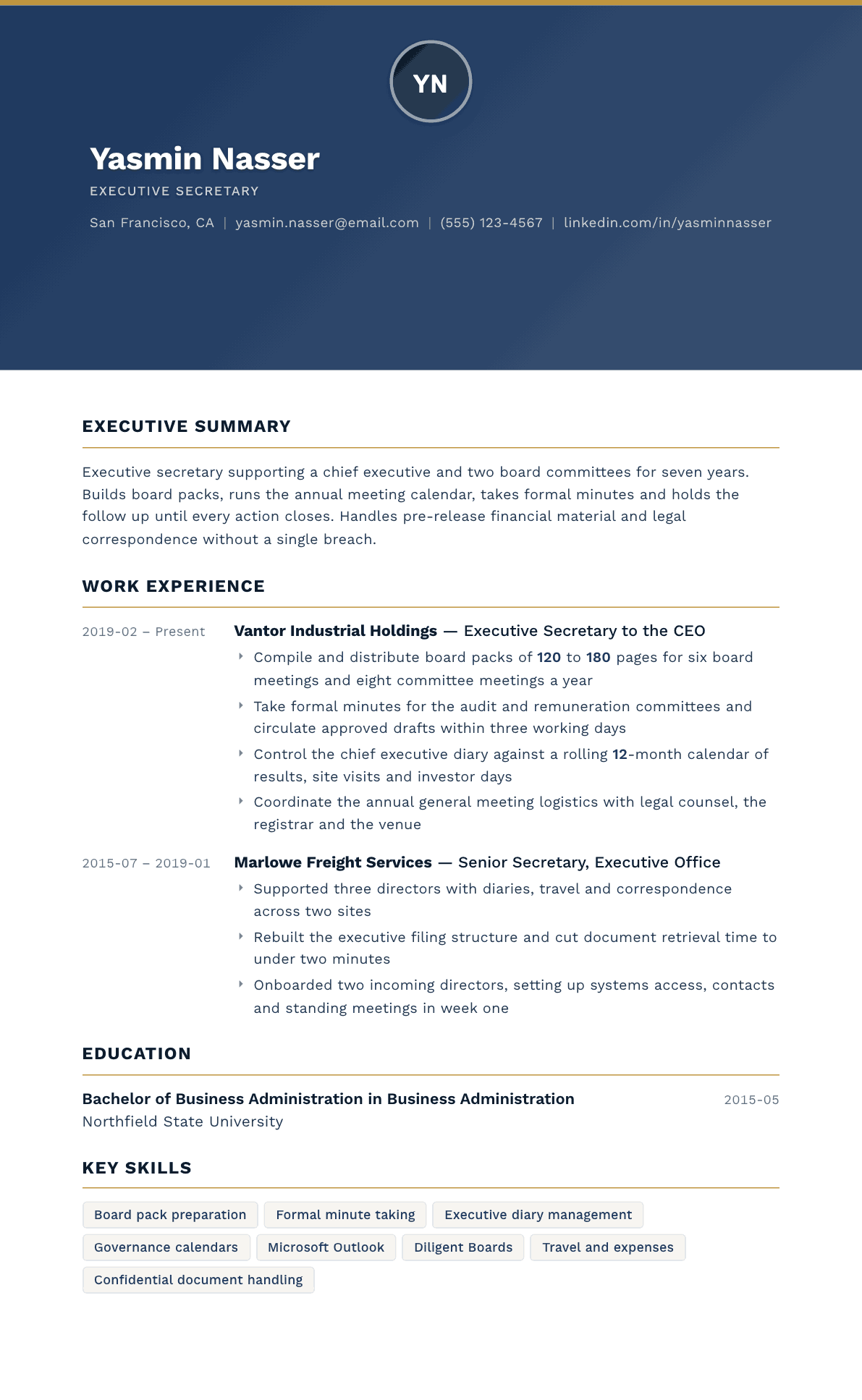
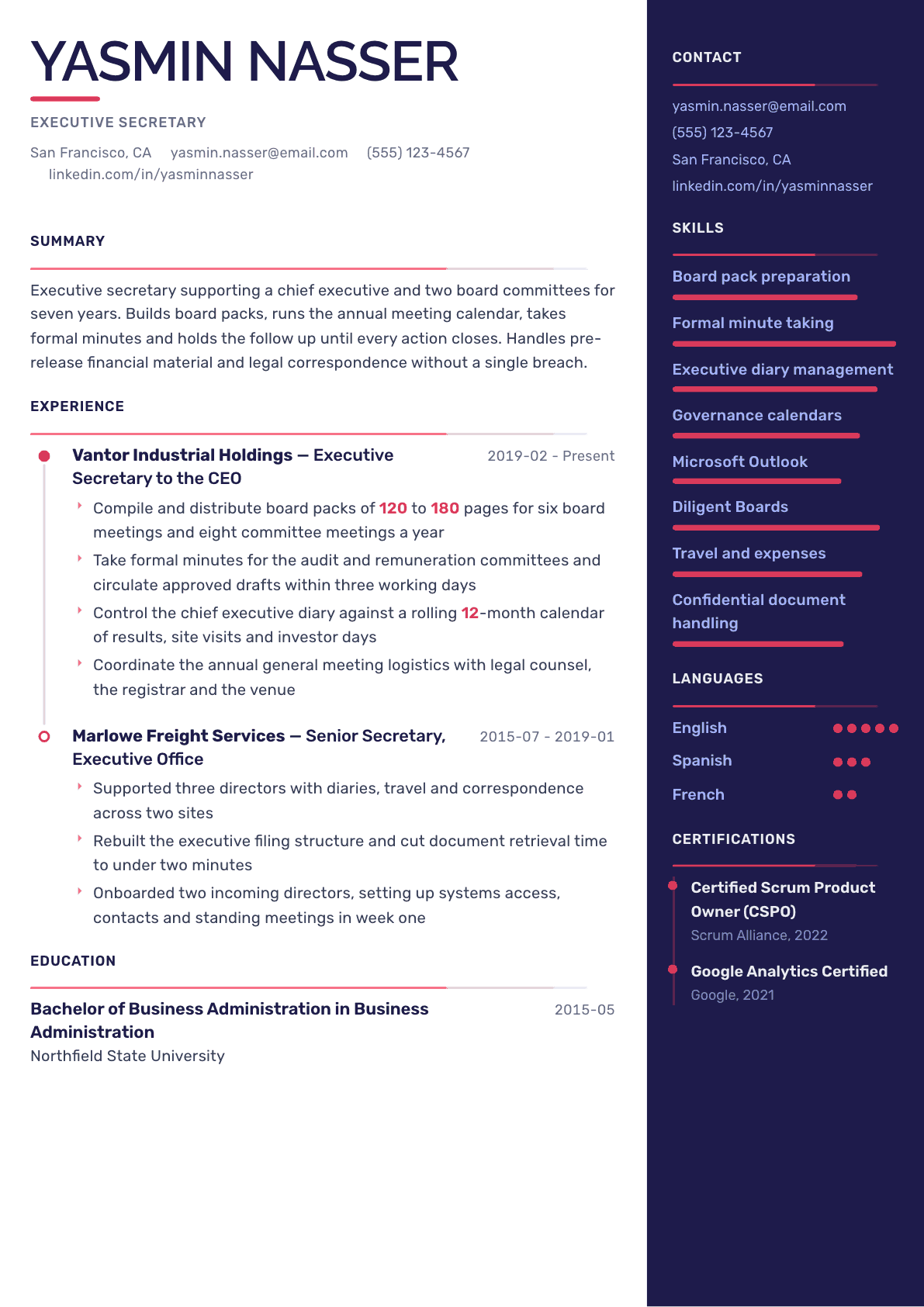
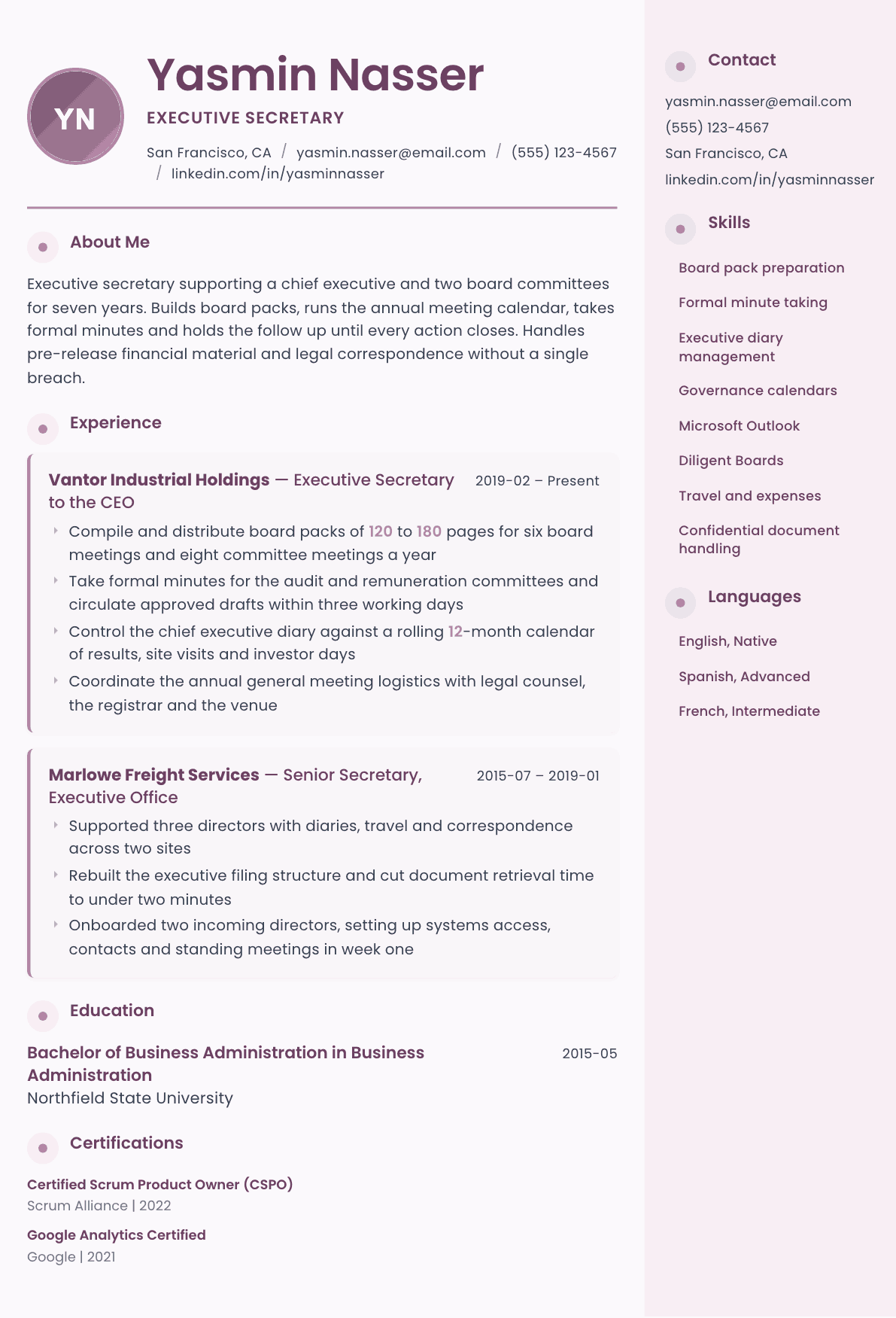
Example Executive Secretary summary
Executive secretary with nine years in the executive office of listed and private companies. Prepares board and committee packs, takes formal minutes, and drives the action log until directors close every item. Runs a chief executive diary against results dates, investor days and site visits, and handles pre-release financial material with strict controls. Seeking a board facing secretarial role.
Skills to list on a Executive Secretary resume
- Board pack preparation
- Formal minute taking
- Action tracking
- Executive diary management
- Governance calendar
- Annual general meeting support
- Microsoft Outlook
- Microsoft PowerPoint
- Board portal administration
- Travel coordination
- Expense approval workflow
- Confidential correspondence
- Stakeholder liaison
- Document control
What actually gets this resume read
- Lead with the level you supported: chief executive, board, committees. That single fact sorts the pile faster than anything.
- Quantify board work with pack size, meeting count per year and how fast approved minutes go out to members.
- Name any board portal you have used, such as Diligent or Boardvantage, since those tools appear directly in postings.
- Show action tracking, not just minute taking, because chasing directors to closure is the part employers value most.
- Reference the confidential material you touched, for example results before release or remuneration papers.
- Give tenure prominence, since boards look for stability and long service in the executive office.
How to write a executive secretary resume
An executive secretary resume is read for altitude. The chief of staff or human resources director screening it wants one fact in the first two lines: whose office you sat in. Supporting a chief executive and two board committees is a different job from supporting a regional manager, and no amount of well written duty bullets will substitute for stating the level outright.
The second thing that gets checked is board work. Pack size, meeting count per year, how fast approved minutes reach members, whether you run the action log or only write it down, and which board portal you have administered. Directors are demanding readers of documents, and an employer wants proof you have survived that scrutiny before.
This guide sets out how to present board and committee support, how to describe a chief executive diary built around results dates and investor days, how to handle pre-release financial material on paper without saying too much, and what to do when your long service looks like a single job with no progression.
Format: two pages is normal at this level
Executive office careers are long, and cramming nine years of board support onto one page forces you to cut the detail that gets you hired. Two pages is expected. Keep a single column, put the level in the job title line, and give the most recent role two thirds of the space.
Add a short governance section if your board work spans several bodies. Listing the board, the audit committee, the remuneration committee and the annual general meeting as a block, with the meeting frequency beside each, is faster to read than the same facts scattered through bullets.
- Job title lines that name the office: Executive Secretary to the CEO, not Executive Secretary.
- A governance block listing the bodies you serviced and their meeting cadence.
- Dates that make long tenure obvious rather than something a reader has to add up.
Summary: level, governance, control
Open with the office and the years, then the board bodies, then the part of the job that involves holding other people to account. Executive secretaries are hired to chase directors, and saying so directly separates you from candidates who describe themselves as supporting senior management.
Finish with the sensitivity of the material you handle. Results before release, remuneration papers, legal correspondence and acquisition documents each say something about the level of the office you sat in, and each is a legitimate detail to state without disclosing content.
Board and committee work: the section that decides it
Give the numbers a company secretary would ask for. How many board meetings and committee meetings a year, how large the packs run, how long before the meeting the pack goes out, and how many working days it takes for approved minutes to reach members. A pack of 120 to 180 pages compiled for six board and eight committee meetings a year tells a reader immediately that you can handle their calendar.
Then show the follow through. Formal minute taking is a skill, but action tracking is the value: recording the item, assigning the director, setting the due date, and chasing until it closes. Name the annual general meeting work too, including the coordination with legal counsel, the registrar and the venue, because that project runs to a legal timetable nobody can slip.
Name any board portal you have administered, such as Diligent Boards or a comparable governance platform, and say whether you loaded papers, managed director access or only viewed. Postings list these tools explicitly and a screener matches on the word.
The executive diary: a calendar with fixed points
A chief executive diary is not a series of meetings, it is a rolling annual calendar of results announcements, board dates, investor days, site visits and travel, with everything else fitted around the immovable dates. Describe it that way. Show that you build the year first and defend it, and that you know which meetings can move and which cannot.
Cover the gatekeeping too: who reaches the chief executive, how requests are triaged, how you brief before an external meeting, and how you protect preparation time in the days before a board meeting. That is the difference between an executive secretary and a diary administrator.
Confidential material and document control
Say what class of document you controlled and how control worked: numbered copies, restricted distribution lists, portal access rather than email, collection of papers after a meeting, secure destruction. Employers in listed companies care about the mechanism, not the promise.
Never quote content, never name an unannounced transaction, and never imply access you did not have. One clear sentence on the class of material and the controls you operated is enough, and it reads as someone who understands why the controls exist.
Executive Secretary resume summary examples
Stepping into the executive office
Senior secretary with three years supporting two directors across diaries, travel and correspondence, including agendas and minutes for a monthly operations meeting. Rebuilt the executive filing structure and onboarded an incoming director in their first week. Ready for a first executive secretary role in a board facing office.
Six years supporting a CEO
Executive secretary to a chief executive for six years, compiling board packs of 120 to 180 pages for six board and eight committee meetings a year. Takes formal audit and remuneration committee minutes, circulates approved drafts within three working days, and holds the action log until every item closes.
Executive office lead
Executive secretary with twelve years in the executive offices of listed and private companies, servicing the board, audit and remuneration committees and the annual general meeting. Controls the chief executive calendar against results dates and investor days, and operates numbered distribution for pre-release financial papers.
Work experience bullets: before and after
Before: Prepared board papers for meetings.
After: Compiled and distributed board packs of 120 to 180 pages for six board and eight committee meetings a year, circulating each pack five working days ahead.
Pack size, meeting count and lead time let a company secretary judge the workload instantly.
Before: Took minutes at committee meetings.
After: Took formal minutes for the audit and remuneration committees and circulated approved drafts within three working days of the chair signing off.
Naming the committees and the turnaround shows formal minute discipline rather than general note taking.
Before: Tracked actions from meetings.
After: Held the committee action log across roughly 40 open items a year, assigning owners and due dates and chasing directors until each item closed on the record.
The chasing is the value, and the volume proves it was a real log rather than a spreadsheet nobody opened.
Before: Managed the CEO diary.
After: Controlled the chief executive diary against a rolling 12-month calendar of results announcements, site visits and investor days, protecting board preparation time in the week before each meeting.
Fixed points and protected preparation time describe an executive calendar rather than a booking service.
Before: Handled confidential documents.
After: Operated numbered distribution and portal-only access for pre-release financial results and remuneration papers, collecting printed copies at the close of each meeting.
The controls are stated as a mechanism, which is verifiable, instead of confidentiality claimed as a virtue.
Hard skills
- Board pack preparation
- Formal minute taking
- Action log ownership
- Governance calendar management
- Annual general meeting coordination
- Board portal administration
- Executive diary control
- Microsoft Outlook
- Microsoft PowerPoint
- Travel and itinerary coordination
- Expense approval workflow
- Document control and numbered distribution
- Stakeholder liaison
Soft skills
- Chasing directors without friction
- Judgment on access to the chief executive
- Composure in a board anteroom
- Precision under a legal timetable
- Confidence with senior stakeholders
- Written accuracy under sign-off
Certifications worth listing
- Certified Administrative Professional (CAP) (International Association of Administrative Professionals)
- Professional Administrative Certification of Excellence (PACE) (American Society of Administrative Professionals)
- Chartered Governance Professional (The Chartered Governance Institute)
- Notary Public commission (State commissioning authority)
Mistakes that cost executive secretary candidates the interview
- Failing to name the office you supported, which leaves a reader unable to judge the altitude of your experience.
- Describing board work without pack size, meeting count or minute turnaround, the three numbers a company secretary checks.
- Presenting minute taking as the whole of governance support and omitting the action log you actually ran.
- Leaving the board portal unnamed when postings list Diligent or an equivalent platform as a screening requirement.
- Compressing twelve years into one page and cutting exactly the board detail that qualifies you for the job.
- Hinting at confidential transactions to prove access, when stating the class of document and the controls is both safer and stronger.
Executive Secretary resume questions
What is the difference between an executive secretary and an executive assistant?
Titles vary by company, but an executive secretary role usually carries formal governance work such as board packs, committee minutes and the annual general meeting, while an executive assistant leans toward project support and team coordination. Apply under whichever title the posting uses and lead with the governance evidence.
How do I show board experience if my company had no formal board?
Use the closest equivalent and name it accurately: a management committee, a partnership meeting, a trustee board or an operations council. Give the frequency, the papers you produced and the minute turnaround, so a reader can map your experience onto their own governance cycle.
Should long service at one employer be broken into separate roles?
Yes, list each title under the same employer with its own dates and bullets. Nine years shown as one block reads as stagnation, while the same period split into senior secretary and executive secretary shows progression and keeps the tenure advantage intact.
Do I need to list every committee I supported?
List the standing committees by name and group the occasional ones. Audit, remuneration and nomination committees are recognized everywhere and each signals different material, while a one-off working group adds length without adding information a reader can use.
How much technical governance knowledge should the resume show?
Enough to prove you understand why the process exists: notice periods, quorum, conflicts of interest declarations, minute approval and retention of board papers. You are not applying to be the company secretary, but a reader wants to see the vocabulary used correctly.
Related resume examples
- Executive Assistant Resume example
- Office Manager Resume example
- Senior Administrative Assistant Resume example
- Secretary Resume example
- Team Assistant Resume example
- Document Controller Resume example