Development Director Resume Examples: what gets the call
Drive Growth with a Development Director Resume
By Mustafa Tarabya, founder of CVBooster · Published · Updated
Build a development director resume that showcases your fundraising leadership, team management, and strategic revenue growth for nonprofits.
Sample resumes for a development director
The same development director content laid out in three CVBooster templates, so you can see what the finished document looks like before you write a word.
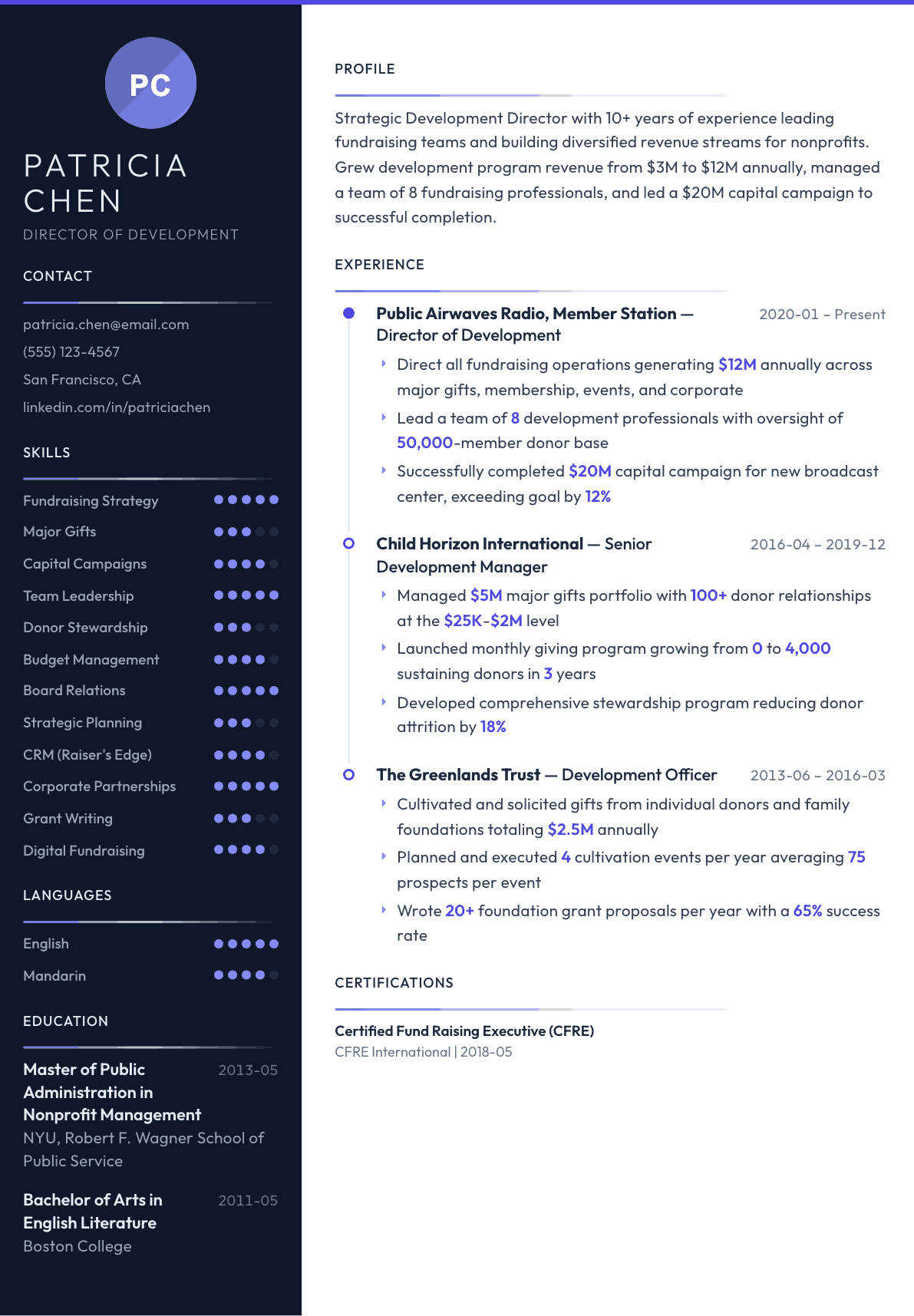
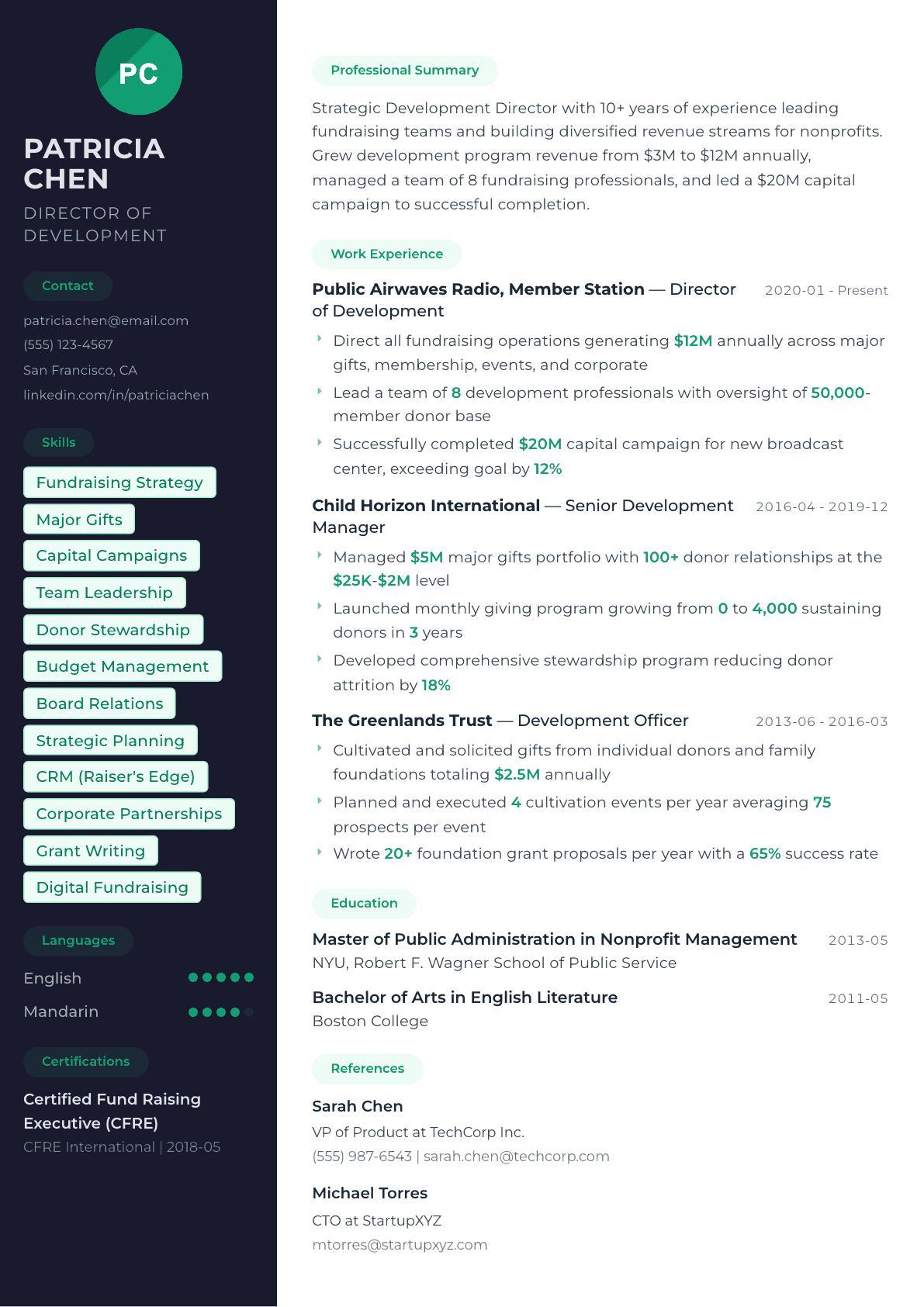
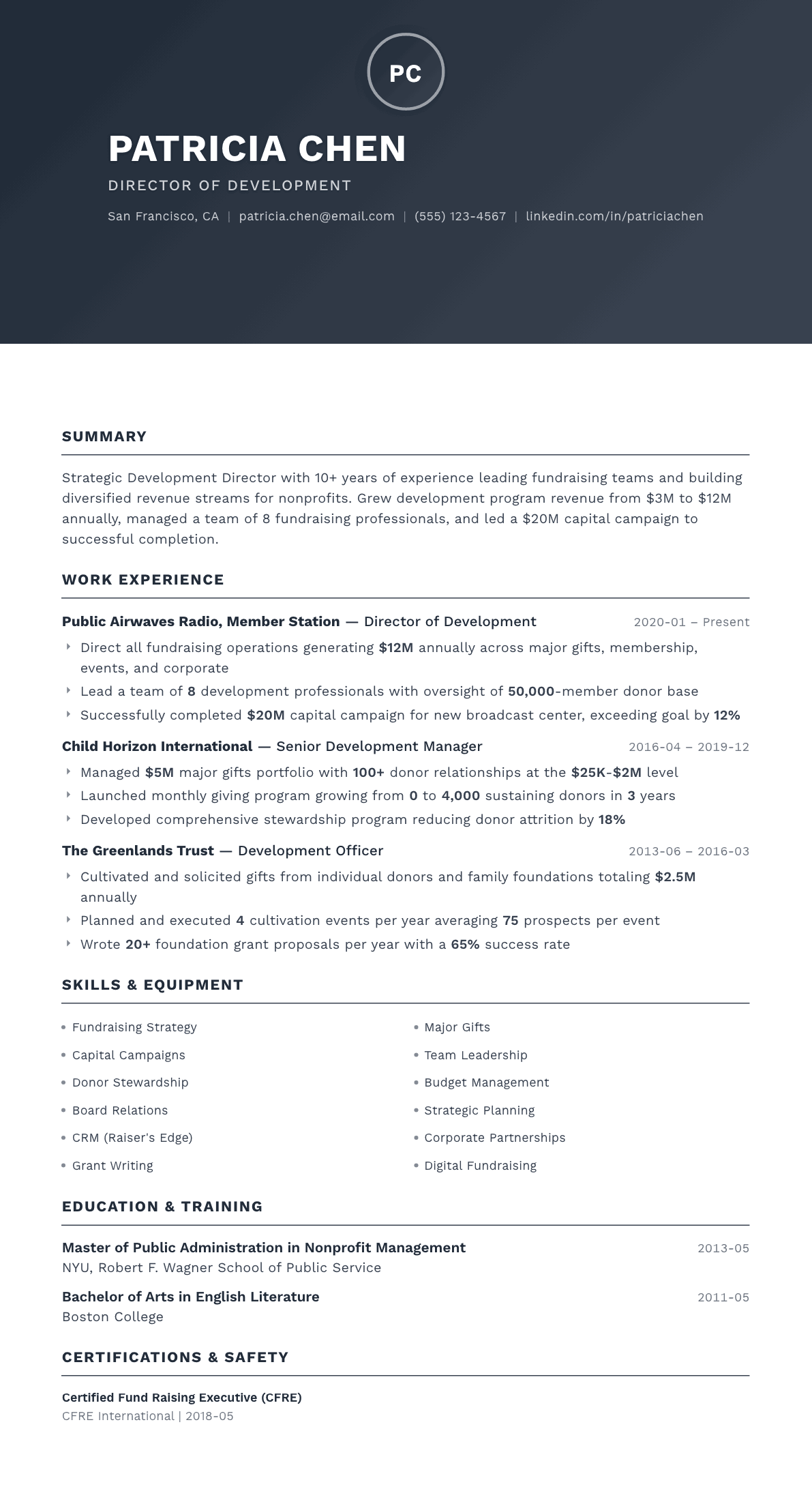
Example Development Director summary
Strategic Development Director with 10 years of experience growing nonprofit revenue from $3M to $12M annually. Led a $20M capital campaign to completion and managed teams of 8 development professionals. Seeking a VP of development role at a national nonprofit.
Skills to list on a Development Director resume
- Fundraising Strategy
- Major Gift Cultivation
- Capital Campaigns
- Team Leadership
- Donor Stewardship
- Annual Fund Management
- Board Relations
- Strategic Planning
- CRM Systems
- Corporate Partnerships
- Grant Writing
- Planned Giving
- Digital Fundraising
- Budget Management
- Prospect Research
What actually gets this resume read
- Lead with total development program revenue and year-over-year growth percentages.
- Highlight capital campaign experience with goal amounts and completion status.
- Show team management: number of direct reports, performance improvements, and hiring successes.
- Include board interaction experience: presentations, committee participation, governance support.
- Quantify donor base growth, retention rates, and average gift increases.
- List comprehensive fundraising channels managed: major gifts, annual fund, events, planned giving, corporate.
How to write a development director resume
A development director resume is read by an executive director who is worried about next year's budget and by a board development committee that wants proof you can carry a portfolio and manage the people who carry the rest. They are looking for revenue growth you owned, a donor pipeline you can describe by segment, and evidence that you have worked alongside a board rather than around it.
The common failure is a resume that reads like a list of duties: managed the annual fund, oversaw events, supported the board. Every development director does those. What separates candidates is the shape of the revenue, the size and retention of the major gift portfolio, the campaign experience, and whether the growth came from new donors or from one lucky bequest.
This guide sets out how to structure the sections, how to present revenue honestly without inflating your role, summaries for a first-time director through a seasoned campaign leader, and the rewrites that make a fundraising record verifiable.
Format: two pages, revenue visible in the first third
Two pages is standard at this level and nobody will hold it against you. What matters is that the reader finds the revenue figures without hunting. Put a short summary, then experience, and inside each role open with a scope line before the bullets so the reader knows the budget size, the team size and the donor base before reading a single accomplishment.
Fundraising is a numbers profession, so the resume should look like one. Keep formatting plain, use consistent number styles, and avoid graphics and charts, which parse badly in the applicant tracking systems most nonprofits now run through their human resources platform.
- Scope line per role: organization budget, development team size, contributed revenue, donor count.
- Order: summary, experience, campaign highlights if you have them, education, credentials, systems.
- Keep a consistent way of expressing revenue growth so the reader can compare roles at a glance.
Summary: revenue owned, team led, campaign experience
Three lines. Say the size of the contributed revenue you have been accountable for, how many fundraisers reported to you, whether you have run a capital or endowment campaign, and which revenue streams you personally know well. A director who has grown individual giving is a different hire from one who came up through institutional grants, and search committees are usually filling one of those two gaps.
Name the sector if it is relevant. Higher education, health care, human services, arts and advocacy have different donor behavior and different board cultures, and a committee will read your fit through that lens whether or not you address it.
Experience: pipeline, portfolio, retention, and the board
The strongest bullets describe a moving pipeline. Show how many prospects you qualified, how many visits you made in a year, how many proposals you put in front of donors, and what closed. A director who reports 120 donor visits a year is telling the committee something a revenue total cannot.
Show retention as well as acquisition. Growth built on churn is fragile, and experienced readers know it. Report donor retention, upgrade rates within the mid-level program, and multi-year commitments, because those are the numbers that predict whether the growth holds after you leave.
Then show the board work explicitly. Staffing a development committee, preparing trustees for solicitation visits, running a board giving campaign to full participation, and building a campaign cabinet are all skills a committee is quietly testing for, since a director who cannot work with trustees will stall no matter how good the pipeline is.
- Portfolio size and gift range you personally managed, separate from what your team managed.
- Visits, solicitations and proposals per year, not just dollars closed.
- Retention and upgrade figures alongside growth figures.
- Board and cabinet work: recruitment, training, participation rates.
- Team building: hires made, roles created, turnover you inherited and fixed.
Campaigns: goal, structure, your actual role
Capital and endowment campaigns are the clearest signal on a development director resume, so give them their own treatment. Name the goal, the working goal if it changed, the quiet phase and public phase, the lead gift, the cabinet structure, and the counsel firm if one was engaged. Then be exact about your role, because committees check this in references.
Directing a campaign, staffing one under a consultant, and managing the prospect research behind one are three different jobs. Claiming the first when you did the third is the fastest way to lose an offer late in a search.
Systems and compliance: name the database and the standards
List the constituent relationship management systems you have actually administered or reported from: Raiser's Edge NXT, Salesforce Nonprofit Success Pack, Bloomerang, DonorPerfect, Virtuous, Kindful. Add the wealth screening and research tools such as DonorSearch, iWave or WealthEngine, and the marketing platforms you have used for appeals.
Add the parts of the job that keep an organization out of trouble: gift acceptance policies, donor intent and restricted fund tracking, gift agreements, acknowledgment timelines, and reconciliation between the donor database and the finance ledger. A director who mentions reconciliation is telling a chief financial officer that audit season will go smoothly.
Development Director resume summary examples
First director role
Development professional stepping into a first director role after 6 years in major gifts, most recently managing a 110-donor portfolio and closing 38 gifts a year. Grew the mid-level program 45% in 2 years and staffed the board development committee through a full participation campaign.
Seven years directing
Development director with 7 years leading a 5-person team for a human services agency, accountable for contributed revenue that grew 60% over 4 years. Built a mid-level giving program from scratch, lifted donor retention from 52% to 68%, and ran a successful endowment campaign with a volunteer cabinet.
Chief development officer track
Senior development director with 15 years across health care and higher education, leading teams of 12 and a comprehensive campaign that closed above goal 9 months early. Rebuilt a stalled major gifts program, doubled the qualified pipeline, and reset gift acceptance and reconciliation practice with finance.
Work experience bullets: before and after
Before: Managed the annual fund and increased revenue.
After: Rebuilt the annual fund around 4 segmented appeals and a sustainer ask, lifting first-year donor retention from 21% to 34% and growing annual fund revenue 42% across 3 fiscal years.
Naming the segmentation, the retention shift and the time frame shows the mechanism behind the growth.
Before: Cultivated relationships with major donors.
After: Carried a portfolio of 120 households rated at mid five figures and above, completed 96 face-to-face visits a year, and closed 31 gifts including 6 first-time multi-year commitments.
Portfolio size, visit volume and multi-year closes are the pipeline metrics a search committee can test.
Before: Worked closely with the board of directors.
After: Staffed a 9-member development committee, trained 14 trustees on solicitation visits, and moved board giving participation from 68% to 100% in one fiscal year.
Board participation is a hard number and shows you can move trustees, not just brief them.
Before: Led a capital campaign for a new building.
After: Directed the quiet phase of an 8-figure capital campaign, recruited a 12-member cabinet, secured a lead gift covering a quarter of goal, and set the public launch at 63% raised.
Phase, cabinet, lead gift and launch threshold prove campaign literacy rather than proximity to one.
Before: Implemented a new donor database.
After: Migrated 9,400 constituent records to Raiser's Edge NXT, rebuilt the coding scheme for restricted funds, and set a monthly reconciliation with finance that cleared 3 years of unmatched gift entries.
The record volume, the fund coding and the reconciliation turn a software project into an operations fix.
Hard skills
- Major gift portfolio management
- Capital and endowment campaigns
- Annual fund segmentation
- Planned giving basics
- Prospect research and wealth screening
- Moves management
- Institutional and corporate giving
- Raiser's Edge NXT
- Salesforce Nonprofit Success Pack
- Gift acceptance and restricted fund policy
- Revenue forecasting and budgeting
- Board and cabinet staffing
Soft skills
- Asking without flinching
- Trustee coaching
- Team development
- Discretion with donor information
- Patience across long cycles
- Cross-functional negotiation
Certifications worth listing
- Certified Fund Raising Executive (CFRE) (CFRE International)
- Chartered Advisor in Philanthropy (CAP) (The American College of Financial Services)
- Certified Specialist in Planned Giving (CSPG) (American Institute for Philanthropic Studies)
Mistakes that cost development director candidates the interview
- Claiming organizational revenue totals that included government contracts and earned income you never touched.
- Reporting growth without retention, which tells an experienced reader the base may have churned underneath it.
- Describing a campaign role vaguely, since committees verify whether you directed, staffed or supported it.
- Omitting portfolio size and visit counts, the two numbers that show whether you still fundraise or only manage.
- Skipping the board work, which is half the job and the half most first-time directors are weakest at.
- Listing every database you have logged into rather than the two you can build a report in.
Development Director resume questions
How do I present revenue growth without taking credit for the whole organization?
State the scope in the role line, then attribute precisely. Say which streams you owned, which your team owned, and which existed before you arrived. Committees respect a candidate who separates inherited revenue from new revenue, and they check it in references anyway.
Do I need to be a CFRE to get a development director job?
It is not required and many strong directors do not hold it, but it does signal a serious commitment to the profession and some search committees screen for it. If you have it, put it after your name and in a credentials line. If you do not, lead with the campaign and portfolio record.
How should I handle a short tenure at one organization?
Keep it on the resume with the dates, and let the cover letter carry the explanation. Development turnover is common and readers know it. What raises concern is a pattern of two-year stints with no revenue results attached to any of them.
Should I list the names of major donors I have closed?
Never name individual donors. Describe gift ranges, the type of donor and the purpose instead. Search committees read named donors as a confidentiality problem, and a director who leaks portfolio detail in a resume will worry a board.
What if I have never run a capital campaign?
Say so plainly and show the closest adjacent experience: a major gifts initiative with a goal and a deadline, a giving day, a matching challenge, or a feasibility study you helped run. Overstating campaign experience is the most commonly caught exaggeration in fundraising searches.
Related resume examples
- Fundraising Manager Resume example
- Executive Director (Nonprofit) Resume example
- Grant Writer Resume example
- Executive Resume example
- Startup Founder Resume example
- Executive Director Resume example