Nonprofit Program Manager Resume Examples: free score
Write a Nonprofit Program Manager Resume That Shows Outcomes
By Mustafa Tarabya, founder of CVBooster · Published · Updated
Nonprofit program manager resume examples with grant, outcome and volunteer bullets, ATS keywords, and a guide to writing each section clearly.
Sample resumes for a nonprofit program manager
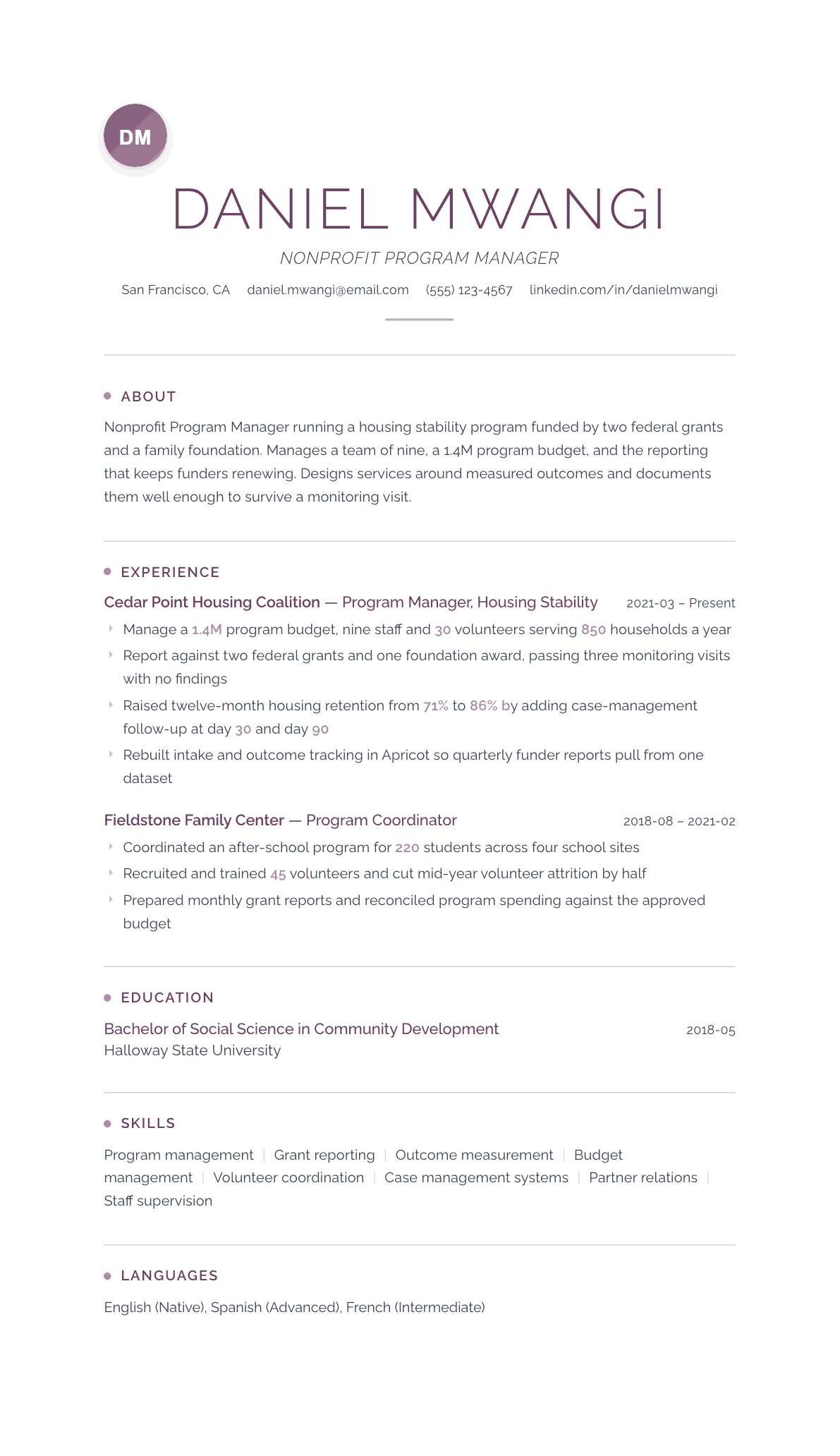
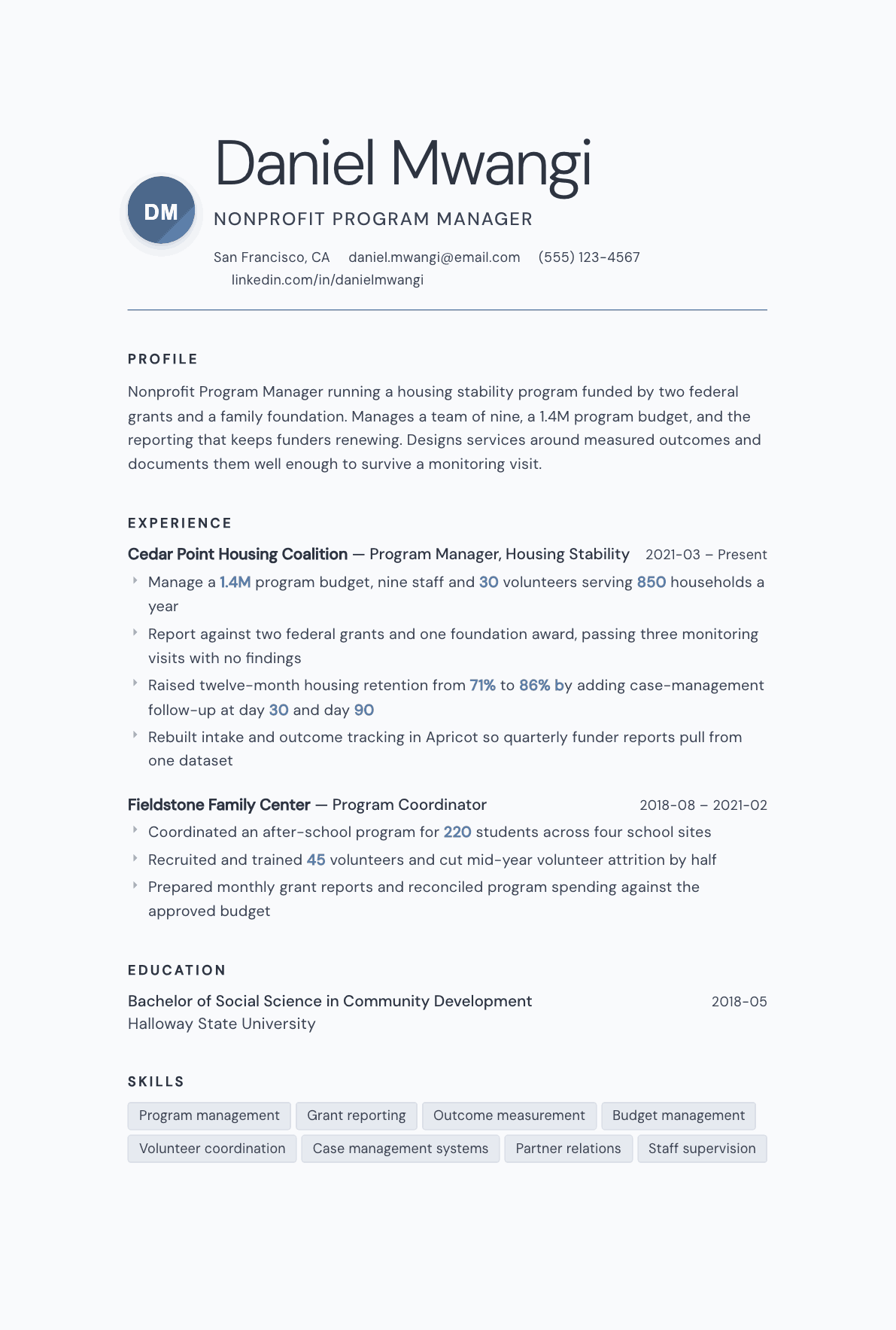
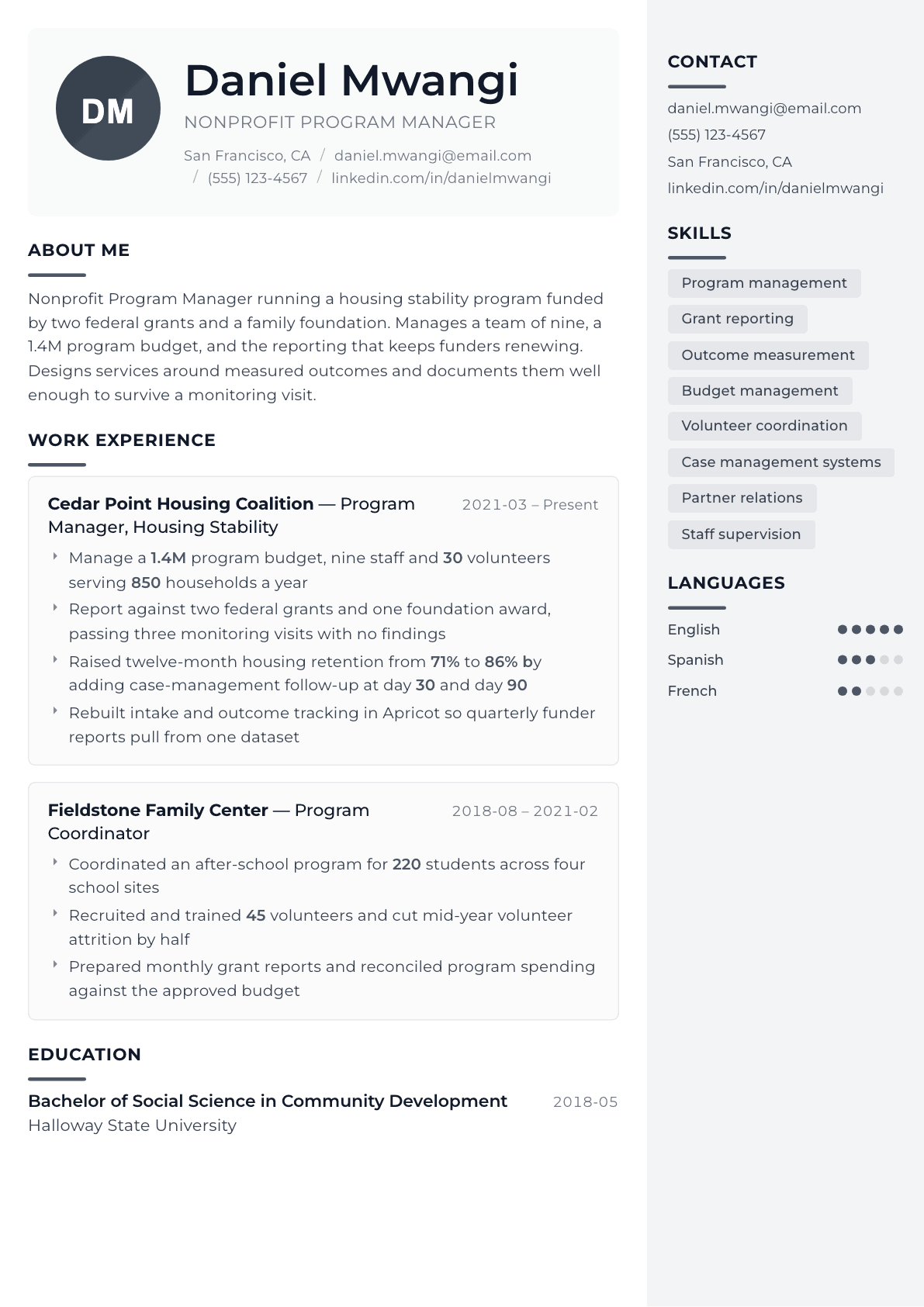
The same nonprofit program manager content laid out in three CVBooster templates, so you can see what the finished document looks like before you write a word.
Example Nonprofit Program Manager summary
Nonprofit Program Manager with seven years in housing and youth services, currently running a 1.4M program with nine staff and 30 volunteers serving 850 households a year. Manages two federal grants and a foundation award, passed three monitoring visits with no findings, and raised twelve-month housing retention from 71% to 86% by adding structured follow-up.
Skills to list on a Nonprofit Program Manager resume
- Program management
- Grant compliance
- Grant reporting
- Outcome measurement
- Logic models
- Budget management
- Volunteer management
- Staff supervision
- Case management systems
- Community partnerships
- Data collection and analysis
- Program evaluation
- Stakeholder communication
- Federal grant regulations
What actually gets this resume read
- Lead with the people served, the budget and the funding source, since those three define program scope for a reader.
- Report outcomes, not activities: retention, completion, placement or recidivism beats a count of workshops held.
- Name the grants you managed by type, federal, state, foundation or corporate, and the reports you were responsible for.
- Show compliance results such as monitoring visits, audit findings or corrective action plans you closed.
- List the case management or data system you used, for example Apricot, Salesforce Nonprofit Cloud, ETO or CaseWorthy.
- Include supervision and volunteer numbers separately, because they are different management skills to a hiring director.
How to write a nonprofit program manager resume
A nonprofit program manager sits where the funding meets the service. The director reading your resume needs to know whether you can run a program that helps people and simultaneously produce the evidence a funder requires. Candidates almost always show one side. The ones who get interviewed show both on the same page.
Scope for this role is described in four numbers: people served, program budget, staff and volunteers supervised, and the funding sources you report against. Those four belong under every job title, because a manager running a small foundation funded pilot and one running a multi million dollar federally funded program face very different compliance and staffing demands.
This guide sets out how to organize the page, how to write outcome bullets that a funder relations director will believe, three summaries across career stages, and the questions program managers ask when moving between direct service, grants management and program leadership.
Format: scope line, outcomes, compliance, people
Reverse chronological, single column, one page for most program managers and two once you supervise supervisors. Under each title, put participants served per year, program budget, staff and volunteers, and the funders.
Group your bullets so a reader can find the four things they need without hunting: what the program achieved, how it was funded and reported, who you supervised, and which partners you worked with. A jumbled list of duties forces the reader to do that sorting for you, and they will not.
- Scope line: participants served, program budget, staff and volunteers, funding sources.
- Section order: summary, experience, program outcomes, systems and compliance, education.
- Name the population served in plain language, because search terms follow the population.
Summary: population, funding, and one outcome that moved
Three or four lines. The population and service area, program size, funding type, and one outcome you improved with a before and after figure. Retention, completion, placement, housing stability and recidivism are the measures funders read first.
Name the compliance side too. A single clause about passing monitoring visits or managing federal reporting tells a hiring director that you will not create audit problems, which is a genuine fear when they hire.
Experience: outcomes over activities
Write outcomes, not activity counts. Workshops delivered and meetings held describe effort. Retention at twelve months, completion rate, placements sustained at ninety days and reduction in repeat crisis contacts describe results. When you must use an activity number, tie it to the outcome it produced.
Show the design work. If you changed a program and the numbers moved, say what you changed: a follow up contact at day thirty, a bus pass that removed a transport barrier, a shift in group size, an eligibility change. Funders and directors both want a manager who can diagnose a program, not only run one.
Cover the money. Budget managed, spending reconciled against the approved budget, budget modifications requested, and cost per participant if your organization tracks it. Program managers who understand their own budget are promoted; those who leave it to finance are not.
Cover the people. Staff supervised, hiring and training you led, and volunteers recruited and retained. Keep staff and volunteer numbers separate, since supervising employees and coordinating volunteers are different management skills.
Cover the partners. Schools, clinics, housing authorities, courts, employers and other agencies. Referral relationships are the infrastructure of most nonprofit programs and they take real work to maintain.
Compliance and data: what keeps the grant
Name the funders by type, the reports you produced and their frequency, and the results of any monitoring visit or audit. Passing a federal monitoring visit with no findings is a concrete, verifiable achievement and belongs on the page.
Name the data system you worked in and what you did inside it. Building an intake form that feeds the quarterly report directly is worth describing, because most organizations still assemble those reports by hand under deadline pressure.
- Case management and data: Apricot, Salesforce Nonprofit Cloud, ETO, CaseWorthy, homeless management information systems.
- Reporting: quarterly and annual funder reports, logic models, outcome frameworks, data quality checks.
- Compliance: federal grant rules, subrecipient monitoring, eligibility documentation, confidentiality practices.
Keywords used in nonprofit program postings
Recurring terms include program management, grant compliance, outcome measurement, logic model, participant outcomes, budget management, volunteer coordination, community partnerships, data collection, subrecipient monitoring and continuous quality improvement. Add the population and service words the posting uses, such as reentry, workforce development, early childhood or housing stability.
Match the funder language exactly where you can. A posting that names a specific federal program will be screened by someone who knows its reporting requirements, and using the right terms shows you have lived them.
Nonprofit Program Manager resume summary examples
Program coordinator
Program coordinator running an after school program for 220 students across four school sites. Recruited and trained 45 volunteers and cut mid year volunteer attrition by half. Prepares monthly grant reports and reconciles program spending against the approved budget. Ready for a program manager role.
Program manager
Program manager for a housing stability program serving 850 households a year with a 1.4M budget, nine staff and 30 volunteers. Reports against two federal grants and a foundation award, passed three monitoring visits with no findings, and raised twelve month housing retention from 71% to 86%.
Senior program manager
Senior program manager overseeing three service lines, 4M in restricted funding and 26 staff across two counties. Built the shared outcome framework that replaced four inconsistent reporting methods, and led the redesign that lifted employment placements sustained at ninety days by a third.
Work experience bullets: before and after
Before: Managed a housing program for the organization.
After: Managed a 1.4M housing stability program with nine staff and 30 volunteers, serving 850 households a year across two counties.
Budget, staffing, participants and geography let the reader size the program instantly.
Before: Improved outcomes for program participants.
After: Raised twelve month housing retention from 71% to 86% by adding structured case management follow up at day thirty and day ninety.
A named measure with a before and after, plus the design change that caused it, is what a funder wants to read.
Before: Reported to funders on program progress.
After: Produced quarterly reports for two federal grants and one foundation award, passing three monitoring visits with no findings.
The compliance result converts a routine duty into evidence that grant money is safe with you.
Before: Worked with volunteers and staff.
After: Recruited and trained 45 volunteers, restructured the scheduling and recognition practices, and cut mid year volunteer attrition by half.
Separating recruitment from retention, with a number on each, shows real volunteer management.
Before: Collected data for the program.
After: Rebuilt intake and outcome tracking in the case management system so quarterly funder reports pull from a single dataset instead of four spreadsheets.
It names the problem solved and the practical result, which is faster and more accurate reporting.
Hard skills
- Program design and management
- Grant compliance and reporting
- Outcome measurement
- Logic models and theory of change
- Program budget management
- Case management systems
- Data collection and quality checks
- Volunteer recruitment and retention
- Staff supervision and training
- Community partnership development
- Federal grant regulations
- Continuous quality improvement
Soft skills
- Advocacy for participants
- Cultural humility
- Calm handling of crisis situations
- Clear writing for funders
- Collaboration across agencies
- Boundaries in emotionally demanding work
Certifications worth listing
- Certified Nonprofit Professional (CNP) (Nonprofit Leadership Alliance)
- Grant Professional Certified (GPC) (Grant Professionals Certification Institute)
- Project Management Professional (PMP) (Project Management Institute)
- Certified Fund Raising Executive (CFRE) (CFRE International)
Mistakes that cost nonprofit program manager candidates the interview
- Listing activities delivered rather than the outcomes those activities were funded to produce.
- Leaving out the funding source, when the compliance demands of federal and foundation money differ sharply.
- Never mentioning the budget, which suggests you executed a program someone else financially managed.
- Merging staff and volunteer counts into one number, hiding which management experience you actually have.
- Skipping monitoring and audit results, the fastest available proof of compliance competence.
- Using internal program acronyms that mean nothing to a hiring director at another organization.
Nonprofit Program Manager resume questions
What outcomes should a nonprofit program manager put on a resume?
Use the measure your funder actually paid for: retention, completion, placement, stability at a given interval, or reduction in a negative event. Give the before and after, the time frame, and the change you made that produced the movement.
How do I show grant compliance experience?
Name the funder type, the reports you owned and their frequency, and the outcome of any monitoring visit or single audit. Mention eligibility documentation and subrecipient monitoring if you handled them, since those are the areas findings usually come from.
Should I include the population I serve on my resume?
Yes, in plain language, because hiring directors search by population. Say youth aging out of foster care, adults in recovery, or families facing eviction rather than a generic phrase like underserved communities that could mean anything.
How do I move from direct service into program management?
Highlight the coordination you already do: caseload management, data entry that feeds reports, training new colleagues, and partner communication. Then add anything budget or supervision related, even informally, since those are the two gaps directors probe.
Is a master degree required for nonprofit program management?
Often preferred rather than required. Social work, public administration and public health degrees appear frequently in postings, but a manager with documented outcomes, clean compliance history and supervisory experience competes strongly without one.
Related resume examples
- Program Coordinator Resume example
- Development Director Resume example
- Executive Director Resume example
- Grants Manager Government Resume example
- Grant Writer Resume example
- Executive Director (Nonprofit) Resume example