Executive Director (Nonprofit) Resume Examples: free
Lead with Purpose: Build an Executive Director Resume
By Mustafa Tarabya, founder of CVBooster · Published · Updated
Create an executive director resume that highlights your nonprofit leadership, fundraising success, and mission-driven impact.
Sample resumes for a executive director (nonprofit)
The same executive director (nonprofit) content laid out in three CVBooster templates, so you can see what the finished document looks like before you write a word.
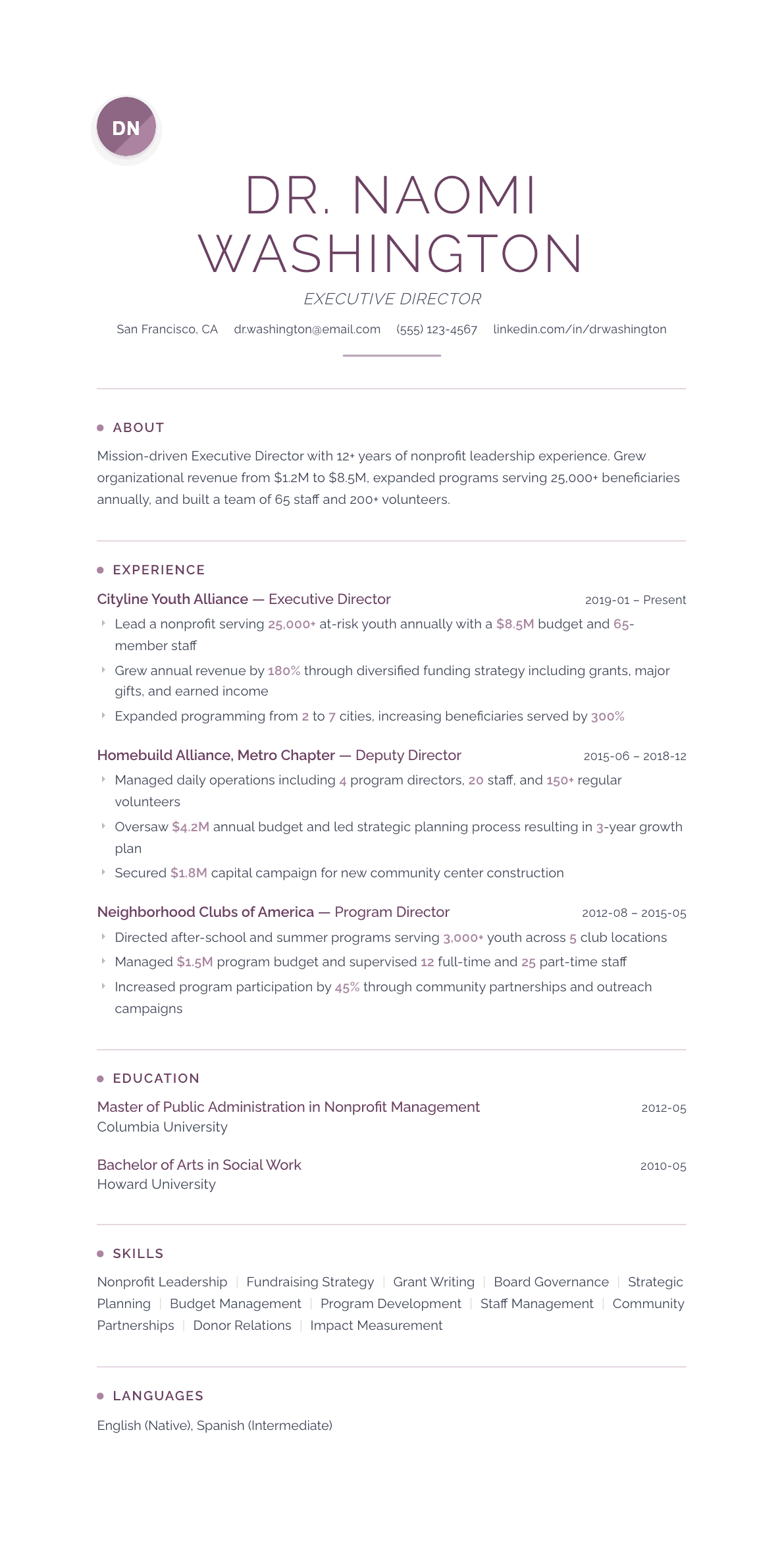
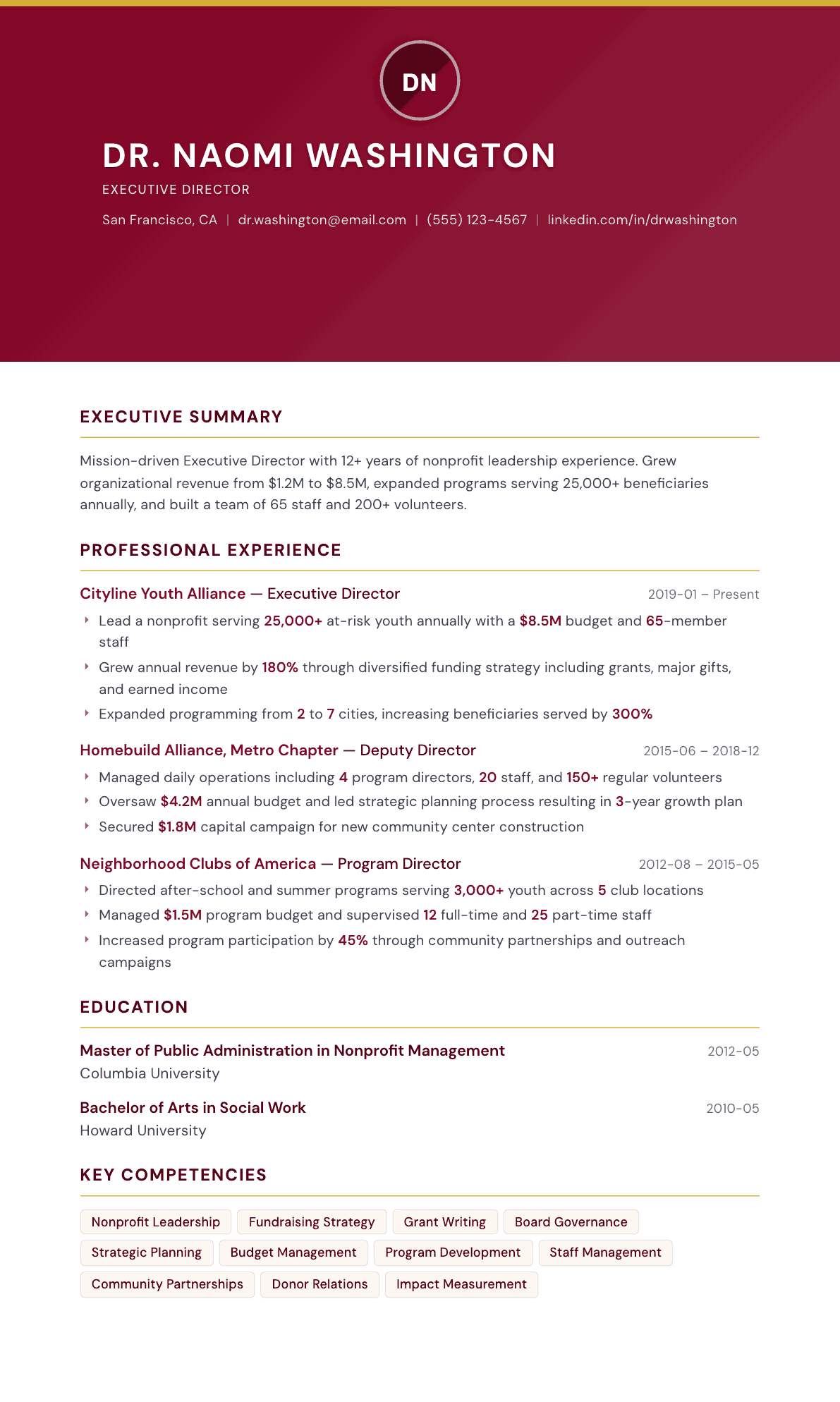
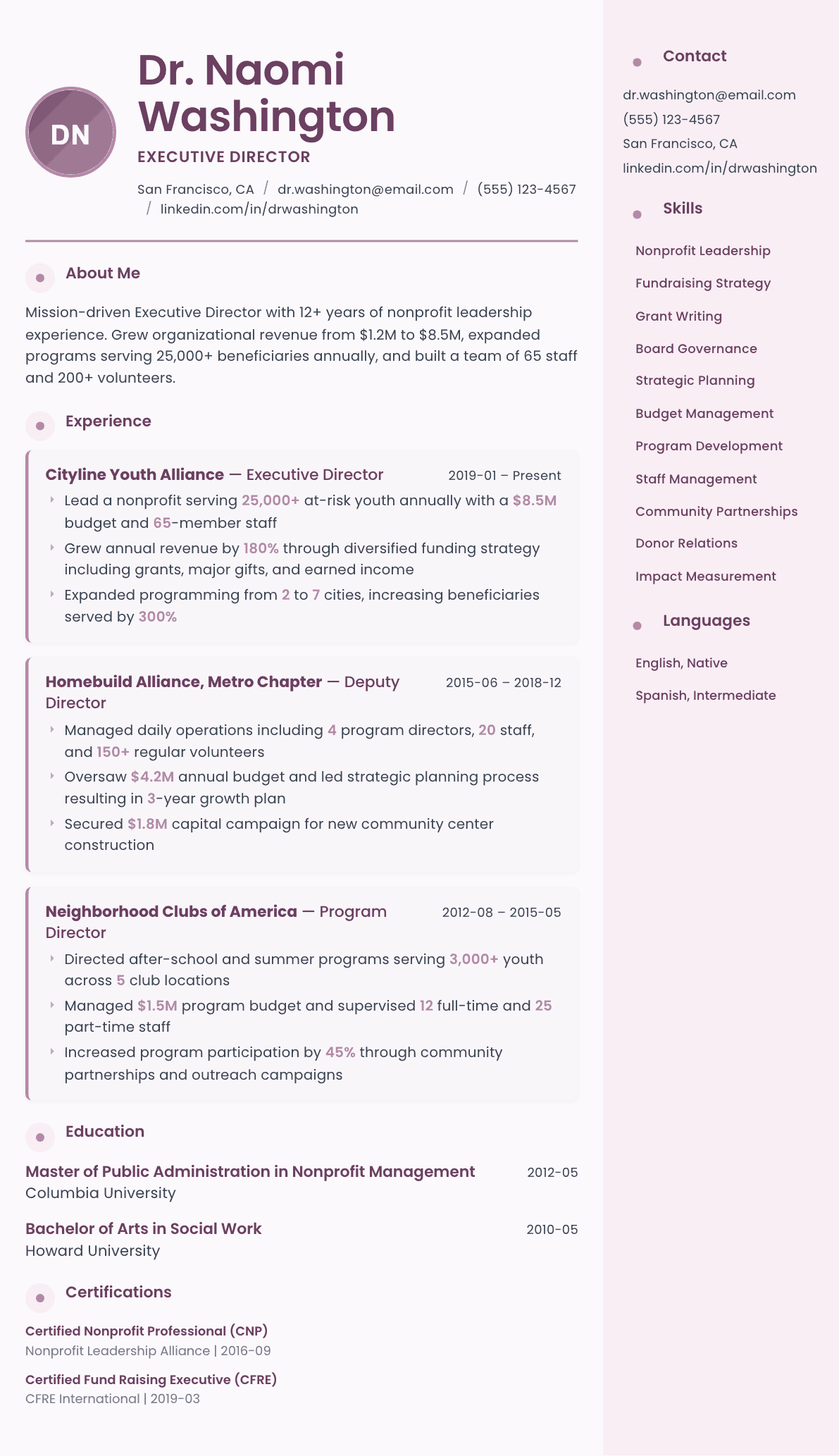
Example Executive Director (Nonprofit) summary
Mission-driven Executive Director with 12 years of nonprofit leadership growing organizations from $1.2M to $8.5M in revenue. Expanded programs across 7 cities serving 25,000+ beneficiaries with teams of 65+ staff. Seeking an executive director role at a national nonprofit.
Skills to list on a Executive Director (Nonprofit) resume
- Nonprofit Leadership
- Fundraising & Development
- Grant Writing
- Board Governance
- Strategic Planning
- Budget & Finance
- Program Development
- Staff Management
- Community Partnerships
- Donor Relations
- Impact Measurement
- Advocacy
- Marketing & Communications
- Volunteer Management
What actually gets this resume read
- Lead with organizational growth metrics: revenue increases, beneficiaries served, geographic expansion.
- Highlight fundraising achievements with specific dollar amounts raised through grants, major gifts, and campaigns.
- Show board governance experience: board development, committee leadership, strategic planning facilitation.
- Include impact measurement and program evaluation capabilities.
- Mention partnerships with government agencies, foundations, and corporate sponsors.
- List CFRE, CNP, or other nonprofit management credentials.
How to write a executive director (nonprofit) resume
An executive director resume is screened by a board search committee, usually with a consultant guiding them, and the committee is not made up of professional recruiters. They are trustees reading between meetings, and they are trying to answer three questions: has this person carried a budget of our size, can they raise money, and will they survive a board that has never hired anyone before.
Because the audience is a volunteer committee, the resume has to be unusually legible. Scope up front, mission results next, finances and governance close behind. The candidates who lose are usually not the weakest leaders, they are the ones whose resume buried the budget size and the fundraising record under paragraphs about vision.
This guide covers the section order a search committee reads, how to show financial stewardship and board partnership without sounding like a job description, summaries for a first executive director role through a multi-site leader, and rewrites that make leadership claims checkable.
Format: two pages, scope before story
Two pages, reverse-chronological, no graphics. Open each leadership role with a scope line: operating budget, staff headcount, sites, people served, and contributed versus earned revenue split. A trustee comparing five finalists needs those numbers in the same place on every page, and yours should be the easiest to compare.
Add a short leadership profile of three or four lines instead of an objective. Search consultants often build a slate summary from the top of the resume, so the first fifty words of your document may become the version of you that most of the committee reads.
- Scope line per role: budget, staff, volunteers, sites, annual people served.
- Order: profile, executive experience, board and governance, education, credentials, civic service.
- Include your own board service, since a committee reads it as evidence you understand their side of the table.
Financial stewardship: the section that decides finalists
Boards hire executive directors to keep the organization solvent and honest. Show the financial arc of your tenure: how the budget changed, whether you moved from deficit to surplus, how many months of operating reserve you built, and how the revenue mix shifted. A leader who reduced reliance on a single government contract has told a committee something important without saying a word about strategy.
Name the compliance work as well. Clean single audits, timely federal reporting for organizations that draw down federal awards, a functioning audit or finance committee, indirect cost rate negotiation, and cost allocation across restricted grants. Committees rarely ask about these in the first interview and always ask about them in the last.
- Budget at start and end of tenure, and the reason for the change.
- Operating reserve in months, and whether you built or spent it.
- Revenue mix shift: government, foundation, individual, earned.
- Audit findings inherited and cleared, and any single audit experience.
Board and governance: partnership, not compliance
Write the board relationship as work you did, not a duty you had. Recruiting trustees with skills the board lacked, running a governance committee, rewriting bylaws, standing up a board assessment, moving the board from an operational role to a strategic one, and leading a succession or transition plan all count.
Strategic planning belongs here too, but only if you name the outcome. A plan that produced three measurable program decisions is worth more than a plan that produced a document, and every committee has seen a binder that nobody opened again.
Mission results: people served and what changed for them
Program growth needs both scale and quality. Give the number of people served and the outcome the program was designed to produce: housing placements sustained at a year, graduation rates, clinical measures, recidivism, job placements retained past six months. Committees are increasingly asked by funders to show outcomes, and a director who already speaks that language reduces their risk.
Say who was at the table. Boards care whether programs were designed with the community they serve, whether staff and participant feedback shaped decisions, and whether you have led an organization through a serious equity or culture change rather than announcing one.
The parts nobody puts on the resume but committees ask about
Crisis leadership, staff retention and external voice are the three areas most executive director resumes leave out and every search asks about. If you led an organization through a funding cliff, a merger, a leadership scandal, a facility loss or a rapid scale-up, put it on the page with what you did and what held.
Add retention if it is good, since executive turnover cascades. Add external work that a board values: legislative testimony, coalition leadership, media representation, and relationships with the public agencies that contract with you.
Executive Director (Nonprofit) resume summary examples
First executive director role
Nonprofit leader moving into a first executive director role after 8 years as deputy director of a youth services agency, where I ran a 40-person program department, held the contract relationship with 3 county funders, and rebuilt a program that had lost a third of its enrollment.
Six years leading
Executive director with 6 years leading a community health nonprofit through growth from 18 to 52 staff and 4 sites. Built a 5-month operating reserve, cleared 2 inherited audit findings, diversified away from a single county contract, and led the board through a governance rewrite.
Multi-site chief executive
Chief executive with 16 years leading nonprofits through scale and turnaround, most recently a multi-site human services organization with 210 staff across 7 counties. Completed a merger, closed a structural deficit within 2 fiscal years, and moved 60% of revenue to unrestricted sources.
Work experience bullets: before and after
Before: Responsible for overall management of the organization.
After: Led a human services nonprofit with 52 staff, 4 sites and a 7-figure operating budget, reporting to a 15-member board and holding direct contract relationships with 3 county funders.
A scope line lets a trustee compare you to the other finalists in one glance instead of guessing.
Before: Improved the financial position of the organization.
After: Closed a structural deficit within 2 fiscal years by renegotiating an indirect cost rate, exiting an underwater contract, and building an operating reserve from 3 weeks to 5 months.
Naming the three levers proves financial command rather than a fortunate year.
Before: Worked with the board on strategic planning.
After: Facilitated a board strategic planning process that produced 3 decisions with budget attached: closing one program, opening a second site, and moving case management to an evidence-based model.
A plan is only credible when the reader can see what the organization actually decided to do differently.
Before: Grew programs and served more clients.
After: Grew supportive housing from 60 to 190 units and held 12-month housing retention above 85% through the expansion, verified in the county continuum of care reporting.
Pairing scale with a retained outcome and an external verification source answers the funder question in advance.
Before: Handled a difficult period for the organization.
After: Led the organization through the loss of a contract that funded a fifth of the budget: kept every program open, reduced administrative costs, and replaced the revenue with 2 foundation partnerships within 18 months.
Crisis leadership only counts when the reader learns what was cut, what was protected and what replaced it.
Hard skills
- Nonprofit budgeting and forecasting
- Board governance and bylaws
- Fundraising strategy and major gifts
- Government contract management
- Single audit and grant compliance
- Indirect cost rate negotiation
- Strategic planning facilitation
- Program outcome measurement
- Mergers and organizational restructuring
- Human resources and compensation policy
- Public policy and legislative advocacy
- Risk management and insurance oversight
Soft skills
- Board partnership
- Decision-making under scarcity
- Public representation
- Difficult conversations with staff
- Coalition diplomacy
- Steadiness in a crisis
Certifications worth listing
- Certified Nonprofit Professional (CNP) (Nonprofit Leadership Alliance)
- Certified Fund Raising Executive (CFRE) (CFRE International)
- BoardSource Certificate of Nonprofit Board Consulting (BoardSource)
Mistakes that cost executive director (nonprofit) candidates the interview
- Opening with mission language instead of scope, so a trustee cannot tell whether you have run an organization of their size.
- Leaving out budget and headcount, the two numbers every search committee sorts candidates by first.
- Presenting a strategic plan as an accomplishment when no decision or budget change followed it.
- Hiding a turnaround or a crisis, which references will surface anyway and which is usually your strongest material.
- Listing fundraising totals without saying which streams you personally solicited and which the development staff owned.
- Omitting your own board service, which shows a committee that you understand governance from their seat.
- Writing at a length no volunteer will read, when three tight pages of scope beat six pages of narrative.
Executive Director (Nonprofit) resume questions
How long should an executive director resume be?
Two pages for most candidates, three at the top of the field with a long tenure history. Search committees are volunteers reading a stack at night, so density beats completeness. Move the full history of publications and speaking into a separate document if a consultant asks for it.
Do I need nonprofit experience to become an executive director?
Not always, but you have to translate. Boards worry that a corporate leader will misjudge the board relationship, restricted funding and mission tradeoffs. Show nonprofit board service, grant or contract exposure, and any budget you managed with restricted sources attached.
Should I include the organization budget for every role?
Yes for every leadership role, because scope is the first sorting criterion. For earlier program roles, give the department budget instead. Consistency matters more than precision, so pick one convention and use it for the whole document.
How do I explain leaving an organization after a conflict with the board?
Keep the resume factual with clean dates and no editorializing. Prepare a short, calm account for the interview that centers on what the organization needed rather than on individuals. Committees are far more troubled by a defensive story than by a departure.
What financial detail should a first-time executive director candidate show?
Whatever you actually held: a department budget, a contract you managed end to end, a grant you were the fiscal lead on, or a fee-for-service line you priced. Boards do not expect a deputy to have run the whole ledger, but they do expect real numbers rather than exposure to them.
Related resume examples
- Development Director Resume example
- Grant Writer Resume example
- Program Coordinator Resume example
- Executive Director Resume example
- Fundraising Manager Resume example
- Chief of Staff Resume example