Team Assistant Resume Examples: the lines they read
Create a Team Assistant Resume That Shows Who You Keep Running
By Mustafa Tarabya, founder of CVBooster · Published · Updated
Team assistant resume example with calendar, expense and department support detail, keyword list, and a writing guide.
Sample resumes for a team assistant
The same team assistant content laid out in three CVBooster templates, so you can see what the finished document looks like before you write a word.
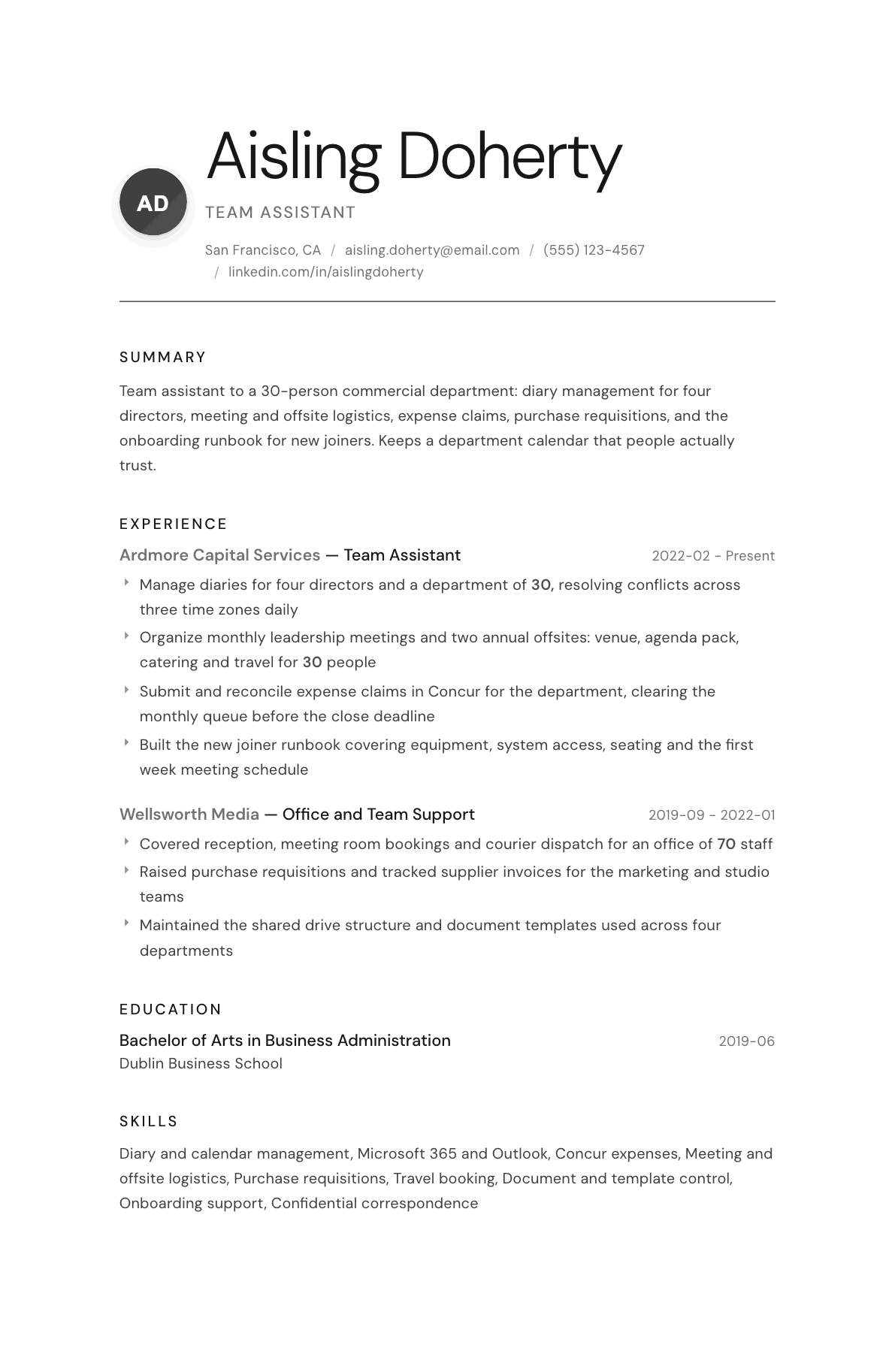
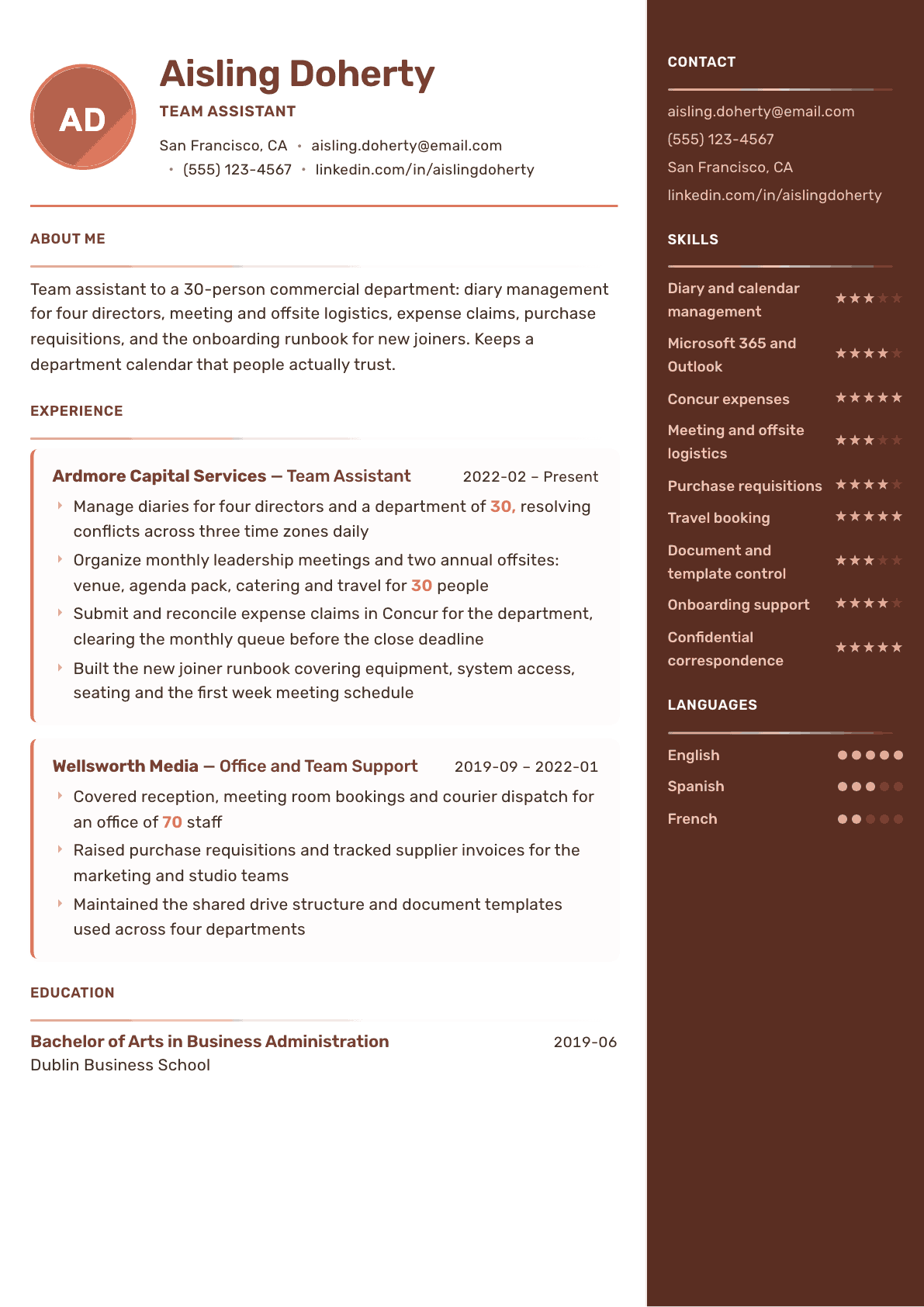
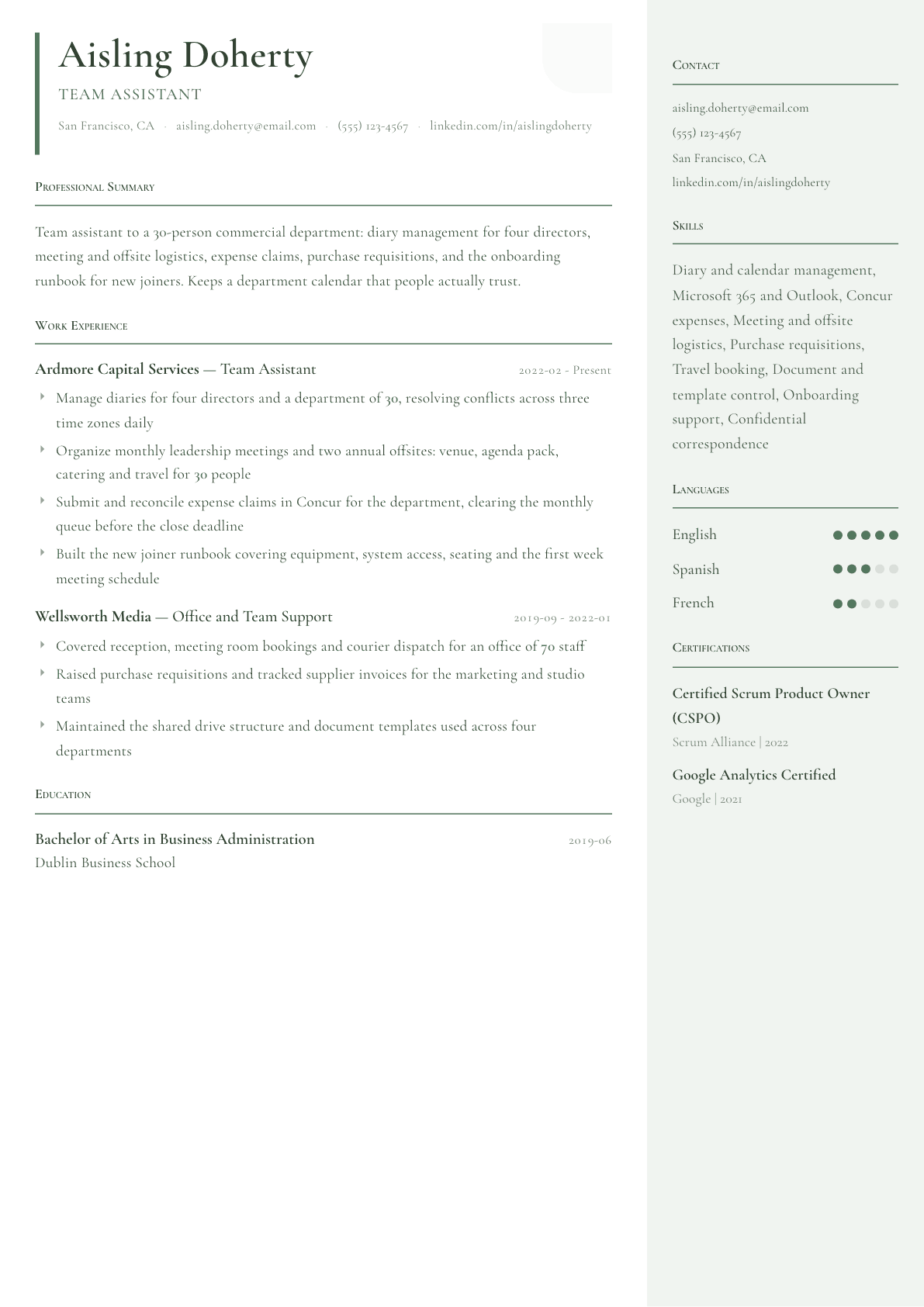
Example Team Assistant summary
Team assistant with six years supporting commercial and creative departments. Manages diaries for four directors and a team of 30 across three time zones, organizes leadership meetings and annual offsites end to end, and clears the department expense queue in Concur before every close. Wrote the new joiner runbook the department still uses. Bachelor degree in business administration.
Skills to list on a Team Assistant resume
- Calendar and diary management
- Microsoft Outlook
- Google Workspace
- Meeting and offsite logistics
- Expense processing
- Concur
- Purchase requisitions
- Travel and accommodation booking
- Minute taking
- Document management
- Onboarding coordination
- Visitor and reception cover
- Stakeholder communication
- Confidential correspondence
What actually gets this resume read
- Say how many people and how many senior stakeholders you support, because a team assistant role is sized by that.
- Name the systems you live in: Outlook, Google Workspace, Concur, SAP Ariba, Slack, or the intranet you maintained.
- Show diary work as decision making, such as resolving clashes and protecting focus time, not merely booking rooms.
- Give one logistics example with real scale: an offsite, a board meeting, or a department move with headcount attached.
- Include a finance touch such as expenses, requisitions or budget tracking, since most team assistant roles carry one.
- Describe something you standardized, for example an onboarding runbook or a template pack the team now reuses.
How to write a team assistant resume
A team assistant resume is read by the person who will be relieved when you arrive: a department head, a chief of staff, or the senior assistant who has been covering the gap. She is sizing one thing first, the shape of the support load. How many people, how many senior diaries, how many time zones, and how much of the department finance and logistics you can take off her plate.
The word assistant hides an enormous range. Supporting one manager in a single office is a different job from holding diaries for four directors and a department of thirty across three time zones while running expenses, requisitions and two annual offsites. If the numbers are not on the page, the reader assumes the smaller version of the role.
This guide covers how to structure the page, how to write diary management as decision making rather than booking, three summary examples at different stages, before and after bullets, and the questions team assistants ask when they move between industries or aim for an executive assistant seat.
Format: one page, support load stated immediately
One page under seven years, reverse chronological, plain sections. The first line under each employer should be the support load: the department size, the number of senior stakeholders whose diaries you held, the office headcount you covered, and the time zones involved. Every judgment the reader makes about you follows from those numbers.
Add the sector in a short parenthetical. Financial services, media, professional services and technology departments all use the title team assistant, and the rhythms differ: some are dominated by client meetings and travel, others by internal governance and document control. Naming the sector helps a reader picture your week.
- Header: name, city and state, phone, email, then a systems strip such as Outlook, Concur, SharePoint, Slack.
- Section order: summary, systems and skills, support experience, education, training and certifications.
- Open each job with headcount supported and number of senior diaries held.
Summary: who you keep running, and what you took off their desk
Name the population you supported and the senior stakeholders inside it, then the two or three workstreams you owned outright. Diary management for four directors and a department of thirty, expense processing for the whole team, and offsite logistics is a complete summary in one sentence, and it tells a hiring manager exactly what she stops doing when you start.
Close with the thing you standardized. A new joiner runbook, a template pack, a meeting room booking convention or a shared drive structure are all small artifacts with a long life, and they are the strongest single proof that you improve a department rather than merely keep pace with it.
Experience: diaries, meetings, money, logistics, documents
Diary work needs to read as judgment. Anyone can accept an invitation. What matters is resolving clashes between senior people, protecting preparation time before a board or client meeting, moving a recurring series when a travel plan changes, and knowing which meeting yields when two collide. Write that, with the time zone count attached, and the bullet stops sounding clerical.
Meeting and event logistics should carry scale. A monthly leadership meeting and two annual offsites for thirty people, with venue, agenda pack, catering, travel and accommodation, is a project rather than a booking. Name what you owned end to end, and say whether you handled the budget for it.
Almost every team assistant role carries a finance touch, so give it a bullet. Expense claims submitted and reconciled before the close deadline, purchase requisitions raised and tracked against supplier invoices, or a small departmental budget monitored. Then add the document layer: template control, shared drive structure, minute taking, and confidential correspondence handled without leaks.
- Name the systems by product: Microsoft Outlook, Google Workspace, Concur, an internal requisition system, the intranet.
- Say what you covered beyond your own team: reception cover, visitor management, courier dispatch, office moves.
- Include onboarding work with the components: equipment, system access, seating and the first week meeting schedule.
Discretion and reliability: show them, do not claim them
Team assistants sit next to compensation discussions, restructuring plans and client confidential material. Discretion is therefore assumed as a claim and disbelieved as an adjective. Show it structurally instead: handling confidential correspondence for a director group, preparing board or leadership packs, or managing a document set with restricted access.
Reliability is shown the same way, through a standard you held. Clearing the department expense queue before every monthly close, or publishing the leadership meeting pack a day before the meeting, are checkable commitments. A reader who sees one standard being met assumes the others were too.
Education, credentials and the words the posting reuses
A business administration degree is common and rarely required at this level. What reads well is applied training: advanced Excel or Outlook, a minute taking course, a business administration diploma, or an executive assistant program with a named provider. List the provider, since unnamed training reads as unverifiable.
Postings for this role recycle a predictable set of nouns: diary management, calendar management, meeting logistics, offsite coordination, expense processing, purchase requisitions, travel booking, minute taking, onboarding coordination, document management and confidential correspondence. Mirror the ones that are true, once in the skills block and once inside a bullet, phrased in your own words.
Team Assistant resume summary examples
First support role
Business administration graduate with a year covering reception, meeting room bookings and courier dispatch for an office of 70. Raised purchase requisitions, tracked supplier invoices and maintained shared drive templates for four departments. Seeking a team assistant seat supporting a department and its senior managers.
Six years in
Team assistant to a 30-person commercial department, holding diaries for four directors across three time zones. Organizes monthly leadership meetings and two annual offsites end to end, clears the department expense queue in Concur before every close, and wrote the new joiner runbook still in use.
Senior or moving to executive assistant
Senior team assistant with nine years across financial services and media, supporting departments above 50 staff and holding diaries for a leadership group of six. Owns board pack preparation, department expense and requisition processes, offsite delivery, and the onboarding standard used across three teams.
Work experience bullets: before and after
Before: Managed calendars for the team.
After: Managed diaries for four directors and a department of 30 across three time zones, resolving daily clashes and protecting preparation blocks before client and leadership meetings.
The stakeholder count, time zones and the protected preparation time turn booking into judgment a reader can trust.
Before: Organized company events and meetings.
After: Organized monthly leadership meetings and two annual offsites for 30 people end to end: venue, agenda pack, catering, travel and accommodation, all within the departmental budget.
Scale, components and budget ownership present the work as a project rather than a series of bookings.
Before: Processed expenses for the department.
After: Submitted and reconciled expense claims in Concur for the whole department, chasing missing receipts and clearing the queue before every monthly close deadline.
A named system and a recurring deadline standard make reliability checkable instead of asserted.
Before: Helped new starters settle in.
After: Built the new joiner runbook covering equipment, system access, seating and the first week meeting schedule, and ran it for every new member of the department.
An artifact that outlives the individual task is stronger evidence than a description of being helpful.
Before: Handled confidential information.
After: Handled confidential correspondence and leadership meeting packs for a director group, controlling document access and distributing materials only to named recipients.
Describing the control shows discretion in practice, where the adjective alone would be dismissed on sight.
Hard skills
- Diary and calendar management
- Microsoft Outlook and Microsoft 365
- Google Workspace
- Meeting and offsite logistics
- Expense processing in Concur
- Purchase requisitions and invoice tracking
- Travel and accommodation booking
- Minute taking and action follow up
- Document and template control
- SharePoint and shared drive structure
- Onboarding coordination
- Visitor and reception cover
- Board and leadership pack preparation
- Departmental budget tracking
Soft skills
- Discretion with senior information
- Anticipating needs before being asked
- Diplomacy between competing diaries
- Steadiness during a busy week
- Clear written communication
- Saying no to a low value meeting request
Certifications worth listing
- Certified Administrative Professional (CAP) (International Association of Administrative Professionals)
- Microsoft Office Specialist: Excel Associate (Microsoft)
- Microsoft Office Specialist: Outlook Associate (Microsoft)
- Certified Associate in Project Management (CAPM) (Project Management Institute)
Mistakes that cost team assistant candidates the interview
- Leaving out the support load, so the reader assumes you supported one manager in one office.
- Writing diary work as booking meetings rather than as resolving clashes and protecting preparation time.
- Skipping the finance touch, when expenses or requisitions sit inside almost every team assistant role.
- Claiming discretion as an adjective instead of showing a document or access control you operated.
- Naming only Microsoft Office, when the expense, requisition and intranet systems are what postings filter on.
- Listing events with no headcount or budget attached, which reduces a project back to a set of bookings.
Team Assistant resume questions
What is the difference between a team assistant and an executive assistant?
A team assistant supports a department and often several senior managers at once, balancing many requests. An executive assistant supports one or two leaders in depth, with more exposure to strategy and gatekeeping. Show the number of stakeholders and the seniority to place yourself correctly.
How do I show the size of the team I supported?
Give the department headcount, the number of senior diaries you held, the offices or time zones involved, and any wider office population you covered for reception or facilities. Four numbers do more for your ranking than any paragraph of description.
Should I include minute taking on a team assistant resume?
Yes, and treat it as a skill with a standard. Say which meetings you minuted, how quickly the record was circulated, and whether actions carried owners and dates. That turns a routine duty into evidence that meetings you attend produce outcomes.
How do I move from team assistant to executive assistant?
Show gatekeeping and judgment: inbox management on behalf of a leader, meeting requests you declined or reshaped, board packs you prepared, and travel you planned around a strategy calendar. Then reduce the general office duties so the file reads at the seniority you are targeting.
Does industry experience matter for a team assistant role?
It helps but rarely decides. Financial services and legal departments value confidentiality and document discipline, while agencies and technology teams value speed and logistics. Name your sector, then lead with the duties closest to the one you are applying into.
Related resume examples
- Administrative Assistant Resume example
- Office Manager Resume example
- Office Assistant Resume example
- Personal Assistant Resume example
- Administrative Coordinator Resume example
- Executive Assistant Resume example