Facilities Coordinator Resume Examples: read this first
Write a Facilities Coordinator Resume That Reads Like a Building Runs
By Mustafa Tarabya, founder of CVBooster · Published · Updated
Facilities coordinator resume examples with work order, vendor and CMMS keywords, and a guide to bullets a facilities manager will believe.
Sample resumes for a facilities coordinator
The same facilities coordinator content laid out in three CVBooster templates, so you can see what the finished document looks like before you write a word.
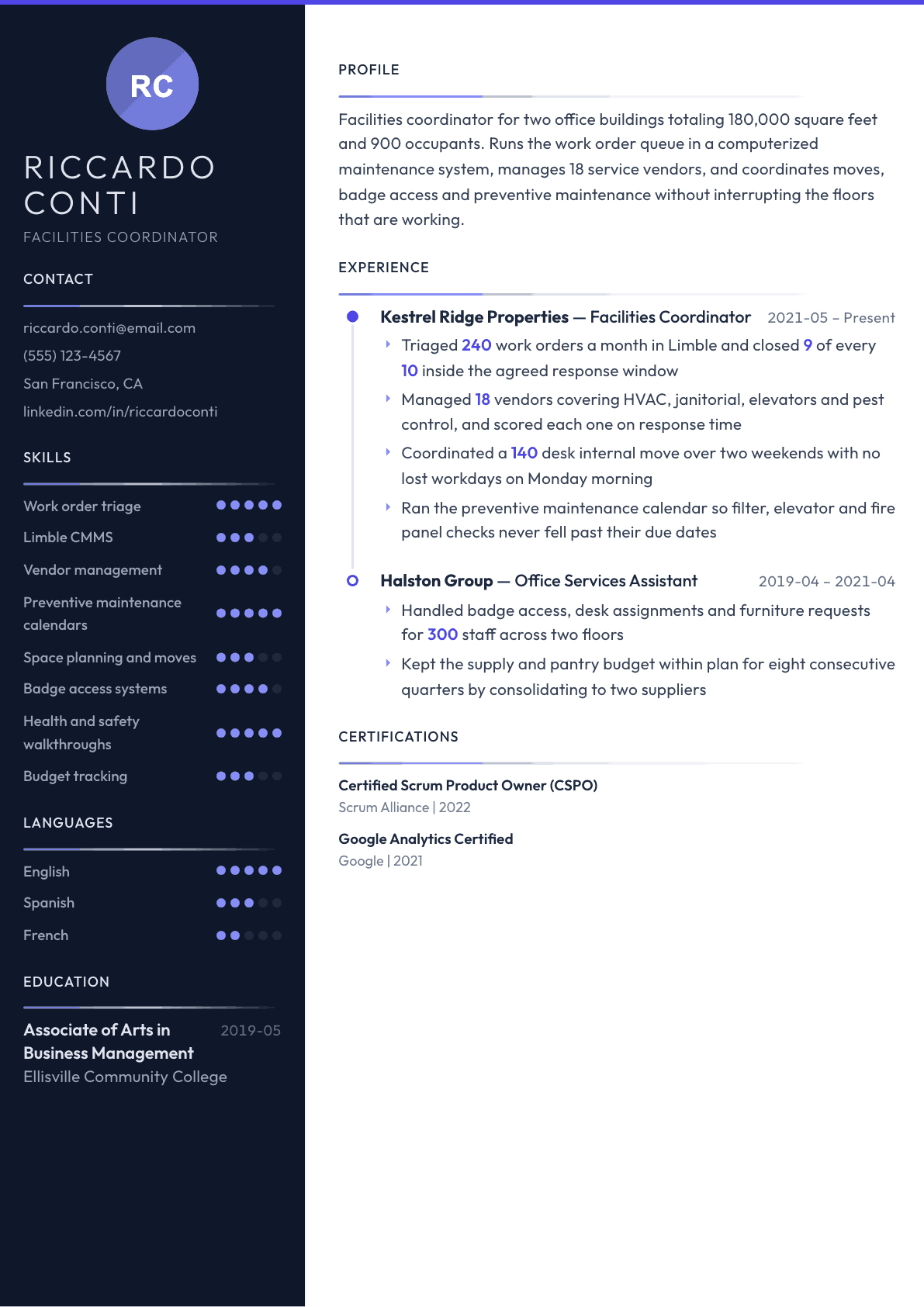
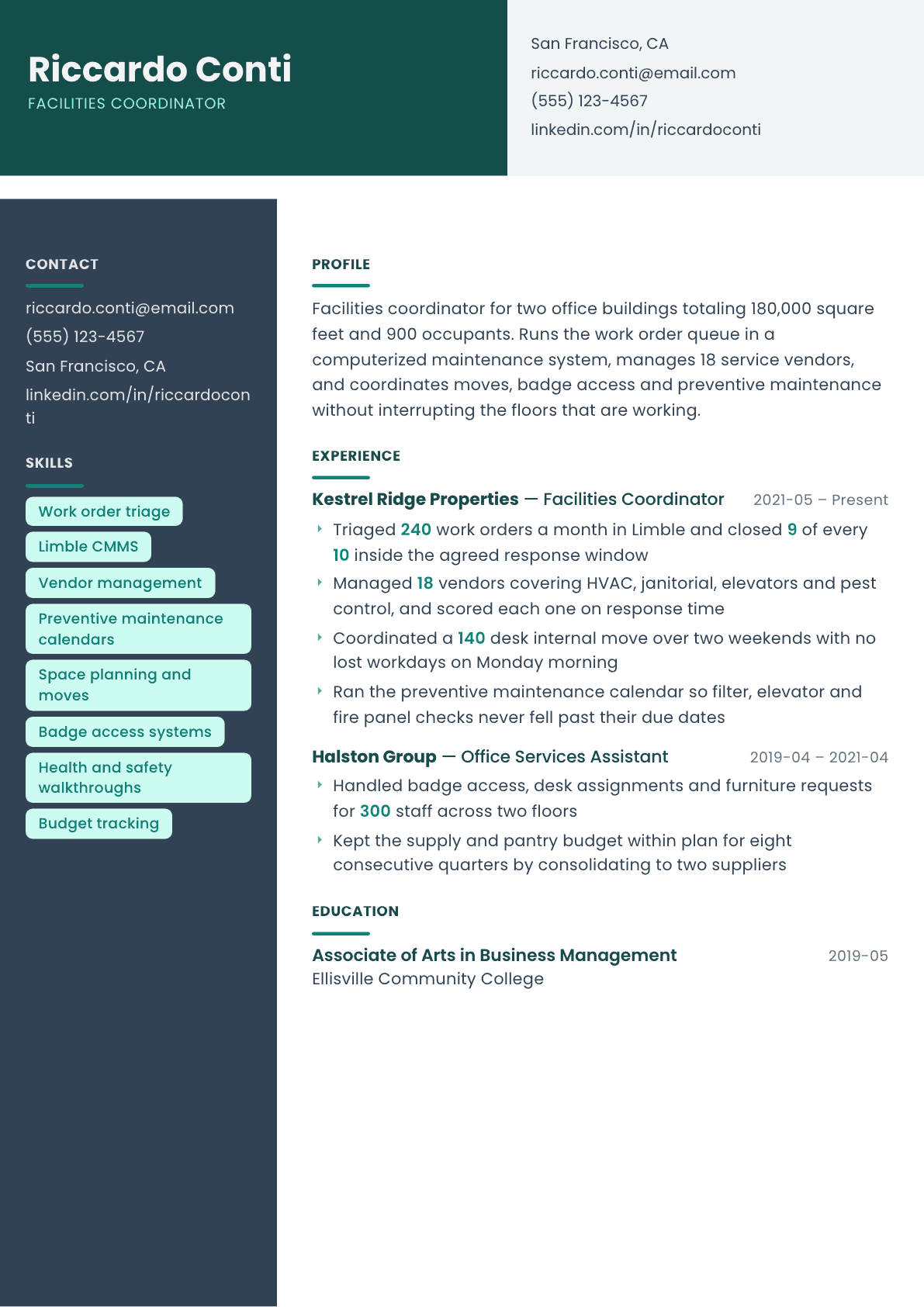
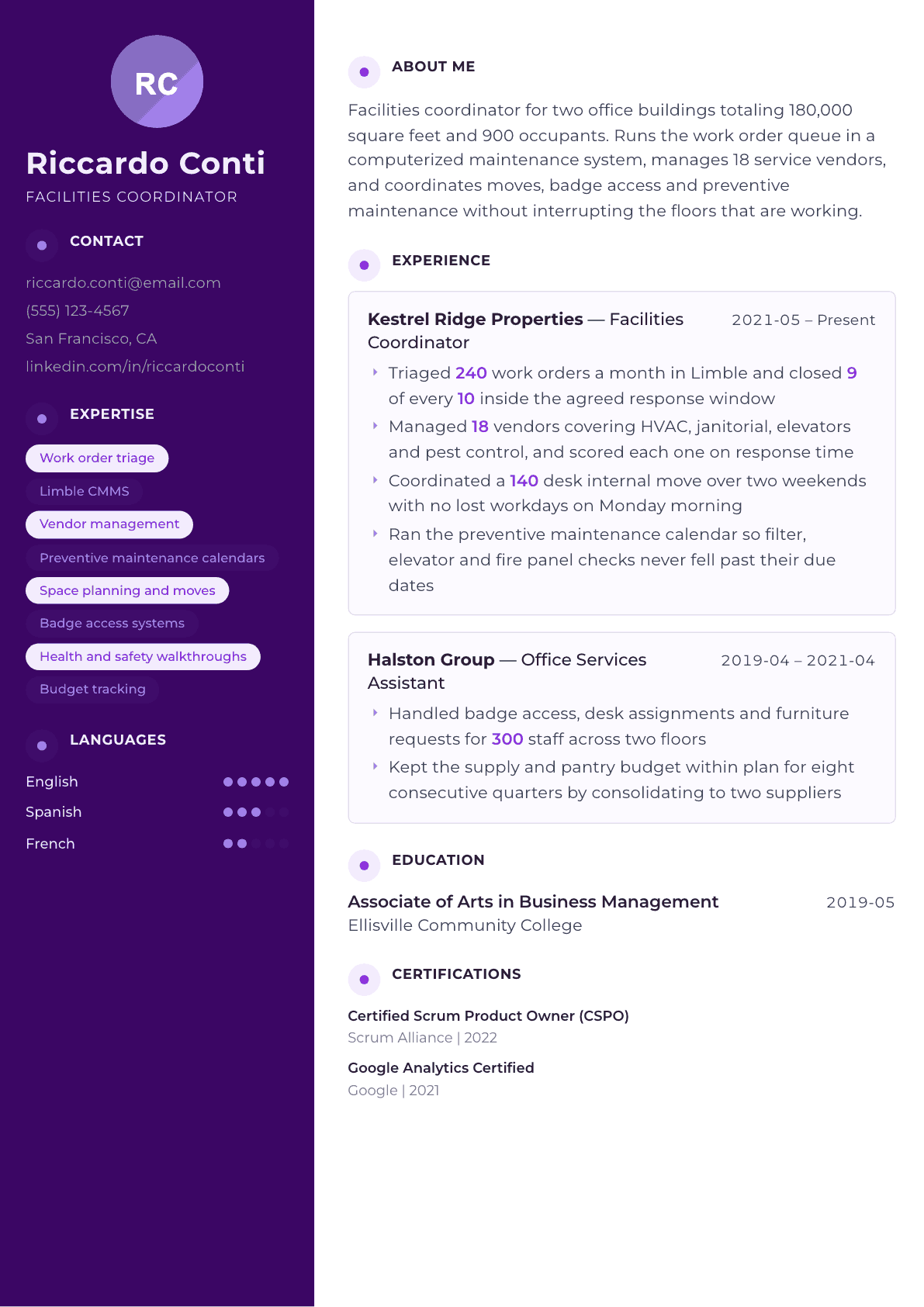
Example Facilities Coordinator summary
Facilities coordinator supporting two office buildings of 180,000 square feet and 900 occupants, triaging 240 work orders a month in Limble and closing nine in ten inside the response window. Manages 18 trade vendors and ran a 140 desk move across two weekends with no lost workdays. Seeking a coordinator role in a portfolio where preventive maintenance is taken seriously.
Skills to list on a Facilities Coordinator resume
- Work order management
- CMMS administration
- Vendor coordination
- Preventive maintenance scheduling
- Space planning
- Office moves and fit outs
- Badge and access control
- Health and safety inspections
- Budget and invoice tracking
- Purchase order processing
- Building systems basics
- Contractor escorting
- Emergency response procedures
- Supplier negotiation support
What actually gets this resume read
- State the portfolio you support: number of buildings, square footage and headcount, since that sets the whole scale.
- Give monthly work order volume and the share closed inside the response window agreed with the business.
- Name the maintenance system by name, whether that is Limble, Corrigo, FMX or a service desk queue in ServiceNow.
- List the trades you coordinate, because HVAC, elevator and life safety vendors each carry different obligations.
- Include one move, refit or fit out project with its size in desks or floors, since projects show planning ability.
- Add safety and compliance work such as fire panel checks or inspection readiness, which a manager screens for early.
How to write a facilities coordinator resume
A facilities coordinator resume is read by someone whose phone rings when a floor is too hot, an elevator is stuck or a contractor turns up with no escort. She is looking for a candidate who makes those calls stop happening, and she judges that by the portfolio you have carried, the work order volume you triaged, and whether preventive maintenance ever slipped past its due date on your watch.
The mistake that keeps good candidates out of interviews is writing the role as office administration. Ordering supplies and greeting vendors is part of the day, but it is not the part that separates a coordinator who can hold two buildings from an office assistant with an expanded job title. Work orders, vendor performance, moves and compliance checks are the four things being screened for.
This guide sets out the section order a facilities manager expects, three summaries covering office services through coordinator lead, before and after bullets from work order and move work, and the questions coordinators ask when they want to move from a single floor to a real portfolio.
Format: one page, portfolio scale stated first
One page, reverse chronological, single column. Open each job with the portfolio: buildings supported, square footage and headcount. Those three numbers set the scale of everything below them, and without them the reader has to guess whether you ran a floor or a campus.
Write square footage in words when it runs large, and keep the headcount plain. A coordinator supporting two buildings and 900 occupants is doing a job a facilities manager can picture immediately.
- Header: name, city and state, phone, email, and the maintenance system you have administered.
- Section order: summary, experience, systems and trades, certifications, education.
- Each job header: buildings, square footage, occupant count, and whether the site was owned or leased.
Summary: portfolio, work order volume, response, vendors
Four facts again. The portfolio, the monthly work order volume, the share closed inside the agreed response window, and the number of vendors you managed. That last one matters more than candidates realize, because vendor coordination is where a coordinator either creates leverage or becomes a message relay.
Add one project. A desk move, a floor refit or a fit out with its size in desks or floors proves you can plan rather than only react, and planning is the difference between the coordinator seat and the assistant seat.
Experience: triage, vendors, projects, compliance
Start with the queue. Work orders triaged per month, how you prioritized them, and the share closed inside the response window the business agreed to. Facilities is one of the few administrative fields with a genuine service level built in, so use it.
Then vendors. List the trades rather than the count alone, since heating and cooling, elevators, janitorial, pest control and life safety carry very different obligations and inspection regimes. If you scored vendors on response time or held a quarterly review with them, that is management rather than dispatch and belongs in its own bullet.
Then projects and compliance. A move with a desk count and a weekend window shows planning under a hard deadline. Preventive maintenance calendars, filter changes, elevator inspections and fire panel checks show that the unglamorous half of the job was never allowed to lapse, which is exactly the half a manager gets audited on.
Systems and trades: name the platform and the disciplines
Name the computerized maintenance management system you worked in and say whether you configured asset records and preventive maintenance schedules inside it or only closed tickets. Configuring is the skill that scales, and a manager will ask.
Then the surrounding systems: the access control platform where badges are issued, the space or desk booking tool, the purchase order workflow you raise work through. Facilities coordinators live across four or five systems, and listing them honestly is how a hiring manager plans the first month.
- Maintenance systems: Limble, Corrigo, FMX, or a service desk queue configured for facilities requests.
- Trades coordinated: heating and cooling, elevators, janitorial, pest control, electrical, and life safety contractors.
- Adjacent: badge and access control, space planning and moves, purchase orders and invoice tracking, health and safety walkthroughs.
Certifications and education: the facilities ladder
An associate degree in business or facilities is typical and a degree is rarely a hard requirement. What does carry weight is the professional credential path, because facilities has a clear one and managers know it. The facility management professional credential is the usual first step, and the certified facility manager designation sits above it.
Safety training is worth listing separately when you hold it. A general industry safety course tells a manager you can walk a building with a contractor and recognize what should not be happening, which is a real part of the coordinator role.
Facilities Coordinator resume summary examples
Office services assistant
Office services assistant handling badge access, desk assignments and furniture requests for 300 staff across two floors. Kept the supply and pantry budget within plan for eight consecutive quarters by consolidating to two suppliers. Seeking a facilities coordinator seat with work order and vendor responsibility.
Coordinator, two buildings
Facilities coordinator for two office buildings totaling one hundred eighty thousand square feet and 900 occupants. Triages 240 work orders a month in Limble, closes nine in ten inside the agreed response window, and manages 18 trade vendors covering heating and cooling, janitorial, elevators and pest control.
Senior coordinator
Senior facilities coordinator running the maintenance system configuration, the preventive maintenance calendar and vendor performance reviews across a multi building portfolio. Delivered a 140 desk internal move over two weekends with no lost workdays, and closed two safety inspections with no outstanding items.
Work experience bullets: before and after
Before: Handled maintenance requests from staff.
After: Triaged 240 work orders a month in Limble by urgency and impact, closing nine of every ten inside the response window agreed with the business.
Volume plus a service level turns a reactive duty into a measurable operation the manager can compare with her own.
Before: Worked with outside vendors and contractors.
After: Managed 18 vendors across heating and cooling, janitorial, elevators and pest control, scoring each on response time and reviewing the scores with them quarterly.
Naming the trades and the scorecard shows vendor management rather than message passing between staff and suppliers.
Before: Helped with an office move.
After: Coordinated a 140 desk internal move across two weekends, sequencing furniture, network patching and badge updates so every team worked normally on Monday morning.
The desk count, the window and the dependencies prove genuine project planning under a deadline that could not slip.
Before: Made sure preventive maintenance was done.
After: Ran the preventive maintenance calendar so filter changes, elevator inspections and fire panel checks were completed before their due dates across both buildings.
Naming the specific recurring checks shows familiarity with the compliance half of the job rather than a generic claim.
Before: Managed the office supply budget.
After: Held the supply and pantry budget within plan for eight consecutive quarters by consolidating from six suppliers to two and moving to a single monthly purchase order.
The consolidation and the ordering change explain how the budget was held, which makes the streak believable.
Hard skills
- Work order triage and closure
- Computerized maintenance system administration
- Preventive maintenance scheduling
- Vendor coordination and performance review
- Space planning and desk moves
- Office fit out coordination
- Badge and access control administration
- Health and safety walkthroughs
- Purchase order and invoice tracking
- Contractor escorting and permits
- Building systems fundamentals
- Emergency response procedures
Soft skills
- Prioritizing competing urgent requests
- Holding vendors to a commitment
- Working weekends without drama
- Clear notice to occupants before disruption
- Practical problem solving on the floor
- Budget discipline
Certifications worth listing
- Facility Management Professional (FMP) (International Facility Management Association)
- Certified Facility Manager (CFM) (International Facility Management Association)
- Facilities Management Administrator (FMA) (BOMI International)
- OSHA 30-Hour General Industry (OSHA Training Institute)
Mistakes that cost facilities coordinator candidates the interview
- Writing the resume as office administration, which prices the candidate below the facilities coordinator seat.
- Leaving out square footage, building count and headcount, the three figures that establish the scale you have carried.
- Reporting work order volume with no response window, so the reader cannot tell whether the queue was actually served.
- Listing a vendor count without naming the trades, when life safety and elevator contracts carry the real obligations.
- Skipping preventive maintenance and inspection work, the half of the job the facilities manager gets audited on.
- Claiming a maintenance system without saying whether you configured assets and schedules or only closed tickets.
Facilities Coordinator resume questions
Do I need technical trade knowledge to be a facilities coordinator?
You need enough to triage correctly and to know when a contractor is telling you something implausible, not enough to do the repair. Show that with bullets on the systems you scheduled maintenance for rather than by claiming hands on trade skills you do not hold.
What is the best metric for a facilities coordinator resume?
Work orders handled per month paired with the share closed inside the agreed response window. It shows both volume and reliability. Vendor count, preventive maintenance completion and project size in desks or floors round out the picture.
How do I move from office services into facilities?
Lead with anything that touched the building rather than the office: badge access, desk moves, supplier consolidation, contractor escorting, safety walkthroughs. Then name the maintenance system you want to learn and any safety training you already hold.
Should I list every vendor I have worked with?
No, list the trades and the count. A manager wants to know you have coordinated life safety and elevator contractors, not the names of the companies. An itemized vendor list uses space that a move project or a compliance result would use better.
Is the facility management professional credential worth listing?
Yes, and it is worth pursuing if you intend to stay in the field, because facilities has an unusually well recognized credential ladder. Put it in the header line and again in its own section, and never list a credential you are still studying for as if it were earned.
Related resume examples
- Office Manager Resume example
- Office Coordinator Resume example
- Scheduling Coordinator Resume example
- Administrative Assistant Resume example
- Administrative Coordinator Resume example
- Senior Administrative Assistant Resume example