Fashion Stylist Resume Examples: the lines they read
Build a Fashion Stylist Resume Editors Actually Call Back
By Mustafa Tarabya, founder of CVBooster · Published · Updated
Fashion stylist resume examples with credits, pull and return workflow, editorial and commercial keywords, plus a complete writing guide.
Sample resumes for a fashion stylist
The same fashion stylist content laid out in three CVBooster templates, so you can see what the finished document looks like before you write a word.
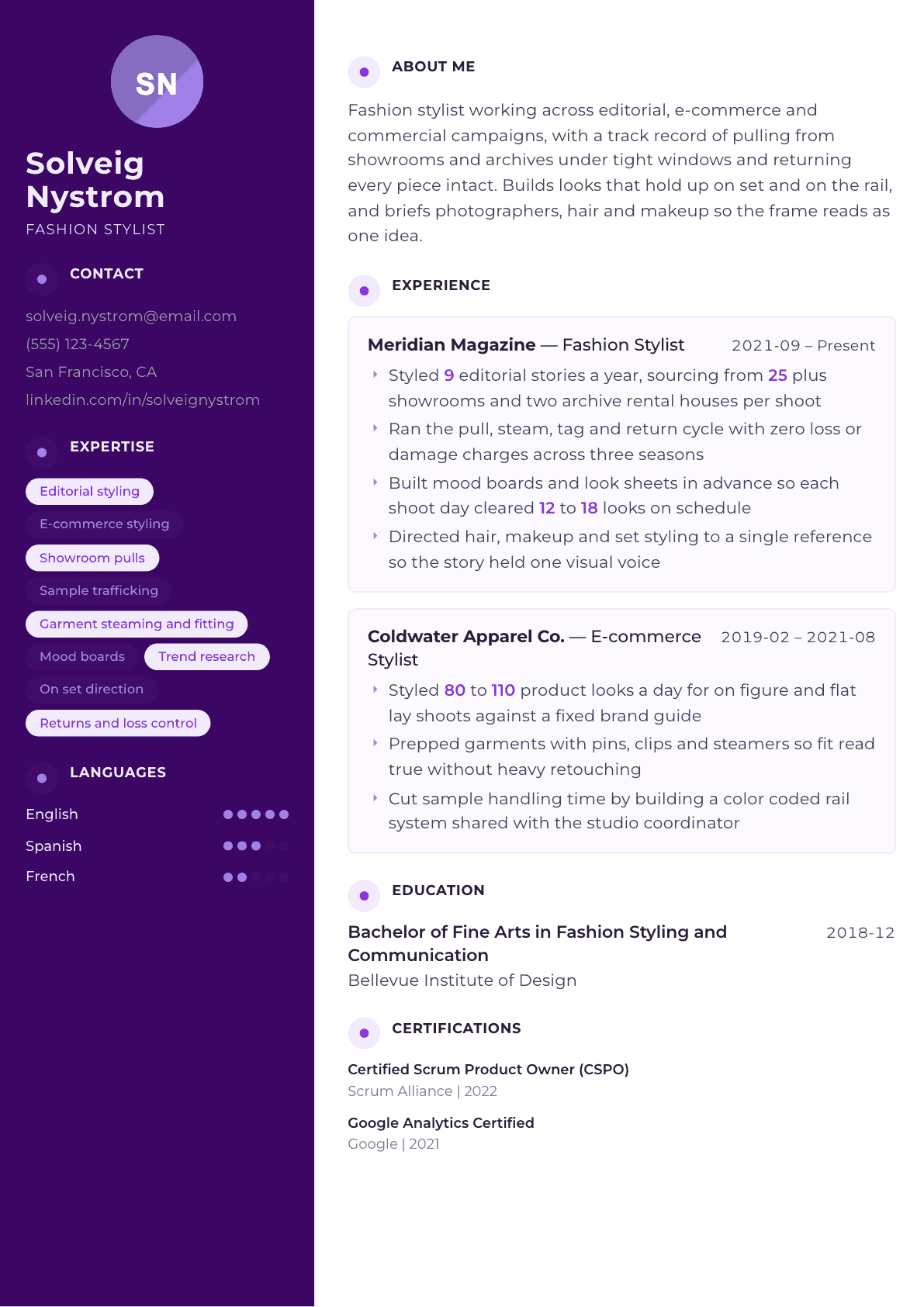
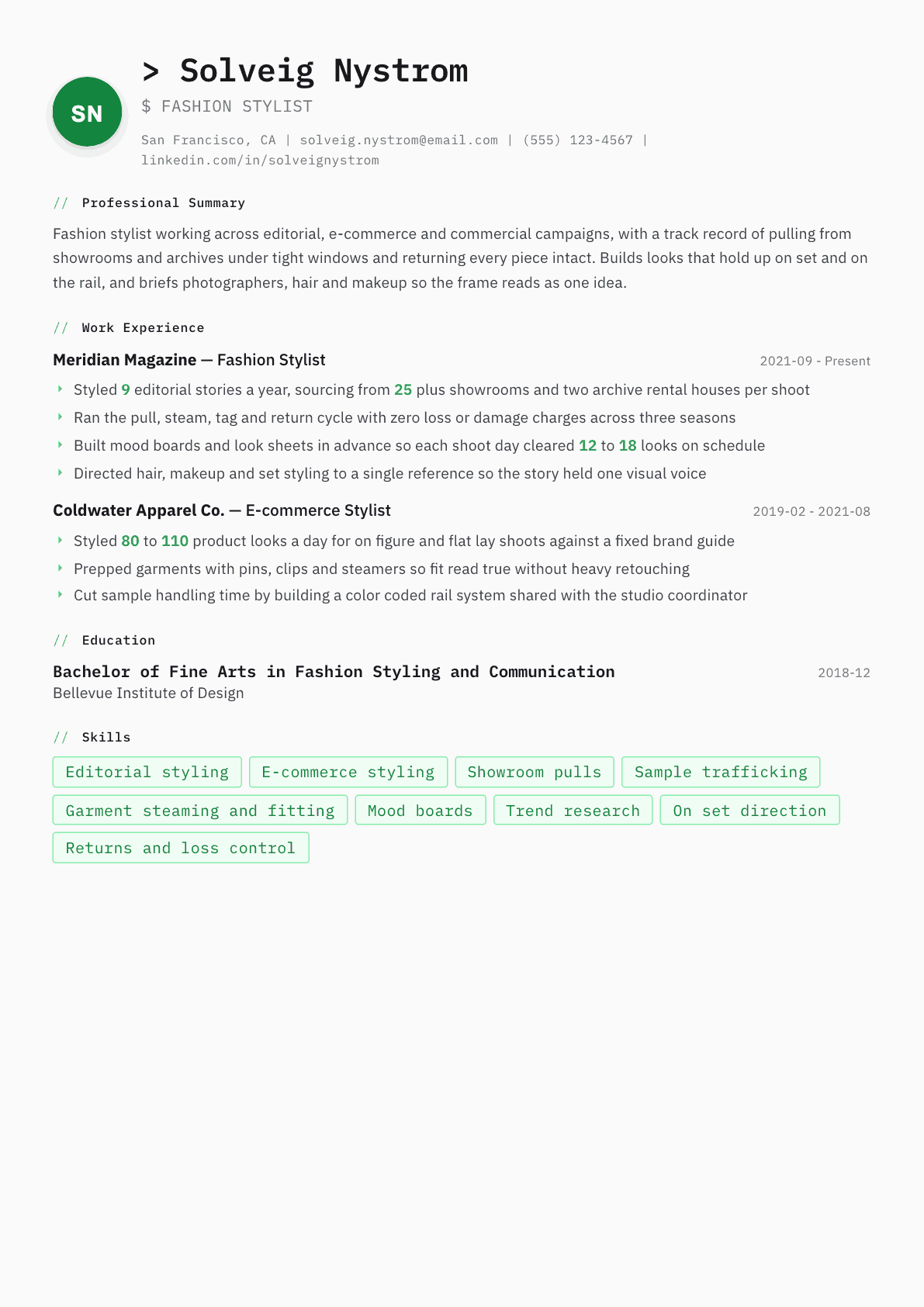
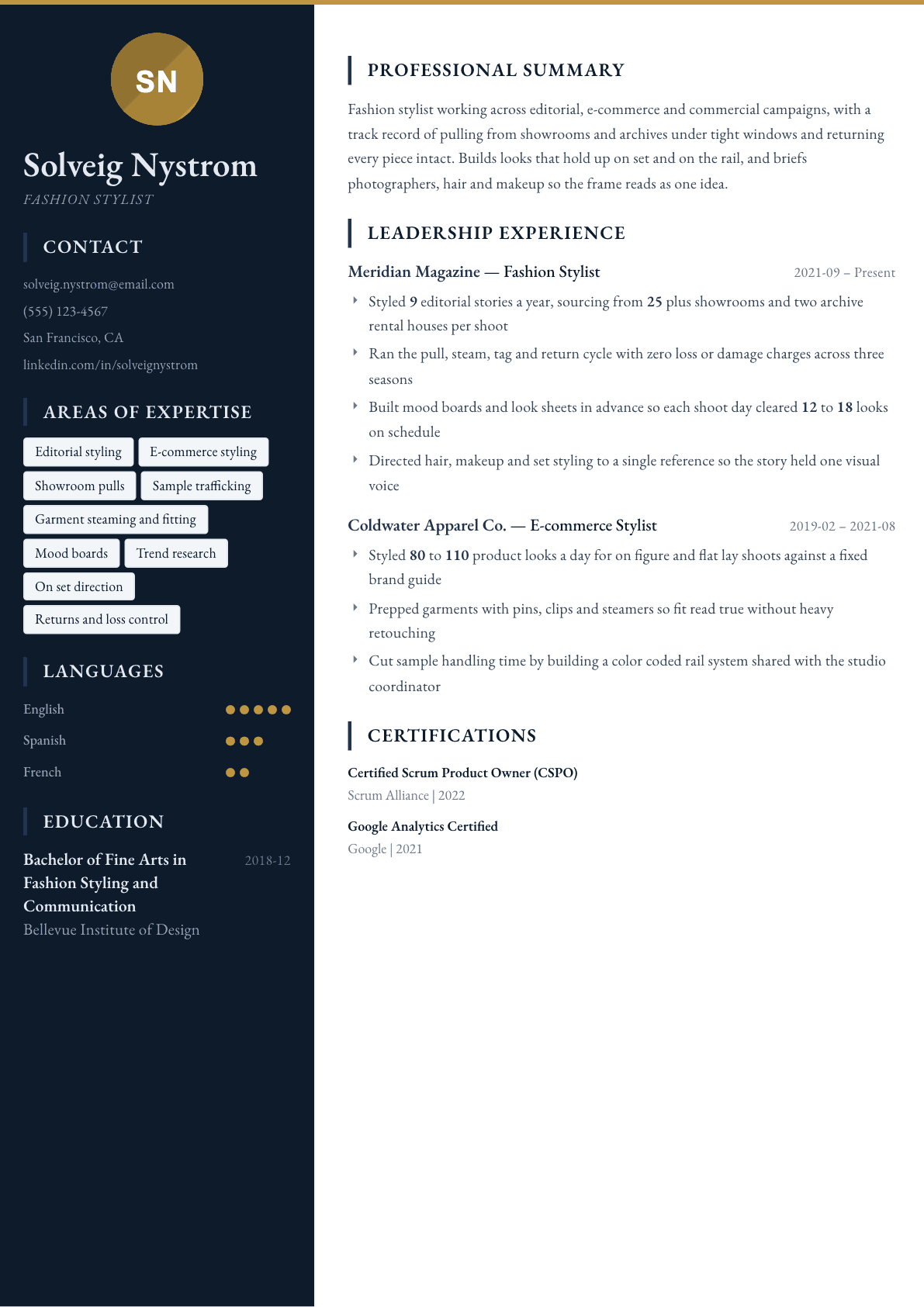
Example Fashion Stylist summary
Fashion stylist with five years across editorial, campaign and e-commerce work. Sources from showrooms, archives and vintage dealers, prepares garments so fit reads true in camera, and returns every sample on time and undamaged. Comfortable clearing high look counts on studio days and equally at home directing a small crew on a location story with a single reference board.
Skills to list on a Fashion Stylist resume
- Editorial styling
- Commercial and campaign styling
- E-commerce and catalog styling
- Showroom and press office pulls
- Sample trafficking
- Garment preparation and steaming
- Fit correction on set
- Mood board and look sheet building
- Trend and reference research
- Talent fittings
- Hair and makeup briefing
- Wardrobe budgeting
- Returns and damage control
- Set etiquette and call sheets
What actually gets this resume read
- Put a credits block near the top listing publication, brand, photographer and year for your strongest work.
- Separate editorial, commercial and e-commerce credits, because those three markets hire on different evidence.
- Say how many looks per day you clear on volume shoots; studio managers screen on that throughput number.
- Name the showrooms and rental houses you have accounts with, since access is a real part of the job.
- Show the pull and return discipline with a loss or damage record, which is the risk a producer worries about.
- Link a portfolio and keep the resume to the working facts, so the reader is not asked to judge taste from text.
How to write a fashion stylist resume
A fashion stylist resume has an unusual job to do: it has to prove taste without asking the reader to judge taste from text. That work belongs to the portfolio link. The resume proves the other half, the half that gets you rebooked, which is access to showrooms, discipline on pulls and returns, and the ability to clear a look count on schedule with a crew waiting on you.
Editors, studio managers and production companies read for three different things, and they hire from three different piles. An editor reads credits: publication, photographer, story, year. A commercial producer reads reliability and budget behavior. An e-commerce studio manager reads throughput, looks per day, and whether samples come back intact. A single resume that blurs all three usually loses all three.
This guide sets out how to structure credits, what to say about pulls and returns, how to write bullets for editorial, campaign and catalog work, and the questions stylists ask most when a resume is suddenly required by a brand rather than an agent.
Format: credits high, one page, portfolio link in the header
Put a credits block directly under the header, above employment history. For a freelance stylist the credits are the career and the employment dates are secondary. For a staff e-commerce or studio stylist, reverse that and lead with employment, because a studio manager wants continuity and daily output more than mastheads.
Keep it to one page unless you have a decade of split editorial and commercial work. Single column, no decorative type, one link to the portfolio. The portfolio does the visual argument; a resume that tries to be a lookbook loses the facts a producer is scanning for.
- Header: name, base city, travel willingness, phone, email, portfolio link, agency representation if you have it.
- Credits grouped by market: editorial, campaign and commercial, e-commerce and catalog.
- Each credit as publication or brand, photographer, story or campaign name, and year.
Summary: markets, volume, access
Three lines naming the markets you work in, the years, and the two facts that separate stylists: the showrooms and press offices you hold accounts with, and the look counts you clear on volume days. Access is a real asset in this job and no other section states it.
If you are pivoting between markets, say it plainly. An e-commerce stylist moving into editorial should name the transferable strengths, garment preparation, fit correction and speed, and then point at the test shoots that prove the editorial eye, rather than hoping the reader assumes it.
Experience: pulls, prep, set and returns
Every styling job runs the same cycle, so write bullets along it. Sourcing and pulls, from how many showrooms, archive houses or vintage dealers. Preparation, meaning steaming, pinning, clipping and taping so fit reads true in camera without heavy retouching. On set, the look sheet and the direction you give hair, makeup and set styling. Then returns, the part producers actually worry about.
Volume belongs in the bullets. An e-commerce day cleared at eighty to a hundred and ten looks is a different skill from an editorial day of twelve to eighteen looks, and a studio manager screens directly on that number. Give it honestly with the shoot type attached, because a reader who knows the work can tell when a number is inflated.
Loss and damage is your risk record. A stylist who can say three seasons of pulls with no loss or damage charge is easier to book than one with a longer credit list and no such line, because a damaged archive piece becomes the production company debt.
Credits: separate the three markets
Editorial credits prove eye and access. Campaign and commercial credits prove you can work inside a brand guideline with a client on set. E-commerce credits prove speed and consistency. Listing them in one undifferentiated run makes a reader do the sorting, and readers do not sort.
Name the photographer on editorial credits. In this field a photographer name is a shorthand for the level of production you have stood on, and it is the fastest way for an editor to place you without opening the portfolio.
Skills: mechanics of the job, not adjectives
The skills list should read like a call sheet: showroom and press office pulls, sample trafficking, garment steaming and fit correction, mood board and look sheet building, talent fittings, wardrobe budgeting, returns and damage control, set etiquette. Trend research belongs here too, stated as a research practice rather than as a claim to be forward thinking.
Add the practical extras that make a stylist bookable. A driver license and a car for pull runs, a kit that includes steamer, clips and tape, comfort with continuity notes on multi day shoots, and any second language useful in the showrooms you work.
Fashion Stylist resume summary examples
Styling assistant
Styling assistant with two years supporting editorial and campaign shoots. Runs pulls across 20 plus showrooms, prepares and steams garments on set, and manages the tag, log and return cycle. Cleared three seasons of pulls with no loss or damage charge, and holds a car for same day pull runs.
Working stylist
Fashion stylist with five years across editorial, campaign and e-commerce work. Styles 9 editorial stories a year sourcing from showrooms and two archive rental houses, and clears 80 to 110 looks a day on studio catalog shoots. Briefs hair and makeup so a story reads as one idea.
Lead stylist
Lead fashion stylist with nine years and a working relationship with more than 40 showrooms and press offices. Runs campaign wardrobe from concept board through fittings and on set direction, manages a wardrobe budget and two assistants, and has delivered multi day location stories with full continuity.
Work experience bullets: before and after
Before: Styled fashion editorials for magazines.
After: Styled 9 editorial stories a year for a monthly title, sourcing each from 25 plus showrooms and two archive rental houses inside a three day pull window.
Story count, sourcing breadth and the pull window show access and speed, which is what an editor books on.
Before: Responsible for sample returns.
After: Ran the full pull, steam, tag and return cycle across three seasons with zero loss or damage charges billed back to production.
Returns are the producer risk, and a stated record beats a stated responsibility.
Before: Worked quickly on e-commerce shoots.
After: Styled 80 to 110 product looks a day for on figure and flat lay shooting against a fixed brand guide, holding the day rate throughput without retouch escalations.
A studio manager screens on looks per day, so the number and the shoot type replace the word quickly.
Before: Prepared clothes before the shoot.
After: Prepped garments with pins, clips, tape and steamers so fit read true in camera and cut the retouching required on shape and hem lines.
The technique list shows craft, and the downstream saving explains why the craft matters.
Before: Collaborated with hair and makeup.
After: Briefed hair, makeup and set styling to a single reference board each morning so the story held one visual voice across 12 to 18 looks.
Naming the artifact, the cadence and the look count turns collaboration into a leadership practice.
Hard skills
- Editorial styling
- Campaign and commercial styling
- E-commerce and catalog styling
- Showroom and press office pulls
- Sample trafficking and logging
- Garment steaming and preparation
- Fit correction on set
- Mood board and look sheet building
- Talent fittings
- Wardrobe budgeting
- Trend and reference research
- Returns and damage control
- Continuity notes
- Flat lay styling
Soft skills
- On set diplomacy
- Talent handling
- Speed under a fixed call time
- Clear direction to crew
- Negotiating access
- Attention to small detail
Mistakes that cost fashion stylist candidates the interview
- Mixing editorial, commercial and catalog credits into one list, so no reader finds the evidence for the pile they hire from.
- Leaving out look counts per day, which is the single number a studio manager screens on for volume work.
- Describing personal aesthetic in prose instead of linking a portfolio and keeping the resume to working facts.
- Omitting showroom and press office access, the asset that most distinguishes one stylist from another.
- Skipping the returns record, which is the first thing a producer asks about after a damaged archive piece.
- Listing a photographer only by first name, which reads as name dropping rather than a verifiable credit.
Fashion Stylist resume questions
Do fashion stylists need a resume if they have a portfolio?
Yes, once brands, studios and production companies are hiring you directly rather than an agent booking you. Their process runs on documents and rate cards, and the portfolio cannot show pull access, look counts, budget handling or a clean returns record.
How do I list credits with no publication names I can share?
Describe the work without naming a client under embargo: a monthly fashion title, a national retailer, a European sportswear brand. Give format, look count and photographer when permitted. Never invent a masthead, because this industry checks by phone in a single call.
Should I include assisting work on a stylist resume?
Yes while it is your strongest evidence, labeled clearly as assisting with the lead stylist named. It shows the productions you have stood on. Move it below your own credits once you have two years of independently styled work.
How do I show I can handle a wardrobe budget?
State the budget behaviors rather than a figure: purchase versus rental decisions, returns discipline that recovers spend, negotiating loan terms with press offices, and reconciling receipts to the production after wrap. Producers are buying predictability more than thrift.
What belongs on an e-commerce stylist resume that editorial resumes skip?
Daily look throughput, adherence to a brand guide, rail and sample organization systems, on figure versus flat lay technique, and coordination with the studio coordinator and photographer on shot lists. Editorial storytelling language is largely wasted on a catalog studio manager.