Fashion Merchandiser Resume Examples: what gets the call
Write a Fashion Merchandiser Resume That Proves Stock Control
By Mustafa Tarabya, founder of CVBooster · Published · Updated
Fashion merchandiser resume examples covering WSSI, allocation, stock cover and forecasting keywords, with sample bullets and a writing guide.
Sample resumes for a fashion merchandiser
The same fashion merchandiser content laid out in three CVBooster templates, so you can see what the finished document looks like before you write a word.
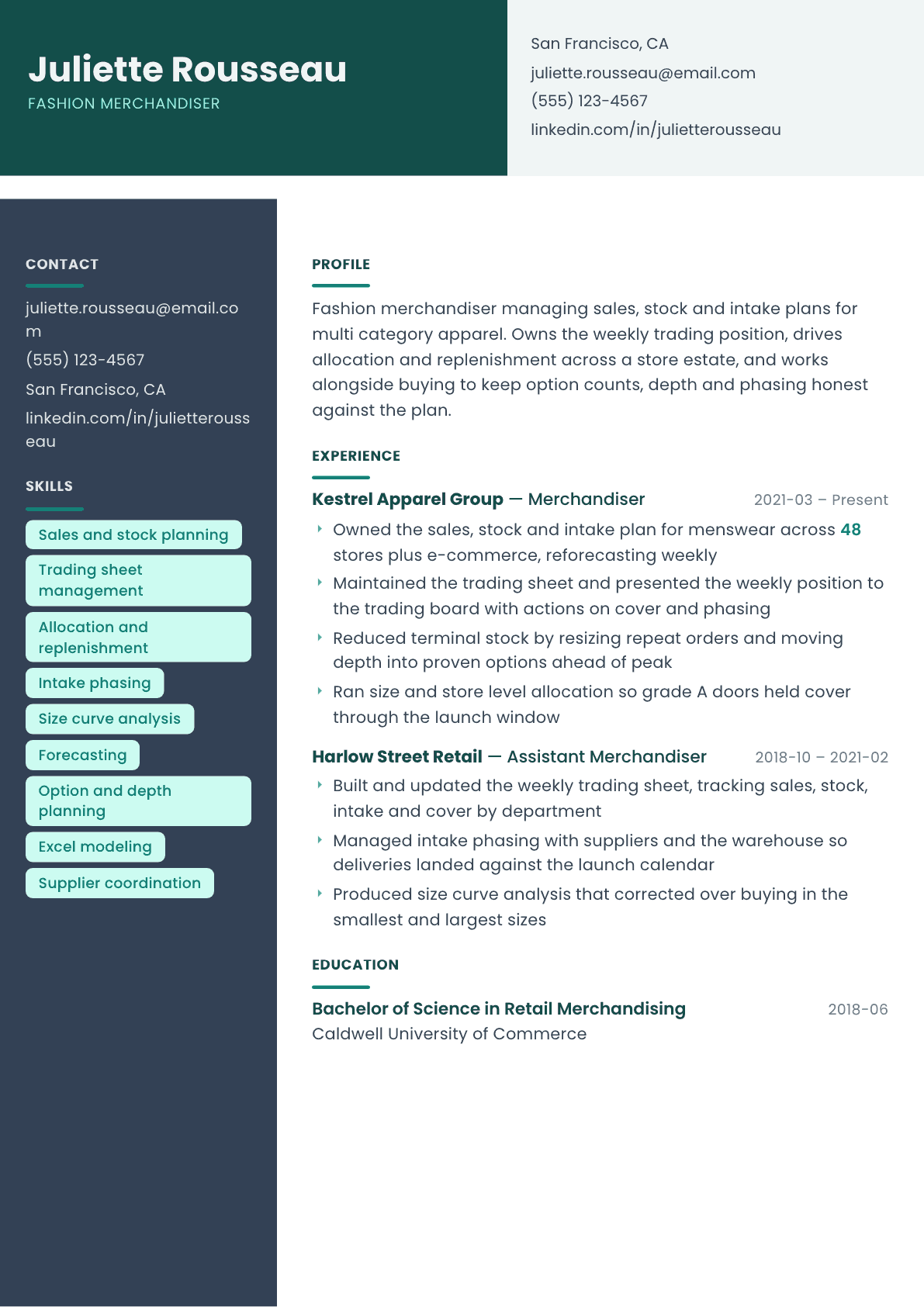
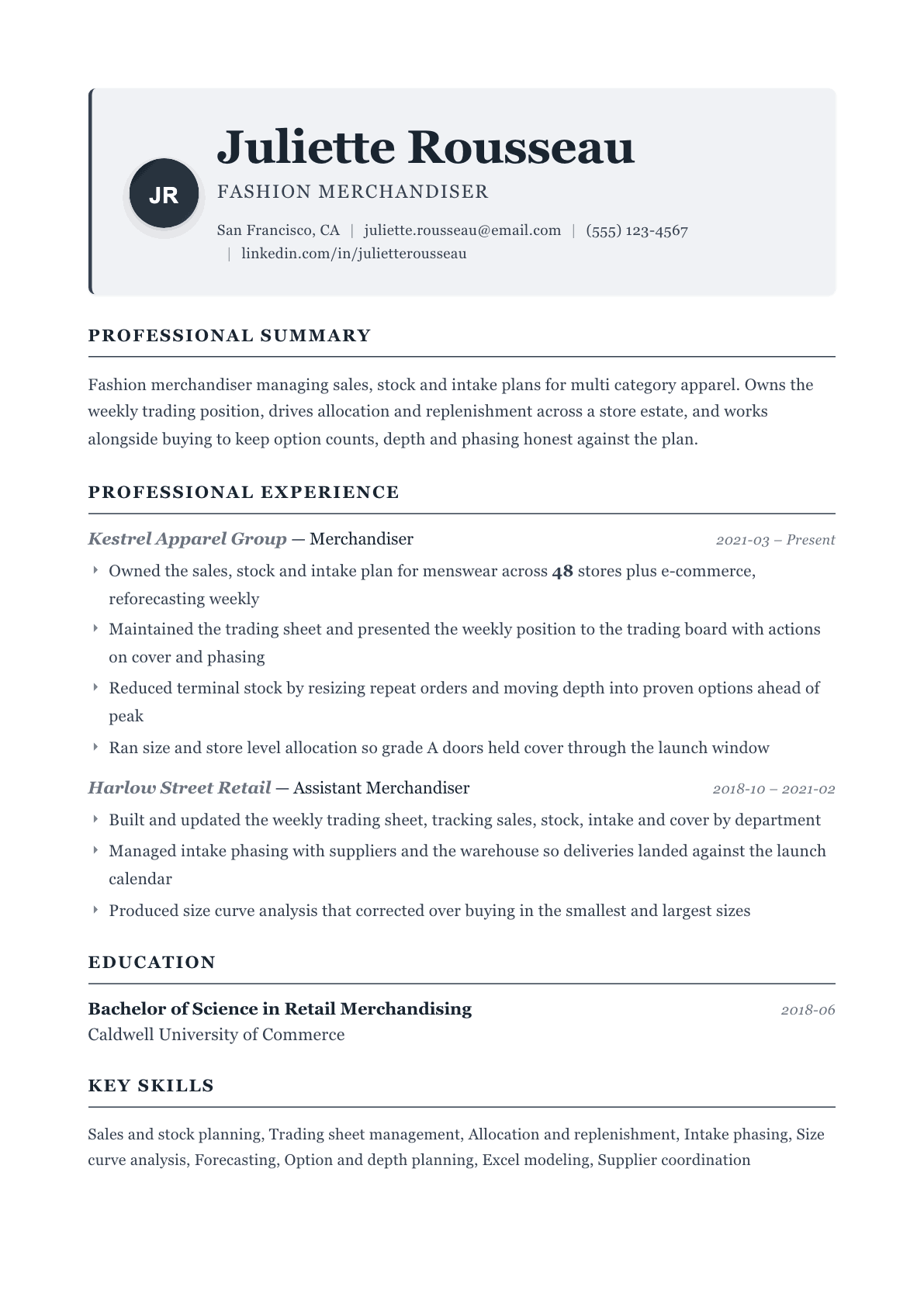
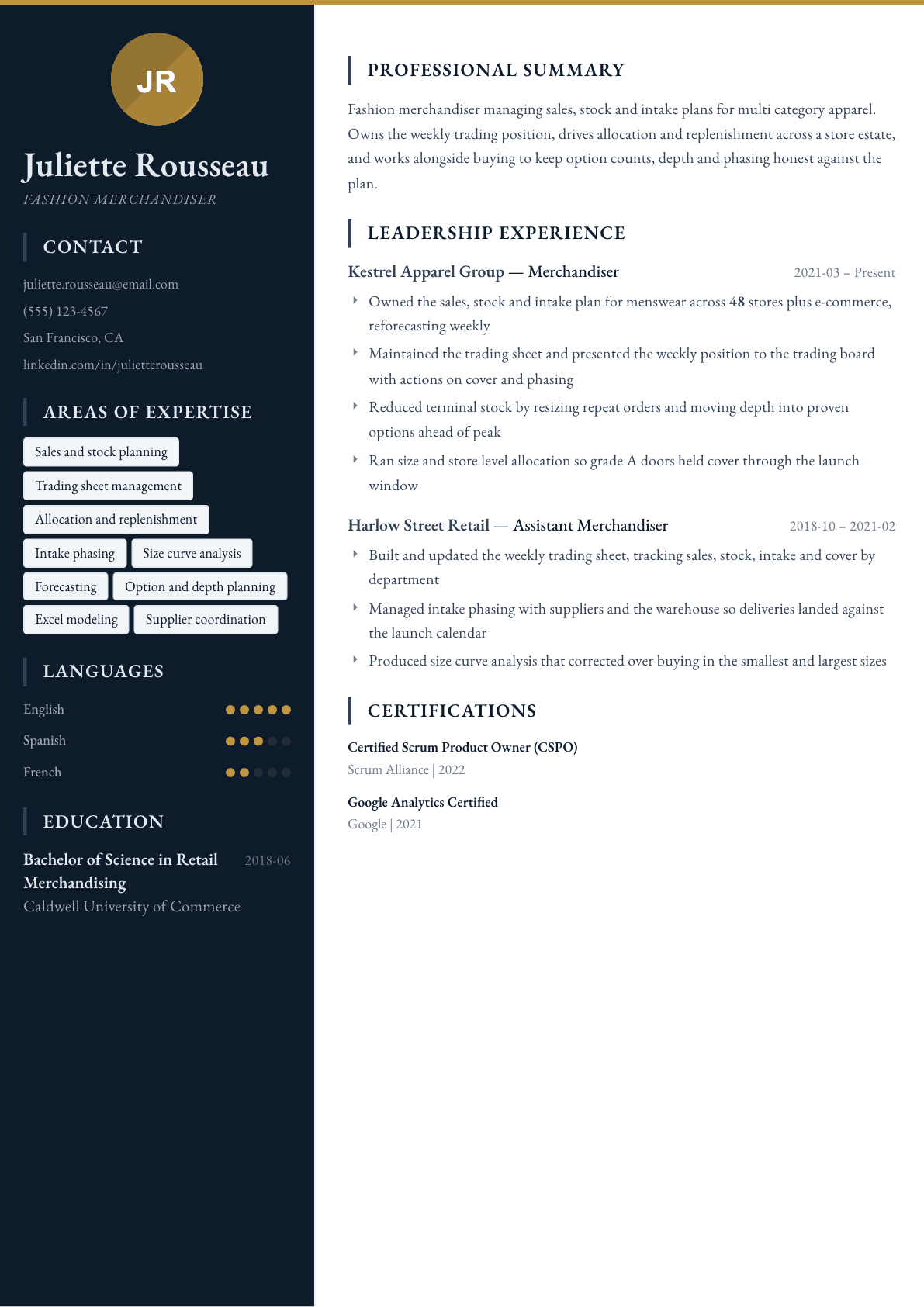
Example Fashion Merchandiser summary
Fashion merchandiser with six years planning sales, stock and intake for apparel departments across stores and online. Owns the weekly trading position, reforecasts against actuals, and drives allocation and replenishment so the right size and store gets the right depth. Works closely with buying on option counts, phasing and repeat orders to protect margin through peak.
Skills to list on a Fashion Merchandiser resume
- Sales, stock and intake planning
- Weekly trading sheet ownership
- Forecasting and reforecasting
- Allocation by store grade
- Replenishment planning
- Size curve analysis
- Option and depth planning
- Stock cover management
- Terminal stock reduction
- Intake phasing
- Markdown modeling
- Supplier and warehouse coordination
- Excel and pivot analysis
- Retail planning systems
What actually gets this resume read
- State the departments, door count and channels you planned, because merchandising scope is read as numbers first.
- Show that you owned the weekly trading position, not just the reporting pack that describes it.
- Quantify stock outcomes: cover weeks, terminal stock, availability, and what you changed to move them.
- Include allocation and replenishment detail by store grade and size curve, which junior resumes usually skip.
- Name the planning system and your Excel depth, since most merchandising tests are a spreadsheet exercise.
- Describe how you worked with buying on option counts and depth, because the partnership is the actual job.
How to write a fashion merchandiser resume
A fashion merchandiser resume is read by a head of merchandising who is trying to answer one question: can this person be handed a department and own the weekly trading position without supervision. Ownership is the word that matters. Producing the trading sheet is administration. Deciding what the trading sheet means and acting on cover, phasing and intake is merchandising.
The second filter is numerical fluency. This role lives inside a sales, stock and intake plan, and readers assume a spreadsheet test will follow the interview. A resume that lists forecasting and allocation as bare skills, with no evidence of a reforecast that changed an order or an allocation that fixed availability, tells the reader nothing they can test.
This guide covers how to state department scope, how to write bullets about cover, terminal stock and size curves, how to describe the partnership with buying, and the questions merchandisers ask when they move between a store estate and a pure play online business.
Format: scope line first, numbers legible
Reverse chronological and single column, one page for assistants and two once you own a department. Give each job a scope line before the bullets: departments planned, door count, channels and the annual intake or option volume. Merchandising scope is read as numbers, and a reader who has to infer it will assume the smaller version.
Keep the layout plain enough that figures stay readable. Merchandising bullets carry more numbers than most resumes, so short lines and generous spacing serve you better than a dense block where cover weeks and option counts blur together.
- Header: name, city, phone, email, and the product areas you have planned.
- Sections in this order: summary, experience with scope lines, systems and analysis, education.
- Assistant merchandisers add the recurring analyses they own, such as size curve and store grading work.
Summary: departments, channels, and what you own weekly
Name the departments, the estate size and the channels, then the years, then the weekly artifact you own. Saying you own the trading position and present it with actions on cover and phasing is a precise claim about seniority that a head of merchandising can immediately price.
If you are moving between business models, name it. A store estate merchandiser moving to a pure play online business should say so and point at the transferable parts, forecasting and intake phasing, while acknowledging that allocation by store grade is replaced by warehouse depth and returns behavior.
Experience: plan, trade, allocate
Write bullets along the three activities that make up the job. Planning: building the sales, stock and intake plan, option and depth planning with buying, phasing intake against the launch calendar. Trading: reforecasting weekly against actuals, presenting the position, acting on cover and rate of sale. Allocation: store grading, size curves, replenishment rules and holding cover through a launch window.
Show the decisions, not the reports. A bullet that says you resized repeat orders and moved depth into proven options ahead of peak, and that terminal stock fell as a result, is worth more than three bullets describing the pack you circulate. The reader is buying judgment, and judgment only shows in decisions.
Include the supplier and warehouse side. Chasing intake, rephasing deliveries, negotiating a split delivery to protect a launch and working the booking in slots with the distribution center are all merchandising work that junior resumes leave out entirely.
The partnership with buying
The buyer and the merchandiser make the range together, and a resume that never mentions the counterpart reads as if the candidate worked in a spreadsheet vacuum. Say where you pushed back: option counts that exceeded what the space could carry, depth on an untested silhouette, a price architecture that would not deliver the margin the plan needed.
Frame it as commercial partnership rather than conflict. A line about agreeing a smaller trial door group with the buyer before committing bulk shows both the relationship and the risk discipline that gets a merchandiser promoted.
Systems and analysis: name the tool and the technique
State the planning system you worked in and what you built inside it, then be specific about Excel. Pivot analysis, lookups, a working weekly trading sheet, a size curve model and a markdown ladder are the artifacts that come up in a merchandising test. Say which of them you have built from scratch rather than inherited.
Add any reporting or query work you can do independently, such as pulling sales data yourself instead of waiting on a business intelligence team. Merchandisers who can source their own data move faster and readers know it.
Fashion Merchandiser resume summary examples
Assistant merchandiser
Assistant merchandiser with two years building the weekly trading sheet across sales, stock, intake and cover by department. Manages intake phasing with suppliers and the warehouse against the launch calendar, and produced size curve analysis that corrected over buying at the top and bottom of the range.
Department merchandiser
Fashion merchandiser with six years owning the sales, stock and intake plan for menswear across 48 stores and e-commerce. Reforecasts weekly, presents the trading position with actions on cover and phasing, and runs size and store level allocation so grade A doors hold cover through launch.
Senior merchandiser
Senior merchandiser with nine years planning multi category apparel across a store estate and online, managing two assistant merchandisers. Owns the divisional intake plan and markdown strategy, and has reduced terminal stock across three consecutive seasons by resizing repeats and rephasing intake ahead of peak.
Work experience bullets: before and after
Before: Produced weekly reports on sales and stock.
After: Owned the weekly trading position for menswear across 48 stores and e-commerce, reforecasting against actuals and presenting actions on cover and phasing to the trading board.
Ownership, scope and the audience for the decisions replace a description of a report that anyone could run.
Before: Helped reduce excess stock.
After: Reduced terminal stock by resizing repeat orders against rate of sale and moving depth into proven options ahead of peak trading.
The two levers used are named, so a reader can judge the technique rather than take the outcome on trust.
Before: Managed allocation to stores.
After: Ran size and store level allocation across four store grades so grade A doors held cover through the full launch window without emergency transfers.
Grades, sizes and the avoided failure show allocation as a controlled system rather than a routine task.
Before: Worked with suppliers on deliveries.
After: Phased intake with suppliers and the distribution center so deliveries landed against the launch calendar, splitting two late orders to protect the launch depth.
Naming the split delivery decision shows the intervention, not just the coordination.
Before: Did analysis on sizes.
After: Built a size curve model from two seasons of sales data that corrected over buying in the smallest and largest sizes across the department.
The data source, the artifact and the specific over buying it fixed make the analysis testable in interview.
Hard skills
- Sales, stock and intake planning
- Weekly trading sheet ownership
- Forecasting and reforecasting
- Allocation by store grade
- Replenishment planning
- Size curve analysis
- Option and depth planning
- Stock cover management
- Terminal stock reduction
- Intake phasing and critical path
- Markdown modeling
- Supplier and warehouse coordination
- Excel and pivot analysis
- Retail planning systems
Soft skills
- Commercial judgment
- Working with buying
- Presenting to a trading board
- Attention to numerical detail
- Prioritizing under a weekly cycle
- Constructive pushback
Mistakes that cost fashion merchandiser candidates the interview
- Writing the resume as a list of reports produced instead of decisions taken on cover, depth and phasing.
- Omitting departments, door count and channels, so the reader cannot size the plan you carried.
- Leaving out allocation and replenishment detail, which is exactly what separates a planner from an assistant.
- Never mentioning the buyer, which makes the job look like solitary spreadsheet work rather than a trading partnership.
- Listing Excel without the specific models, when the interview almost always includes a spreadsheet exercise.
- Using merchandising to mean visual display in one bullet and planning in another, confusing the reader about the role.
Fashion Merchandiser resume questions
What is the difference between merchandising and buying on a resume?
The buyer selects the product and negotiates cost; the merchandiser owns the money, the depth and the flow of stock through the season. Write your resume from whichever seat you sat in, and name the counterpart so the split is clear to the reader.
How do I show I can own a trading position rather than support one?
Name the meeting you present in, the actions you took away, and one decision you made against the reforecast. Ownership shows in a repeat you canceled, an intake you rephased or a markdown you argued for, not in the pack you circulated.
Does a fashion merchandiser resume need a specific planning system?
Retailers train you on their own suite, so the transferable evidence is the discipline underneath. State the system you used and then be specific about the Excel models you built yourself, since that is what a merchandising test actually examines.
How do I write this resume for a pure play online retailer?
Replace store grade allocation with warehouse depth, returns rates and rate of sale by option, and emphasize forecasting accuracy and intake phasing. Say clearly which parts of your estate experience carry across so the reader does not have to guess.
Should I include visual merchandising experience here?
Only if the role blends both, which happens in smaller businesses. Otherwise it dilutes the numerical story and confuses a reader who is scanning for planning scope. Keep it to a single line under additional experience if it is genuinely relevant.