Photographer Resume Examples: free ATS score and gap list
Focus Your Photographer Resume for Maximum Impact
By Mustafa Tarabya, founder of CVBooster · Published · Updated
Photographer resume examples with expert tips, ATS keywords, and professional templates. See exactly what a winning professional photographer resume looks like.
Sample resumes for a photographer
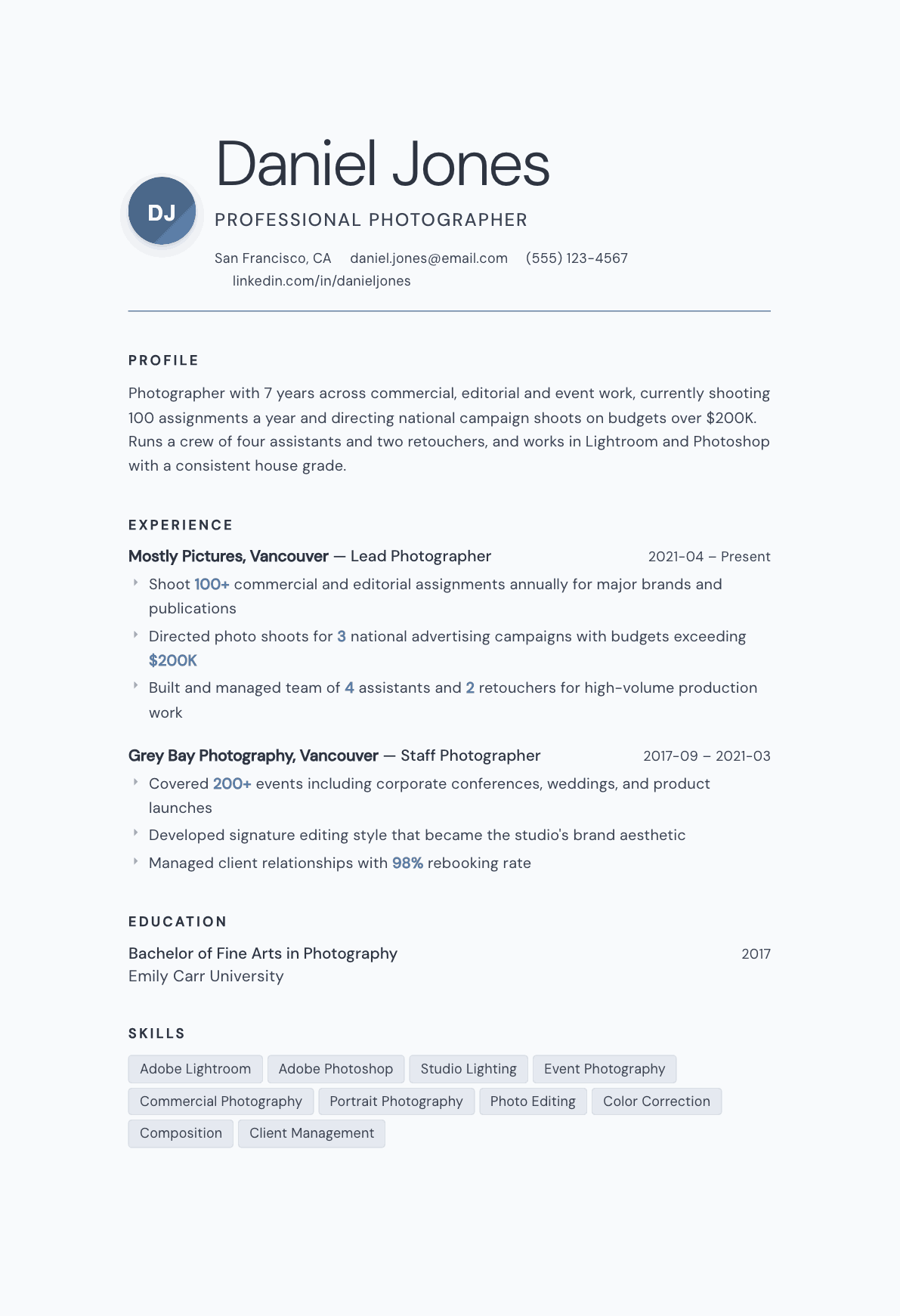
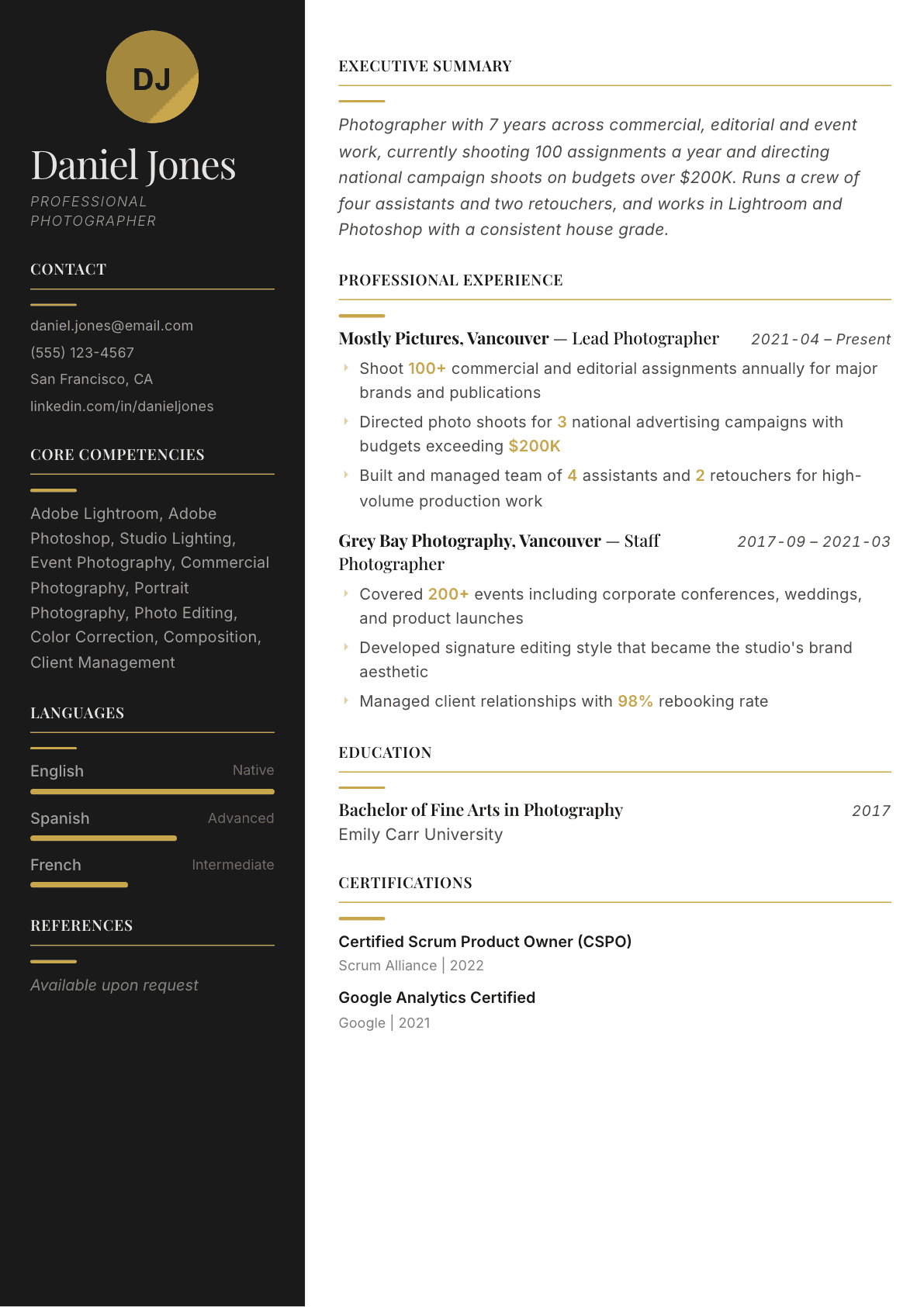
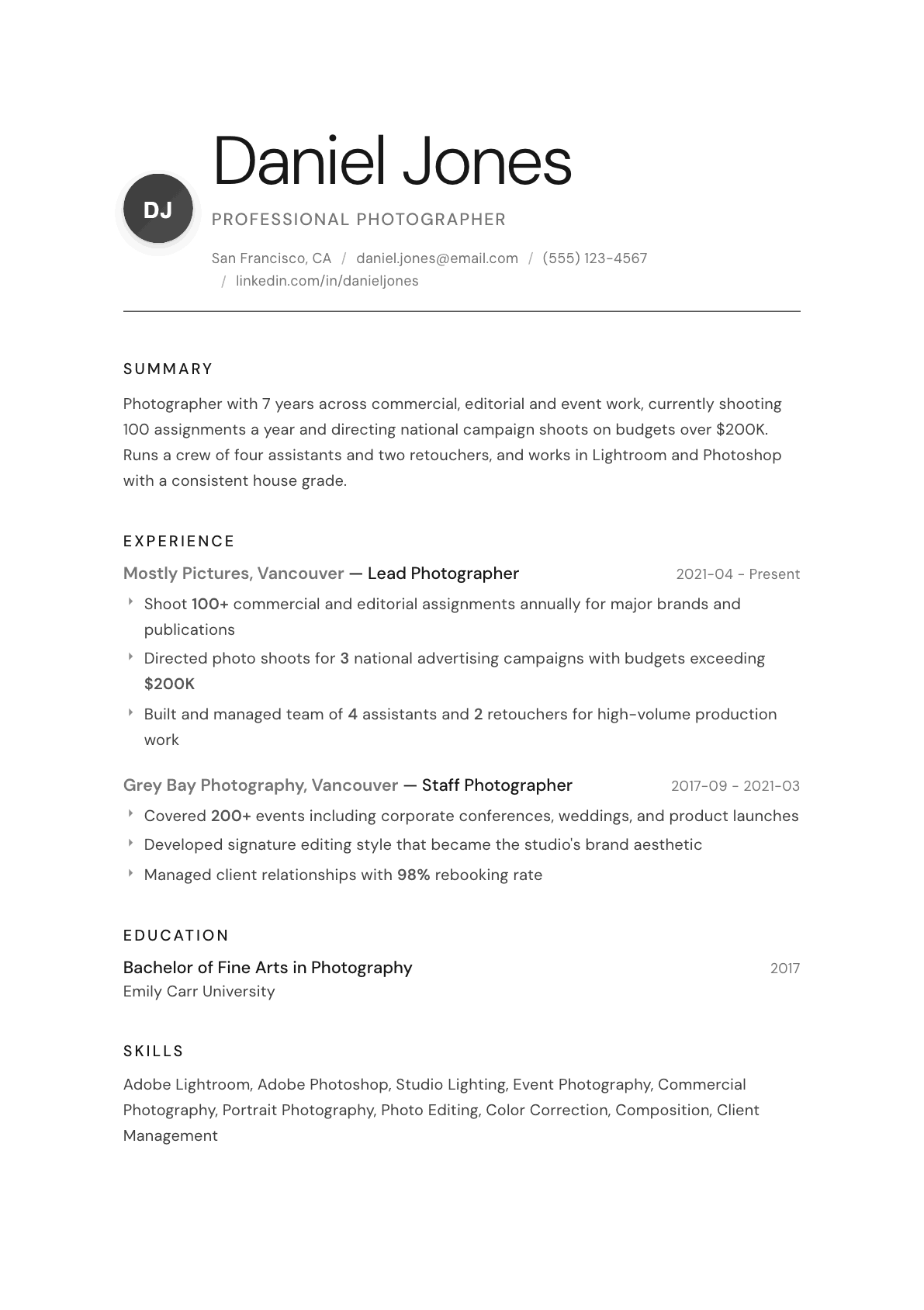
The same photographer content laid out in three CVBooster templates, so you can see what the finished document looks like before you write a word.
Example Photographer summary
Commercial and editorial photographer, 7 years, 100 assignments a year with published magazine and brand campaign credits. Directs shoots with a crew of six, covered 200 corporate and wedding events as a staff photographer, and keeps a 98% client rebooking rate.
Skills to list on a Photographer resume
- Adobe Lightroom
- Adobe Photoshop
- Studio Lighting
- Event Photography
- Commercial Photography
- Portrait Photography
- Photo Editing
- Color Correction
- Composition
- Client Management
What actually gets this resume read
- Include a link to your online portfolio. This matters more than the resume itself.
- List notable publications, clients, or brands you've worked with.
- Show versatility across photography styles (commercial, editorial, event).
- Mention specific equipment and post-processing tools you use.
- Include any awards, exhibitions, or press features.
How to write a photographer resume
A photographer is hired on the work, not the document. The portfolio link decides whether anyone reads past your name, so the resume has one narrow job: prove you can be trusted with a paid assignment, a deadline and a client who changes the brief at 4pm. Photo editors, studio owners and in-house creative directors all skim for the same three things: what you shoot, who you have shot it for, and whether you can deliver a finished, color-managed file on time.
Photography hiring splits into lanes that barely overlap. A newspaper photo desk wants speed, captioning and IPTC metadata discipline. An e-commerce studio wants tethered capture, consistent lighting and volume per day. A wedding studio wants second-shooter experience and a temperament. An agency wants art direction, crew management and licensing literacy. Sending one generic resume to all four is the most common reason a strong shooter never gets called.
This guide covers the layout that works for both staff jobs and studio contracts, how to write summaries at three career stages, before and after bullets that put the numbers where a hiring manager expects them, and the questions photographers keep asking when they sit down to write.
Format: one page, portfolio link in the header, credits over duties
Keep it to one page unless you have more than a decade of staff credits. The header carries your name, city, phone, email and the portfolio URL written out in full so it survives being printed or pasted into an email. If your site is your name, say so plainly. A QR code is not a substitute, because the file is usually read on the same screen the link would open on.
Order the sections the way a photo editor reads: summary, selected clients and publications, experience, technical proficiency, equipment, education, awards and exhibitions. Freelancers replace the experience block with a client-based structure, one heading per major client or a single self-employed heading with sub-bullets for named campaigns.
- Header: name, city, phone, email, portfolio URL, and Instagram handle only if that account is your professional book.
- A selected clients line of eight to twelve names beats a paragraph of adjectives about your style.
- Keep image thumbnails out of the resume file itself; they inflate the attachment and break parsers.
- Freelancers should state a business name and years active so the reader knows the gaps are contracts, not unemployment.
Summary: genre, setting, output volume, the name that opens a door
Three lines. Say what you shoot (editorial portraiture, product on white, architectural interiors, live events), where you shoot it (studio, on location, in a client facility), and the scale you work at. Then land one credible proof point: a publication, a national brand, a long-running contract, an award from a body a reader recognizes.
Avoid the word passionate and avoid describing your eye. Every photographer claims a distinctive eye and no reader can verify it from text. What they can verify is that you shot a campaign for a named client and delivered it retouched.
Experience: assignments, deliverables, turnaround
Each job gets the employer or studio, your title, the location and the dates. Then bullets built around the unit of work in your lane: assignments per year, shoot days, SKUs per day for product work, galleries delivered for events, or pages published for editorial. A photo editor reads volume as reliability.
Turnaround belongs in the bullets. Same day filing from a live event, a 48 hour first gallery, a two week retouched delivery for a campaign: these are the promises a client is buying. So is workflow ownership. If you culled, color corrected, retouched, captioned and archived the take yourself, say it, because that is a second job most people assume was done by someone else.
When you have directed a set, name the crew you ran: assistants, digital tech, stylist, hair and makeup, retouchers. Managing a set is the difference between a shooter and someone who can carry an advertising day rate.
Technical section: capture, light, post, and the file at the end
Split the technical block so a reader can scan it. Capture covers the systems you are fluent on, whether that is a full frame mirrorless body, a medium format back or a view camera, plus tethered capture software such as Capture One. Lighting covers strobe and continuous systems, modifiers, and whether you can build a set from scratch or only supplement daylight.
Post covers Lightroom Classic, Photoshop, Capture One catalogs, frequency separation, dodge and burn, and color management: profiled monitors, soft proofing, and delivering both a CMYK press file and an sRGB web set. Delivery covers metadata, IPTC captioning, keywording, naming conventions and the archive structure you keep. That last group is unglamorous and it is exactly what separates a hire from a hobbyist.
- Name the software versions of your workflow, not every application you have opened once.
- State whether your gear is owned, so a client knows what is included in a day rate.
- If you have drone work, list the certification, not the aircraft.
- Mention retouching depth honestly: beauty retouching and composite work are separate skills from a clean raw conversion.
Credits, awards and the rights conversation
A selected publications and clients block is the single highest value section on a photographer resume. List the outlet or brand and, where it helps, the kind of work: a magazine for portraiture, a retailer for lookbooks, a nonprofit for documentary coverage. Do not pad it with a brand you shot once as a third assistant.
Awards and exhibitions go near the bottom and only when the issuing body is real and checkable. Juried festivals, press photographer association contests and gallery shows carry weight. Contests run by stock sites do not.
Licensing literacy is worth one line somewhere on the page. A photographer who understands usage terms, exclusivity windows, model and property releases, and what a buyout actually costs is far easier to hire than one who hands over files and hopes.
Keywords a photo job posting reuses
Studio and in-house postings recycle a stable vocabulary: studio lighting, on location, tethered capture, retouching, color correction, art direction, post production workflow, digital asset management, and the specific genre word for the job. Mirror the posting wording once in the technical block and once inside a bullet where it is demonstrated. Agency and publication postings add art buyer, creative brief, mood board, call sheet and production schedule, so use those words if you have genuinely worked that way.
Photographer resume summary examples
Assisting into first credits
Photographer with two years assisting on commercial and editorial sets, now shooting portrait and product assignments independently. Fluent in tethered capture, three point strobe lighting and Lightroom to Photoshop retouching. Delivered 40 product galleries for two local retail clients on 48 hour turnaround.
Five years, mixed commercial book
Commercial and editorial photographer with five years across portrait, product and event work. Shoots roughly 90 assignments a year, running her own lighting and full post workflow from raw cull to press ready file. Clients include regional magazines, two national retail brands and a university communications office.
Lead photographer running sets
Lead photographer with eleven years of campaign and editorial work, directing crews of up to six including digital tech, stylist and retoucher. Owns the studio calendar, gear budget and licensing terms for a team shooting 1,200 finished images a month across catalog, lifestyle and portrait assignments.
Work experience bullets: before and after
Before: Took photos for clients at various events.
After: Covered 120 corporate events and conferences a year as sole shooter, filing a captioned 60 image gallery to the client server within 24 hours of each call time.
Volume, coverage model and turnaround turn a hobby sentence into a service a client can buy.
Before: Edited photos in Photoshop and Lightroom.
After: Culled and color graded 3,000 frame takes in Capture One, then retouched selects in Photoshop using frequency separation, delivering matched CMYK press files and sRGB web sets.
It names the actual post pipeline and the two output formats a print client needs, instead of naming two applications.
Before: Worked with big brands on advertising campaigns.
After: Shot two national retail campaigns from creative brief through delivery, running a five person set with digital tech, stylist and two assistants across four shoot days.
Directing a crew across shoot days is the skill that justifies a campaign rate, and it is invisible in the weak version.
Before: Responsible for the studio photography.
After: Built a tethered white background workflow that lifted studio output from 60 to 140 e-commerce SKUs per day while holding a fixed lighting and color standard across the catalog.
A throughput number plus a consistency standard is exactly what an e-commerce studio manager is hiring for.
Before: Managed my own freelance photography business.
After: Ran a solo photography practice for six years: quoting usage based licenses, issuing model releases, invoicing 45 recurring clients and maintaining an archived, keyworded library of six years of client takes.
It shows the business and rights side of the job, which is what makes a freelancer safe to hand a contract to.
Hard skills
- Studio strobe lighting
- Location and natural light
- Tethered capture
- Capture One
- Adobe Lightroom Classic
- Adobe Photoshop retouching
- Color management and soft proofing
- Product and still life photography
- Editorial portraiture
- Event and documentary coverage
- IPTC captioning and keywording
- Digital asset management
- Image licensing and releases
- Set and crew direction
Soft skills
- Directing nervous subjects
- Working to a creative brief
- Client expectation setting
- Composure on live assignments
- Time management across bookings
- Feedback and revision handling
Certifications worth listing
- Certified Professional Photographer (CPP) (Professional Photographers of America)
- Remote Pilot Certificate, Part 107 (Federal Aviation Administration)
- Adobe Certified Professional, Photoshop (Adobe)
Mistakes that cost photographer candidates the interview
- Leaving the portfolio link out of the header or hiding it behind a shortened URL that a recruiter cannot verify at a glance.
- Describing your style in adjectives instead of naming the genres, clients and deliverables a reader can check.
- Embedding sample images in the resume file, which balloons the attachment and confuses applicant tracking parsers.
- Listing every camera body and lens you own while never mentioning lighting, post workflow or delivery format.
- Claiming clients you assisted for as clients you shot for, which collapses the moment someone in the industry asks who art directed it.
- Sending the same document to a newsroom and a catalog studio, when one is buying speed and captions and the other is buying consistency and throughput.
Photographer resume questions
Do photographers even need a resume if the portfolio is what gets seen?
Yes, for any staff, in-house or studio position, and for most agency rosters. The portfolio proves the pictures are good, and the resume proves you can hold a schedule, run a set, manage files and work with a client without the job falling apart.
How do I handle freelance years without it looking like gaps?
Create one heading with your business name and the full date range, then use bullets for named campaigns, recurring clients and annual volume. That reads as a continuous business rather than a scatter of unexplained months between staff jobs.
Should I list my camera gear on a photography resume?
List systems and lighting kit briefly, and only if it matters to the job. A studio job cares that you own strobes and can shoot tethered. A newsroom cares about a reliable body, fast glass and speed. Nobody needs a full serial numbered inventory.
What goes in a selected clients section if my names are small?
Regional and local names still work when they are grouped by kind of work: two independent magazines, a university, a hospital system, three restaurant groups. That pattern shows range and repeat business, which reads better than one famous name shot once.
How do I move from wedding and event work into commercial photography?
Rewrite the summary around the transferable parts: lighting under pressure, directing people who are not models, and delivering a large take fast. Then lead each job with the closest work you have, such as branded portrait sessions or product shots for a venue, and rebuild the portfolio to match.