Fashion Designer Resume Examples: the lines they read
Resume for Fashion Design Jobs: Fashion Designer Examples
By Mustafa Tarabya, founder of CVBooster · Published · Updated
A resume for fashion design jobs: category and tier up top, styles per season, tech pack and fit work, graduate collections, and a fashion designer sample.
Sample resumes for a fashion designer
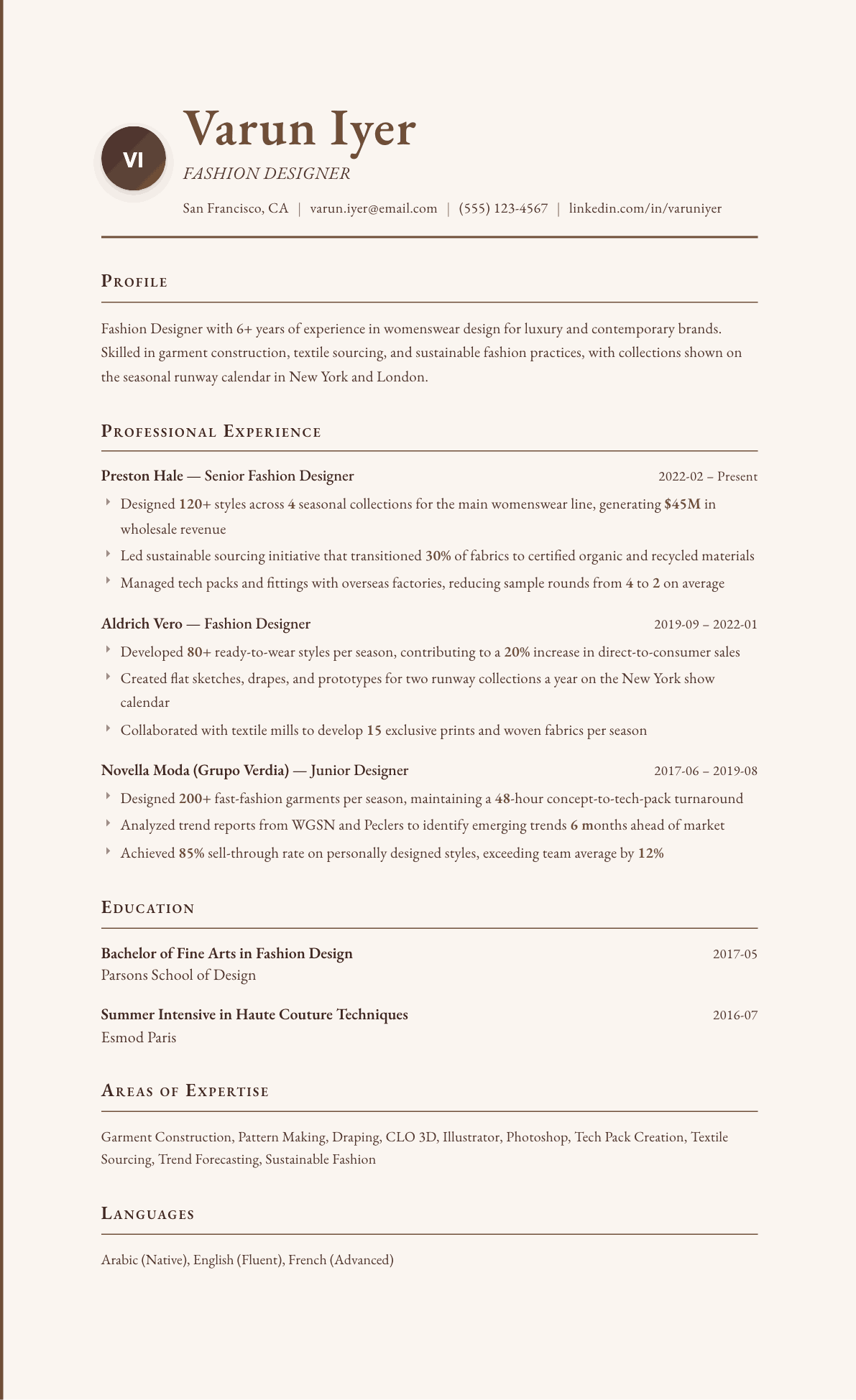
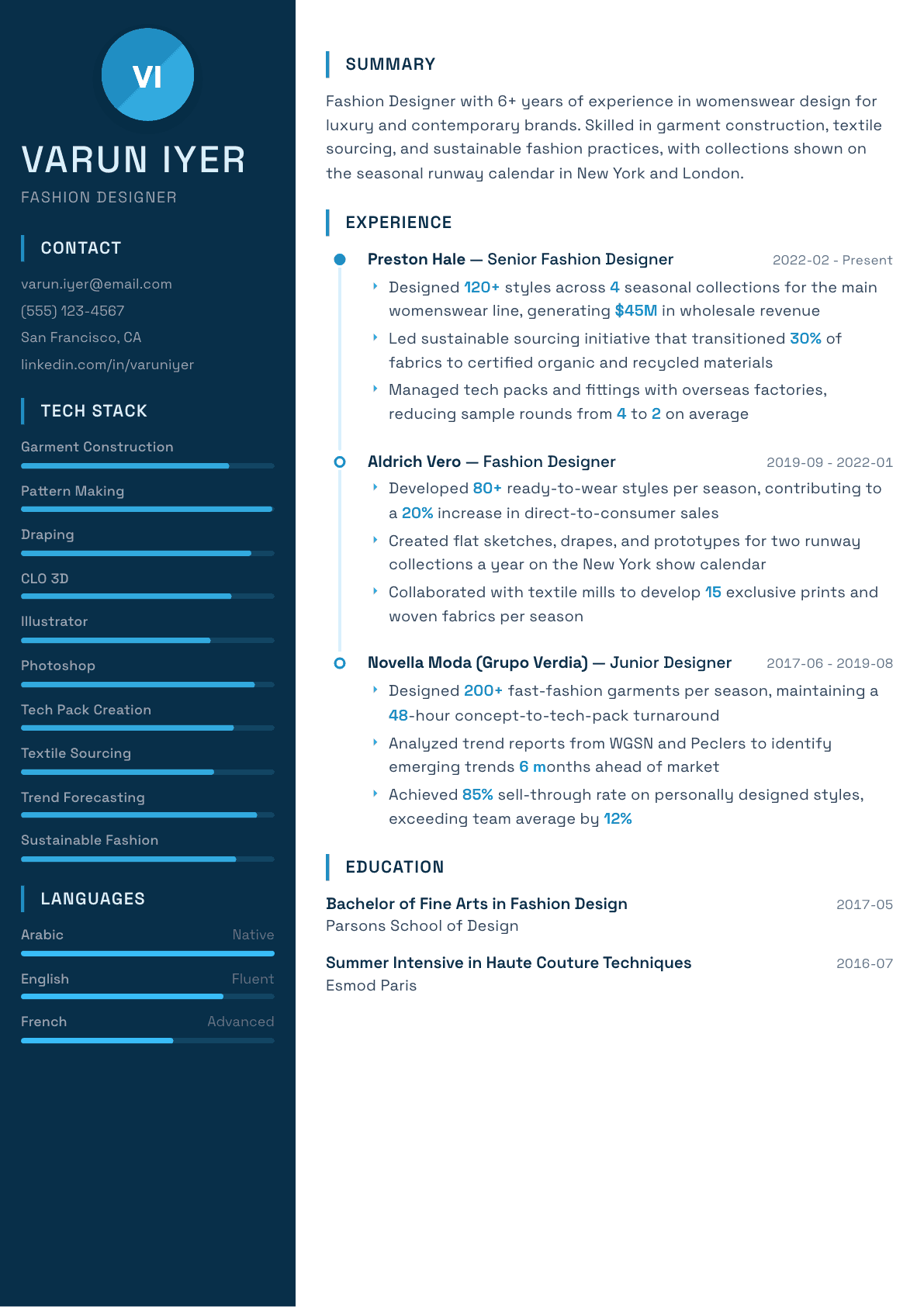
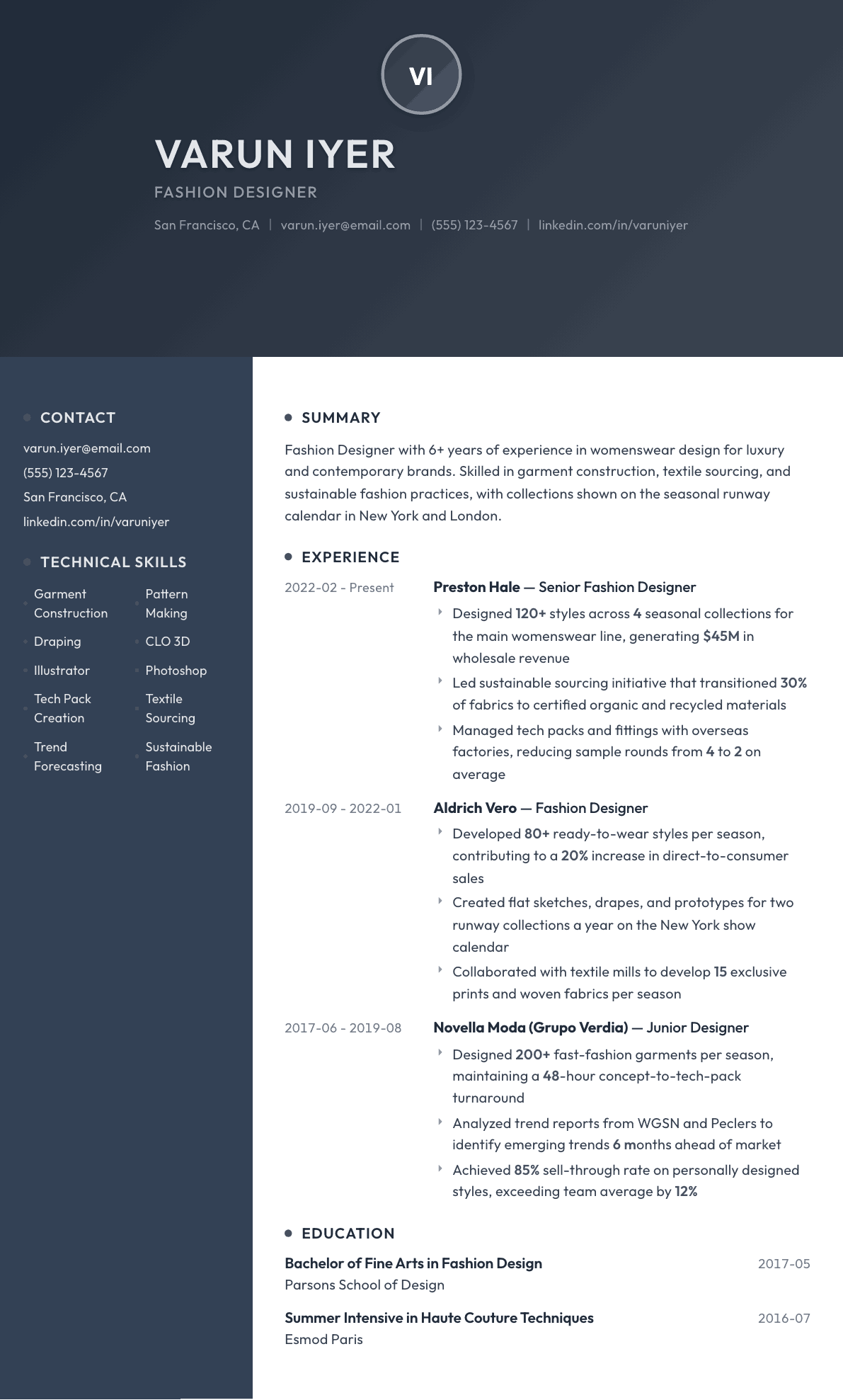
The same fashion designer content laid out in three CVBooster templates, so you can see what the finished document looks like before you write a word.
Example Fashion Designer summary
Creative Fashion Designer with 6 years of experience designing womenswear for luxury and contemporary brands. Runway collections on the New York and London show calendars, with $45M in wholesale revenue behind the main line. Expert in sustainable sourcing, garment construction, and trend forecasting. Seeking a design lead role to drive collection vision.
Skills to list on a Fashion Designer resume
- Garment Construction
- Pattern Making
- Draping
- CLO 3D
- Illustrator
- Photoshop
- Tech Pack Creation
- Textile Sourcing
- Trend Forecasting
- Sustainable Fashion
- Color Theory
- Print Design
- Knitwear
- Collection Development
What actually gets this resume read
- Lead with your strongest collections and the brands you have designed for -- name recognition matters.
- Quantify output: styles per season, revenue generated, sell-through rates, or production cost savings.
- Include both technical skills (pattern making, draping, CLO 3D) and soft skills (trend analysis, client relations).
- Mention sustainability initiatives -- they are increasingly valued across luxury and fast fashion.
- Show your range: ready-to-wear, couture, accessories, prints, or knitwear.
- Link to a lookbook or portfolio site with professional photography of your work.
How to write a fashion designer resume
A fashion designer is hired on the portfolio, but the resume decides whether the portfolio gets opened. The design director scanning applications wants three facts in the first six seconds: what category you design (womenswear, menswear, kids, denim, knitwear, accessories, activewear), what price tier you have worked at (mass, contemporary, bridge, luxury), and whether you can take a style from sketch through tech pack to an approved production sample.
That last part is where most resumes fail. Candidates write about mood boards and inspiration and leave out the unglamorous half of the job: grading rules, fit sessions, comments back to the vendor, lab dips, strike offs, minimum order quantities, and the calendar that says the line must be locked by a certain week. A design team hires the person who can carry a season, not the person with the prettiest sketches.
This guide covers the section order a fashion recruiter expects, how to describe a collection so its scale is obvious, three summaries at different career stages, before and after bullets, and the questions designers ask when a technical design role and a concept role want two different resumes. The same rules hold for fashion resumes outside the design studio: a footwear designer, a textile designer or an assistant merchandiser is read for category, tier and the part of the season they own, not for the layout.
Format: one page, portfolio link in the header, no decorative layout
Keep it to one page until you have run collections of your own, then two. The temptation is to design the resume itself, and it is the wrong instinct: brand recruiting teams at large houses run applications through a tracking system that mangles text boxes and image-based type. Let the portfolio carry the visual argument.
The header carries name, city, phone, email and the portfolio URL, plus a password if the site is gated. A gated portfolio without the password on the resume is a rejected application, because nobody writes to ask.
Here is the top of a plain one written out for an invented footwear designer, Leah Moreno, so you can see how little decoration a strong fashion resume needs. Header: Leah Moreno, Footwear Designer, Women's Casual and Athleisure, Portland, OR, phone, email, portfolio link. Summary: Footwear designer with five years in women's casual at a mid priced brand, owning two seasons a year from sketch to confirmation sample, with factory partners in Vietnam. First bullet: Designed a capsule of twelve sneaker and sandal styles, wrote the spec sheets and ran the fit trials that cleared the last for production.
- Header: name, city, phone, email, portfolio link and password if required.
- Order: summary, experience, technical skills, education, awards and press.
- Students and recent graduates put education first and add a collections or capstone section.
- Name your category in the header line under your name: "Womenswear Designer, Contemporary".
Summary: category, tier, years, and what you own in the process
Two or three lines. Name the product category, the market tier, the years, and the part of the calendar you own. A director reading "designer with a passion for storytelling through clothing" learns nothing about whether you can do the job on her team next season.
If you are moving tiers or categories, say it plainly and name the bridge. A fast fashion designer moving to contemporary should point to the volume of styles carried per season and the tech pack discipline, because those transfer directly, then acknowledge the different fabric budget rather than pretending it does not exist.
Experience: styles per season, the calendar, and where the samples were made
Every role needs the brand, the category, the tier and the scale. A line such as "Womenswear designer, contemporary dresses and separates, four seasonal deliveries per year, roughly ninety styles per season" tells a hiring director more than a paragraph of adjectives, because it maps onto her own workload.
Then bullets that follow the real sequence: research and trend direction, line planning with merchandising, sketching and flats, fabric and trim development with mills, tech packs, fittings, vendor communication, and sell in. Say which of those you personally owned and which you contributed to. Designers who overclaim get caught in the first fit story an interviewer asks for.
Name your production geography. Working with vendors in Portugal, Turkey, India, Vietnam or China each brings different lead times, minimums and communication rhythms, and brands hire for the region they source from. If you have run development in a time zone twelve hours away, that is a bullet.
Technical skills: separate the software from the hand skills
Split the list so a reader can scan it. Digital tools go first because they are what a tracking system matches: Adobe Illustrator and Photoshop for flats and prints, CLO 3D or Browzwear for virtual sampling, InDesign for line sheets and boards, and any product data management system you have entered tech packs into. Then the hand skills: draping on the stand, pattern drafting, garment construction, machine sewing, embroidery, knit programming.
Virtual sampling is worth a line of its own if you have done it, because it changes a brand cost structure. Saying you built three dimensional fit samples that removed a physical sample round is more persuasive than listing the software name alone.
- Flats and specs: Illustrator, technical flats, colorways, print repeats.
- Three dimensional: CLO 3D or Browzwear, avatar setup, virtual fit reviews.
- Development: tech packs, bill of materials, grading rules, points of measure.
- Materials: woven and knit construction, lab dips, strike offs, trim sourcing.
Awards, press and collections: proof that is not the portfolio
A short section for anything a stranger can verify: a collection shown at a recognized fashion week, a competition placement, a stocklist, a collaboration, a piece of press coverage with the publication named. Keep it factual and short. One verifiable credit outweighs a paragraph of self assessment.
For sustainability work, be concrete. Naming the certification standard you sourced to, the recycled content you specified, or the process you changed reads as expertise. Calling yourself passionate about sustainable fashion reads as a sentiment every applicant shares.
Resume for fashion design graduates: projects in place of seasons
A resume for fashion design jobs at entry level cannot quote styles per season yet, so it quotes projects instead. The graduate collection, the capstone brief set by a brand partner, the internship where you updated tech packs: each one gets the same treatment a working designer gives a season, with the category, the number of looks, the fabrics and the part you did with your own hands.
Put education first, then a short collections section, then internships and any studio or retail work. Retail on a brand floor counts, because it shows you know how the product sells and what customers return. Keep the portfolio link in the header exactly as a senior designer would.
- Graduate collection: six womenswear looks in wool and recycled polyester, draped, patterned and constructed in the college studio, shown at the graduate show.
- Brand brief: a capsule of eight menswear styles for a sportswear partner, with flats, colorways and a costed bill of materials.
- Internship: updated tech packs and points of measure for 40 styles, logged fit comments and sent them to two overseas vendors.
- Technical line: Illustrator flats, CLO 3D fit checks, pattern drafting and industrial machine sewing.
Fashion Designer resume summary examples
Recent graduate
Fashion design graduate with a six-look womenswear thesis collection in tailored wool and a design internship at a contemporary dress brand. Fluent in Illustrator flats, CLO 3D sampling and tech pack writing, with hands-on draping and industrial machine experience from a factory placement.
Five years in
Womenswear designer with five years in contemporary knitwear and jersey, owning roughly 70 styles across four deliveries a year. Runs fabric development with Turkish and Portuguese mills, writes and maintains tech packs, and led the move to recycled yarn on the core sweater program.
Senior designer or design lead
Senior womenswear designer with eleven years across luxury and contemporary, currently leading a team of three on a dress and separates division of about 200 styles a year. Owns seasonal concept, line architecture with merchandising, fit standards, and vendor development across three sourcing regions.
Work experience bullets: before and after
Before: Designed clothing for seasonal collections.
After: Designed 85 to 95 womenswear styles per season across four deliveries, covering dresses, blouses and tailored separates for a contemporary price tier.
Style counts, delivery rhythm, product classes and tier let a director judge your workload against hers.
Before: Created tech packs and worked with factories.
After: Wrote and maintained tech packs with full points of measure and grading rules for 90 styles a season, and ran fit comments with vendors in Vietnam and Portugal on a two-round sample schedule.
Naming the documents, the regions and the number of sample rounds proves production discipline rather than familiarity.
Before: Worked on sustainable materials.
After: Converted the core knit program to certified recycled yarn by qualifying two new mills, running strength and pilling tests, and holding the landed cost within the existing margin target.
The specific process and the cost constraint turn a value statement into a piece of engineering work.
Before: Used CLO 3D for samples.
After: Built three-dimensional fit samples in CLO 3D for the dress category, removing one physical proto round on roughly 40 styles per season and cutting development time by about two weeks.
It shows what the software bought the business, not that you can open it.
Before: Researched trends for upcoming seasons.
After: Built seasonal concept boards and color direction from runway, retail comp shopping and sell-through data, then presented the line plan to merchandising and design leadership at concept sign-off.
Naming the inputs and the meeting where the work was defended shows commercial judgment, not scrapbooking.
Hard skills
- Technical flats in Adobe Illustrator
- Tech pack development
- Points of measure and grading rules
- CLO 3D virtual sampling
- Pattern making and draping
- Garment construction
- Fabric and trim sourcing
- Print design and repeat development
- Colorway and lab dip approval
- Fit session management
- Line planning and range building
- Knitwear and jersey development
- Adobe Photoshop and InDesign
- Vendor and mill communication
Soft skills
- Design critique and defense
- Cross-functional work with merchandising
- Calendar discipline
- Vendor relationship building
- Mentoring assistant designers
- Decisiveness under a locked line date
Certifications worth listing
- CLO 3D certification (CLO Virtual Fashion)
- Higg Index training (Cascale)
- Textile Exchange standards training (Textile Exchange)
Mistakes that cost fashion designer candidates the interview
- Sending a portfolio link that needs a password without putting the password on the resume.
- Writing about inspiration and mood while leaving out tech packs, fittings and vendor work, which is most of the job.
- Hiding the category and price tier, so the reader cannot tell whether you design mass market denim or luxury eveningwear.
- Designing the resume as a layout piece with image-based type that a recruiting system cannot read.
- Listing every software in the Adobe suite while never saying what you produced with any of it.
- Claiming credit for a full collection when you assisted on it, which collapses the moment an interviewer asks about a specific fit.
- Leaving off style counts and delivery rhythm, the two numbers that show a director whether you can carry the season.
Fashion Designer resume questions
Do I need a portfolio if I already have a fashion designer resume?
Yes. The resume gets you the portfolio review and nothing more. Put the link in the header, keep the site to your strongest three or four projects, and show flats and tech packs alongside the finished looks so a technical designer can see how you work.
What should a resume for fashion design jobs include?
The category and price tier you design for, styles per season or delivery, the steps you own from sketch to production sample, your software and hand skills, and a portfolio link in the header. Graduates swap the season counts for the collection, the brand brief and the internship, each with its look count and fabrics.
Should fashion resumes use a creative template with sketches or images?
No. The decorated fashion resume templates on design sites look good as thumbnails and parse badly in brand tracking systems. Keep the resume as plain text with one clean font, and let the portfolio carry the visuals. If a brand asks for a combined application, send a separate portfolio file.
How do I move from fast fashion to a luxury or contemporary brand?
Lead with the transferable discipline: high style volume, quick turnaround, tech pack accuracy and vendor management. Then show any work with better fabrics or more complex construction, and rebuild your portfolio around fewer, deeper projects rather than breadth.
What is the difference between a design and a technical design resume?
A design resume leads with concept, category, line building and aesthetic point of view. A technical design resume leads with fit, points of measure, grading, pattern correction and vendor comments. If you can do both, write two versions and send the one that matches the posting.